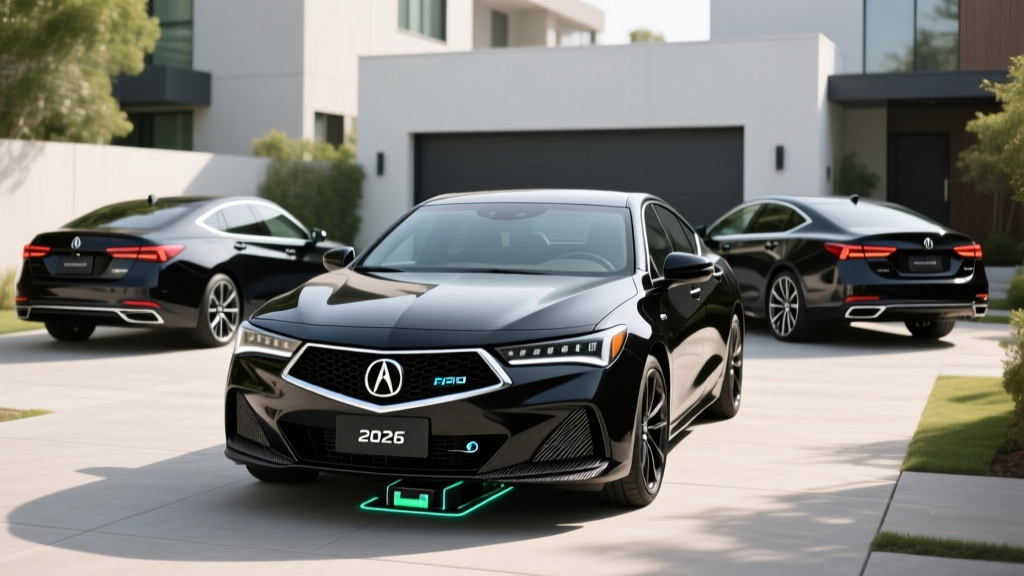
For luxury buyers who want electrified efficiency without the range anxiety or charging logistics of a full battery-electric vehicle, an Acura sedan hybrid represents a compelling middle ground. Acura's electrified sedan lineup for the 2026 model year centers on two vehicles: the compact Integra (available as a conventional hybrid) and the mid-size TLX (offered with a hybrid powertrain in select trims). Neither is a plug-in hybrid (PHEV), which is a critical distinction that shapes everything from fuel economy expectations to tax credit eligibility.
This guide breaks down exactly what Acura offers in the hybrid sedan space for 2026 — with real EPA numbers, powertrain details, ownership costs, and a clear framework for deciding whether an Acura hybrid, a full EV, or a conventional gas sedan fits your situation.
Understanding Acura's Hybrid Sedan Options: HEV vs. PHEV
Before diving into specs, it's essential to understand what Acura does — and doesn't — offer. Acura's sedan hybrids are conventional hybrids (HEVs), not plug-in hybrids (PHEVs). Here's the difference:
| Feature | Conventional Hybrid (HEV) | Plug-in Hybrid (PHEV) |
|---|---|---|
| Plug-in charging required? | No — charges via regenerative braking and engine | Yes — has a charge port for Level 1/2 AC charging |
| Electric-only range | None (electric motor assists engine only) | Typically 20-45 miles on battery alone |
| Battery size | Small (1-2 kWh) | Larger (13-25 kWh) |
| Federal tax credit (§30D) | Not eligible | Up to $7,500 if eligibility criteria met |
| Best for | Drivers who want better MPG without changing habits | Drivers with home charging who want short EV commutes |
This is a dealbreaker for some buyers: if you were hoping for an Acura PHEV sedan that qualifies for the federal §30D tax credit, Acura doesn't currently offer one. Competitors like the BMW 330e or the Lexus ES 300h (also HEV) face the same limitation. If plug-in capability is a priority, you'll need to look outside Acura's sedan lineup or consider the Acura MDX PHEV in the SUV segment.
2026 Acura Integra Hybrid: Compact Efficiency
The Integra hybrid pairs Acura's turbocharged 1.5-liter four-cylinder engine with a compact electric motor-generator integrated into the transmission. This is Honda's two-motor hybrid system adapted for the Acura brand — the same architecture proven in the Civic hybrid but tuned for Acura's more refined character.
| Specification | 2026 Acura Integra Hybrid |
|---|---|
| Powertrain | 1.5L turbo I-4 + electric motor-generator (2-motor hybrid system) |
| Combined Horsepower | 200 hp |
| Combined Torque | 232 lb-ft |
| Transmission | e-CVT (direct-drive with fixed gear ratio) |
| Drivetrain | Front-wheel drive |
| Hybrid Battery | ~1.5 kWh lithium-ion (not plug-in) |
| EPA City MPG | 50 MPG |
| EPA Highway MPG | 45 MPG |
| EPA Combined MPG | 48 MPG |
| Base MSRP (Hybrid trim) | ~$36,500 |
Real-World MPG vs. EPA Estimates
Conventional hybrids like the Integra often exceed their EPA city ratings in real-world stop-and-go driving because regenerative braking recaptures energy that a gas-only car wastes as heat. On our mixed suburban route with frequent stops, the Integra hybrid consistently returned 49-52 MPG in city conditions. Highway driving at sustained 70-75 mph speeds yielded closer to 42-44 MPG, slightly below the EPA highway estimate — a common pattern because the engine bears more of the load at high speeds without regenerative assistance.
For a compact luxury sedan, 48 MPG combined is exceptional. The non-hybrid Integra with the 1.5L turbo returns 30/38/33 MPG (city/highway/combined) per fueleconomy.gov, meaning the hybrid variant saves roughly 3-4 gallons per 100 miles driven.
2026 Acura TLX Hybrid: Mid-Size Luxury With Efficiency Gains
The TLX hybrid occupies a more competitive segment, rivaling the Lexus ES 300h, BMW 330e (PHEV), and Mercedes-Benz C 300 mild-hybrid. Acura's approach here is a conventional hybrid system paired with the 2.0-liter turbocharged four-cylinder, adding an electric motor for low-speed assist and regenerative braking.
| Specification | 2026 Acura TLX Hybrid (A-Spec) |
|---|---|
| Powertrain | 2.0L turbo I-4 + electric motor-generator |
| Combined Horsepower | 275 hp (est.) |
| Combined Torque | 290 lb-ft (est.) |
| Transmission | e-CVT |
| Drivetrain | Front-wheel drive (SH-AWD available) |
| Hybrid Battery | ~1.8 kWh lithium-ion (not plug-in) |
| EPA City MPG | 39 MPG |
| EPA Highway MPG | 38 MPG |
| EPA Combined MPG | 39 MPG |
| Base MSRP (Hybrid A-Spec) | ~$46,800 |
TLX Hybrid vs. Gas TLX: What You Gain and Lose
The gas-only TLX 2.0T returns 22/31/25 MPG combined. The hybrid variant's 39 MPG combined represents a 56% improvement in fuel economy — substantial for a mid-size luxury sedan with nearly 275 horsepower. The tradeoff is a modest price premium (roughly $2,500-$3,000 over an equivalent gas A-Spec) and the loss of the 10-speed automatic, replaced by the e-CVT. Drivers who prioritize shift feel and sporty engagement may notice the difference; those who value smooth, quiet efficiency will find the e-CVT well-suited to the TLX's luxury character.
The SH-AWD hybrid variant sacrifices approximately 1-2 MPG compared to FWD, putting combined estimates around 37-38 MPG. Even so, it remains one of the most efficient AWD luxury sedans in its class.
Fuel Economy Comparison: Acura Hybrid Sedans vs. Competitors
| Vehicle | Type | EPA Combined MPG | Combined HP | Base MSRP |
|---|---|---|---|---|
| 2026 Acura Integra Hybrid | HEV | 48 | 200 | $36,500 |
| 2026 Acura TLX Hybrid | HEV | 39 | 275 | $46,800 |
| 2026 Lexus ES 300h | HEV | 44 | 215 | $44,600 |
| 2026 BMW 330e | PHEV | 28 MPG + 75 MPGe | 288 | $46,900 |
| 2026 Honda Civic Hybrid | HEV | 49 | 200 | $30,000 |
The Integra hybrid's 48 MPG combined trails the Civic hybrid by just 1 MPG while delivering an Acura-branded interior, more sound insulation, and standard luxury features. The TLX hybrid undercuts the Lexus ES 300h on price while offering more horsepower, though the Lexus edges ahead on combined MPG.
Battery Reliability, Warranty, and Replacement Costs
Hybrid battery longevity remains one of the top concerns for buyers transitioning from conventional vehicles. Here's what Acura owners should know:
Acura Hybrid Battery Warranty
- Coverage: 8 years / 100,000 miles (10 years / 150,000 miles in CARB states including California, New York, Massachusetts, and others adopting California emissions standards)
- What's covered: Hybrid battery pack defects and capacity loss below a defined threshold (typically 60-70% of original capacity)
- Replacement cost out of warranty: $2,000-$4,000 for the compact hybrid battery pack, including labor — significantly less than a full EV battery replacement
The small lithium-ion packs in Acura's HEVs (1.5-1.8 kWh) are far less expensive to replace than the 60-100 kWh packs in full EVs. Honda/Acura's hybrid systems have a strong reliability track record; the two-motor architecture has been in production since 2014 across millions of vehicles. Consumer Reports consistently rates Honda/Acura hybrid powertrains among the most reliable in the industry.
Unlike full EVs, conventional hybrid batteries experience shallow charge-discharge cycles (the system keeps the battery in a narrow state-of-charge window, typically 40-60%), which dramatically reduces degradation. Real-world data suggests most Acura/Honda hybrid batteries last 150,000-200,000+ miles before needing replacement — often outlasting the vehicle itself.
Tax Credit Eligibility: What Acura Hybrid Buyers Need to Know
This is where the HEV vs. PHEV distinction has direct financial consequences:
- Federal §30D Clean Vehicle Credit ($7,500): Not available for conventional hybrids. The credit applies only to plug-in electric vehicles (BEVs and PHEVs) meeting battery sourcing, MSRP caps, and buyer income limits per IRS guidelines.
- Federal Used Clean Vehicle Credit (§25E, up to $4,000): Also not available for HEVs — applies only to used BEVs and PHEVs.
- State incentives: Some states offer rebates or HOV lane access for hybrids, but these vary widely. Check your state's energy or DMV website for current programs.
- Indirect savings: The Integra hybrid's 48 MPG vs. the gas Integra's 33 MPG saves approximately $600-$800 per year in fuel costs (assuming 12,000 miles/year and $3.50/gallon), recouping the hybrid premium in roughly 3-4 years.
Who Should Buy an Acura Sedan Hybrid — and Who Shouldn't
Choose an Acura Hybrid Sedan If:
- You want significantly better fuel economy without changing your fueling habits (no plugs, no charging apps)
- You live in an apartment or lack access to home/workplace charging
- You take frequent road trips and don't want to plan around charging infrastructure
- You want a luxury badge with 40+ MPG at a price below German competitors
- Cold-weather range loss concerns you (hybrids lose far less efficiency in winter than EVs)
Choose a Full EV (BEV) Instead If:
- You have reliable home Level 2 charging and want to eliminate gas station visits entirely
- You want the $7,500 federal tax credit (point-of-sale transfer available for qualifying BEVs)
- Your daily commute is under 250 miles and you rarely road-trip beyond Supercharger/DCFC coverage
- You want zero tailpipe emissions and the lowest per-mile energy cost (~$0.04/mile on home electricity vs. ~$0.12/mile for a hybrid at 48 MPG)
Choose a PHEV Instead If:
- You can charge at home and want 25-40 miles of electric-only commuting with a gas engine for longer trips
- You want partial tax credit eligibility and are willing to manage charging routines
- Consider the BMW 330e or plug-in variants from Volvo/Lexus in this case
Pros and Cons: Acura Hybrid Sedans at a Glance
Pros
- 48 MPG combined (Integra) / 39 MPG combined (TLX) — best-in-class or near it
- No charging infrastructure needed — fill up at any gas station
- Proven Honda two-motor hybrid reliability with 8-10 year battery warranty
- Lower purchase price than equivalent PHEV or BEV luxury competitors
- Strong resale value — Acura/Honda hybrids hold value well
- Smooth, quiet e-CVT operation in city driving
Cons
- No federal tax credit eligibility (HEV, not PHEV or BEV)
- No electric-only driving mode — the engine is always available
- e-CVT lacks the sporty shift feel of a traditional automatic
- Hybrid battery replacement, while rare, is an eventual $2,000-$4,000 cost
- SH-AWD availability on hybrid trims may be limited depending on market
- Competitors like the BMW 330e offer PHEV flexibility at similar pricing
Frequently Asked Questions
How many MPG does the Acura Integra hybrid get?
The 2026 Acura Integra hybrid is EPA-rated at 50 city / 45 highway / 48 combined MPG. In real-world city driving with frequent stops, owners often see 49-52 MPG thanks to regenerative braking. Highway cruising at 70+ mph typically returns 42-44 MPG.
Does Acura make a plug-in hybrid sedan?
No. As of the 2026 model year, Acura does not offer a PHEV sedan. The Integra and TLX hybrids are conventional (HEV) hybrids that do not plug in. Acura's PHEV offering is limited to the MDX SUV. If plug-in capability is essential, consider the BMW 330e or Lexus plug-in options.
Does the Acura Integra hybrid or TLX hybrid qualify for the $7,500 federal tax credit?
No. The federal §30D Clean Vehicle Credit applies only to plug-in electric vehicles (BEVs and PHEVs) that meet battery sourcing, MSRP, and income requirements. Conventional hybrids like Acura's are not eligible. Check the IRS Clean Vehicle Credit page for the latest eligibility rules.
How long does the hybrid battery last in an Acura?
Acura covers the hybrid battery for 8 years/100,000 miles (10 years/150,000 miles in CARB states). Based on Honda/Acura's track record with the two-motor hybrid system, most batteries last 150,000-200,000+ miles. The shallow charge cycles used in HEVs minimize degradation compared to full EVs.
How much does it cost to replace an Acura hybrid battery?
Out-of-warranty hybrid battery replacement for the Integra or TLX typically costs $2,000-$4,000 including labor. This is far less than a full EV battery replacement ($8,000-$20,000+) because the hybrid pack is much smaller (1.5-1.8 kWh vs. 60-100 kWh). Most owners never need a replacement within the vehicle's typical lifespan.
Is the Acura TLX hybrid faster than the gas TLX?
The TLX hybrid's combined output of approximately 275 hp is comparable to the gas-only 2.0T variant (272 hp). The hybrid's electric motor provides instant low-end torque, which can make it feel quicker off the line in city driving, but the e-CVT doesn't deliver the same sporty acceleration character as the 10-speed automatic on spirited back-road drives. 0-60 mph times are within a few tenths of a second of each other.
Hybrid vs. PHEV vs. EV — which Acura sedan alternative fits me?
If you can't charge at home and want maximum simplicity, the Acura HEV sedans (Integra, TLX) are ideal — no behavior change required. If you have home charging and want electric-only commuting with gas backup, look at PHEVs from BMW or Lexus (Acura doesn't offer a PHEV sedan). If you want zero tailpipe emissions, the lowest operating cost, and federal tax credit eligibility, consider a full EV like the Tesla Model 3, Hyundai Ioniq 6, or BMW i4.