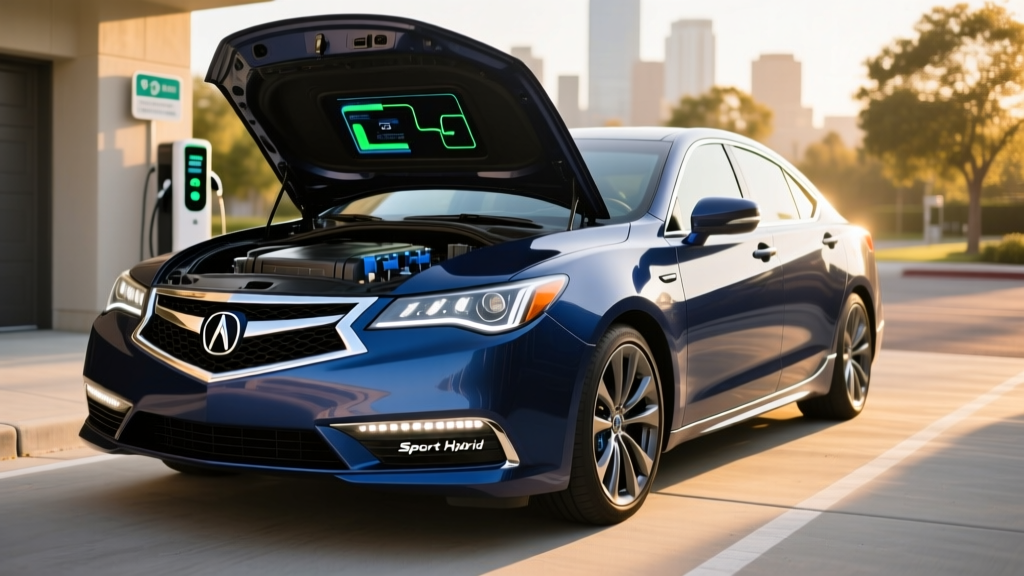
The Acura RLX Sport Hybrid occupies a specific niche in the luxury hybrid sedan market: a full-size, all-wheel-drive flagship that pairs a V6 with a three-motor hybrid system to deliver both performance and efficiency. Discontinued after the 2020 model year, the RLX Sport Hybrid remains a compelling option on the used market for buyers who want Honda/Acura reliability, genuine all-weather traction, and hybrid fuel savings — without the plug-in requirement or the premium price of a brand-new luxury PHEV.
This guide covers everything a 2026 used-car shopper needs to know: exact EPA fuel economy, the SH-AWD powertrain breakdown, real-world MPG expectations, battery longevity, warranty coverage, and how the RLX Sport Hybrid stacks up against current hybrid sedans and plug-in alternatives.
Acura RLX Sport Hybrid: Quick Spec Overview
| Specification | Value |
|---|---|
| Powertrain | 3.5L V6 + 3-motor hybrid (SH-AWD) |
| Combined Horsepower | 377 hp |
| EPA Fuel Economy (City / Hwy / Combined) | 28 / 29 / 28 MPG |
| Drivetrain | Super Handling All-Wheel Drive (SH-AWD) |
| 0–60 mph | ~5.1 seconds |
| Hybrid Battery Type | Lithium-ion, ~1.3 kWh (non-plug-in HEV) |
| EPA Total Range | ~414 miles (14.8-gal tank) |
| Original MSRP (2020) | $69,045 (Technology) / $73,545 (Advance) |
| 2026 Used Market Price (est.) | $28,000 – $38,000 depending on mileage/condition |
| Hybrid Battery Warranty (original) | 8 years / 100,000 miles (10 yr / 150,000 mi in CARB states) |
HEV vs. PHEV: Where the RLX Sport Hybrid Fits
Conventional Hybrid (HEV): The RLX Sport Hybrid is a self-charging hybrid. It does not plug in. The lithium-ion battery charges through regenerative braking and the gasoline engine. You refuel at any gas station and never need to think about charging infrastructure. This is the same category as the Toyota Camry Hybrid or Honda Accord Hybrid — just with significantly more power and all-wheel drive.
Plug-In Hybrid (PHEV): Vehicles like the BMW 530e or Toyota RAV4 Prime have larger batteries (typically 10–20 kWh) that can be plugged into a wall outlet or public charger for 20–40 miles of electric-only driving before the gas engine kicks in. The RLX Sport Hybrid is not a PHEV — it has no electric-only range figure and no charging port.
Full EV (BEV): Battery-electric vehicles like the Tesla Model S or BMW i5 have no gasoline engine at all. They offer 250–400+ miles of range, require home or public charging, and have zero tailpipe emissions.
The RLX Sport Hybrid's position is clear: it's a performance-oriented HEV designed for drivers who want hybrid efficiency gains without changing their refueling habits. If you can't charge at home and don't want to plan around charging stations, this architecture makes sense.
Fuel Economy: EPA Numbers and Real-World MPG
| Driving Cycle | EPA Rating |
|---|---|
| City | 28 MPG |
| Highway | 29 MPG |
| Combined | 28 MPG |
Source: EPA Fuel Economy Guide
Real-World MPG: What to Actually Expect
The RLX Sport Hybrid's EPA numbers are unusual for a hybrid: the highway rating (29 MPG) slightly exceeds the city rating (28 MPG). This is because the SH-AWD system's three rear electric motors are most beneficial in stop-and-go city driving where they can torque-vector and recapture energy, but the 3,800-pound curb weight and all-wheel-drive mechanical drag limit the typical hybrid city-driving advantage.
In real-world ownership, expect the following:
- City / suburban driving: 26–30 MPG. The hybrid system recaptures energy effectively in traffic, but the V6 and heavy platform prevent the 40+ MPG city figures you'd see in a lighter Camry Hybrid.
- Highway cruising (70–80 mph): 27–31 MPG. At steady highway speeds, the engine operates efficiently in its Atkinson-like cycle, but aerodynamic drag on a large sedan limits gains.
- Cold weather (below 30°F): 24–27 MPG. The engine runs more frequently to maintain cabin heat and battery temperature, reducing hybrid efficiency by roughly 10–15%.
- Aggressive / mountain driving: 22–26 MPG. The 377-hp powertrain rewards enthusiastic driving, and fuel consumption reflects it.
For context, the non-hybrid 2020 Acura RLX with the 3.5L V6 (FWD, 310 hp) was rated at 20/29/23 MPG. The Sport Hybrid gives you 77 more horsepower, all-wheel drive, and a 5 MPG combined improvement — a meaningful trade.
The SH-AWD Powertrain: 377 HP Explained
Acura's Sport Hybrid Super Handling All-Wheel Drive (SH-AWD) is one of the most sophisticated hybrid powertrains in the luxury sedan segment. Here's the hardware:
- Front axle: 3.5-liter SOHC i-VTEC V6 producing 310 hp, paired with a 7-speed dual-clutch transmission (DCT) with an integrated 47-hp electric motor.
- Rear axle: Two independent 36-hp electric motors (one per rear wheel), housed in a Twin Motor Unit (TMU). These motors provide torque vectoring — they can send more torque to the outside rear wheel during cornering, actively rotating the car.
- Combined system output: 377 hp.
- Hybrid battery: A compact lithium-ion pack (~1.3 kWh usable capacity) mounted behind the rear seats. This is a conventional HEV battery — it charges via regen and engine power, not from a wall outlet.
The result is a full-size luxury sedan that hits 60 mph in roughly 5.1 seconds and handles corners with a poise that belies its 3,800-pound weight. The rear torque vectoring is not a marketing gimmick — it's a genuinely noticeable handling advantage in wet and dry conditions alike.
Battery Longevity, Warranty, and Replacement Cost
Original Hybrid Battery Warranty: 8 years / 100,000 miles nationwide. In CARB-emission states (CA, NY, MA, NJ, CT, RI, VT, ME, NH, OR, WA, MD, CO, and others that have adopted California emissions standards), the warranty extends to 10 years / 150,000 miles.
Expected Battery Lifespan: Honda/Acura hybrid battery packs in this generation have demonstrated strong longevity. Based on owner reports and Honda's track record with similar IMA and Sport Hybrid systems, the RLX's lithium-ion pack typically retains functional capacity well past 150,000 miles under normal use.
What Does a Replacement Cost?
If the hybrid battery does fail outside warranty, here's the financial picture:
- Dealer replacement (OEM): $3,000 – $5,000 including labor. The RLX Sport Hybrid's battery is relatively compact compared to PHEV or BEV packs, which keeps replacement costs manageable.
- Independent hybrid specialist: $2,000 – $3,500 with a refurbished or reconditioned pack.
- Cell-level repair: Some hybrid battery specialists can replace individual degraded cells for $1,000 – $2,000, though this is less common for the RLX given its lower production volume.
For used buyers in 2026: a 2018–2020 RLX Sport Hybrid is now 6–8 years old. If you're purchasing in a CARB state, the original 10-year/150,000-mile battery warranty may still be in effect — verify with an Acura dealer using the VIN. This is a significant advantage for used buyers and one of the strongest reasons to prefer a CARB-state vehicle.
Is the RLX Sport Hybrid Reliable?
Acura (and parent company Honda) has one of the strongest reliability reputations in the hybrid segment. The 3.5L J-series V6 is a proven, long-running engine family. The 7-speed DCT in the RLX Sport Hybrid is more complex than a conventional automatic and has drawn some owner complaints about low-speed jerkiness — but major mechanical failures are uncommon based on available data.
Key reliability considerations for used buyers:
- The DCT should be serviced per Acura's maintenance schedule (fluid changes). Verify service records.
- The rear TMU motors have been robust in Acura's MDX Sport Hybrid (which shares the same architecture), with few reported failures.
- Standard Acura reliability concerns (infotainment glitches, minor electrical gremlins) apply but are not powertrain-related.
Tax Credits and Incentives: What Applies in 2026
Because the RLX Sport Hybrid is a conventional hybrid (HEV) — not a plug-in hybrid or battery-electric vehicle — it does not qualify for the federal §30D Clean Vehicle Credit, which requires a minimum battery capacity of 7 kWh and plug-in capability. This applies whether buying new (when it was available) or used.
For used buyers in 2026:
- Federal used EV credit (§25E): Not applicable. This credit covers used BEVs and PHEVs with at least 7 kWh of battery capacity. The RLX Sport Hybrid's ~1.3 kWh pack does not meet this threshold.
- State incentives: A small number of states offer rebates or HOV-lane access for conventional hybrids, but these are increasingly rare as policy focuses on plug-in vehicles. Check your state's energy office for current programs.
- Insurance discounts: Some insurers offer modest hybrid-vehicle discounts (typically 5–10%). Check with your provider.
The bottom line: buy the RLX Sport Hybrid for its powertrain, reliability, and value proposition — not for tax incentives. The savings come at the pump (roughly 5 MPG better than the non-hybrid RLX) and in long-term reliability, not at the dealership.
RLX Sport Hybrid vs. Alternatives: Which Should You Choose?
| Vehicle | Combined MPG | Horsepower | AWD? | Est. Used Price (2018–2020) |
|---|---|---|---|---|
| Acura RLX Sport Hybrid | 28 MPG | 377 hp | Yes (SH-AWD) | $28,000 – $38,000 |
| Lexus GS 450h | 31 MPG | 338 hp | No (RWD) | $30,000 – $40,000 |
| BMW 540i xDrive (non-hybrid) | 25 MPG | 335 hp | Yes (xDrive) | $32,000 – $42,000 |
| Toyota Avalon Hybrid | 44 MPG | 215 hp | No (FWD) | $22,000 – $30,000 |
| Honda Accord Hybrid | 48 MPG | 212 hp | No (FWD) | $18,000 – $26,000 |
Pros
- 377 hp with genuine torque-vectoring AWD — unique in the segment
- 28 MPG combined in a 3,800-lb luxury sedan with a V6
- Honda/Acura reliability and proven hybrid architecture
- Strong battery warranty, potentially still active on 2018–2020 models in CARB states
- Significant depreciation = excellent used value vs. original $70K+ MSRP
- Premium interior (leather, ELS audio, AcuraWatch safety suite)
Cons
- Discontinued — no new models, limited future parts support uncertainty
- MPG lags behind lighter hybrid sedans (Accord Hybrid gets 48 combined)
- No plug-in capability; no federal or state EV tax credits
- 7-speed DCT can feel jerky at low speeds in stop-and-go traffic
- Rear-seat space slightly compromised by battery placement
- Smaller dealer network and fewer used examples than Toyota/Lexus competitors
Who Should Buy the RLX Sport Hybrid — and Who Shouldn't
Choose the Acura RLX Sport Hybrid if:
- You want a powerful (377 hp), all-wheel-drive luxury sedan with hybrid efficiency
- You live in a region with rain, snow, or mixed conditions where SH-AWD torque vectoring adds real value
- You prefer the simplicity of a conventional hybrid — no plug, no charging logistics
- You're buying used and want strong depreciation value (paying $30K for what was a $70K car)
- Honda/Acura reliability and long-term battery durability are priorities
Choose a different vehicle if:
- Maximum MPG is your top goal — the Accord Hybrid (48 MPG) or Avalon Hybrid (44 MPG) deliver far more efficiency
- You want electric-only driving for short commutes — look at a PHEV like the BMW 530e or Toyota Prius Prime
- You want a new vehicle with a full factory warranty — the RLX is discontinued
- You want to qualify for the §30D federal tax credit — only PHEVs and BEVs are eligible
- You prioritize the latest infotainment and driver-assistance tech — the 2020 RLX's tech is a generation behind current models
Frequently Asked Questions
How many MPG does the Acura RLX Sport Hybrid get?
The EPA rates the RLX Sport Hybrid at 28 MPG city, 29 MPG highway, and 28 MPG combined. Real-world results typically range from 24–31 MPG depending on driving style, weather, and terrain. Expect roughly 27–29 MPG in mixed driving under normal conditions.
Is the RLX Sport Hybrid a plug-in hybrid?
No. The RLX Sport Hybrid is a conventional hybrid (HEV). It has no charging port and no electric-only range. The ~1.3 kWh lithium-ion battery charges exclusively through regenerative braking and the gasoline engine. You refuel at a gas station like any other car.
How far can it go on electric only?
The RLX Sport Hybrid cannot drive on electric power alone for any meaningful distance. The small hybrid battery assists the V6 during acceleration and enables brief low-speed electric assists (typically under 1 mile at very low speeds), but it is not designed for EV-mode commuting. If electric-only driving is a priority, you need a PHEV or BEV.
Does the RLX Sport Hybrid qualify for any tax credit?
No. The federal §30D Clean Vehicle Credit requires plug-in capability and a minimum 7 kWh battery. The RLX Sport Hybrid's ~1.3 kWh pack does not qualify. The §25E used-EV credit also does not apply for the same reason. Some states may offer minor hybrid incentives, but these are uncommon in 2026.
Is the hybrid battery reliable and what does replacement cost?
Honda/Acura hybrid batteries have a strong reliability record. The original warranty covers 8 years / 100,000 miles (10 years / 150,000 miles in CARB states). If replacement is needed out of warranty, expect $3,000–$5,000 at a dealer or $2,000–$3,500 at an independent hybrid specialist. Many packs last well beyond 150,000 miles.
How does the RLX Sport Hybrid compare to the Acura MDX Sport Hybrid?
Both use Acura's three-motor SH-AWD system and the 3.5L V6, but the MDX Sport Hybrid is tuned for an SUV platform (combined 321 hp, 26–27 MPG combined). The RLX Sport Hybrid is lighter, more powerful (377 hp), and slightly more efficient. The core hybrid architecture and reliability profile are shared.
Should I buy a used RLX Sport Hybrid or a new hybrid sedan?
A 2018–2020 RLX Sport Hybrid at $28,000–$38,000 gives you a 377-hp, AWD luxury sedan at roughly half its original price. A new Honda Accord Hybrid starts around $34,000 and delivers 48 MPG but with 212 hp, FWD only, and a non-luxury interior. The choice depends on whether you prioritize performance and luxury (RLX) or maximum efficiency and new-car warranty (Accord). For a detailed look at the current federal tax credit rules that apply to new PHEVs and BEVs, see the IRS Clean Vehicle Credit page.
Sources: EPA Fuel Economy (fueleconomy.gov), IRS §30D Clean Vehicle Credit, Acura Newsroom archived specifications.