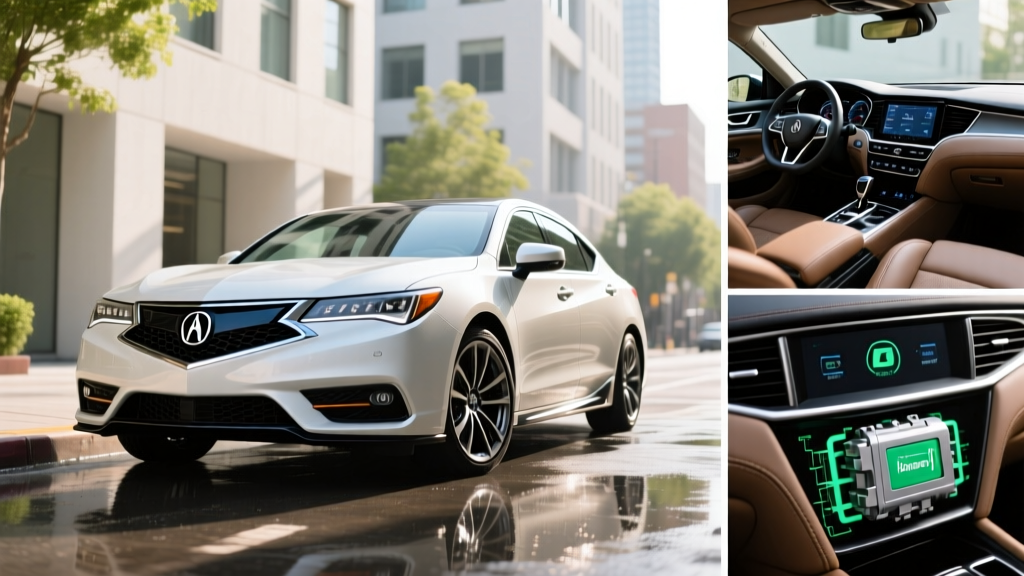
The Acura RLX Sport Hybrid AWD occupies a unique corner of the luxury hybrid sedan market. Discontinued after the 2020 model year, it remains one of the most technically ambitious conventional hybrids Acura ever built — pairing a 3.5-liter V6 with a three-motor system and the brand's torque-vectoring Super Handling All-Wheel Drive (SH-AWD). For buyers evaluating a used RLX Sport Hybrid in 2026, understanding its real-world fuel economy, hybrid battery longevity, and ownership economics is essential before signing any paperwork.
What Is the Acura RLX Sport Hybrid AWD?
The RLX Sport Hybrid is a conventional hybrid (HEV), not a plug-in hybrid (PHEV). It does not have a charging port, cannot drive on electric power alone for meaningful distances, and does not qualify for federal EV tax credits. Instead, it uses a small lithium-ion battery pack to supplement the gasoline engine — recapturing energy during braking and deploying electric torque for acceleration and all-wheel-drive traction.
HEV vs. PHEV: Where the RLX Sport Hybrid Fits
Conventional Hybrid (HEV): Small battery (~1-2 kWh), self-charging via regenerative braking and engine, no plug, no electric-only range to speak of. The RLX Sport Hybrid falls here.
Plug-in Hybrid (PHEV): Larger battery (typically 10-25 kWh), charges via plug, offers 20-50 miles of electric-only driving. Examples: Toyota RAV4 Prime, BMW 330e.
Battery Electric (BEV): No gasoline engine, 200-400+ miles of range, requires charging infrastructure. Examples: Tesla Model S, Lucid Air.
Fuel Economy: EPA MPG and Real-World Expectations
The EPA rated the 2020 Acura RLX Sport Hybrid AWD at the following fuel economy figures:
| Cycle | EPA Rating | Real-World Expectation |
|---|---|---|
| City | 28 MPG | 27-30 MPG |
| Highway | 29 MPG | 26-28 MPG |
| Combined | 28 MPG | 26-29 MPG |
Real-world note: Unlike many hybrids that significantly exceed their EPA city rating in stop-and-go traffic, the RLX Sport Hybrid's city and highway numbers are remarkably close. This is because the 3.5L V6 is a large engine for a hybrid system, and the SH-AWD rear motors consume energy even in city driving. On the highway, expect slightly below the EPA sticker — the sedan's 4,300+ lb curb weight and all-wheel-drive parasitic losses work against it at sustained speeds. Source: EPA fueleconomy.gov.
Powertrain: 377 HP and Three Electric Motors
The RLX Sport Hybrid's powertrain is one of the most complex in the Honda/Acura lineup:
| Specification | Value |
|---|---|
| Engine | 3.5L V6, direct injection |
| Gas Engine Output | 310 hp @ 6,500 rpm |
| Front Electric Motor | 47 hp (integrated into 7-speed DCT) |
| Rear Electric Motors (x2) | 36 hp each (SH-AWD torque vectoring) |
| Combined System Output | 377 hp |
| Transmission | 7-speed dual-clutch automatic |
| Drivetrain | SH-AWD (torque-vectoring rear axle) |
| 0-60 mph | ~4.9 seconds |
| Hybrid Battery | 1.3 kWh lithium-ion |
| Curb Weight | ~4,354 lbs |
The twin rear motors are the headline feature. They can independently apply torque to each rear wheel, effectively "pushing" the car through corners by overdriving the outside rear wheel. This gives the RLX Sport Hybrid handling dynamics that belie its executive-sedan size. The front motor fills torque gaps during the DCT's gear shifts, smoothing what could otherwise be a jerky dual-clutch experience at low speeds.
Hybrid Battery Longevity and Warranty
Hybrid Battery Warranty & Replacement
Original warranty: 8 years / 80,000 miles (federal emissions mandate). In California and states adopting CARB standards, coverage extends to 10 years / 150,000 miles.
Battery degradation: Honda/Acura hybrid systems historically show minimal capacity loss. The RLX's 1.3 kWh pack is small and never deeply cycled — the system keeps the battery in a narrow state-of-charge window (roughly 40-80%), which dramatically extends cell life. Most Honda hybrid batteries from this era outlast 150,000+ miles without issue.
Replacement cost (2026 estimate): $2,500-$4,500 for a refurbished or new OEM pack, including labor. Aftermarket refurbished options from hybrid battery specialists typically run $1,800-$2,800.
The RLX Sport Hybrid's battery is far less stressed than a PHEV or BEV pack. Because it's only 1.3 kWh and operates in a shallow cycle window, thermal management demands are modest. Failures in Honda's hybrid battery systems are statistically rare compared to high-voltage BEV packs. The primary wear concern for a used 2020 model in 2026 is age-related cell imbalance rather than cycle wear — a pre-purchase hybrid system diagnostic at an Acura dealer is strongly recommended.
Pricing, Tax Credits, and Used-Market Value
The RLX Sport Hybrid was discontinued after 2020, so no new examples are available. Original MSRP ranged from approximately $69,000 to $73,000 depending on options.
Used-market pricing (2026): Expect to pay $28,000-$42,000 depending on mileage, condition, and trim. Low-mileage examples (under 40,000 miles) in the Technology or Advance trims command the top of that range.
Federal tax credit eligibility:
- New vehicle (§30D): Not applicable — the RLX is discontinued and was never a PHEV or BEV. Conventional hybrids have never qualified for the §30D new-vehicle credit.
- Used vehicle (§25E): The federal used clean vehicle credit offers up to $4,000 (30% of sale price, capped) for qualifying used EVs and PHEVs purchased from a dealer. However, conventional hybrids like the RLX Sport Hybrid do not qualify for the §25E credit. Only plug-in vehicles are eligible. See IRS.gov §25E guidelines.
No state-level incentives apply to conventional hybrids in most jurisdictions. A few states previously offered hybrid rebates, but nearly all have shifted incentive budgets exclusively to plug-in vehicles.
Pros and Cons of the RLX Sport Hybrid in 2026
Pros
- 377 hp with smooth, instantaneous electric torque fill
- SH-AWD torque vectoring provides exceptional cornering for its class
- No plug-in requirement — refuel at any gas station
- Strong reliability record from Honda's proven hybrid architecture
- Spacious cabin, excellent ride quality, premium materials
- Depreciation makes it a luxury bargain on the used market
Cons
- 28 MPG combined is modest — a 4-cylinder hybrid (Camry Hybrid: 52 MPG) far exceeds it
- Discontinued model — limited dealer support for body/trim parts
- No tax credit eligibility (HEV, not PHEV/BEV)
- 7-speed DCT can feel hesitant at very low speeds despite motor smoothing
- Infotainment (dual-screen) feels dated by 2026 standards
- High curb weight (4,354 lbs) hurts tire wear and braking distances
RLX Sport Hybrid vs. PHEV vs. Full EV: Which Fits You?
Decision Framework
Choose the RLX Sport Hybrid (HEV) if: You want all-weather AWD capability and luxury performance without any charging dependency. You drive 12,000-18,000 miles/year and lack reliable home or workplace charging. You value a V6's smoothness and want a sedan that handles like a sport coupe.
Choose a PHEV (e.g., BMW 530e xDrive, used Volvo S60 Recharge) if: You have home Level 2 charging and a commute under 30 miles. You want to drive most daily miles on electricity while keeping a gas engine for road trips. You want to potentially qualify for the §25E used clean vehicle credit (up to $4,000).
Choose a full EV (e.g., Tesla Model S, Lucid Air Pure) if: You have reliable home charging, want minimal maintenance (no oil changes, no transmission fluid), and prioritize the lowest per-mile energy cost. A BEV's MPGe equivalent typically runs 100-130 MPGe — vastly cheaper per mile than even an efficient hybrid.
The RLX Sport Hybrid's 28 MPG combined translates to roughly $2,200-$2,600 per year in fuel (at 15,000 miles and $3.50-$4.00/gallon). A comparable PHEV used mostly in electric mode could cut that to $800-$1,200 annually, while a BEV on average residential electricity ($0.16/kWh) might spend $600-$900 per year. The RLX trades fuel savings for simplicity, zero charging infrastructure requirements, and a driving character that neither current PHEV nor EV sedans fully replicate.
Frequently Asked Questions
How many MPG does the Acura RLX Sport Hybrid AWD get?
The EPA rates it at 28 city / 29 highway / 28 combined MPG. Real-world driving typically yields 26-29 MPG combined, with highway driving sometimes falling slightly below the EPA estimate due to the vehicle's weight and AWD system losses.
Is the RLX Sport Hybrid a plug-in hybrid?
No. It is a conventional hybrid (HEV). It has no charging port, no meaningful electric-only range, and recharges its small 1.3 kWh battery entirely through regenerative braking and the gasoline engine. You never need to plug it in.
Is the Acura RLX Sport Hybrid reliable?
Yes. Honda/Acura's hybrid systems — particularly the two-motor and three-motor architectures — have demonstrated strong long-term reliability. The RLX's hybrid battery operates in a shallow cycle window that minimizes degradation. The 7-speed DCT is the component most likely to require attention at higher mileages, though failures remain uncommon.
What does hybrid battery replacement cost?
Expect $2,500-$4,500 for a new OEM battery pack with labor, or $1,800-$2,800 for a refurbished unit from a hybrid specialist. Given the battery's 1.3 kWh size and shallow cycling, replacement is rarely needed before 150,000+ miles.
Does the RLX Sport Hybrid qualify for any tax credit?
No. As a conventional hybrid with no plug-in capability, it does not qualify for the federal §30D new vehicle credit or the §25E used clean vehicle credit. Those credits are reserved for plug-in vehicles (PHEVs and BEVs) meeting battery sourcing and MSRP/income requirements per IRS §30D rules.
How does the SH-AWD system work with the hybrid motors?
The twin rear electric motors independently drive each rear wheel, enabling true torque vectoring. In cornering, the system can send up to 70% of available rear torque to the outside wheel, effectively rotating the car into turns. This is a performance and stability system — not merely a traction system for snow.