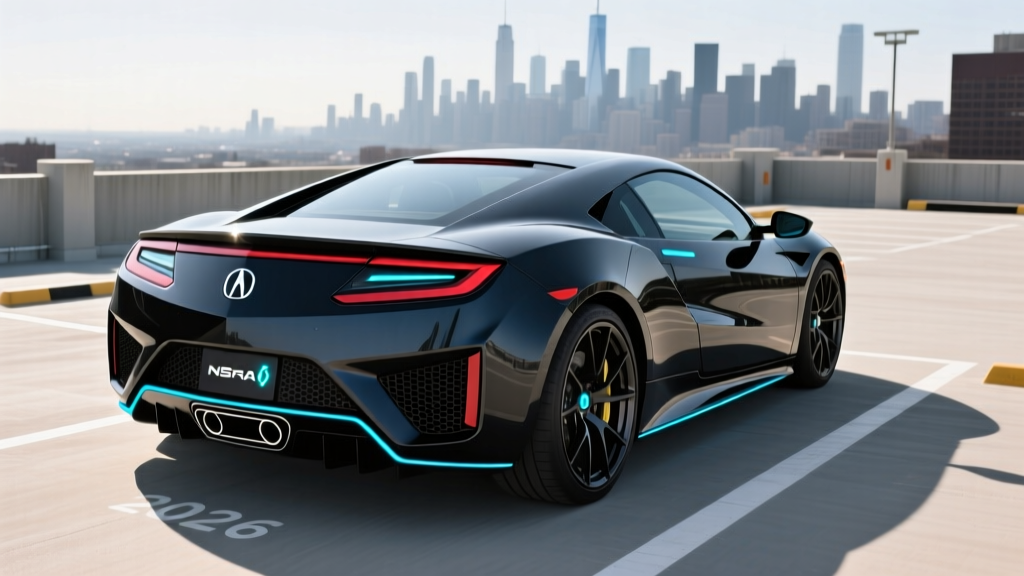
The second-generation Acura NSX remains one of the most technically ambitious hybrid supercars ever built. Unlike the plug-in hybrids dominating today's headlines, the NSX uses a conventional hybrid (HEV) system — no charging cable required — that leverages electrification not for maximum efficiency, but for instantaneous torque vectoring and supercar performance. With production ending after the 2022 model year, the NSX now lives exclusively on the used and collector market, making a thorough understanding of its hybrid powertrain, battery longevity, and real-world fuel economy essential for prospective buyers in 2026.
Acura NSX Hybrid Powertrain: How It Works
The Acura NSX (second generation, 2016–2022) uses what Acura calls its Sport Hybrid SH-AWD system — a three-motor hybrid architecture paired with a mid-mounted 3.5-liter twin-turbocharged V6 engine. Here's how the components break down:
| Component | Specification |
|---|---|
| Engine | 3.5L Twin-Turbo V6, 500 hp / 406 lb-ft |
| Front Motors (x2) | Independent twin motor unit (TMU), 36 hp each, torque-vectoring |
| Rear Motor (x1) | Direct drive motor, 47 hp, integrated with 9-speed DCT |
| Combined System Output | 573 hp / 476 lb-ft torque |
| Transmission | 9-speed dual-clutch automatic (DCT) |
| Drivetrain | SH-AWD (Super Handling All-Wheel Drive) |
| Hybrid Battery | 1.3 kWh lithium-ion (usable ~0.9 kWh) |
| 0–60 mph | 2.9 seconds (Car and Driver tested) |
| Top Speed | 191 mph |
The two front-mounted electric motors are the NSX's secret weapon. They independently torque-vector the front axle, sending positive or negative torque to each front wheel in milliseconds. This eliminates the traditional understeer that plagues mid-engine AWD cars and makes the NSX feel unnaturally agile for its 3,878-pound curb weight. The rear motor fills in torque before the turbos spool, eliminating lag entirely.
HEV vs PHEV: The NSX Is a Conventional Hybrid
The NSX is a conventional hybrid (HEV), not a plug-in hybrid (PHEV). This is a critical distinction:
- No plug, no charging cable: The NSX battery recharges exclusively through regenerative braking and the gasoline engine. You never plug it in.
- No electric-only driving mode for meaningful distance: The 1.3 kWh battery provides only brief low-speed electric assist — not a standalone EV range.
- HEV purpose: Electrification enhances performance (instant torque, torque vectoring), not fuel economy.
If you're looking for a hybrid you can plug in and drive 30+ miles on electricity alone, the NSX is not that vehicle. PHEVs like the Toyota RAV4 Prime or the (now-discontinued) BMW i8 offer plug-in capability. The NSX's hybrid system serves an entirely different mission.
Acura NSX MPG: EPA Ratings vs Real-World Fuel Economy
For a 573-hp supercar, the NSX's fuel economy is genuinely impressive — though it's important to set expectations against its performance-car peers, not against a Prius.
| Driving Cycle | EPA Rating |
|---|---|
| City | 21 MPG |
| Highway | 22 MPG |
| Combined | 21 MPG |
Data sourced from fueleconomy.gov.
Real-World MPG: What Owners Actually See
Hybrid vehicles — particularly performance hybrids — often behave differently in the real world than their EPA stickers suggest. Based on owner-reported data from Fuelly and enthusiast forums, here's what to expect:
- City driving (with regenerative braking): 19–23 MPG. The hybrid system recovers energy during stop-and-go, keeping city MPG close to or slightly below the EPA rating.
- Highway cruising: 22–26 MPG. At steady speeds, the twin-turbo V6 is relatively efficient in its 9th-gear overdrive. Some owners report mid-20s on long, flat highway runs.
- Spirited/track driving: 10–14 MPG. Aggressive throttle use and high RPMs dramatically reduce fuel economy, as with any supercar.
- Mixed daily driving: 18–22 MPG is the typical owner average.
The NSX's 15.3-gallon fuel tank yields a practical range of approximately 300–340 miles in mixed driving. On a long highway trip, you could stretch that to roughly 380 miles.
NSX Hybrid Battery: Size, Longevity, and Replacement Cost
The NSX's lithium-ion hybrid battery pack is small by modern standards — just 1.3 kWh total capacity (approximately 0.9 kWh usable). This is intentional. A smaller pack means less weight (the entire hybrid system adds roughly 200 lbs vs. a conventional powertrain) and faster charge/discharge cycles, which is what enables the instant torque-fill and aggressive regenerative braking.
Battery Warranty and Expected Lifespan
- Acura hybrid battery warranty: 8 years / unlimited miles (federal emissions warranty) or 10 years / 150,000 miles in CARB states (California, New York, and others adopting CARB standards).
- Expected battery lifespan: The NSX's small battery undergoes relatively shallow charge/discharge cycles (it rarely drops below 40% or charges above 80% state of charge in normal use), which significantly extends cell longevity. Most hybrid batteries in shallow-cycle applications last 150,000–200,000+ miles before significant degradation.
- Replacement cost: As of 2026, a replacement NSX hybrid battery pack from Acura runs approximately $3,500–$5,500 for the battery module itself, plus $500–$1,000 in labor. Because the pack is small and accessible (mounted behind the seats), replacement is less invasive than in a large-battery EV.
For context, the NSX's Intelligent Power Unit (IPU) — which includes the battery and power electronics — is covered under the hybrid system warranty. If you're buying a used 2017–2022 NSX, check whether the original hybrid warranty is still active or has been transferred.
Battery Degradation: What to Watch For
Because the NSX battery is small and conservatively managed, degradation is generally not a concern for normal ownership. However, two factors can accelerate wear:
- Extreme heat exposure: Repeated track days in hot climates (Arizona, Texas summers) without adequate cool-down periods can stress the cells. The NSX has active thermal management for the battery, but sustained 150°F+ ambient track conditions push the system hard.
- Long-term storage at low SoC: If the car sits for months without being driven or started, the 12V auxiliary battery and hybrid battery can both discharge to unhealthy levels. Acura recommends starting and running the car at least once every two weeks.
NSX Reliability: Hybrid System and Overall Ownership
The second-generation NSX has earned a reputation for surprising reliability — unusual for a mid-engine, twin-turbo, three-motor supercar. Several factors contribute:
- Honda/Acura engineering culture: The NSX was over-engineered for daily usability. The 9-speed DCT, developed in-house, has proven more durable than some European dual-clutch units.
- Hybrid system simplicity: The electric motors have no brushes, no wear items, and no maintenance schedule. They are effectively lifetime components.
- No turbo timing-belt issues: The V6 uses timing chains, which are maintenance-free under normal conditions.
Common issues reported by owners and documented on NSX enthusiast forums include:
- DCT clutch wear (high-mileage/track cars): The dual-clutch transmission may require clutch pack replacement above 60,000–80,000 miles if the car has been tracked frequently. Cost: $3,000–$5,000.
- Front TMU motor bearing noise (rare): A small number of early 2016–2017 models experienced front motor bearing wear. Acura addressed this under warranty.
- 12V battery drain: Like many modern cars with complex electronics, the NSX's 12V auxiliary battery can drain if the car sits unused. A battery tender is strongly recommended for garage-kept examples.
Acura NSX Pricing in 2026: Used Market and Tax Credit Eligibility
The Acura NSX ended production after the 2022 model year (with a limited Type S farewell edition). As of early 2026, all NSX examples are available only on the used or collector market.
| Model Year | Typical Price Range | Notes |
|---|---|---|
| 2016–2018 | $110,000–$135,000 | Pre-refresh; higher mileage examples at lower end |
| 2019–2021 | $140,000–$175,000 | 2019 refresh brought suspension, steering, and interior updates |
| 2022 Type S | $225,000–$300,000+ | Limited to 350 units; collector-grade pricing |
Does the Acura NSX Qualify for a Federal Tax Credit?
No. The Acura NSX does not qualify for any federal EV or plug-in hybrid tax credit. Under IRS §30D rules (see irs.gov), the federal clean vehicle credit applies exclusively to battery electric vehicles (BEVs) and plug-in hybrid electric vehicles (PHEVs) that meet battery capacity, critical mineral sourcing, MSRP cap, and buyer income requirements. The NSX is a conventional hybrid (HEV) with no plug-in capability, so it is categorically ineligible.
The used clean vehicle credit (up to $4,000 under §25E) also requires the vehicle to be a BEV, PHEV, or fuel cell vehicle. The NSX does not qualify here either.
Some states offer their own incentives for hybrid vehicles, but these are increasingly rare and typically target PHEVs. Check your state's energy or environmental agency for current programs.
NSX Hybrid vs Full EV vs Gas Supercar: Which Is Right for You?
Who Should Choose the Acura NSX Hybrid?
Choose the NSX if:
- You want supercar performance (sub-3-second 0–60, AWD grip, torque-vectoring agility) with daily-driver usability and 21 MPG combined.
- You prefer a conventional hybrid that requires no charging infrastructure — just fill up with premium fuel and drive.
- You value Honda/Acura reliability and relatively manageable maintenance costs for the supercar segment.
- You appreciate a future classic: limited production numbers (fewer than 3,000 units total across all years) suggest strong long-term collector value.
Consider a full EV (like the Porsche Taycan Turbo S or Tesla Model S Plaid) if:
- You have home Level 2 charging access and want the lowest per-mile "fuel" cost.
- You prioritize instant, silent acceleration and zero tailpipe emissions for daily commuting.
- You want the latest infotainment, OTA updates, and ADAS features (the NSX's tech interior reflects its 2016 origins).
Consider a gas-only supercar (Porsche 911 Turbo S, Audi R8) if:
- You want maximum auditory drama — the NSX's V6 note is muted compared to naturally aspirated or larger-displacement engines.
- You prefer a manual transmission or a more analog driving experience.
- You track the car frequently and want to avoid any hybrid system thermal management considerations.
NSX Hybrid Pros
- 573 hp with AWD and 21 MPG combined — a rare combination
- Torque-vectoring front motors deliver supercar handling without supercar understeer
- No plug-in charging required — HEV simplicity
- Honda/Acura reliability and parts availability
- Limited production supports long-term collector value
- Daily-driver comfort: quiet EV-mode at low speeds, compliant ride
NSX Hybrid Cons
- Out of production — used-only market with limited inventory
- No federal or state tax credit eligibility
- Interior technology feels dated (2016-era infotainment)
- V6 engine note lacks the drama of V8/V10 competitors
- Cargo space is minimal (4.4 cu ft frunk only)
- Premium fuel required (91 octane minimum)
- No ADAS features beyond a backup camera
Frequently Asked Questions
How many MPG does the Acura NSX hybrid get?
The EPA rates the Acura NSX at 21 MPG city, 22 MPG highway, and 21 MPG combined. In real-world mixed driving, most owners report 18–22 MPG. Highway cruising can yield 22–26 MPG, while track driving drops to 10–14 MPG. For a 573-hp supercar, this is exceptional efficiency — enabled by the hybrid system's regenerative braking and electric torque-fill reducing the engine's workload.
Can the Acura NSX drive on electric power only?
Technically yes, but only at very low speeds (parking lots, residential streets) and for very short distances (roughly a mile or less). The NSX's 1.3 kWh battery is not designed for meaningful electric-only range. Unlike a PHEV, the NSX has no dedicated EV mode button and no plug-in charging capability. The electric motors exist primarily for performance enhancement, not emissions-free commuting.
Is the Acura NSX hybrid reliable, and what does battery replacement cost?
The NSX has proven surprisingly reliable for a complex hybrid supercar. The electric motors are maintenance-free lifetime components. The hybrid battery is warrantied for 8 years (unlimited miles under federal emissions rules) or 10 years/150,000 miles in CARB states. Replacement cost for the hybrid battery is approximately $3,500–$5,500 plus labor — modest for the supercar segment. The most expensive maintenance item is potential DCT clutch replacement at high mileage ($3,000–$5,000).
Does the Acura NSX qualify for any federal tax credit?
No. The NSX is a conventional hybrid (HEV), not a plug-in hybrid (PHEV) or battery electric vehicle (BEV). Under current IRS §30D and §25E rules, federal clean vehicle tax credits are available only for BEVs and PHEVs that meet battery sourcing, MSRP, and income requirements. The NSX is ineligible for both the new and used clean vehicle credits. Some states may offer minor hybrid incentives, but these are uncommon and vary by jurisdiction.
Hybrid vs PHEV vs EV — which should I choose for a performance car?
It depends on your priorities and charging access. A conventional hybrid (HEV) like the NSX offers performance enhancement with zero lifestyle change — no charging, no range anxiety, just premium fuel. A plug-in hybrid (PHEV) like the discontinued BMW i8 gives you 15–20 miles of electric-only range for commuting plus a gas engine for road trips, but requires home charging to realize the benefit. A full EV (BEV) like the Porsche Taycan Turbo S offers the lowest operating cost and the most instant torque, but requires reliable home or public charging infrastructure and accepts range limitations on road trips. For a supercar buyer who wants one car for track days and daily driving without infrastructure changes, the NSX's HEV approach remains compelling.
What is the total range of the Acura NSX on a full tank?
With its 15.3-gallon fuel tank and 21 MPG combined EPA rating, the NSX delivers approximately 320 miles of total range in mixed driving. On a steady highway cruise at 24–25 MPG, you could reach roughly 370–380 miles. In aggressive driving conditions, expect 200 miles or less before needing to refuel.