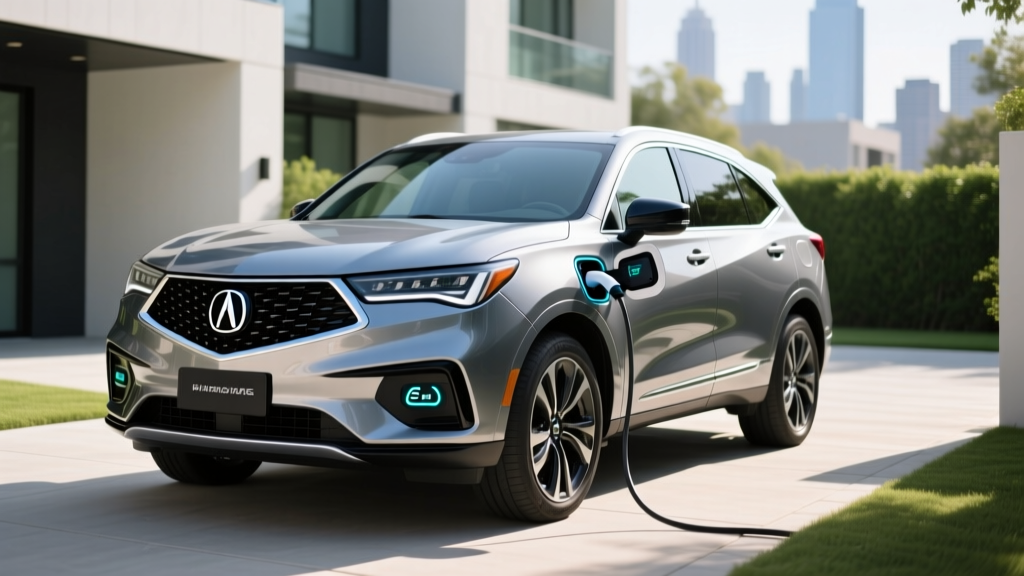
Acura has been one of the more conservative luxury brands when it comes to electrification. While rivals like BMW (X5 xDrive50e), Volvo (XC90 Recharge), and Lincoln (Corsair Grand Touring) have offered plug-in hybrid variants for years, Acura's electrification strategy has largely focused on conventional hybrids and, more recently, the all-electric ZDX built on GM's Ultium platform. That leaves a specific question for loyal Acura SUV buyers who want electric driving without full EV commitment: is there an Acura plug-in hybrid SUV, and if so, does it make sense for your garage?
This guide breaks down the current Acura SUV lineup's electrification status, the closest PHEV alternatives in the luxury compact-to-midsize segment, and the decision framework that determines whether a conventional hybrid (HEV), a plug-in hybrid (PHEV), or a battery-electric vehicle (BEV) is the right call.
Does Acura Currently Make a Plug-In Hybrid SUV?
As of the 2026 model year, Acura does not sell a dedicated plug-in hybrid SUV in the United States. The current MDX and RDX are available with conventional hybrid powertrains (HEV) that recapture braking energy and assist the gasoline engine but cannot be plugged in and do not offer meaningful electric-only driving range. The all-electric Acura ZDX, developed with General Motors, fills the zero-emission slot in the lineup.
This matters because many shoppers searching for an "Acura plug-in hybrid SUV" may be conflating two different technologies. Let's separate them clearly.
HEV vs. PHEV — The Core Difference
| Attribute | Conventional Hybrid (HEV) | Plug-In Hybrid (PHEV) |
|---|---|---|
| Plugs in? | No — self-charging via regen & engine | Yes — Level 1/Level 2 AC charging |
| Battery size | ~1.0–2.0 kWh | ~13–25 kWh usable |
| Electric-only range | Less than 1 mile (low-speed assist) | 20–45 miles typical |
| Gas engine | Always available, seamlessly blends | Always available, kicks in after EV range depletes |
| Federal tax credit | No | Up to $7,500 (subject to §30D rules) |
| Best for | Drivers without home charging access | Drivers with home/workplace Level 2 charging |
If you've seen Acura hybrid badging on the MDX Sport Hybrid or RDX, those are HEVs — efficient, reliable, but not plug-in vehicles. The confusion is understandable given how many automakers use the word "hybrid" broadly.
Acura MDX Sport Hybrid: MPG, Powertrain & Specs
The closest electrified Acura SUV to a plug-in experience is the MDX Sport Hybrid, which pairs a 3.0-liter V6 with a three-motor hybrid system. It delivers strong acceleration and better fuel economy than the standard MDX, but it operates strictly as a conventional hybrid.
| Specification | 2026 Acura MDX Sport Hybrid (Estimated) |
|---|---|
| Powertrain | 3.0L V6 + 3-motor hybrid system |
| Combined horsepower | ~321 hp |
| Battery capacity | ~1.3 kWh (lithium-ion, not plug-in) |
| EPA fuel economy (city) | 28 MPG |
| EPA fuel economy (highway) | 27 MPG |
| EPA fuel economy (combined) | 27 MPG |
| Electric-only range | Not applicable (HEV) |
| DC fast charging | Not applicable |
| Drivetrain | SH-AWD (Super Handling All-Wheel Drive) |
| 0–60 mph | ~6.1 seconds |
| Starting MSRP | ~$58,500 |
Sources: fueleconomy.gov for EPA ratings; Acura.com for manufacturer specifications.
Real-World MPG vs. EPA Sticker
Conventional hybrids like the MDX Sport Hybrid tend to perform close to or slightly above their EPA city rating in stop-and-go driving because regenerative braking is most effective at lower speeds. On the highway, where the gasoline engine does most of the work, expect figures closer to or slightly below the EPA highway number. In mixed real-world driving, owners of Acura's SH-AWD hybrid systems typically report 25–29 MPG combined, depending on climate and driving style. Cold weather reduces efficiency by roughly 5–10% due to increased engine load for cabin heat and reduced battery efficiency.
Luxury PHEV SUV Alternatives: What Competes Where Acura Doesn't
If plug-in capability is a priority — meaning you want 25–40 miles of electric-only commuting before the gas engine engages — several luxury midsize SUVs compete directly with the MDX in price and positioning. Here's how they stack up:
| Model | EPA EV Range | Battery (kWh) | Combined HP | EPA Combined (gas) | MSRP (base) |
|---|---|---|---|---|---|
| BMW X5 xDrive50e | 38 mi | 25.7 kWh (usable ~22) | 483 hp | 22 MPG | ~$73,000 |
| Volvo XC90 Recharge T8 | 32 mi | 18.6 kWh (usable ~15) | 455 hp | 27 MPG | ~$76,000 |
| Lincoln Corsair Grand Touring | 28 mi | 14.4 kWh (usable ~12) | 266 hp | 33 MPG | ~$55,000 |
| Mercedes GLE 350e | 45 mi | 23.3 kWh (usable ~20) | 375 hp | 23 MPG | ~$70,000 |
| Porsche Cayenne E-Hybrid | 27 mi | 25.9 kWh (usable ~21) | 463 hp | 21 MPG | ~$92,000 |
Notable: None of these PHEVs support DC fast charging. They charge via Level 1 (120V, ~1.4 kW) or Level 2 (240V, 3.6–7.2 kW). A full Level 2 charge typically takes 2.5 to 5 hours, which is ideal for overnight home charging but means public DC fast chargers won't help you.
Tax Credit Eligibility: PHEVs vs. HEVs
This is where the distinction between conventional hybrid and plug-in hybrid becomes financial, not just technical.
Federal §30D Clean Vehicle Credit — Who Qualifies?
- Vehicle type: Only PHEVs and BEVs qualify. Conventional hybrids (HEVs) do not.
- Maximum credit: Up to $7,500 for new vehicles (split between critical minerals and battery component requirements).
- Battery capacity: PHEV must have at least 7 kWh of battery capacity.
- MSRP cap: SUVs, pickups, and vans capped at $80,000 MSRP; sedans capped at $55,000.
- Buyer income cap: AGI ≤ $150,000 (single), $225,000 (head of household), $300,000 (joint).
- Battery sourcing: Critical minerals and battery components must meet phased-in domestic/free-trade sourcing thresholds that tighten annually through 2029.
- Point-of-sale transfer: Eligible buyers can transfer the credit to the dealer for an immediate price reduction rather than waiting for tax filing.
- FEOC restriction: Vehicles with battery components from a "foreign entity of concern" (certain Chinese manufacturers) are disqualified.
Source: IRS.gov — Clean Vehicle Credit. Eligibility rules change; verify current-year requirements with a tax professional.
Bottom line: The Acura MDX Sport Hybrid (HEV) does not qualify for the federal §30D credit. Competing PHEVs like the BMW X5 xDrive50e or Lincoln Corsair Grand Touring may qualify for partial or full credit depending on the model year's battery sourcing compliance — but buyers must verify at the point of purchase, as the IRS updates eligible model lists regularly.
Hybrid vs. PHEV vs. Full EV — Which Fits Your Garage?
The "right" electrified SUV depends less on brand loyalty and more on your daily routine, charging access, and risk tolerance. Here's the decision framework:
Choose a Conventional Hybrid (HEV) If:
- You lack reliable home or workplace charging access (apartment, street parking, no 240V outlet).
- You want better MPG than a gas-only SUV with zero behavior change.
- You frequently take long road trips and don't want to plan charging stops.
- You prefer the lowest upfront cost and proven long-term reliability.
Choose a Plug-In Hybrid (PHEV) If:
- You have Level 2 charging at home or work and your commute is under 35 miles round-trip.
- You want EV-like daily driving but need a gas engine for weekend road trips or towing.
- You want to hedge against charging infrastructure gaps in your region.
- You can capture the federal tax credit, narrowing the price gap with a full EV.
Choose a Full EV (BEV) If:
- You have reliable home Level 2 charging and your daily driving is under 250 miles.
- You want the lowest per-mile fuel cost and minimal maintenance (no oil changes, fewer moving parts).
- You're comfortable planning DC fast-charging stops on road trips (~20–30 min every 200–250 miles).
- You want maximum federal and state incentives and the quietest, smoothest powertrain.
For Acura loyalists specifically: if you want a plug-in hybrid badge on your garage wall, you'll need to cross-shop competing brands. If you're committed to Acura, your current electrified options are the MDX Sport Hybrid (HEV) for efficiency without plugging in, or the ZDX (BEV) for full electric driving with a 300+ mile range.
Battery Warranty, Lifespan & Replacement Costs
Battery longevity is one of the top concerns for hybrid and PHEV buyers. Here's what the data shows:
Hybrid & PHEV Battery Warranty Standards
| Category | Typical Coverage |
|---|---|
| Federal minimum (EPA-mandated) | 8 years / 80,000 miles (emissions-related components including hybrid battery) |
| California & CARB states | 10 years / 150,000 miles |
| Most manufacturer warranties | 8–10 years / 100,000–150,000 miles |
| Capacity threshold | Most warranties trigger if battery drops below 60–70% of original capacity |
Replacement cost reality: If a hybrid battery fails outside warranty, replacement typically ranges from $2,000–$4,000 for an HEV (smaller battery) and $5,000–$9,000+ for a PHEV (larger, more complex pack). However, real-world failure rates for modern lithium-ion hybrid batteries are low. Toyota's hybrid systems, for instance, have demonstrated batteries lasting 200,000+ miles with gradual capacity loss rather than sudden failure. Acura's hybrid systems, while less battle-tested than Toyota's volume, use similar lithium-ion chemistry and benefit from the same federal warranty mandates.
Degradation expectations: PHEV batteries lose roughly 1–2% of capacity per year under normal use. After 10 years, expect roughly 80–88% of original electric range — meaning a PHEV rated at 35 miles new might deliver 28–31 miles at age 10. This is gradual and rarely catastrophic.
Will Acura Release a Plug-In Hybrid SUV?
Acura's parent company, Honda, has announced a global electrification strategy that includes PHEV models for certain markets. However, Honda's North American strategy has pivoted heavily toward full EVs (via the Honda Prologue and Acura ZDX, both on GM's Ultium platform) and conventional hybrids. As of early 2026, Acura has not announced a plug-in hybrid SUV for the U.S. market.
This could change if Honda's next-generation hybrid architecture — expected later this decade — includes a PHEV variant with sufficient electric-only range to qualify for U.S. tax credits. Until then, Acura buyers seeking plug-in capability must look elsewhere or opt for the all-electric ZDX.
Pros and Cons: The Acura Electrified SUV Landscape
Pros — Acura MDX Sport Hybrid (HEV)
- No charging required — plug-and-play efficiency
- SH-AWD provides excellent all-weather traction
- ~27 MPG combined is strong for a 3-row luxury SUV
- Lower upfront cost than PHEV competitors
- Acura reliability reputation and dealer network
- Proven hybrid battery longevity (8–10 year warranty)
Cons — No Acura PHEV Option
- Zero electric-only driving range — always burning fuel
- No federal tax credit eligibility for the HEV
- Cannot access HOV/carpool lanes in most states
- Higher daily fuel cost vs. PHEV for short commutes
- Forced to cross-shop BMW, Volvo, Mercedes for PHEV
- Acura's electrification roadmap remains unclear
Frequently Asked Questions
How many MPG does the Acura MDX hybrid get?
The Acura MDX Sport Hybrid (conventional HEV) is EPA-rated at approximately 28 city / 27 highway / 27 combined MPG. Real-world results typically fall in the 25–29 MPG combined range depending on driving conditions. This is a conventional hybrid — it cannot be plugged in and has no electric-only driving mode.
Does Acura make a plug-in hybrid SUV with electric-only range?
No. As of the 2026 model year, Acura does not offer a plug-in hybrid (PHEV) SUV in the United States. The MDX and RDX are available as conventional hybrids (HEV), and the ZDX is a fully electric SUV. Buyers seeking a luxury PHEV SUV should consider the BMW X5 xDrive50e, Volvo XC90 Recharge, Mercedes GLE 350e, or Lincoln Corsair Grand Touring.
Hybrid vs. PHEV vs. EV — which should I buy?
If you have home Level 2 charging and a commute under 35 miles, a PHEV offers the best of both worlds: electric daily driving with gas backup for road trips. If you lack charging access, a conventional HEV like the MDX Sport Hybrid improves MPG without any plug-in requirement. If you have reliable charging and rarely drive over 250 miles in a day, a full EV like the Acura ZDX delivers the lowest operating cost and smoothest experience.
Is the Acura hybrid battery reliable, and what does replacement cost?
Acura's hybrid battery systems are covered by a minimum 8-year/80,000-mile federal warranty (10 years/150,000 miles in California and CARB states). Out-of-warranty replacement for a conventional hybrid battery typically costs $2,000–$4,000. Modern lithium-ion hybrid batteries have demonstrated 150,000–200,000+ mile lifespans with gradual degradation rather than sudden failure.
Does the Acura MDX hybrid qualify for a federal tax credit?
No. The federal §30D Clean Vehicle Credit applies only to plug-in hybrid electric vehicles (PHEVs) and battery-electric vehicles (BEVs) with at least 7 kWh of battery capacity. The Acura MDX Sport Hybrid is a conventional hybrid (HEV) with approximately 1.3 kWh and does not qualify. Consult IRS.gov for current eligible vehicle lists.
How far can a luxury PHEV SUV go on electric only?
Current luxury PHEV SUVs offer between 27 and 45 miles of EPA-rated electric-only range. The Mercedes GLE 350e leads at 45 miles, followed by the BMW X5 xDrive50e at 38 miles and the Volvo XC90 Recharge at 32 miles. Real-world electric range is typically 10–20% lower in cold weather or at sustained highway speeds above 65 mph.
Can a PHEV SUV use DC fast chargers?
Most luxury PHEV SUVs, including the BMW X5 xDrive50e, Volvo XC90 Recharge, and Mercedes GLE 350e, support only Level 1 (120V) and Level 2 (240V) AC charging. They cannot use DC fast chargers. A full Level 2 charge takes 2.5–5 hours depending on the onboard charger rating (typically 3.6–7.2 kW). This is designed for overnight home charging, not public fast-charging networks.