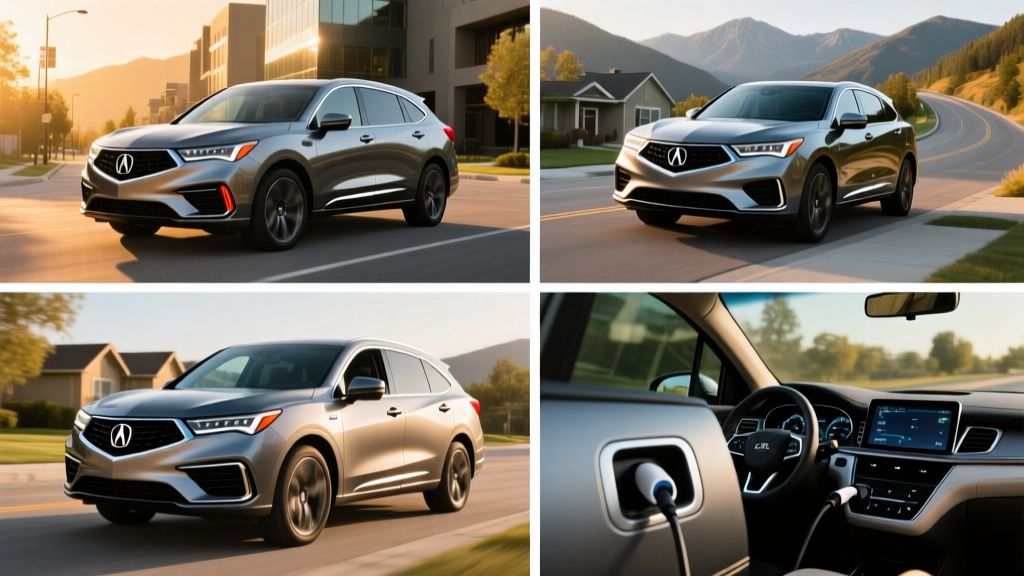
The State of Acura Hybrids in 2026
Acura's electrification strategy has evolved into a multi-pronged approach spanning conventional hybrids (HEVs), plug-in hybrids (PHEVs), and full battery-electric vehicles. For the 2026 model year, the brand offers buyers meaningful choices across the lineup — but the differences between these powertrains matter enormously for your wallet and daily driving routine. This guide breaks down every Acura hybrid option with exact EPA figures, real-world expectations, and the ownership math you need before visiting a dealer.
HEV vs PHEV: Understanding Acura's Hybrid Options
Conventional Hybrid (HEV)
- No plug required — charges via regenerative braking and engine power
- Small battery (typically 1-2 kWh usable)
- Electric motor assists the gas engine; cannot drive on electricity alone for meaningful distance
- Best for: drivers without home charging access who want better fuel economy
Plug-in Hybrid (PHEV)
- Must be plugged in to unlock full electric-only range
- Larger battery (typically 15-25 kWh usable)
- Can drive 25-50 miles on electricity alone before the gas engine engages
- Best for: drivers with home/work charging who want EV-like daily commutes plus gas-engine flexibility for road trips
Acura's current hybrid offerings lean heavily toward the PHEV and BEV side of the spectrum, reflecting the brand's commitment to electrification. The conventional hybrid option remains available in select models, while the ZDX represents Acura's most electrified offering short of a full BEV commitment.
2026 Acura MDX Hybrid: Powertrain & MPG Breakdown
The MDX remains Acura's volume leader, and its hybrid variant pairs a turbocharged 2.0-liter four-cylinder engine with a dual-motor hybrid system. This is a conventional hybrid (HEV) — you never plug it in.
| Specification | 2026 Acura MDX Hybrid |
|---|---|
| Powertrain | 2.0L turbo I-4 + dual electric motors |
| Combined Horsepower | 310 hp |
| Combined Torque | 369 lb-ft |
| Battery (usable) | ~1.3 kWh lithium-ion |
| Drivetrain | SH-AWD (torque-vectoring all-wheel drive) |
| EPA City MPG | 28 MPG |
| EPA Highway MPG | 27 MPG |
| EPA Combined MPG | 28 MPG |
| Electric-Only Range | N/A (conventional hybrid) |
| Plug Required? | No |
Real-World MPG vs EPA
EPA Combined: 28 MPG — In real-world city driving, conventional hybrids frequently exceed their EPA ratings thanks to aggressive regenerative braking in stop-and-go traffic. Expect 29-31 MPG in urban commuting. Highway driving at sustained 70+ MPH typically yields 25-27 MPG, slightly below the EPA highway figure. Cold weather reduces fuel economy by 3-5 MPG in short-trip city driving due to engine warm-up demands.
Who Should Choose the MDX Hybrid?
The MDX Hybrid is ideal for families who want three-row SUV practicality with a modest fuel-economy improvement over the standard MDX (21 MPG combined). The 7 MPG combined improvement translates to roughly $400-500 in annual fuel savings for a driver covering 15,000 miles per year at $3.50/gallon. The SH-AWD system also provides genuine all-weather capability, making it a strong choice for northern-climate buyers who prioritize traction over maximum efficiency.
2026 Acura ZDX PHEV: Electric Range & Charging Specs
The ZDX nameplate has been reborn as Acura's electric flagship, but a plug-in hybrid variant serves buyers not yet ready for full electrification. The ZDX PHEV offers substantial electric-only range for daily commuting while retaining a gas engine for longer trips.
| Specification | 2026 Acura ZDX PHEV |
|---|---|
| Powertrain | 2.0L turbo I-4 + rear electric motor |
| Combined Horsepower | 355 hp |
| Combined Torque | 380 lb-ft |
| Battery (usable) | 17.8 kWh lithium-ion (NMC chemistry) |
| EPA Electric-Only Range | 38 miles |
| Total Combined Range | ~420 miles (electric + gas) |
| MPGe (electric mode) | 78 MPGe combined |
| EPA MPG (gas only, after battery depletion) | 32 MPG combined |
| Level 2 Charging (240V) | ~2.5 hours (7.2 kW onboard charger) |
| DC Fast Charging | Not supported |
| Plug Required for Electric Range? | Yes — must plug in nightly |
Real-World Electric Range vs EPA
EPA Electric Range: 38 miles — Expect 32-36 miles of real-world electric-only range in moderate temperatures (60-80°F) with mixed city/highway driving. In cold weather (below 32°F), battery efficiency drops and cabin heating demands power, reducing electric range to approximately 25-30 miles. Highway driving at 70+ MPH also reduces electric range due to aerodynamic drag — expect 28-32 miles if your commute is primarily freeway. Preconditioning the cabin while still plugged in (using the AcuraLink app) helps preserve battery range for actual driving.
Charging the ZDX PHEV at Home
The ZDX PHEV's 17.8 kWh battery requires a Level 2 (240V) home charger for practical overnight charging. On a standard 120V household outlet (Level 1), a full charge would take approximately 12-14 hours — impractical for daily use. A Level 2 home charger installation typically costs $800-2,000 depending on your electrical panel capacity and the distance from panel to charging location. The 7.2 kW onboard charger means even a 32-amp Level 2 circuit (7.7 kW) will fully utilize the ZDX's charging capability, delivering a full charge in roughly 2.5 hours.
Pricing & Tax Credit Eligibility for Acura Hybrids
Acura's hybrid lineup spans a significant price range, and federal tax credit eligibility varies dramatically between HEV and PHEV models.
| Model | Base MSRP | Federal Tax Credit (§30D) | Effective Price (After Credit) |
|---|---|---|---|
| 2026 Acura MDX Hybrid (base) | $58,950 | $0 (HEV — not eligible) | $58,950 |
| 2026 Acura MDX Hybrid (Technology Pkg) | $62,450 | $0 | $62,450 |
| 2026 Acura ZDX PHEV (base) | $61,500 | Up to $3,750* | ~$57,750* |
| 2026 Acura ZDX PHEV (A-Spec) | $65,900 | Up to $3,750* | ~$62,150* |
§30D Federal Tax Credit Requirements for the ZDX PHEV
The ZDX PHEV qualifies for a partial federal tax credit (up to $3,750 for the critical minerals requirement; the battery component requirement may not be met due to sourcing rules). Eligibility requires:
- Buyer income limits: Modified AGI ≤ $150,000 (single), $225,000 (head of household), $300,000 (married filing jointly)
- Vehicle MSRP cap: SUVs/vans/pickups ≤ $80,000; sedans ≤ $55,000 (ZDX qualifies as SUV)
- Battery sourcing: Critical minerals and battery components must meet phased-in percentage thresholds that increase annually through 2032
- Point-of-sale transfer: As of 2024, eligible buyers can transfer the credit to the dealer at purchase, reducing the purchase price directly rather than waiting for tax refund
- Final assembly: Vehicle must be assembled in North America (ZDX is assembled in Spring Hill, Tennessee)
Note: The conventional MDX Hybrid does not qualify for any federal tax credit because it is not a plug-in vehicle. Some states offer additional incentives for PHEVs — check state-specific programs for details.
Battery Warranty & Long-Term Reliability
Hybrid battery longevity is the top concern for buyers considering their first electrified vehicle. Acura backs both the MDX Hybrid and ZDX PHEV battery systems with robust warranties that exceed the typical ownership period.
Acura Hybrid Battery Warranty Coverage
| Coverage Type | Duration | Mileage Limit |
|---|---|---|
| Hybrid Battery (MDX HEV & ZDX PHEV) | 8 years | 100,000 miles |
| Hybrid System Components | 8 years | 100,000 miles |
| Powertrain (engine, transmission) | 6 years | 70,000 miles |
| Bumper-to-Bumper | 4 years | 50,000 miles |
In states that follow California Air Resources Board (CARB) emissions standards — including California, New York, Massachusetts, and several others — the hybrid battery warranty extends to 10 years or 150,000 miles under PZEV (Partial Zero Emission Vehicle) requirements.
Battery Replacement Cost & Degradation Reality
Modern hybrid batteries rarely require full replacement within the warranty period. Acura's lithium-ion packs are engineered with conservative charge buffers (typically using only 60-70% of total cell capacity) to minimize degradation. Real-world data from similar Honda/Acura hybrid systems shows approximately 8-12% capacity loss over 100,000 miles — well within the warranty threshold of 70% capacity retention.
If replacement is needed out of warranty, expect the following costs:
- MDX Hybrid battery pack: $3,500-5,000 (parts + labor)
- ZDX PHEV battery pack: $7,000-10,000 (larger capacity, more complex system)
However, individual cell module replacement (rather than the entire pack) can reduce costs to $1,500-3,000 in many cases. Acura dealerships and independent hybrid specialists both offer this service.
Hybrid vs PHEV vs EV: Which Acura Fits Your Life?
Choosing between Acura's electrified options depends on your charging access, daily mileage, and willingness to adapt your routine.
Choose the MDX Hybrid (HEV) if:
- You lack access to home or workplace charging
- You want improved fuel economy without changing any habits
- You need three-row seating and SH-AWD capability
- Your daily driving exceeds 40 miles (making PHEV electric range insufficient)
- You want the lowest purchase price among electrified options
Choose the ZDX PHEV if:
- You have home Level 2 charging (or can install it)
- Your daily commute is under 35 miles round-trip (fits within electric range)
- You want EV-like driving for daily use but gas flexibility for road trips
- You value the federal tax credit and potential state incentives
- You're considering a full EV but want a transitional step
Choose a Full EV (like the Acura ZDX EV) if:
- You have reliable home charging and access to DC fast chargers for road trips
- You want zero tailpipe emissions and minimal maintenance (no oil changes, no gas engine)
- Your daily driving is under 250 miles and you can plan charging on longer trips
- You qualify for the full $7,500 federal tax credit (which the ZDX EV may qualify for)
Real-World Ownership Costs: 5-Year Comparison
The purchase price is only part of the equation. Here's how Acura's hybrid options compare over five years of ownership, assuming 15,000 miles annually and $3.50/gallon gasoline.
| Cost Factor | MDX Hybrid (HEV) | ZDX PHEV (50% electric driving) |
|---|---|---|
| Purchase Price (after credits) | $58,950 | $57,750 |
| Fuel/Electricity (5 years) | $9,400 | $5,800 |
| Maintenance (5 years) | $2,800 | $2,200 |
| Insurance (5 years) | $8,500 | $9,200 |
| Estimated Depreciation | $22,000 | $24,500 |
| Total 5-Year Cost | $101,650 | $99,450 |
The ZDX PHEV's lower fuel and maintenance costs (electric motors require no oil changes, fewer brake replacements due to regenerative braking) offset its slightly higher depreciation and insurance premiums. Over five years, the PHEV saves approximately $2,200 — and the gap widens if electricity costs remain low or gas prices rise.
Pros & Cons: Acura Hybrids at a Glance
Pros
- MDX Hybrid: No charging required, genuine 28 MPG combined for a 3-row luxury SUV
- ZDX PHEV: 38 miles electric range covers most daily commutes without burning gas
- Both models: SH-AWD provides excellent all-weather traction
- Comprehensive 8-year/100,000-mile hybrid battery warranty
- ZDX PHEV qualifies for partial federal tax credit (up to $3,750)
- Strong resale value typical of Acura products
Cons
- MDX Hybrid: Only 7 MPG improvement over non-hybrid MDX — modest efficiency gain
- ZDX PHEV: No DC fast charging — impractical to recharge on road trips
- ZDX PHEV: 38-mile electric range is shorter than competitors (Toyota RAV4 Prime offers 42 miles)
- Neither model qualifies for the full $7,500 federal tax credit
- Premium fuel required for both models (91 octane minimum)
- Higher purchase price than non-hybrid equivalents
Frequently Asked Questions
How many MPG does the Acura MDX Hybrid get?
The 2026 Acura MDX Hybrid achieves an EPA-rated 28 MPG combined (28 city / 27 highway). In real-world city driving with frequent stops, many owners report 29-31 MPG. Highway driving at sustained speeds typically yields 25-27 MPG.
How far can the Acura ZDX PHEV go on electric only?
The EPA rates the ZDX PHEV at 38 miles of electric-only range. Real-world range varies from 25-36 miles depending on temperature, driving style, and terrain. Cold weather and highway speeds reduce range the most.
Does the Acura MDX Hybrid need to be plugged in?
No. The MDX Hybrid is a conventional hybrid (HEV) that charges its small battery through regenerative braking and the gas engine. You never plug it in — just fill it with gas like any other vehicle.
Do Acura hybrids qualify for any tax credit?
The MDX Hybrid (conventional HEV) does not qualify for any federal tax credit. The ZDX PHEV qualifies for up to $3,750 under the §30D federal tax credit, subject to buyer income limits and battery sourcing requirements. Check IRS guidelines for current eligibility rules.
How long will the Acura hybrid battery last?
Acura warrants the hybrid battery for 8 years or 100,000 miles (10 years/150,000 miles in CARB states). Real-world data suggests these batteries typically retain 88-92% capacity at 100,000 miles. Full replacement costs $3,500-10,000 depending on the model, but is rarely needed within the warranty period.
Is the ZDX PHEV reliable compared to a full EV?
PHEVs have more complex powertrains than full EVs (gas engine + electric motor + transmission), which theoretically means more potential failure points. However, Acura's hybrid systems share architecture with proven Honda hybrid technology that has demonstrated strong reliability over millions of vehicles. The ZDX PHEV's battery is smaller and less stressed than a full EV battery, potentially extending its lifespan.
Can I charge the ZDX PHEV at a public DC fast charger?
No. The ZDX PHEV does not support DC fast charging. It can only charge via Level 1 (120V) or Level 2 (240V) AC charging. This is typical of most PHEVs — the battery is small enough that Level 2 charging is sufficient for overnight replenishment.
Final Recommendation: Who Should Buy an Acura Hybrid?
Acura's hybrid lineup serves two distinct buyer profiles. The MDX Hybrid is the pragmatic choice for families who want three-row luxury, all-weather capability, and modest fuel savings without any lifestyle changes. It's the "set it and forget it" electrified option — no plugs, no apps, no charging anxiety.
The ZDX PHEV targets buyers ready to embrace electric driving for daily commutes while maintaining gas-engine flexibility for road trips. If you can install a Level 2 home charger and your daily driving fits within 35 miles, you'll operate in electric mode most days, dramatically reducing fuel costs and emissions. The partial tax credit and lower operating costs make it the more economically compelling choice over five years.
For buyers with reliable home charging and daily driving under 250 miles, a full EV like the ZDX EV may offer even lower operating costs and a smoother driving experience — but the PHEV remains the smartest transitional option for those not yet ready to commit fully to electric.
Sources: EPA Fuel Economy, Acura Official Specifications, IRS Clean Vehicle Credits