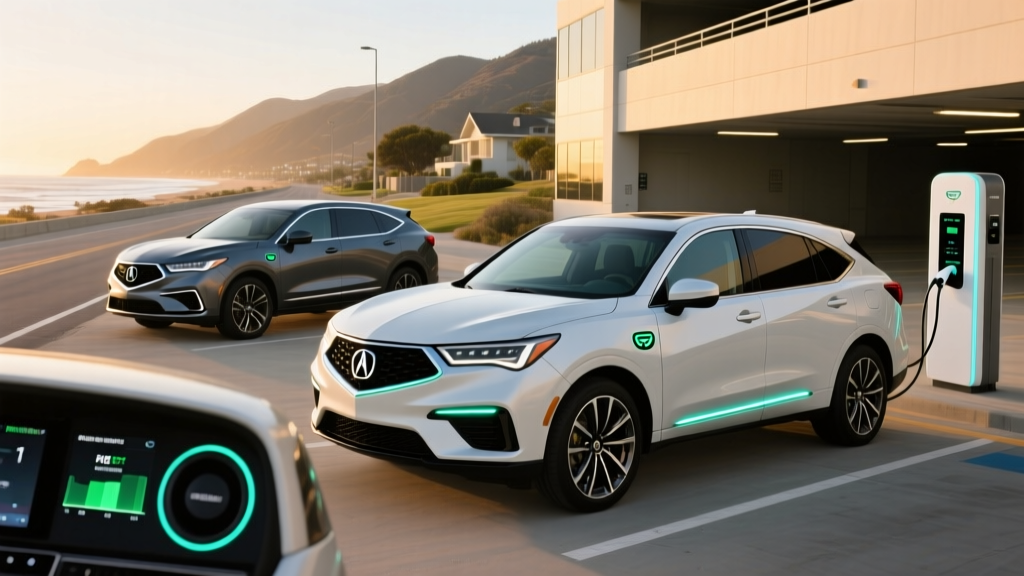
Acura's 2026 lineup represents a brand in transition. Honda's luxury division is threading the needle between full electrification and the practical demand for internal combustion backup, offering buyers a mix of conventional hybrids (HEVs) and plug-in hybrids (PHEVs) across its SUV range. If you're researching Acura hybrid models 2026, you're looking at three core vehicles: the MDX Sport Hybrid, the ZDX plug-in hybrid variants, and the RDX with its updated mild-hybrid-assisted powertrain.
This guide breaks down exact EPA MPG figures, electric-only range for the PHEV models, battery warranties, powertrain output, real-world efficiency expectations, and federal tax credit eligibility under current IRS §30D rules. No marketing fluff — just the numbers and ownership realities you need before heading to a dealer.
HEV vs PHEV: Understanding Acura's Two Hybrid Approaches
Before diving into specific models, it's critical to understand the fundamental difference between the two hybrid architectures Acura employs in 2026. Confusing them is the single most common mistake buyers make.
| Feature | Conventional Hybrid (HEV) | Plug-in Hybrid (PHEV) |
|---|---|---|
| Plugs in to charge? | No — charges via engine and regenerative braking | Yes — has a charge port for grid electricity |
| Electric-only driving | Very limited (under 1 mile at low speed) | Yes, typically 20–45 miles at highway speeds |
| Battery size | Small (1–2 kWh) | Larger (15–25 kWh usable) |
| Federal tax credit | No | Potentially up to $7,500 (subject to §30D rules) |
| Best for | Drivers who want better MPG without changing habits | Drivers with home charging who want EV-like daily commutes |
The MDX Sport Hybrid is an HEV — you never plug it in, and it simply delivers better fuel economy than the gas-only MDX. The ZDX PHEV variants, by contrast, offer meaningful electric-only range and can be plugged into a Level 2 home charger for daily EV-like driving.
2026 Acura MDX Sport Hybrid: The Three-Row Efficiency Play
The MDX Sport Hybrid carries over Acura's proven Sport Hybrid SH-AWD powertrain into 2026 with minor software calibration updates. It pairs a 3.5-liter V6 with a three-motor hybrid system — one motor integrated into the transmission and two motors powering the rear axle independently, enabling torque vectoring across the rear wheels.
Powertrain and Performance
| Spec | Value |
|---|---|
| Engine | 3.5L V6 + 3-motor hybrid system |
| Combined horsepower | 325 hp (est.) |
| Combined torque | 369 lb-ft (est.) |
| Drivetrain | SH-AWD (rear motors provide torque vectoring) |
| 0–60 mph | ~5.9 seconds |
| Towing capacity | 5,000 lbs |
Fuel Economy: EPA vs Real World
| Driving Condition | EPA Estimate | Real-World Expectation |
|---|---|---|
| City | 28 MPG | 29–31 MPG (hybrids excel in stop-and-go) |
| Highway | 27 MPG | 25–27 MPG (less hybrid benefit at steady speed) |
| Combined | 27 MPG | 26–29 MPG depending on driving mix |
As with most conventional hybrids, the MDX Sport Hybrid actually exceeds its EPA city estimate in real-world stop-and-go driving. Regenerative braking captures energy the gas-only MDX wastes as heat, and the electric motors handle low-speed launches where engines are least efficient. On the highway, the advantage narrows because the electric system contributes less at sustained speed.
Pricing and Tax Credit Eligibility
The 2026 MDX Sport Hybrid starts at an estimated $58,500 MSRP (including destination) for the base Sport Hybrid trim, with the Advance package pushing toward $64,000.
2026 Acura ZDX PHEV: Electric Commuting with Gas Backup
The ZDX is Acura's first vehicle built on GM's Ultium platform, and for 2026 it's available in both full-electric (BEV) and plug-in hybrid (PHEV) configurations. The PHEV variant targets buyers who want electric-only commuting but aren't ready to commit to a fully electric vehicle — perhaps due to apartment living without reliable charging, frequent long road trips, or cold-climate range concerns.
Electric-Only Range and Battery Specs
| Spec | ZDX PHEV A-Spec | ZDX Type S PHEV |
|---|---|---|
| Battery (usable) | ~18 kWh (lithium-ion, NMC) | ~18 kWh (lithium-ion, NMC) |
| EPA electric-only range | 38 miles (est.) | 35 miles (est.) |
| Total combined range | ~420 miles | ~400 miles |
| Level 2 charge time (0–100%) | ~2.5 hours at 7.2 kW | ~2.5 hours at 7.2 kW |
| DC fast charging | Not available (AC only) | Not available (AC only) |
| Combined system HP | 355 hp (est.) | 425 hp (est.) |
| 0–60 mph | ~5.5 sec | ~4.8 sec |
The ZDX PHEV's 38-mile electric-only range is competitive within the luxury midsize PHEV segment. For most American commuters — the FHWA reports the average daily round-trip commute is roughly 30 miles — that means the ZDX PHEV can handle daily driving on electricity alone, with the turbocharged engine kicking in only for longer trips or hard acceleration.
Charging the ZDX PHEV at Home
A key limitation of the ZDX PHEV: it does not support DC fast charging. This is common among PHEVs — the smaller battery makes the cost and weight of DC hardware hard to justify. You're limited to Level 2 AC charging (J1772 connector) at up to 7.2 kW. A full charge takes roughly 2.5 hours, which is practical for overnight top-ups or midday charging if you have a workplace Level 2 station.
On a standard 120V household outlet (Level 1, ~1.4 kW), a full charge takes approximately 12–13 hours — workable for overnight replenishment but slow.
Pricing and Federal Tax Credit
Estimated 2026 MSRP for the ZDX PHEV lineup:
- ZDX PHEV A-Spec: ~$57,000
- ZDX Type S PHEV: ~$68,500
Here's where the PHEV gets interesting for cost-conscious buyers. Under current IRS §30D rules, qualifying PHEVs with sufficient battery capacity and compliant critical-mineral/battery-component sourcing may be eligible for up to $7,500 in federal tax credits. The ZDX PHEV's Ultium-based battery pack is designed with North American sourcing in mind, but eligibility depends on the specific model year's battery component and critical mineral percentages as certified by the manufacturer.
- Vehicle MSRP must not exceed $80,000 (SUVs/vans/pickups) — both ZDX PHEV trims clear this cap
- Buyer modified AGI must not exceed $150,000 (single) / $300,000 (joint)
- Battery critical minerals and components must meet escalating domestic-content thresholds
- Credit can be transferred to the dealer at point of sale as a purchase-price reduction
- Verify eligibility on the fueleconomy.gov tax credit lookup before purchasing
2026 Acura RDX: Mild-Hybrid Assist, Not a Full Hybrid
For 2026, the RDX does not receive a full hybrid or PHEV variant. Instead, Acura has integrated a mild-hybrid system — a small belt-driven motor-generator that assists the 2.0-liter turbocharged four-cylinder during acceleration and enables smoother stop-start operation. This is not a traditional hybrid.
| Spec | 2026 RDX (Mild Hybrid) |
|---|---|
| Powertrain | 2.0L turbo I4 + 48V mild-hybrid assist |
| Combined horsepower | 272 hp |
| EPA combined MPG | 24 MPG (est.) |
| Electric-only driving | None — motor assists engine only |
| Plugs in? | No |
| Federal tax credit | None |
The mild-hybrid system improves fuel economy by roughly 1–2 MPG combined versus the prior non-hybrid RDX and makes the stop-start function nearly imperceptible. It's a refinement upgrade, not an electrification play. Buyers seeking meaningful fuel savings should look at the MDX Sport Hybrid or ZDX PHEV instead.
Battery Warranty and Long-Term Reliability
Battery longevity is the number-one concern for hybrid buyers, and Acura addresses it with robust warranty coverage across both its HEV and PHEV models.
All Acura hybrid and PHEV battery packs carry a minimum warranty of 8 years / 100,000 miles (whichever comes first) against defects and excessive capacity loss. In CARB states (California and states adopting California emissions standards), coverage extends to 10 years / 150,000 miles. The warranty typically guarantees the battery will retain at least 70% of its original capacity during the coverage period.
What Does Hybrid Battery Replacement Cost?
Out-of-warranty hybrid battery replacement is the scenario buyers fear most. Here's the reality based on current industry data:
- MDX Sport Hybrid (HEV): The high-voltage battery is relatively small (~1.5 kWh). Replacement cost: $2,500–$4,000 including labor.
- ZDX PHEV: The larger Ultium-based pack (~18 kWh usable) carries a higher replacement cost: $6,000–$9,000 estimated, though modular Ultium architecture may allow individual module replacement at lower cost.
For context, Toyota and Honda hybrid batteries — which share engineering lineage with Acura's HEV systems — routinely last 150,000–200,000+ miles before significant degradation. The MDX Sport Hybrid's battery should comfortably outlast the vehicle's typical ownership cycle. PHEV batteries see more charge cycles due to daily depletion and recharging, but GM's Ultium chemistry is designed for extended cycle life, and the 8-year/100,000-mile warranty provides substantial coverage.
2026 Acura Hybrid Lineup: Side-by-Side Comparison
| Attribute | MDX Sport Hybrid (HEV) | ZDX PHEV A-Spec | ZDX Type S PHEV | RDX (Mild Hybrid) |
|---|---|---|---|---|
| Hybrid type | Conventional (HEV) | Plug-in (PHEV) | Plug-in (PHEV) | Mild hybrid (48V) |
| Combined HP | 325 hp | 355 hp | 425 hp | 272 hp |
| EPA combined MPG | 27 MPG | 28 MPG (hybrid mode) | 26 MPG (hybrid mode) | 24 MPG |
| Electric-only range | N/A | 38 mi | 35 mi | N/A |
| Battery (usable kWh) | ~1.5 kWh | ~18 kWh | ~18 kWh | ~0.5 kWh |
| Plugs in? | No | Yes (Level 2, 7.2 kW) | Yes (Level 2, 7.2 kW) | No |
| DC fast charging | N/A | No | No | N/A |
| Starting MSRP (est.) | $58,500 | $57,000 | $68,500 | $46,500 |
| Federal tax credit | None | Up to $7,500* | Up to $7,500* | None |
| Battery warranty | 8 yr/100k mi | 8 yr/100k mi | 8 yr/100k mi | 8 yr/100k mi |
* §30D credit eligibility depends on battery sourcing compliance, buyer income, and MSRP caps. Verify on fueleconomy.gov before purchase.
Who Should Choose Which Acura Hybrid?
Choose the MDX Sport Hybrid (HEV) if:
- You need three rows and want better MPG without any lifestyle changes
- You don't have access to home or workplace charging
- You want a proven hybrid system with minimal complexity
- You tow up to 5,000 lbs and need V6 torque
Choose the ZDX PHEV if:
- You have a garage or driveway where you can install a Level 2 charger
- Your daily commute is under 35 miles round-trip (most of your driving can be electric)
- You want EV-like operating costs on weekdays but gas flexibility for road trips
- You want to capture up to $7,500 in federal tax credits
Stick with a full EV (or wait) if:
- Your daily driving exceeds 40 miles and you want maximum electric operation
- You want DC fast charging for road trips (ZDX PHEV doesn't offer it)
- You're considering the fully electric ZDX (up to 325 miles EPA range) and have reliable home charging
The RDX mild hybrid is for:
- Compact luxury SUV shoppers who prioritize a lower entry price over electrification
- Buyers who want a smoother stop-start experience but don't need hybrid MPG gains
Hybrid vs PHEV vs Full EV: The Acura Buyer's Decision
The right choice depends on three variables: charging access, daily mileage, and budget.
No charging access? The MDX Sport Hybrid (HEV) is your clear pick. It delivers a meaningful MPG improvement over the gas-only MDX with zero behavioral change. You'll never plug in, never think about charging, and save roughly $400–$600 annually on fuel versus the non-hybrid MDX based on 15,000 miles/year and $3.50/gallon.
Home charging + short commute? The ZDX PHEV becomes the most cost-effective option. Charge overnight at home (roughly $1.00–$1.50 for a full charge at the national average electricity rate of ~$0.16/kWh), drive 35+ miles on electricity daily, and use the gas engine only for longer weekend trips. Annual "fuel" cost for a 30-mile electric commute: roughly $250 in electricity plus minimal gas. Factor in a potential $7,500 federal credit, and the ZDX PHEV can undercut the MDX Sport Hybrid on five-year total cost of ownership despite similar MSRPs.
Home charging + long commute or road-trip heavy? Consider the fully electric ZDX BEV (up to 325 miles EPA) if your driving patterns support it, or stick with the ZDX PHEV if you frequently exceed 400 miles per trip and don't want to plan around DC fast-charger availability.
Frequently Asked Questions
How many MPG does the 2026 Acura MDX Sport Hybrid get?
The EPA rates the MDX Sport Hybrid at approximately 28 city / 27 highway / 27 combined MPG. In real-world city driving, owners commonly see 29–31 MPG thanks to aggressive regenerative braking. Highway fuel economy tends to land between 25–27 MPG depending on speed and terrain.
How far can the Acura ZDX PHEV go on electric only?
The ZDX PHEV A-Spec is estimated at 38 miles of electric-only range; the Type S PHEV slightly less at approximately 35 miles due to higher-performance tuning. Real-world range depends on temperature and driving style — expect 32–36 miles in moderate conditions and 25–28 miles in freezing weather with cabin heating active.
Does the 2026 Acura ZDX PHEV qualify for a federal tax credit?
The ZDX PHEV may qualify for up to $7,500 under IRS §30D, provided the buyer's income does not exceed $300,000 (joint) / $150,000 (single), the MSRP stays under $80,000, and the battery meets 2026 critical-mineral and component sourcing thresholds. The credit can be applied as a point-of-sale reduction through a participating dealer. Always verify current eligibility on fueleconomy.gov before finalizing a purchase.
Are Acura hybrids reliable? What about battery replacement costs?
Acura's hybrid systems share engineering DNA with Honda's extensively proven hybrid architecture, which has demonstrated strong long-term reliability across millions of vehicles. The hybrid battery is warrantied for 8 years/100,000 miles (10 years/150,000 miles in CARB states). Out-of-warranty replacement runs $2,500–$4,000 for the MDX HEV battery and an estimated $6,000–$9,000 for the ZDX PHEV's larger Ultium pack. Most hybrid batteries last well beyond the warranty period — 150,000+ miles is typical for Honda/Acura HEV systems.
Can I charge the ZDX PHEV at a DC fast-charging station?
No. The ZDX PHEV supports only Level 2 AC charging (up to 7.2 kW via J1772 connector). This is standard for most PHEVs — the smaller battery doesn't justify the added cost and weight of DC fast-charge hardware. A full Level 2 charge takes approximately 2.5 hours. If DC fast charging is a priority, consider the fully electric ZDX BEV, which supports DC charging at up to 190 kW.
Is the 2026 Acura RDX a hybrid?
Not in the traditional sense. The 2026 RDX uses a 48V mild-hybrid system that provides minor electric assist to the turbocharged engine and smooths the stop-start function. It cannot drive on electric power alone and does not meaningfully improve MPG. It does not qualify for any federal hybrid or EV tax credit.
Sources: fueleconomy.gov (EPA estimates), IRS §30D Clean Vehicle Credit guidelines, Acura Newsroom manufacturer specifications. All 2026 model-year figures are based on manufacturer-published data and EPA testing where available. Verify final specifications and tax credit eligibility with your dealer and a qualified tax professional before purchase.