Quick Verdict: The Accord Hybrid Sport in 2026
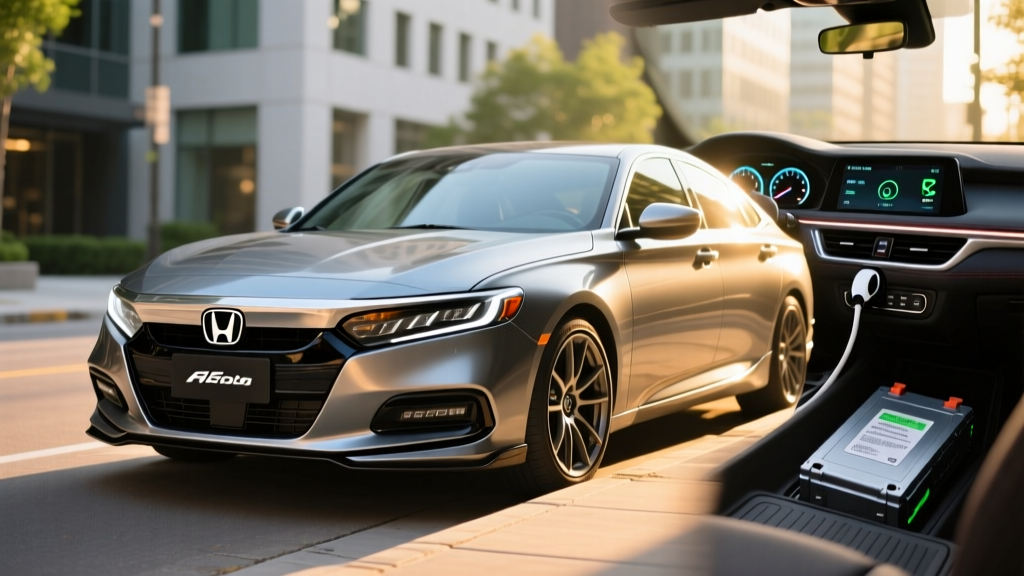
The 2026 Honda Accord Hybrid Sport occupies a specific niche: it's the sportiest-looking trim in Honda's hybrid-only Accord lineup, pairing the same proven two-motor hybrid system with blacked-out exterior accents, 19-inch wheels, and a slightly firmer suspension tune. For buyers who want sedan practicality, genuine 40+ MPG efficiency, and don't want to deal with plug-in charging logistics, the Accord Hybrid Sport remains one of the most rational midsize sedan purchases on the market.
This is a conventional hybrid (HEV), not a plug-in hybrid (PHEV). You never plug it in. The gasoline engine and regenerative braking recharge the small battery pack automatically. If you're looking for electric-only commuting range, you'll want to look at Honda's CR-V-based PHEV offerings or a full BEV instead.
Conventional Hybrid (HEV): Small battery (~1-2 kWh), recharged by engine and regen braking. No plug. Optimizes MPG across all driving. This is what the Accord Hybrid Sport is.
Plug-in Hybrid (PHEV): Larger battery (typically 15-25 kWh), can be plugged in for 25-45 miles of electric-only driving before the gas engine kicks in. Requires access to charging to realize full benefit.
EPA Fuel Economy and Real-World MPG
The 2026 Accord Hybrid Sport carries an EPA rating of 46 MPG city / 41 MPG highway / 44 MPG combined according to fueleconomy.gov. The Sport trim's larger 19-inch wheels and sport-tuned suspension reduce efficiency slightly compared to the Hybrid LX and EX-L trims, which achieve 51/44/48 MPG.
| Trim | City MPG | Highway MPG | Combined MPG |
|---|---|---|---|
| Hybrid LX / EX-L | 51 | 44 | 48 |
| Hybrid Sport | 46 | 41 | 44 |
| Hybrid Sport-L / Touring | 46 | 41 | 44 |
Real-World MPG: What to Actually Expect
Honda's two-motor hybrid system excels in city driving, where the electric motor handles most low-speed propulsion and regenerative braking recaptures energy at every stop. In real-world mixed driving, owners consistently report 42-47 MPG combined, with city-heavy commutes occasionally pushing above 50 MPG.
Highway-only driving at 75+ MPH will drop efficiency to roughly 37-39 MPG, as the gasoline engine operates continuously and aerodynamic drag increases. Cold weather (below 30°F) typically reduces fuel economy by 5-10% due to extended engine warm-up cycles and cabin heating demands. These figures align with broader Accord Hybrid owner data aggregated on fueleconomy.gov's My MPG tracker.
Powertrain Specs: How the Accord Hybrid Sport Drives
The 2026 Accord Hybrid Sport uses Honda's fourth-generation two-motor hybrid system, which pairs a 2.0-liter Atkinson-cycle inline-four engine with two electric motors. One motor functions primarily as a generator, while the larger traction motor drives the front wheels through most of the speed range. At highway cruising speeds, a lock-up clutch connects the engine directly to the wheels for optimal efficiency.
| Specification | Value |
|---|---|
| Engine | 2.0L DOHC Atkinson-cycle I-4 |
| Combined System Horsepower | 204 hp |
| Combined System Torque | 247 lb-ft (electric motor peak) |
| Traction Motor Output | 181 hp / 247 lb-ft |
| Transmission | e-CVT (single-speed direct drive + engine clutch) |
| Drivetrain | Front-wheel drive |
| 0-60 MPH (est.) | ~7.0 seconds |
| Hybrid Battery Type | Lithium-ion, ~1.1 kWh (usable) |
| Fuel Tank Capacity | 12.8 gallons |
| Total Driving Range (est.) | ~560 miles |
The Sport trim adds paddle-shifters that control regenerative braking intensity across four levels, allowing a quasi-one-pedal driving feel in city traffic — though the car will not come to a complete stop without using the brake pedal. The Sport's suspension tuning is marginally firmer than lower trims, trading a small amount of ride comfort for slightly sharper turn-in response.
Pricing, Trims, and Tax Credit Eligibility
The 2026 Honda Accord Hybrid Sport carries a starting MSRP of approximately $34,990 including destination charge. Key competitors in this price band include the Toyota Camry Hybrid SE ($33,500), Hyundai Sonata Hybrid SEL ($33,000), and Kia K5 Hybrid ($32,500).
Federal Tax Credit: Does the Accord Hybrid Qualify?
No. The Honda Accord Hybrid is a conventional hybrid (HEV), not a plug-in hybrid or battery-electric vehicle. Under current IRS §30D Clean Vehicle Credit rules, only new plug-in electric vehicles (PHEVs with at least 7 kWh of battery capacity and BEVs) are eligible for the federal tax credit of up to $7,500. The Accord Hybrid's ~1.1 kWh battery falls far below this threshold.
A handful of states offer their own incentives for conventional hybrids, but these are increasingly rare as state programs shift toward PHEVs and BEVs. Check your state's energy office or DMV website for current programs. Some employers and utilities also offer hybrid purchase rebates — worth investigating locally.
The Accord Hybrid Sport's lack of federal tax credit eligibility is a trade-off against its simplicity. You get zero plug-in charging requirements, no range anxiety, and no dependency on charging infrastructure — but you also miss out on the $3,750-$7,500 federal credit that qualifying PHEVs and BEVs receive. Factor this into your total cost comparison.
Battery Warranty, Reliability, and Replacement Costs
Honda covers the Accord Hybrid's lithium-ion battery pack with an 8-year / 100,000-mile warranty (extended to 10 years / 150,000 miles in California Air Resources Board states, which include CA, CO, CT, ME, MA, NJ, NY, OR, RI, VT, and WA). This warranty covers battery capacity degradation below a specified threshold and complete failure.
Honda's hybrid battery packs have demonstrated strong longevity in real-world use. The current-generation two-motor system has been in production since 2023, and earlier Honda hybrid systems (Insight, previous-gen Accord Hybrid) commonly reached 150,000-200,000+ miles without battery replacement. The smaller battery in an HEV undergoes shallower charge-discharge cycles than a PHEV or BEV, reducing degradation stress.
If out-of-warranty replacement becomes necessary, a Honda Accord Hybrid battery pack typically costs $2,000-$4,000 including labor at a dealership, based on current parts pricing. Independent hybrid specialists may offer refurbished pack installations for $1,500-$2,500. This is significantly less than BEV battery replacement costs, which can exceed $10,000-$20,000.
Overall Reliability
Honda's hybrid powertrain has earned strong reliability marks. The e-CVT design eliminates the traditional multi-speed transmission entirely — there are no gear sets, clutch packs, or bands to wear. The 2.0L Atkinson-cycle engine operates under lighter loads than a conventional engine, which tends to extend its service life. The Accord as a nameplate consistently earns above-average reliability ratings from major evaluators, and IIHS has historically awarded the Accord top safety scores.
Accord Hybrid Sport vs PHEV vs Full EV: Which Fits You?
Choosing between a conventional hybrid, a plug-in hybrid, and a full battery-electric vehicle depends on your driving patterns, charging access, and budget. Here's a practical decision framework:
| Factor | HEV (Accord Hybrid) | PHEV | BEV (Full Electric) |
|---|---|---|---|
| Plug-in charging needed? | No | Yes (for full benefit) | Yes (always) |
| Electric-only range | 0 mi (EV assist only) | 25-45 mi | 220-370 mi |
| Federal tax credit | $0 | Up to $7,500* | Up to $7,500* |
| Fuel cost per mile (avg) | ~$0.08 | ~$0.04-0.07 | ~$0.03-0.05 |
| Road trip flexibility | Excellent | Excellent | Good (requires planning) |
| Maintenance complexity | Low | Moderate | Lowest |
* §30D credit eligibility depends on MSRP caps, buyer income limits, and battery component/critical mineral sourcing requirements. Verify current-year rules at irs.gov.
Choose the Accord Hybrid Sport (HEV) if: You lack home charging access, want maximum simplicity, regularly take long road trips, and prioritize low purchase price over maximum fuel savings.
Choose a PHEV if: You can install a Level 2 home charger, your commute is under 40 miles round-trip, and you want electric daily driving with gas-engine backup for longer trips.
Choose a BEV if: You have reliable home charging, your daily driving is predictable, you want the lowest per-mile fuel cost and minimal maintenance, and you're comfortable with DC fast charging on road trips.
Pros and Cons: 2026 Accord Hybrid Sport
- 44 MPG combined (48 MPG on lower trims) with zero plug-in hassle
- 204 hp with strong electric torque for confident merging
- Spacious cabin with 16.7 cu-ft trunk (no battery intrusion)
- Proven hybrid reliability with 8-yr/100k-mi battery warranty
- Lower battery replacement cost (~$2-4K) vs BEV ($10-20K)
- No range anxiety — 560+ mile total range on one tank
- Sport trim aesthetics without major efficiency penalty
- No federal tax credit eligibility ($0 under §30D)
- 19-inch wheels reduce MPG by ~4 MPG vs base hybrid trims
- No electric-only driving mode — always uses some gasoline
- FWD only — no AWD option unlike Toyota Camry Hybrid
- Higher per-mile fuel cost than a PHEV or BEV
- Sport suspension trades some ride comfort for handling
- Hybrid system adds ~200 lbs vs a gas-only equivalent
Frequently Asked Questions
How many MPG does the Accord Hybrid Sport get?
The EPA rates the 2026 Accord Hybrid Sport at 46 MPG city, 41 MPG highway, and 44 MPG combined. Real-world driving typically yields 42-47 MPG combined, with city-heavy routes occasionally exceeding 50 MPG. Highway-only driving at 75+ MPH drops to roughly 37-39 MPG.
Does the Accord Hybrid need to be plugged in?
No. The Accord Hybrid is a conventional hybrid (HEV). Its small lithium-ion battery is recharged entirely by the gasoline engine and regenerative braking. There is no plug, no charging port, and no electric-only range. You fuel it like any other gasoline car — you just visit the gas station less often.
Is the Accord Hybrid Sport reliable?
Honda's two-motor hybrid system has demonstrated strong long-term reliability. The e-CVT design eliminates traditional transmission wear components, and the Atkinson-cycle engine operates under lighter loads. The hybrid battery is warranted for 8 years/100,000 miles (10 years/150,000 miles in CARB states). Out-of-warranty battery replacement costs approximately $2,000-$4,000.
How does the Accord Hybrid compare to the Toyota Camry Hybrid?
The Camry Hybrid SE offers AWD (the Accord does not) and achieves a slightly higher 46 MPG combined in its SE trim. The Accord Hybrid Sport counters with more rear-seat legroom, a larger trunk, and a more refined interior. Both are strong choices — AWD availability may be the deciding factor for buyers in snow-belt states.
Does the Accord Hybrid qualify for any tax credits?
No federal tax credit is available. The IRS §30D Clean Vehicle Credit applies only to plug-in vehicles (PHEVs and BEVs) with battery packs of at least 7 kWh. The Accord Hybrid's ~1.1 kWh battery does not qualify. Some state or local utility incentives may apply — check your jurisdiction.
What is the total cost of ownership versus a gas-only Accord?
Over five years and 75,000 miles, the Accord Hybrid Sport saves approximately $2,500-$3,500 in fuel costs compared to a hypothetical gas-only Accord achieving 30 MPG combined (at $3.50/gallon average). The hybrid's higher initial purchase price is typically offset within 3-4 years of average driving through fuel savings alone, not counting potentially lower maintenance costs from regenerative braking reducing brake wear.