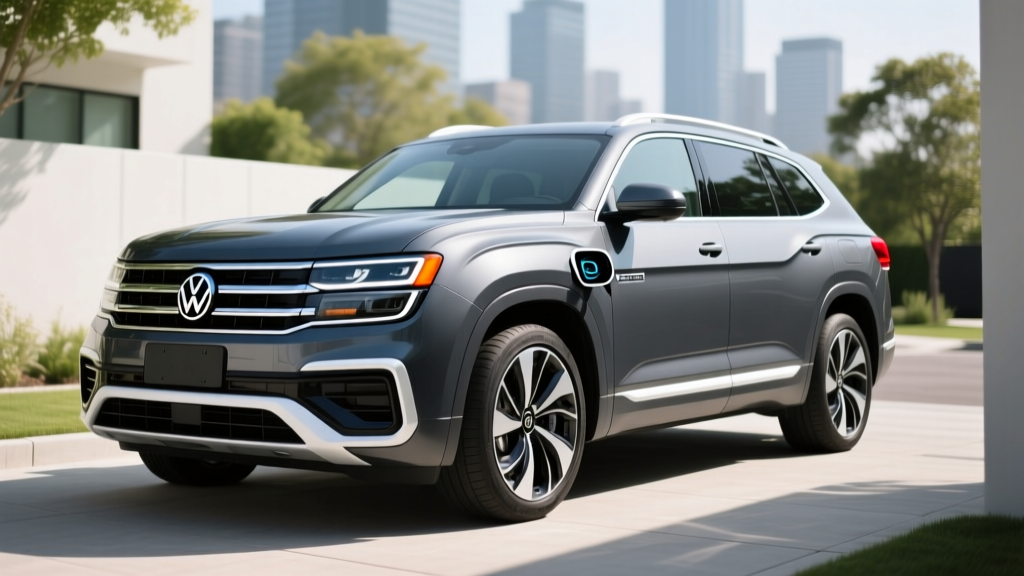
The Volkswagen Atlas has been one of the best-selling three-row SUVs in the U.S. since its debut, but until now it has been offered exclusively with gasoline powertrains. That changes with the 2027 VW Atlas Hybrid, which Volkswagen has confirmed will arrive as a plug-in hybrid electric vehicle (PHEV). For families who want electric-only commuting during the week and gas-engine flexibility for road trips, the Atlas PHEV represents a significant shift in VW's largest SUV lineup.
Because the 2027 Atlas Hybrid has not yet gone on sale as of mid-2026, the specifications below are based on Volkswagen's preliminary announcements, the powertrain architecture shared with the European-market VW Multivan PHEV and the upcoming VW ID. GTX platform, and informed projections. We will update this guide with EPA-certified figures once they are published on fueleconomy.gov.
HEV vs PHEV: Understanding the 2027 Atlas Hybrid Architecture
Before examining specs, it is critical to understand what the 2027 Atlas Hybrid actually is — because "hybrid" covers two very different vehicle types.
Conventional Hybrid (HEV)
A standard hybrid like the Toyota Highlander Hybrid uses a small battery (typically 1-2 kWh) that recharges through regenerative braking and the gas engine. You never plug it in. The electric motor assists the engine to improve MPG, but there is no meaningful electric-only driving range.
Example: Toyota Highlander Hybrid — 35 MPG combined, 0 miles electric-only.
Plug-In Hybrid (PHEV)
A plug-in hybrid like the upcoming Atlas PHEV carries a much larger battery (estimated 15-20 kWh usable) that you plug in to recharge. It delivers 30-40+ miles of electric-only driving before the gas engine activates. Once the battery depletes, it operates like a conventional hybrid.
2027 Atlas Hybrid: ~35* miles electric-only, then ~28* MPG combined on gas.
The 2027 VW Atlas Hybrid is a PHEV, not a conventional HEV. This means you will benefit from daily electric commuting if you charge at home, but the vehicle also carries a gasoline engine for longer trips with no range anxiety.
Estimated Powertrain, Battery, and Performance Specs
Volkswagen has confirmed that the Atlas PHEV will use a variant of the turbocharged 2.0-liter four-cylinder engine paired with an electric motor integrated into the transmission housing. This architecture mirrors the setup in the European Multivan eHybrid and the redesigned Tiguan eHybrid, both of which share VW's MQB Evo platform components.
| Specification | Estimated / Confirmed Value |
|---|---|
| Powertrain Type | Plug-In Hybrid (PHEV) |
| Gas Engine | 2.0L Turbocharged I-4 |
| Electric Motor | Integrated transmission-mounted motor |
| Combined Horsepower | ~270-295 hp* |
| Combined Torque | ~295-330 lb-ft* |
| Battery Capacity (usable) | ~15-19 kWh* (NMC lithium-ion) |
| Electric-Only Range | ~30-40 miles* (EPA est.) |
| Total Combined Range | ~450-500 miles* (electric + gas) |
| MPG (charge-sustaining) | ~26-29 MPG combined* |
| MPGe (electric + gas) | ~75-85 MPGe* |
| Level 2 Charging (240V) | ~3.6-7.2 kW onboard charger* |
| Level 2 Charge Time (0-100%) | ~2.5-5 hours* |
| DC Fast Charging | Not expected (most PHEVs lack DCFC) |
| Drivetrain | FWD standard, 4MOTION AWD available* |
| Seating | 7 passengers (3 rows) |
| Towing Capacity | ~3,500-5,000 lbs* |
Battery Chemistry and Capacity
VW's current PHEV lineup uses NMC (nickel manganese cobalt) lithium-ion cells, which offer higher energy density than LFP chemistry — important for fitting meaningful range into the Atlas's under-floor packaging. The usable capacity is expected to fall between 15 and 19 kWh, with a gross capacity slightly higher to account for the buffer that protects long-term battery health. PHEV batteries are smaller than full BEV packs (which run 60-100+ kWh), so degradation concerns are proportionally similar but the absolute replacement cost is lower.
Charging: What to Expect
Like nearly all PHEVs on the market, the 2027 Atlas Hybrid is expected to charge exclusively via AC power — either a standard 120V household outlet (Level 1) or a 240V Level 2 home or public charger. DC fast charging is unlikely to be offered, which is standard practice for PHEVs. The battery is simply too small to justify the cost and weight of DCFC hardware.
| Charging Level | Power | Time to Full Charge (est.) | Practical Use |
|---|---|---|---|
| Level 1 (120V) | ~1.4 kW | 10-14 hours | Overnight top-up, light commuters |
| Level 2 (240V, 16A) | ~3.6 kW | 4-5 hours | Home wallbox, workplace charging |
| Level 2 (240V, 32A) | ~7.2 kW | 2.5-3 hours | Faster home/public AC charging |
For most PHEV owners, Level 2 home charging is the sweet spot. A full charge overnight gives you 30-40 miles of electric range for the next day's commute — enough to cover the average American's daily driving of roughly 37 miles according to the Federal Highway Administration.
Fuel Economy: EPA Estimates vs Real-World MPG
PHEV fuel economy is uniquely dependent on how you use the vehicle. The EPA rates PHEVs in two ways: MPGe (miles per gallon equivalent, combining electric and gas operation when the battery is charged) and charge-sustaining MPG (gas-only operation after the battery is depleted).
| Mode | City | Highway | Combined |
|---|---|---|---|
| MPGe (charged battery)* | ~85 | ~75 | ~80 |
| Gas-only MPG (depleted)* | ~27 | ~28 | ~27 |
| Gas Atlas (2026 baseline) | 20 | 27 | 23 |
Pricing, Trims, and Federal Tax Credit Eligibility
Volkswagen has not published official MSRP figures for the 2027 Atlas Hybrid, but based on the current gas-powered Atlas pricing and the typical PHEV premium across the industry ($4,000-$7,000 above a comparable gas model), we can project the following:
- Atlas Hybrid SE (base): ~$47,000-$50,000* MSRP
- Atlas Hybrid SEL: ~$52,000-$55,000* MSRP
- Atlas Hybrid SEL Premium: ~$57,000-$60,000* MSRP
Federal Tax Credit Under IRS §30D
PHEVs with sufficient battery capacity are eligible for the same federal tax credit as full battery-electric vehicles under IRS §30D. The 2027 Atlas Hybrid is expected to qualify for a partial or full credit, but eligibility depends on several factors that change frequently:
§30D Tax Credit Eligibility Checklist
- Credit amount: Up to $7,500, split into $3,750 for battery components (North American manufacturing) and $3,750 for critical minerals sourcing
- MSRP cap: SUVs must be priced at or below $80,000 — the Atlas PHEV should clear this easily
- Buyer income cap: AGI must not exceed $150,000 (single), $225,000 (head of household), or $300,000 (joint)
- Battery sourcing: Battery components and critical minerals must meet phased-in North American/free-trade-partner requirements — this is where many PHEVs lose partial credit
- Point-of-sale transfer: As of 2024+, the credit can be transferred to the dealer as a down-payment reduction at purchase, rather than claimed on your tax return
- Final assembly: Must be assembled in North America — VW's Chattanooga, TN plant is a likely production site
Source: IRS.gov — Credits for New Clean Vehicles. Eligibility rules are subject to change. Consult a tax professional before relying on credit assumptions.
Given VW's Chattanooga assembly and evolving battery supply chains, a $3,750 partial credit is a reasonable baseline expectation, with the full $7,500 possible if VW meets all critical-mineral sourcing thresholds by the 2027 model year.
Hybrid vs PHEV vs Full EV: Which Three-Row SUV Fits You?
The Atlas PHEV enters a competitive landscape where buyers can choose gas, hybrid, plug-in hybrid, or fully electric three-row SUVs. Here is how to decide:
Choose Gas (Atlas 2.0T)
- Lowest upfront cost (~$39,000)
- No charging access at home
- Simple ownership, no new habits
- Accept 20-23 MPG combined
Choose PHEV (Atlas Hybrid)
- Home charging available (Level 2)
- Daily commute under 35 miles
- Want gas flexibility for road trips
- Want partial tax credit
Choose Full EV (e.g., Kia EV9)
- Home charging + reliable DCFC nearby
- Want zero tailpipe emissions
- Comfortable with 270-300 mi range
- Want full $7,500 credit (if eligible)
If you regularly drive more than 400 miles in a day, tow heavy loads, or live in an area with sparse charging infrastructure, the Atlas PHEV offers the best compromise. If your daily driving is under 30 miles and you have reliable home charging, a full EV like the Kia EV9 (300-mile EPA range, 210 kW DCFC) may save more over five years.
Battery Warranty, Reliability, and Replacement Cost
Hybrid and PHEV battery longevity remains one of the top concerns for buyers transitioning from gas vehicles. Here is what to expect:
🔋 Battery Warranty & Longevity
| Federal mandate (minimum) | 8 years / 100,000 miles (emissions-related components including hybrid battery) |
| VW expected coverage | 8 years / 100,000 miles (capacity retention above ~70%) |
| Expected battery lifespan | 150,000-200,000+ miles before significant degradation |
| Replacement cost (out of warranty) | $4,000-$8,000* (PHEV batteries are smaller and cheaper than BEV packs) |
PHEV batteries experience less stress than full EV batteries because they operate in a narrower state-of-charge window (typically 15%-85%), and the smaller capacity means each charge cycle represents fewer miles. Toyota's decades-long track record with hybrid batteries (many Prius packs lasting 200,000+ miles) provides a useful benchmark, though VW's PHEV architecture is newer and less proven in the U.S. market.
For reliability data on VW's PHEV systems specifically, IIHS and Consumer Reports track powertrain reliability over model years — we will update this section once the 2027 Atlas Hybrid accumulates real-world data.
Competitive Comparison: Atlas PHEV vs Rivals
The three-row PHEV segment is surprisingly thin in the U.S. market, which gives the Atlas Hybrid a near-unique position. Here is how it stacks up against the closest alternatives:
| Vehicle | Type | Elec. Range | Gas MPG | Est. Price |
|---|---|---|---|---|
| 2027 VW Atlas Hybrid | PHEV | ~35 mi* | ~27 | ~$47,000* |
| Toyota Grand Highlander Hybrid | HEV | 0 mi | 34 | $45,000 |
| Mazda CX-90 PHEV | PHEV | 26 mi | 25 | $51,000 |
| Kia EV9 (full EV) | BEV | 270-300 mi | N/A (3.0 kWh/mi) | $55,000 |
| Toyota Highlander Hybrid | HEV | 0 mi | 35 | $42,000 |
The Mazda CX-90 PHEV is the closest direct competitor, but its 26-mile electric range and smaller third row put it at a disadvantage for families. The Toyota Grand Highlander Hybrid delivers superior gas-only MPG (34 combined) but offers no electric-only mode. The Atlas PHEV aims to split the difference: adequate electric range for commuting, reasonable gas MPG, and VW's class-leading third-row space.
Who Should Buy the 2027 VW Atlas Hybrid?
✅ Ideal For
- Families needing 3 rows + electric commuting
- Homeowners who can install a Level 2 charger
- Daily commutes under 35 miles round-trip
- Buyers who road-trip regularly and don't want to plan DCFC stops
- Those who want a partial federal tax credit without full EV commitment
❌ Skip If
- You cannot charge at home or work (PHEV benefits disappear)
- Your daily drive exceeds 50 miles (you'll burn gas most days)
- You want zero tailpipe emissions (choose a full EV)
- You prioritize maximum MPG above all (HEV rivals like Grand Highlander Hybrid get 34+ MPG)
- You need heavy towing above 5,000 lbs
Frequently Asked Questions
How many MPG does the 2027 VW Atlas Hybrid get?
Estimated at approximately 80 MPGe when combining electric and gas operation with a charged battery, and around 27 MPG combined in charge-sustaining (gas-only) mode after the battery depletes. Final EPA figures will be published closer to launch. For comparison, the gas-only 2026 Atlas gets 23 MPG combined.
How far can the 2027 Atlas Hybrid go on electric only?
Volkswagen's preliminary estimates suggest 30-40 miles of electric-only range. This is enough to cover most daily commutes without using gasoline, provided you charge at home overnight. Real-world electric range will vary with temperature (expect 20-30% reduction in freezing weather), terrain, and driving style.
Does the 2027 Atlas Hybrid qualify for a federal tax credit?
It is expected to qualify for a partial or full §30D credit of $3,750-$7,500, depending on battery sourcing compliance at time of purchase. The MSRP cap for SUVs is $80,000 (easily met), and buyer income caps apply ($150K single / $300K joint). The credit can be applied as a point-of-sale reduction. Always verify current eligibility on fueleconomy.gov and consult a tax professional.
Is the PHEV battery reliable and what does replacement cost?
PHEV batteries are covered by a federal mandate of at least 8 years / 100,000 miles, and VW is expected to match or exceed this. Based on industry data from Toyota, Hyundai, and BMW PHEVs, hybrid batteries typically last 150,000-200,000+ miles before significant degradation. Out-of-warranty replacement for a PHEV pack (15-19 kWh) is estimated at $4,000-$8,000 — substantially less than a full EV battery replacement ($10,000-$20,000+).
Can the 2027 Atlas Hybrid DC fast charge?
No. Like nearly all PHEVs, the Atlas Hybrid is expected to charge only via AC power (Level 1 at 120V or Level 2 at 240V). The battery is small enough that a full Level 2 charge takes 2.5-5 hours, which is practical for overnight home charging. DC fast charging is not included because the small battery does not justify the added cost and weight.
Should I buy the Atlas PHEV or a full electric SUV like the Kia EV9?
If you have reliable home charging, drive under 300 miles on most days, and want zero gas use, the Kia EV9 (300-mile range, DCFC capable) will save more on fuel and maintenance over five years. If you regularly take trips exceeding 300 miles, tow frequently, or live in an area with limited public charging, the Atlas PHEV gives you electric commuting with gas-engine freedom — no route planning required.
This article will be updated with final EPA-certified specifications, confirmed MSRP, and verified tax credit eligibility once the 2027 VW Atlas Hybrid goes on sale. All preliminary estimates are marked with an asterisk (*). Last updated: mid-2026.