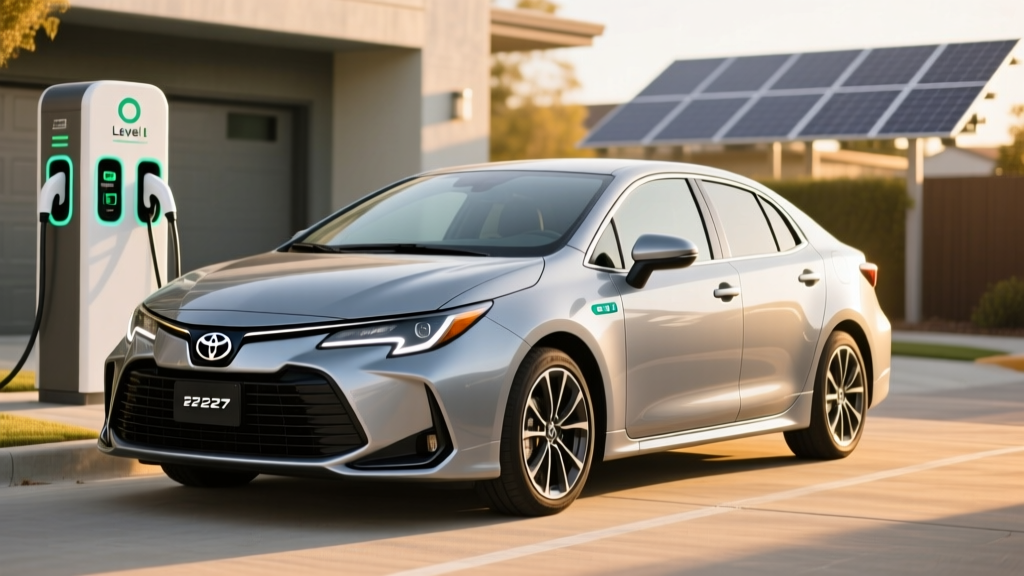
The Toyota Corolla Hybrid has been a benchmark for fuel-efficient commuting since its U.S. debut, and the 2027 Toyota Corolla Hybrid continues that tradition with incremental powertrain refinements and updated tech. As a conventional hybrid (HEV) — not a plug-in — it requires no charging infrastructure, making it one of the most accessible electrified vehicles for apartment dwellers and drivers without home charging access.
This guide breaks down everything buyers need to know about the 2027 Corolla Hybrid: EPA fuel economy, real-world MPG expectations, powertrain details, battery longevity, pricing, and how it stacks up against plug-in hybrids and full battery-electric vehicles (BEVs).
2027 Toyota Corolla Hybrid: Fuel Economy and Efficiency
The 2027 Corolla Hybrid pairs a 1.8-liter four-cylinder Atkinson-cycle engine with Toyota's fifth-generation hybrid transaxle. The result is class-leading fuel economy that holds up across trim levels. Front-wheel-drive (FWD) models deliver the highest EPA figures, while the available electronic all-wheel drive (AWD-e) adds a rear motor for traction with a modest efficiency trade-off.
| Trim / Drivetrain | City MPG | Highway MPG | Combined MPG |
|---|---|---|---|
| LE (FWD) | 53 | 46 | 50 |
| SE (FWD) | 50 | 43 | 47 |
| XLE (FWD) | 50 | 43 | 47 |
| LE (AWD-e) | 51 | 44 | 48 |
| SE (AWD-e) | 49 | 41 | 45 |
Source: EPA / fueleconomy.gov
Toyota hybrids consistently outperform their EPA estimates in city driving thanks to aggressive regenerative braking and frequent engine-off operation at low speeds. In real-world city commuting, owners commonly report 52–56 MPG in the LE FWD trim. Highway driving tells a different story: sustained 75+ mph cruising yields closer to 40–43 MPG, as the gasoline engine bears more of the load. Cold-weather operation (below 35°F) reduces fuel economy by roughly 5–10% due to longer engine warm-up cycles and cabin heating demands. For mixed driving, expect 46–50 MPG in everyday conditions — closely matching or slightly exceeding the EPA combined figure.
Hybrid vs. Plug-In Hybrid: Understanding the Corolla's Powertrain
A common source of confusion among shoppers is the distinction between a conventional hybrid (HEV) and a plug-in hybrid (PHEV). The 2027 Corolla Hybrid is an HEV. Here's what that means in practical terms:
| Feature | HEV (Corolla Hybrid) | PHEV (e.g., Prius Prime) | BEV (e.g., bZ4X) |
|---|---|---|---|
| Plug-in charging required? | No — self-charging via regen + engine | Yes — Level 1/2 for best results | Yes — Level 2 or DC fast charge |
| Electric-only range | ~1 mile at low speed | 35–44 miles (typical) | 220–300+ miles |
| Gasoline engine? | Yes — primary power + battery charging | Yes — kicks in after battery depletes | No |
| Battery size | ~1.3 kWh (small buffer) | ~13.6 kWh usable | 60–80+ kWh |
| Federal tax credit (§30D)? | No | Up to $7,500 (if eligible) | Up to $7,500 (if eligible) |
| Home charger needed? | No | Recommended | Essential |
The Corolla Hybrid's small nickel-metal-hydride (NiMH) battery pack — approximately 1.3 kWh — charges exclusively through regenerative braking and the gasoline engine. You never plug it in. The electric motor assists the engine during acceleration and can propel the car solo at very low speeds for brief distances, but this is not "electric-only range" in the PHEV sense.
If you need meaningful electric-only driving — for short commutes or HOV-lane access — Toyota's Prius Prime (a PHEV with ~44 miles of electric-only range per the EPA) is the better fit. The Corolla Hybrid is optimized for maximum fuel economy without lifestyle changes.
Powertrain Specs and Performance
| Specification | Detail |
|---|---|
| Engine | 1.8L 4-cylinder Atkinson-cycle |
| Engine horsepower | 96 hp @ 5,200 rpm |
| Front electric motor | 94 hp / 120 lb-ft torque |
| Rear electric motor (AWD-e only) | 40 hp (on-demand) |
| Net combined system output | 138 hp |
| Transmission | Continuously Variable (eCVT — planetary gearset) |
| 0–60 mph (est.) | ~9.0 seconds (FWD) |
| Drivetrain | FWD standard; AWD-e available |
| Fuel tank capacity | 11.4 gallons |
| Total driving range (est.) | ~570 miles (LE FWD, combined) |
The 138 combined horsepower figure is modest by modern standards, but the electric motor's instant torque delivery makes the Corolla Hybrid feel responsive in stop-and-go traffic. The eCVT is a planetary gearset — not a belt-driven CVT — which means no rubber-band effect and excellent durability. Acceleration merges onto highways confidently, though passing at speed requires planning.
The AWD-e system adds a small rear-axle motor that engages automatically from 0–6 mph for launch traction and reactivates when front-wheel slip is detected. It adds roughly 100 lbs and costs 2–5 MPG depending on driving conditions, but is valuable for drivers in snowy climates.
Pricing, Trims, and Tax Credit Eligibility
| Trim | Drivetrain | MSRP (est.) |
|---|---|---|
| LE | FWD | $24,550 |
| LE | AWD-e | $25,950 |
| SE | FWD | $26,350 |
| SE | AWD-e | $27,750 |
| XLE | FWD | $28,900 |
Note: Pricing is based on projected 2027 model-year MSRP including destination charge. Final pricing confirmed at launch.
The 2027 Corolla Hybrid is a conventional hybrid (HEV), not a plug-in vehicle. Under IRS §30D rules, only plug-in electric vehicles (PHEVs and BEVs) with sufficient battery capacity qualify for the federal clean vehicle credit. The Corolla Hybrid does not qualify for the $7,500 federal tax credit or the point-of-sale transfer option. However, it may qualify for certain state-level incentives — for example, some states offer rebates or HOV-lane stickers for vehicles exceeding 45 MPG combined. Check your state's energy office or IRS §30D guidance for current eligibility rules.
For buyers specifically seeking a federal tax credit in a Toyota, the Prius Prime (PHEV) qualifies for up to $3,750 under current §30D rules, subject to MSRP caps (≤$55,000 for sedans), buyer income limits ($150K single / $300K joint), and battery-sourcing requirements that change annually. Always verify with a tax professional before relying on credit eligibility.
Battery Longevity, Warranty, and Replacement Cost
Battery reliability is the single most common concern among first-time hybrid buyers. Toyota's hybrid battery track record is among the best in the industry, with millions of units on the road well past the warranty period.
Toyota covers the 2027 Corolla Hybrid's battery pack under its Hybrid Battery Warranty: 10 years or 150,000 miles (whichever comes first), applicable to all 50 states. This covers battery capacity loss below a defined threshold and any manufacturing defects. California-emissions states (CARB states) may see extended coverage up to 10 years/150,000 miles as standard. The hybrid system components — inverter, transaxle, control module — are covered under the Hybrid System Warranty for 8 years or 100,000 miles.
| Item | Detail |
|---|---|
| Battery chemistry | Nickel-metal hydride (NiMH) |
| Battery capacity | ~1.3 kWh (gross) |
| Warranty | 10 years / 150,000 miles |
| Expected lifespan (real-world) | 15–20+ years / 200K+ miles typical |
| Replacement cost (out of warranty) | $2,000–$3,500 (OEM), $1,000–$2,000 (remanufactured) |
| Individual module replacement? | Yes — some shops replace failed modules for $300–$800 |
The NiMH chemistry used in the Corolla Hybrid is less energy-dense than the lithium-ion packs in PHEVs and BEVs, but it is exceptionally durable and tolerant of deep cycling. Unlike lithium-ion batteries, NiMH degrades very gradually and rarely fails catastrophically. Many Prius and Corolla Hybrid owners report original batteries lasting well beyond 200,000 miles with only minor capacity loss.
If replacement is eventually needed, Toyota dealers charge approximately $2,500–$3,500 for a new OEM pack installed. Independent hybrid specialists often offer remanufactured batteries for $1,000–$2,000. In some cases, individual battery modules can be replaced rather than the entire pack, reducing cost further.
Who Should Choose the 2027 Corolla Hybrid?
Choose the Corolla Hybrid If:
- You want maximum MPG without changing your refueling habits
- You live in an apartment or lack access to home/workplace charging
- Your daily commute is longer than 30 miles (where PHEV electric range runs out)
- You want a proven, low-risk powertrain with a 10-year battery warranty
- You prioritize low total cost of ownership over performance or tech features
- You drive 15,000+ miles/year and fuel savings compound quickly
Consider a PHEV or BEV Instead If:
- You have home Level 2 charging and a short commute (PHEV covers it on electricity)
- You want to minimize gasoline use or eliminate it entirely
- You qualify for the $7,500 federal tax credit (income + sourcing rules met)
- You want stronger acceleration (BEVs deliver instant full torque)
- You want HOV-lane access available to EVs/PHEVs in certain states
- You want one-pedal driving and regenerative braking feel of a BEV
At 15,000 miles per year and $3.40/gallon regular unleaded, the Corolla Hybrid LE (50 MPG combined) costs approximately $1,020 annually in fuel. A comparable non-hybrid Corolla (33 MPG combined) would cost roughly $1,545/year. That's a savings of about $525 per year, or $2,625 over five years — enough to offset the hybrid's modest price premium within the first few years of ownership.
Reliability and Safety Overview
Toyota's hybrid powertrain is one of the most thoroughly validated systems in the automotive industry. The eCVT planetary gearset has no belts, clutches, or friction bands to wear out. The regenerative braking system reduces wear on the conventional brake pads — many owners report original brake pads lasting 80,000–100,000 miles.
The 2027 Corolla Hybrid comes standard with Toyota Safety Sense 3.0, which includes:
- Pre-Collision System with Pedestrian Detection
- Full-Speed Range Dynamic Radar Cruise Control
- Lane Departure Alert with Steering Assist
- Lane Tracing Assist (centering)
- Automatic High Beams
- Road Sign Assist
This is an SAE Level 2 driver-assistance system — it requires continuous driver attention and hands-on-wheel engagement. It is not self-driving. For detailed safety ratings, consult the NHTSA and IIHS once crash-test results are published for the 2027 model year.
Frequently Asked Questions
How many MPG does the 2027 Toyota Corolla Hybrid get?
The EPA rates the Corolla Hybrid LE FWD at 53 city / 46 highway / 50 combined MPG. The SE and XLE trims drop to approximately 50/43/47 MPG due to larger wheels and added weight. AWD-e models lose 2–5 MPG. In real-world city driving, many owners exceed the EPA city figure by 2–6 MPG thanks to regenerative braking. Highway driving at sustained speeds typically returns 2–5 MPG below the EPA highway estimate.
Does the Corolla Hybrid need to be plugged in?
No. The Corolla Hybrid is a conventional hybrid (HEV). Its small battery charges through regenerative braking and the gasoline engine. You fuel it like any other car at a gas station. There is no charging port, no plug, and no electric-only driving range to manage.
Is the 2027 Corolla Hybrid reliable?
Toyota's hybrid system has been in production since 1997 (Prius) and is considered one of the most reliable powertrains available. The NiMH battery, eCVT transaxle, and hybrid control electronics have an exceptionally low failure rate. The 10-year/150,000-mile hybrid battery warranty provides additional peace of mind. Consumer Reports historically rates the Corolla Hybrid among the most reliable compact cars.
What does a hybrid battery replacement cost?
Out of warranty, a new OEM hybrid battery from Toyota costs approximately $2,500–$3,500 installed. Remanufactured batteries from independent shops run $1,000–$2,000. However, battery failure before 200,000 miles is uncommon. Individual module replacement is also an option at some specialist shops for $300–$800 if only a portion of the pack has degraded.
Does the Corolla Hybrid qualify for a tax credit?
No. The federal §30D clean vehicle credit applies only to plug-in vehicles (PHEVs and BEVs). The Corolla Hybrid, as a conventional HEV, is not eligible. Some states may offer incentives for high-MPG vehicles, and certain employers offer fuel-efficiency perks. Check your state's energy office for local programs.
Corolla Hybrid vs. Prius: which is better?
The Prius offers slightly higher combined MPG (up to 57 MPG in LE FWD trim), a more aerodynamic design, and available PHEV (Prius Prime) for plug-in capability. The Corolla Hybrid offers a lower starting price, a traditional sedan profile some buyers prefer, and AWD-e availability. If maximum efficiency is the priority, the Prius wins. If budget and conventional styling matter more, the Corolla Hybrid is the pick.
How does the Corolla Hybrid compare to a full EV?
A BEV like the Tesla Model 3 or Hyundai Ioniq 6 eliminates fuel costs entirely (charging at home for ~$0.04/mile vs. ~$0.07/mile on gas in the Corolla Hybrid), delivers stronger acceleration, and may qualify for the $7,500 federal tax credit. However, BEVs require reliable home or workplace charging, cost more upfront, and involve route planning for road trips. The Corolla Hybrid is the pragmatic choice for drivers who want electrified efficiency without infrastructure dependency.