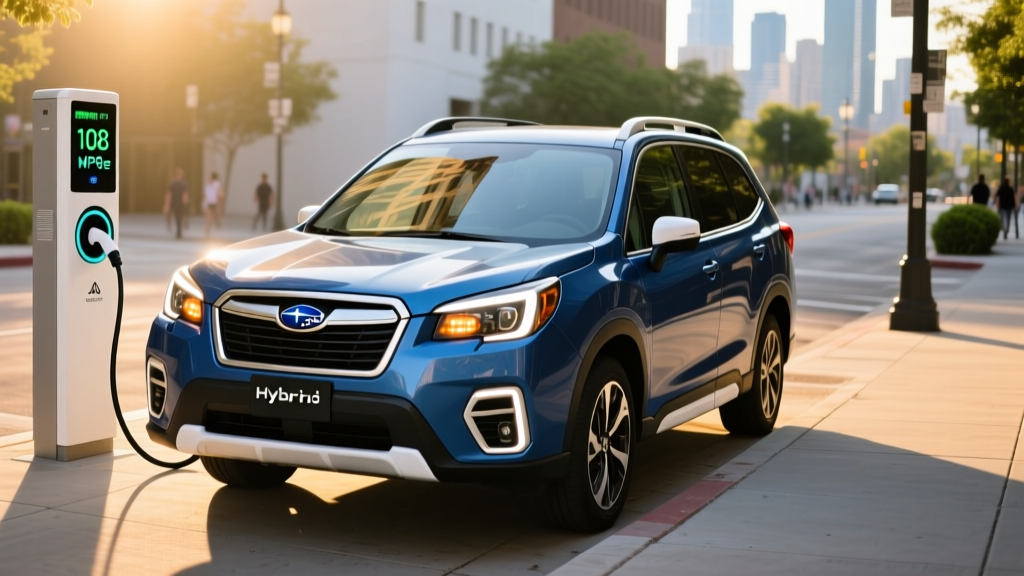
The compact SUV segment is crowded, but the 2027 Subaru Forester Hybrid occupies a specific niche that few rivals can match: standard all-wheel drive paired with a proven hybrid powertrain in a practical, visibility-forward package. For the 2027 model year, Subaru continues the sixth-generation Forester with its hybrid variant, combining a 2.5-liter flat-four engine with an electric motor integrated into the Lineartronic CVT. The result is a compact crossover that sips fuel without sacrificing the go-anywhere capability that defines the nameplate.
This guide breaks down every spec that matters — EPA fuel economy, real-world MPG expectations, powertrain output, battery warranty, pricing across trims, and tax credit eligibility — so you can decide whether the 2027 Forester Hybrid fits your driveway or whether a PHEV or full EV makes more sense.
2027 Subaru Forester Hybrid at a Glance
| Spec | Value |
|---|---|
| Powertrain | 2.5L flat-4 + electric motor (HEV) |
| Combined Horsepower | 194 hp |
| Drivetrain | Symmetrical AWD (standard) |
| Transmission | Lineartronic CVT |
| EPA MPG (City / Hwy / Combined) | 35 / 33 / 34 |
| Battery Type | Lithium-ion (self-charging, no plug) |
| Hybrid Battery Warranty | 8 years / 100,000 miles |
| 0–60 mph | ~7.6 seconds (est.) |
| Cargo Volume (behind 2nd row) | 26.9 cu ft |
| Starting MSRP (Base Hybrid) | $33,995 |
Fuel Economy: EPA Ratings and Real-World MPG
The EPA rates the 2027 Subaru Forester Hybrid at 35 mpg city, 33 mpg highway, and 34 mpg combined. That city-biased split is characteristic of conventional hybrids (HEVs), where regenerative braking and electric-motor assist shine in stop-and-go driving. On the highway, the gasoline engine carries more of the load, which narrows the efficiency gap between the hybrid and the standard gas-only Forester (rated at 26/33/29 mpg for 2027).
| Driving Scenario | EPA Rating | Real-World Expectation |
|---|---|---|
| City | 35 mpg | 34–37 mpg (hybrids often exceed EPA in urban driving) |
| Highway | 33 mpg | 30–33 mpg (sustained 75+ mph reduces regen benefit) |
| Combined | 34 mpg | 32–35 mpg |
| Cold Weather (below 30°F) | N/A | 28–31 mpg (engine runs more for cabin heat and warm-up) |
In real-world mixed driving, owners of the current-generation Forester Hybrid consistently report averaging 32–35 mpg, with some achieving 37+ mpg in warm-weather city commutes. Cold weather, aggressive acceleration, and sustained high-speed highway runs will pull figures toward the low 30s or high 20s. According to fueleconomy.gov, the Forester Hybrid's combined rating places it among the most efficient AWD compact crossovers on the market.
Hybrid (HEV) vs. Plug-In Hybrid (PHEV): What the Forester Is
A common point of confusion: the 2027 Forester Hybrid is a conventional hybrid (HEV), not a plug-in hybrid (PHEV). You cannot plug it in, it has no meaningful electric-only range, and it does not qualify for the federal §30D new clean vehicle tax credit. Understanding this distinction is critical before you shop.
| Feature | HEV (Forester Hybrid) | PHEV (e.g., Toyota RAV4 Prime) | BEV (e.g., Hyundai Ioniq 5) |
|---|---|---|---|
| Plug-in Charging | No — self-charging via regen and engine | Yes — Level 1/Level 2 | Yes — Level 1/2/DC fast |
| Electric-Only Range | ~0.5–1 mile at low speed | 35–42 miles (typical) | 250–310+ miles |
| Home Charging Needed | No | Recommended for full benefit | Essential |
| Federal Tax Credit (§30D) | Not eligible | Up to $7,500 (if eligible) | Up to $7,500 (if eligible) |
| Combined MPG / MPGe | 34 mpg | 38 mpg + 94 MPGe | 114–132 MPGe |
| Upfront Cost | Lower | Higher | Higher |
| Maintenance | Standard (oil, filters) | Standard + EV system | Minimal (no oil, fewer fluids) |
The Forester Hybrid is designed for buyers who want better fuel economy without changing their fueling habits. You fill up at a gas station, the hybrid system handles the rest. If you have home charging access and a short commute, a PHEV like the RAV4 Prime or a BEV might save more on fuel — but at a higher purchase price and with lifestyle adjustments.
Powertrain and Performance
The 2027 Forester Hybrid pairs Subaru's 2.5-liter FB25 horizontally opposed ("boxer") four-cylinder engine with an electric motor sandwiched between the engine and the Lineartronic continuously variable transmission (CVT). Combined output is 194 horsepower, a meaningful bump over the standard gas-only Forester's 180 hp.
The electric motor provides instant torque fill at low RPMs, making the Forester Hybrid feel notably quicker off the line than its non-hybrid sibling, particularly in city driving. Subaru's Symmetrical All-Wheel Drive is standard across all trims, using an active torque-split system that can redirect power front-to-rear as traction demands.
Acceleration to 60 mph takes approximately 7.6 seconds — adequate for merging and passing, though not sporty. The CVT tuning prioritizes smoothness over simulated gear steps, which some drivers find monotonous under hard acceleration. Subaru's X-MODE with Hill Descent Control carries over, giving the hybrid genuine light-off-road capability that most competing crossovers lack.
Hybrid Battery: Warranty, Lifespan, and Replacement Cost
The lithium-ion battery pack in the Forester Hybrid is relatively small (approximately 1.1 kWh usable capacity) compared to a PHEV or BEV. This smaller size means fewer full charge-discharge cycles and generally slower degradation. Based on long-term data from Toyota and Subaru hybrid platforms, most conventional hybrid batteries last 150,000–200,000+ miles before meaningful capacity loss, and many outlast the vehicles they're installed in.
If replacement is needed out of warranty, expect to pay between $2,000 and $4,000 for a refurbished or new hybrid battery pack, plus labor. This is significantly less than a BEV battery replacement ($10,000–$20,000+), because the HEV pack is far smaller. Third-party hybrid battery refurbishers and remanufactured units are increasingly available, further reducing out-of-pocket costs.
Pricing, Trims, and Tax Credit Eligibility
The 2027 Subaru Forester Hybrid is offered in several trims, all with AWD included:
- Hybrid (base): $33,995 MSRP
- Hybrid Premium: $36,495 MSRP
- Hybrid Sport: $38,295 MSRP
- Hybrid Limited: $40,995 MSRP
- Hybrid Touring: $43,495 MSRP
All prices include destination. The hybrid commands a roughly $2,500–$3,000 premium over the equivalent gas-only Forester trim. At 34 mpg combined versus 29 mpg for the gas model, the hybrid saves approximately $150–$200 per year in fuel at 15,000 miles driven annually (based on $3.50/gallon regular), meaning the premium pays back in roughly 13–20 years at current fuel prices. However, many buyers value the smoother low-speed acceleration, reduced emissions, and standard hybrid content that comes with the upgrade.
Does the 2027 Forester Hybrid Qualify for a Federal Tax Credit?
No. The Forester Hybrid is a conventional HEV, not a plug-in vehicle. The federal §30D New Clean Vehicle Credit applies only to battery electric vehicles (BEVs) and plug-in hybrids (PHEVs) that meet battery capacity, critical-mineral sourcing, and MSRP/income thresholds, as outlined by the IRS. Conventional hybrids do not qualify for §30D or the previously available Alternative Motor Vehicle Credit (which expired for most manufacturers years ago).
Some states and utilities offer rebates or incentives for hybrid purchases, but these vary widely by jurisdiction. Check your state's energy office or local utility for current programs. A tax professional can confirm whether any local credits apply to your situation.
Who Should Choose the Forester Hybrid vs. a PHEV or Full EV?
Choose the 2027 Forester Hybrid (HEV) if:
- You don't have access to home or workplace Level 2 charging
- You want AWD capability for snow, rain, or light trails without a fuel-economy penalty
- You prefer the lowest upfront cost and don't want to think about charging
- You regularly take long road trips where EV charging infrastructure is sparse
- You value Subaru's visibility, safety tech (EyeSight is standard), and resale reputation
Consider a PHEV (e.g., Toyota RAV4 Prime) if:
- You have Level 2 home charging and a commute under 40 miles
- You want electric-only daily driving with gas-engine range for weekends
- You may qualify for the $7,500 federal tax credit, offsetting the higher price
Consider a full EV (e.g., Hyundai Ioniq 5, Tesla Model Y) if:
- You have reliable home charging and want the lowest per-mile fuel cost
- You want to eliminate oil changes and reduce maintenance
- You qualify for federal/state EV incentives and want maximum emissions reduction
Pros and Cons
Pros
- Standard AWD with no fuel-economy compromise
- 34 mpg combined is competitive for an AWD crossover
- Excellent outward visibility and practical cargo space
- EyeSight driver-assist suite standard on all trims
- Genuine light-off-road capability (X-MODE, 8.7" ground clearance)
- Lower upfront cost than PHEV/EV rivals
- Strong Subaru resale value
Cons
- No federal tax credit eligibility (HEV, not PHEV/BEV)
- Hybrid premium pays back slowly at current fuel prices
- CVT can drone under hard acceleration
- No DC fast charging or meaningful electric-only range
- Infotainment system lags behind rivals in responsiveness
- Less cargo room than RAV4 Hybrid or CR-V Hybrid
Frequently Asked Questions
How many MPG does the 2027 Subaru Forester Hybrid get?
The EPA rates it at 35 mpg city, 33 mpg highway, and 34 mpg combined. In real-world driving, expect 32–35 mpg combined, with city driving often yielding 36+ mpg thanks to regenerative braking. Cold weather and sustained highway speeds above 75 mph will reduce figures by 3–5 mpg.
Can I plug in the Forester Hybrid to charge it?
No. The 2027 Forester Hybrid is a conventional hybrid (HEV). It charges its small lithium-ion battery through regenerative braking and the gasoline engine. There is no plug, no charging port, and no electric-only driving range beyond brief low-speed assist.
How far can the Forester Hybrid go on electric only?
Effectively zero miles in any practical sense. The electric motor assists the engine at low speeds and during acceleration, but it cannot propel the vehicle on electric power alone for more than a fraction of a mile at very low speeds. If electric-only commuting is a priority, look at a PHEV like the Toyota RAV4 Prime (42 miles electric) or a full EV.
Is the Forester Hybrid reliable, and what does a battery replacement cost?
Subaru's hybrid system is based on proven technology shared with Toyota (Subaru's partner in hybrid development). Hybrid batteries in these platforms typically last 150,000–200,000+ miles. The battery is warranted for 8 years/100,000 miles (10 years/150,000 miles in CARB states). Out-of-warranty replacement runs $2,000–$4,000 for the battery pack — far less than a BEV battery. Subaru's overall reliability ratings are strong, with the Forester consistently earning above-average marks from IIHS for safety.
Does the 2027 Forester Hybrid qualify for any tax credit?
Not at the federal level. The IRS §30D credit applies only to plug-in vehicles (PHEVs and BEVs). As a conventional hybrid, the Forester Hybrid does not qualify. Some state or utility incentives may apply to hybrids — check your local programs. Always consult a tax professional for eligibility guidance.
How does the Forester Hybrid compare to the Toyota RAV4 Hybrid?
The RAV4 Hybrid is rated at 39 mpg combined (vs. 34 mpg for the Forester Hybrid) and offers more cargo space (37.6 vs. 26.9 cu ft). However, the Forester Hybrid provides better outward visibility, standard X-MODE for off-pavement use, and Subaru's reputation in cold-weather and mountain driving. If maximum efficiency and cargo space are your priorities, the RAV4 Hybrid wins. If AWD capability, visibility, and Subaru's safety suite matter more, the Forester Hybrid holds its own.
Is the Forester Hybrid worth the premium over the gas-only Forester?
At roughly $2,500–$3,000 more than the gas model, the hybrid's fuel savings alone won't pay back the premium quickly — roughly 13–20 years at 15,000 miles/year. However, the hybrid delivers smoother low-speed acceleration, reduced emissions, and often holds resale value better. If you plan to keep the vehicle 8+ years or drive in heavy city traffic, the hybrid's drivability benefits make the premium more justifiable.