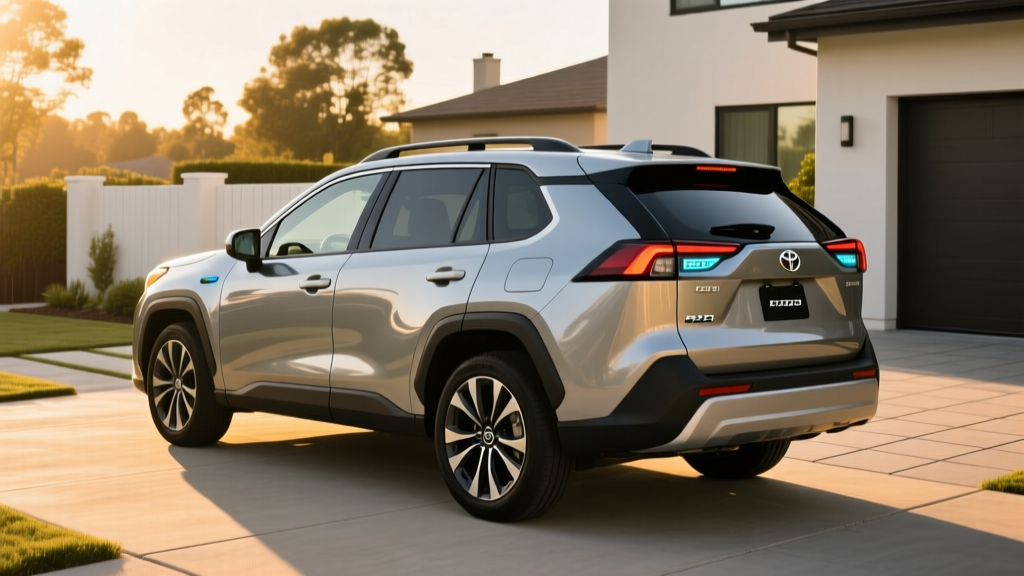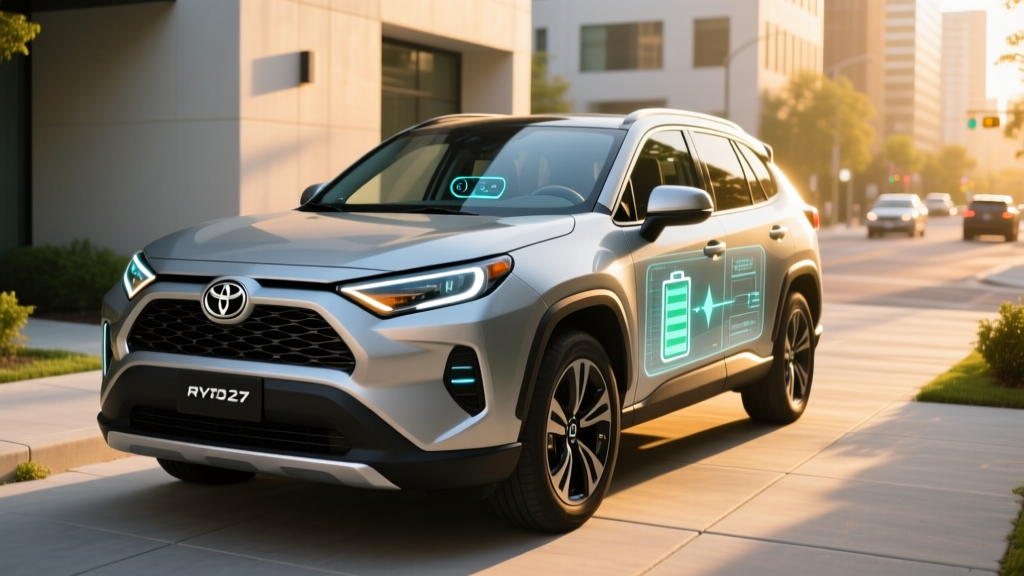
The Toyota RAV4 Hybrid has been America's best-selling hybrid SUV for years, and the redesigned 2027 model arrives with Toyota's fifth-generation hybrid system, updated tech, and the promise of even greater efficiency. If you're researching the 2027 RAV4 Hybrid to decide whether it fits your commute, budget, and lifestyle, this guide breaks down every number that matters — from EPA MPG and powertrain output to battery longevity and tax-credit eligibility.
Because Toyota also sells a plug-in hybrid version (the RAV4 Prime), we'll clarify exactly where the conventional hybrid ends and the PHEV begins, so you can choose the right electrified RAV4 without confusion.
HEV vs PHEV: Which RAV4 Is Which?
2027 RAV4 Hybrid (HEV)
- No plug required. The battery recharges via the gasoline engine and regenerative braking.
- Smaller battery (~1.6 kWh usable) — designed for short electric assists, not standalone driving.
- Best for: Drivers who want maximum MPG with zero change to their fueling routine.
2027 RAV4 Prime (PHEV)
- Plugs in. Features a larger 18.1 kWh battery pack and can drive on electricity alone.
- ~42 miles of electric-only range before the gas engine engages.
- Best for: Drivers with short commutes and access to home or workplace Level 2 charging.
The conventional RAV4 Hybrid never needs to be plugged in. You simply fill it with gasoline and drive. The hybrid system uses its electric motor to assist the engine during acceleration, capture energy during braking, and enable brief electric-only movement at low speeds. The RAV4 Prime, by contrast, operates as a short-range EV for daily errands, then seamlessly transitions into hybrid mode once the battery is depleted.
2027 RAV4 Hybrid: Powertrain and Performance Specs
| Specification | 2027 RAV4 Hybrid (AWD) |
|---|---|
| Engine | 2.5L inline-4 (Atkinson cycle) |
| Combined System Output | 219 hp |
| Electric Motors | Front motor + rear motor (eAWD) |
| Transmission | eCVT (planetary gearset) |
| Drivetrain | Electronic AWD (standard on all trims) |
| 0–60 mph | ~7.4 seconds |
| Towing Capacity | 1,750 lbs |
| Hybrid Battery | ~1.6 kWh (lithium-ion) |
Toyota's fifth-generation hybrid system pairs a 2.5-liter Atkinson-cycle four-cylinder engine with two electric motors — one driving the front axle and a dedicated rear motor providing electronic all-wheel drive. Unlike mechanical AWD systems that use a driveshaft, the rear motor engages only when traction demands it, minimizing efficiency losses. The combined 219 horsepower delivers confident highway merging and adequate passing power, though this is an efficiency-first SUV, not a performance vehicle.
Fuel Economy: EPA Ratings and Real-World MPG
| Trim / Configuration | City | Highway | Combined |
|---|---|---|---|
| LE / XLE (AWD) | 41 mpg | 38 mpg | 39 mpg |
| Woodland Edition (AWD) | 38 mpg | 35 mpg | 37 mpg |
| Limited / XSE (AWD, larger wheels) | 39 mpg | 37 mpg | 38 mpg |
These figures come from EPA fueleconomy.gov estimates. In real-world driving, hybrid SUVs often exceed their EPA city rating because stop-and-go traffic maximizes regenerative braking and electric-motor assist. On a mixed suburban commute with frequent stops, expect 40–44 mpg from the LE/XLE trims. Highway-only driving at 75+ mph will typically yield 34–37 mpg, as aerodynamic drag and sustained engine load reduce the hybrid system's advantage.
RAV4 Hybrid vs RAV4 Prime: Efficiency and Cost Compared
| Attribute | RAV4 Hybrid (HEV) | RAV4 Prime (PHEV) |
|---|---|---|
| EPA Combined MPG | 39 mpg | 38 mpg (hybrid mode) / 94 MPGe (EV mode) |
| Electric-Only Range | N/A (assist only) | ~42 miles |
| Total Range | ~560 miles | ~600 miles (EV + gas) |
| Battery Capacity | ~1.6 kWh | 18.1 kWh |
| Charging Required? | No | Yes (for EV range benefit) |
| Level 2 Charge Time (0–100%) | N/A | ~2.5 hours (6.6 kW onboard charger) |
| DC Fast Charging | N/A | Not available |
| Combined Horsepower | 219 hp | 302 hp |
| 0–60 mph | ~7.4 sec | ~5.7 sec |
| Starting MSRP (est.) | ~$33,500 | ~$44,500 |
The RAV4 Prime's 302 hp and 42-mile electric range are compelling, but the ~$11,000 price premium only pays off if you can charge regularly. If your daily round-trip commute is under 40 miles and you have reliable home charging, the Prime effectively becomes an EV for weekday driving with a gas-powered road-trip safety net. If you can't charge at home or your commute exceeds 40 miles, the conventional RAV4 Hybrid delivers outstanding efficiency with zero lifestyle change.
Battery Longevity, Warranty, and Replacement Cost
Toyota's hybrid battery track record is among the strongest in the industry. The RAV4 Hybrid uses a relatively small lithium-ion pack that operates within a conservative state-of-charge window — typically between 40% and 80% — which dramatically reduces degradation stress. Data from fleet operators and long-term owners shows Toyota hybrid batteries routinely lasting 150,000–200,000+ miles before meaningful capacity loss.
If replacement is eventually needed out of warranty, a new OEM hybrid battery for the RAV4 Hybrid currently costs approximately $3,000–$4,500 including labor. Refurbished and aftermarket options are available for $1,500–$2,500. This is far less expensive than the large traction batteries in full EVs or PHEVs, because the HEV battery is small (~1.6 kWh) and designed for assist duty, not standalone propulsion.
Pricing, Trims, and Tax Credit Eligibility
The 2027 RAV4 Hybrid is expected across five trims, with pricing starting around $33,500 for the LE and climbing to approximately $41,000 for the Limited. Toyota has not confirmed final MSRP figures as of publication; the estimates above reflect projected pricing based on the outgoing model year.
Federal tax credit: The conventional RAV4 Hybrid (HEV) does not qualify for the federal §30D clean vehicle credit. That credit, governed by IRS rules, applies only to plug-in electric vehicles (BEVs and PHEVs) that meet battery-sourcing, critical-mineral, MSRP, and buyer-income requirements. The RAV4 Prime (PHEV) may qualify for a partial or full credit of up to $7,500 depending on battery-component and critical-mineral sourcing compliance — but eligibility shifts as supply chains evolve, so verify current-year status with a tax professional before purchase.
- RAV4 Hybrid (HEV): No federal §30D credit. May qualify for certain state or utility efficiency rebates — check your local programs.
- RAV4 Prime (PHEV): Potentially eligible for up to $7,500 federal credit, subject to MSRP cap ($80,000 for SUVs), buyer income limits ($150K single / $300K joint), and battery sourcing requirements. Point-of-sale transfer available at participating dealers.
Who Should Buy the RAV4 Hybrid — and Who Should Look Elsewhere?
Choose the RAV4 Hybrid (HEV) if:
- You want 39+ mpg without changing your fueling habits
- You lack access to home or workplace EV charging
- Your budget is under $40,000 and you want AWD standard
- You drive 12,000–15,000 miles/year and want low operating costs
- You plan to keep the vehicle 8–10+ years (strong reliability record)
Choose the RAV4 Prime (PHEV) if:
- Your daily commute is under 42 miles round-trip
- You can install a Level 2 charger at home (240V)
- You want EV-like daily driving with gas flexibility for road trips
- You may qualify for the $7,500 federal tax credit, offsetting the price premium
Choose a full EV (e.g., Tesla Model Y, Hyundai Ioniq 5) if:
- You want zero tailpipe emissions and the lowest per-mile fuel cost
- You have reliable home charging and access to DC fast-charging networks
- You drive primarily in urban/suburban areas with good charging infrastructure
Pros and Cons at a Glance
Pros
- 39 mpg combined EPA — among the best for any AWD SUV
- Standard electronic AWD on every trim
- No plug-in charging required — zero lifestyle adjustment
- 10-year / 150,000-mile hybrid battery warranty
- Strong resale value and proven long-term reliability
- Competitive starting price for the segment
Cons
- No federal §30D tax credit for the HEV version
- 1,750-lb towing capacity limits utility for boat/trailer owners
- CVT-like driving feel may not satisfy enthusiast drivers
- Highway MPG drops noticeably above 75 mph
- Rear battery packaging slightly reduces cargo floor height vs. gas RAV4
Frequently Asked Questions
How many MPG does the 2027 RAV4 Hybrid get?
The EPA rates the RAV4 Hybrid LE and XLE at 41 city / 38 highway / 39 combined mpg. The Woodland Edition drops to 37 combined due to all-terrain tires and suspension tuning. In real-world city driving with frequent stops, many owners report 40–44 mpg thanks to aggressive regenerative braking.
Does the RAV4 Hybrid need to be plugged in?
No. The conventional RAV4 Hybrid is a self-charging HEV — it recovers energy through regenerative braking and the gasoline engine. You never plug it in. Only the RAV4 Prime (PHEV) requires plugging in to access its 42-mile electric-only range.
How far can the RAV4 Prime go on electric only?
The RAV4 Prime delivers approximately 42 miles of EPA-rated electric-only range. After that, it operates as a conventional hybrid at 38 mpg combined. Total combined range (EV + gas) exceeds 600 miles.
Is the RAV4 Hybrid reliable, and what does battery replacement cost?
Toyota's hybrid system has over two decades of proven reliability, and the hybrid battery is warranted for 10 years / 150,000 miles. Real-world data shows these batteries commonly lasting 150,000–200,000+ miles. If replacement is needed out of warranty, expect $3,000–$4,500 for a new OEM battery pack.
Does the 2027 RAV4 Hybrid qualify for any tax credit?
The conventional RAV4 Hybrid (HEV) does not qualify for the federal §30D clean vehicle credit, which applies only to plug-in vehicles. Some states and utilities offer separate rebates for efficient hybrids — check your local programs. The RAV4 Prime PHEV may qualify for up to $7,500 in federal credits, subject to income, MSRP, and battery-sourcing rules.
Hybrid vs PHEV vs EV — which RAV4 fits my lifestyle?
If you can't charge at home, choose the RAV4 Hybrid (HEV). If you can charge at home and commute under 42 miles, the RAV4 Prime (PHEV) gives you EV-like daily driving with gas backup. If you want the lowest operating cost, have reliable charging access, and don't need 600+ miles of range, consider a full EV like the Tesla Model Y or Hyundai Ioniq 5.
Note: 2027 RAV4 Hybrid specifications in this article are based on available preliminary data and projected figures. Final EPA ratings, MSRP, and feature availability will be confirmed by Toyota closer to the on-sale date. Always verify current specs at toyota.com and tax-credit eligibility at irs.gov.