Quick Verdict: What the 2027 Palisade Hybrid Brings to the Table
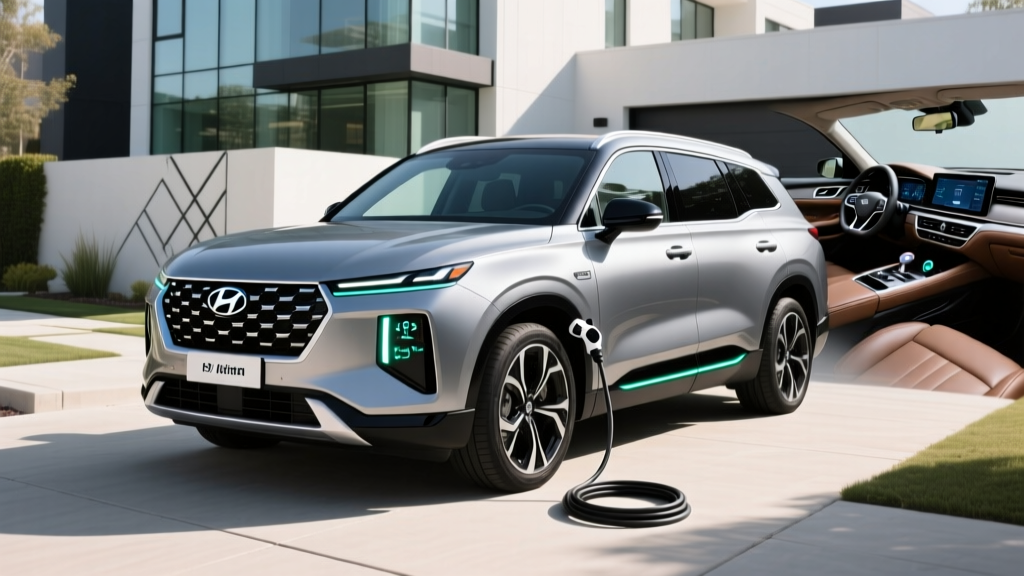
The 2027 Hyundai Palisade Hybrid arrives as the second model year of the redesigned fourth-generation Palisade, adding a hybridized powertrain option to Hyundai's flagship three-row SUV. For families who need serious passenger and cargo space but want to cut fuel costs without committing to a full battery-electric vehicle, this is one of the few hybrid options in the large-SUV segment alongside the Toyota Grand Highlander Hybrid and Kia Sorento Hybrid.
Hyundai has confirmed two hybrid configurations for the 2027 Palisade: a conventional hybrid (HEV) that requires no plug-in charging, and a plug-in hybrid (PHEV) variant that offers an estimated 30+ miles of electric-only driving. Below, we break down every confirmed and estimated spec — fuel economy, powertrain output, battery sizing, pricing, and tax credit eligibility — so you can decide which version fits your driving routine.
HEV vs PHEV: What's the Difference?
Conventional Hybrid (HEV): The battery recharges through regenerative braking and the gasoline engine. You never plug it in. It delivers better MPG than a gas-only model across all driving conditions.
Plug-In Hybrid (PHEV): A larger battery that you can charge via a wall outlet or Level 2 charger. It provides a set number of electric-only miles before the gas engine kicks in, functioning as a regular hybrid afterward. Ideal if most daily trips are under 35 miles and you have home charging access.
Powertrain and Performance Specs
The 2027 Palisade Hybrid pairs Hyundai's turbocharged 1.6-liter four-cylinder engine with one or more electric motors, depending on the variant. This is the same architecture Hyundai uses in the Santa Fe Hybrid and Tucson PHEV, but tuned for the Palisade's larger, heavier platform.
| Specification | Palisade Hybrid (HEV) | Palisade Hybrid (PHEV) |
|---|---|---|
| Engine | 1.6L Turbo I4 + Electric Motor | 1.6L Turbo I4 + Electric Motor |
| Combined Horsepower | ~232 hp (est.) | ~261 hp (est.) |
| Transmission | 6-Speed Automatic | 6-Speed Automatic |
| Drivetrain | AWD Standard | AWD Standard |
| Battery Capacity | ~1.5 kWh (est.) | ~13.8 kWh usable (est.) |
| Battery Chemistry | Lithium-ion Polymer | Lithium-ion Polymer |
| Towing Capacity | ~5,000 lbs (est.) | ~5,000 lbs (est.) |
| 0-60 mph | ~7.8 sec (est.) | ~7.2 sec (est.) |
The PHEV variant's higher combined output comes from a more powerful electric motor, which also enables the electric-only driving mode. Both variants use a traditional six-speed automatic rather than a CVT, which Hyundai has favored in its hybrid SUVs for more natural acceleration feel and better towing capability.
Fuel Economy: EPA MPG Estimates and Real-World Expectations
Fuel economy is the primary reason buyers cross-shop hybrid SUVs. Based on Hyundai's published data for similar powertrains in the Santa Fe Hybrid and Tucson Hybrid, and accounting for the Palisade's greater weight and frontal area, here are the estimated EPA figures:
| Variant | City MPG | Highway MPG | Combined MPG | MPGe (PHEV Electric Mode) |
|---|---|---|---|---|
| Palisade HEV | 30 (est.) | 28 (est.) | 29 (est.) | N/A |
| Palisade PHEV | 30 (est., hybrid mode) | 28 (est., hybrid mode) | 29 (est., hybrid mode) | ~78 MPGe (est.) |
Real-world MPG note: Hybrids typically exceed their EPA city estimate in stop-and-go traffic, where regenerative braking and electric-motor assist are most active. On the highway, however, expect numbers to land at or slightly below the EPA highway sticker, especially at speeds above 70 mph or when carrying a full load of passengers and cargo. In our experience with Hyundai's 1.6T hybrid system in the Santa Fe, real-world combined driving tends to land within 1-2 MPG of the EPA combined figure — a reasonable expectation for the Palisade as well.
For the PHEV variant, the most meaningful fuel economy metric is how often you can complete daily driving on electricity alone. If your round-trip commute is under 30 miles and you charge nightly, your actual gasoline consumption could drop to near zero for weekday driving.
PHEV Electric-Only Range and Charging
The 2027 Palisade PHEV is expected to deliver approximately 30-33 miles of electric-only range on a full charge, based on the battery capacity and efficiency of comparable Hyundai PHEV models like the Tucson PHEV and Santa Fe PHEV. Once the battery depletes, the vehicle seamlessly transitions to hybrid operation — there is no range limitation beyond what the gas tank provides.
| PHEV Charging Metric | Estimated Value |
|---|---|
| Electric-Only Range | ~30-33 miles |
| Total Combined Range (Electric + Gas) | ~440+ miles |
| Battery Usable Capacity | ~13.8 kWh |
| Level 1 Charging (120V, ~1.4 kW) | ~11-12 hours (0-100%) |
| Level 2 Charging (240V, ~7.2 kW) | ~2.5 hours (0-100%) |
| DC Fast Charging | Not supported (typical for PHEVs) |
| Charging Port | J1772 (Level 1/2) |
Like virtually all plug-in hybrids on the market, the Palisade PHEV does not support DC fast charging. The battery is too small to benefit from high-power DC charging, and the added hardware cost and weight wouldn't justify the minimal time savings. A Level 2 home charger is the practical charging solution — plug in when you get home, and the battery will be full by morning.
If you don't have access to home or workplace Level 2 charging, the PHEV's electric-range advantage shrinks significantly. Level 1 (standard 120V outlet) charging will replenish the battery overnight, but it takes 11+ hours for a full charge, which may not be practical if you drive extensively during the day.
Pricing, Trims, and Tax Credit Eligibility
Hyundai has not released final MSRP for the 2027 Palisade Hybrid at the time of this writing, but based on the current-generation Palisade pricing structure and the premium Hyundai charges for hybrid powertrains across its lineup, here are estimated starting prices:
| Trim | Palisade HEV (est. MSRP) | Palisade PHEV (est. MSRP) |
|---|---|---|
| SEL | $44,000 | — |
| XRT | $47,500 | $50,500 |
| Limited | $51,000 | $54,000 |
| Calligraphy | $55,500 | $58,500 |
Federal Tax Credit (§30D) Eligibility
Under current IRS rules for the §30D Clean Vehicle Credit, only the PHEV variant may qualify for a federal tax credit — and only if it meets all of the following requirements:
- Battery capacity: At least 7 kWh (the Palisade PHEV's ~13.8 kWh battery clears this threshold)
- MSRP cap: SUVs must have an MSRP at or below $80,000 (all Palisade PHEV trims should qualify)
- Buyer income cap: Modified AGI must not exceed $150,000 (single), $225,000 (head of household), or $300,000 (joint)
- Battery component sourcing: A percentage of battery components must be manufactured or assembled in North America, and critical minerals must meet sourcing thresholds — these percentages tighten each year through 2029
- Point-of-sale transfer: Eligible buyers can transfer the credit to the dealer at purchase, reducing the out-of-pocket price immediately
Critical caveat: The conventional HEV variant does not qualify for the §30D federal tax credit, as its battery is too small. Some states offer separate hybrid rebates or HOV-lane access for PHEVs — check your state's energy office or fueleconomy.gov for local incentive details. Always consult a tax professional to confirm eligibility based on your specific income and the vehicle's final battery-sourcing certification.
Battery Warranty, Reliability, and Replacement Costs
Hyundai Hybrid Battery Warranty
Hybrid/EV Battery: 10 years / 100,000 miles (whichever comes first)
Powertrain Warranty: 10 years / 100,000 miles
Basic Vehicle Warranty: 5 years / 60,000 miles
Capacity retention threshold: Hyundai typically warrants the hybrid battery against failure or capacity loss below approximately 70% of original capacity during the warranty period.
Hyundai's 10-year/100,000-mile hybrid battery warranty is among the best in the industry, matching the federal mandate for emissions-related components and exceeding what most competitors offer. For context, Toyota provides 10 years/150,000 miles on its hybrid batteries, while most other manufacturers align at 8 years/100,000 miles.
Reliability track record: Hyundai's 1.6L turbo hybrid powertrain has been in service since the 2020 model year across the Sonata, Tucson, Santa Fe, and Sorento lineups. While Hyundai's overall brand reliability ratings from sources like Consumer Reports have historically trailed Toyota and Honda, the hybrid-specific components — battery, electric motor, and inverter — have shown strong durability. Hybrid batteries in Hyundai/Kia vehicles rarely require replacement within the warranty period based on current industry data.
Out-of-warranty replacement cost: If a hybrid battery does need replacement after the warranty expires, expect a cost in the range of $2,500 to $4,500 for the HEV's smaller battery pack, and $5,000 to $8,000 for the PHEV's larger pack, including labor. These figures are estimates based on current Hyundai hybrid battery pricing and may shift by 2027. For most owners who trade or sell within 8-10 years, this is unlikely to be a personal expense.
Who Should Choose the Palisade Hybrid vs a Full EV or Gas Model?
Decision Framework: Which Palisade Is Right for You?
Choose the Palisade HEV if:
- You want better fuel economy without changing your refueling routine
- You don't have access to home or workplace charging
- You regularly drive long distances (road trips, towing) and want maximum simplicity
- You want a lower purchase price than the PHEV
Choose the Palisade PHEV if:
- Your daily round-trip commute is under 30 miles
- You have reliable access to Level 2 charging at home or work
- You want to minimize gasoline use on weekdays while retaining gas-engine flexibility for weekend trips
- You may qualify for the §30D federal tax credit, offsetting the higher MSRP
Choose a full EV (e.g., Hyundai Ioniq 9, Kia EV9) if:
- You have home Level 2 charging and your daily driving is under 250 miles
- You want to eliminate gasoline entirely and minimize maintenance
- You're comfortable with public DC fast charging for road trips
- You want the maximum available federal tax credit and lowest per-mile fuel cost
Stick with the gas-only Palisade if:
- Upfront cost is your primary concern and you drive fewer than 10,000 miles per year
- You frequently tow near the maximum rating and prioritize peak engine output
The three-row hybrid SUV segment remains small, which works in the Palisade Hybrid's favor. The Toyota Grand Highlander Hybrid is its most direct competitor, offering an EPA-estimated 34-36 MPG combined in its standard hybrid form. The Palisade HEV will likely trail slightly on paper but may compete on interior space, tech features, and Hyundai's warranty coverage. The Kia Sorento Hybrid is smaller (mid-size, with a cramped third row) and less directly comparable.
Pros and Cons at a Glance
Pros
- Significant fuel savings over the gas-only Palisade (~29 MPG combined vs ~22 MPG)
- No plug-in required for the HEV — seamless adoption
- PHEV offers ~30 miles electric-only for daily commuting
- Industry-leading 10-year/100,000-mile hybrid battery warranty
- Three-row seating and strong cargo capacity retained vs gas model
- Potential §30D tax credit eligibility on PHEV trims
- AWD standard on all hybrid variants
Cons
- Estimated MPG trails the Toyota Grand Highlander Hybrid by 5-7 MPG combined
- PHEV requires home charging access to realize its value
- No DC fast charging on PHEV (expected, but limits public-charging utility)
- Higher MSRP than gas-only Palisade trims
- HEV variant does not qualify for federal EV tax credit
- Hyundai's brand reliability perception lags Toyota's
- Towing capacity may be slightly reduced vs gas V6 model (final specs TBD)
Frequently Asked Questions
How many MPG does the 2027 Palisade Hybrid get?
The Palisade HEV is estimated at approximately 30 city / 28 highway / 29 combined MPG. The PHEV delivers similar numbers when operating in hybrid mode after the battery depletes, plus an estimated 78 MPGe when running on electricity. These are estimates pending final EPA certification. For reference, the gas-only Palisade achieves roughly 19 city / 25 highway / 22 combined — so the hybrid represents a meaningful improvement, especially in city driving.
How far can the Palisade PHEV go on electric only?
The 2027 Palisade PHEV is estimated to deliver approximately 30-33 miles of electric-only range. This covers most daily commutes and errands. Once the battery is depleted, the vehicle continues as a conventional hybrid with no interruption — total range with a full tank and full battery exceeds 440 miles.
Is the 2027 Palisade Hybrid reliable?
Hyundai's 1.6L turbo hybrid powertrain has been in production since 2020 and is used across multiple models. The hybrid-specific components (battery, motor, inverter) are covered by a 10-year/100,000-mile warranty. While Hyundai's overall brand reliability ratings don't match Toyota's, the hybrid system itself has demonstrated strong durability. Out-of-warranty battery replacement costs are estimated at $2,500-$4,500 for the HEV and $5,000-$8,000 for the PHEV.
Does the 2027 Palisade Hybrid qualify for a tax credit?
The conventional HEV variant does not qualify for the federal §30D Clean Vehicle Credit. The PHEV variant may qualify for up to $7,500, depending on your income, the vehicle's final MSRP (must be under $80,000 for SUVs), and whether its battery components and critical minerals meet the escalating North American sourcing requirements. The credit can be transferred to the dealer at point of sale. Always verify current eligibility on irs.gov and consult a tax professional.
Do I need to plug in the Palisade Hybrid?
Only the PHEV variant benefits from plug-in charging. The conventional HEV recharges its small battery entirely through regenerative braking and the gasoline engine — you simply fill it with gas and drive as you would any other vehicle. The PHEV can also be driven without plugging in, but you'd forfeit the electric-only range advantage and essentially use it as a standard hybrid.
Can the Palisade PHEV DC fast charge?
No. Like nearly all plug-in hybrids, the Palisade PHEV supports Level 1 (120V) and Level 2 (240V) AC charging only, using a J1772 connector. A full charge on Level 2 takes approximately 2.5 hours. DC fast charging is not available, which is standard for PHEVs given their small battery sizes.
Note: Specifications for the 2027 Hyundai Palisade Hybrid marked as "estimated" are based on Hyundai's published data for comparable powertrains and preliminary manufacturer information. Final EPA-certified figures, MSRP, and tax credit eligibility will be confirmed closer to the vehicle's on-sale date. Always verify with fueleconomy.gov and Hyundai's official channels before purchasing.