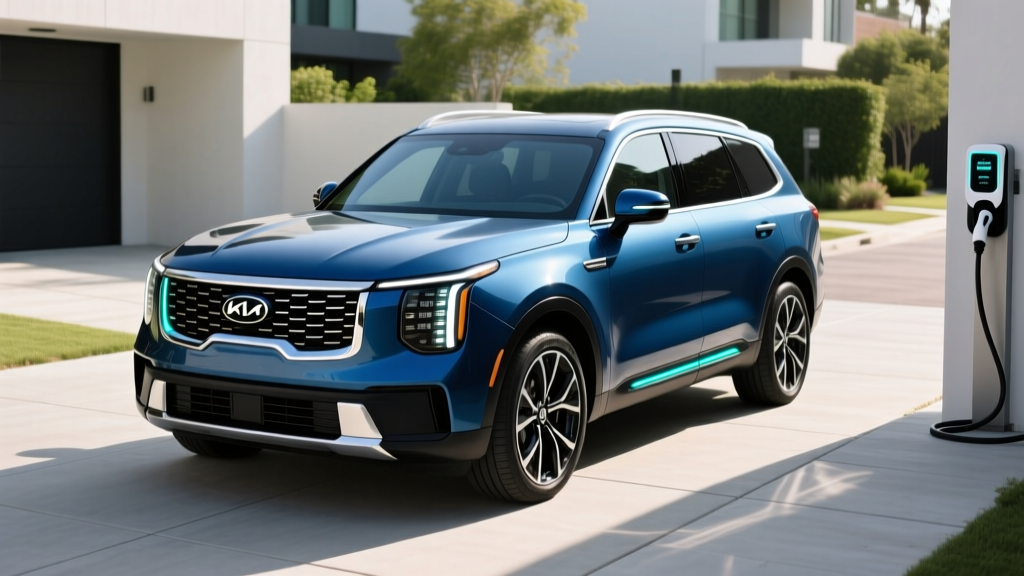
With the mid-cycle refresh behind it, the three-row SUV king is adding electrification. Kia has confirmed that a hybrid variant of the Telluride is in development, and industry reporting points to a debut for the 2027 model year. For families who love the Telluride's space and refinement but want to cut fuel costs without going full EV, the 2027 Kia Telluride hybrid trims could be the most anticipated addition to Kia's lineup this decade.
Because the 2027 Telluride Hybrid has not yet gone on sale, the specs below are based on Kia's current hybrid powertrain architecture (as used in the Sorento Hybrid and Carnival Hybrid), official Kia statements, and credible industry projections. We'll update this guide with EPA-confirmed figures as soon as they're published on fueleconomy.gov. Where numbers are estimates, we've labeled them clearly.
What We Know About the 2027 Kia Telluride Hybrid Lineup
Kia's hybrid strategy has expanded rapidly. The Sorento, Sportage, and Carnival all now offer hybrid or plug-in hybrid variants, and the Telluride is the logical next step. Based on Kia's product roadmap statements and supply-chain reporting, the 2027 Telluride will likely launch with a conventional hybrid (HEV) option. A plug-in hybrid (PHEV) variant may follow either at launch or as a 2028 addition.
Here's what that distinction means in practice:
| Feature | Hybrid (HEV) | Plug-In Hybrid (PHEV) |
|---|---|---|
| Plug in to charge? | No — charges via regenerative braking and engine | Yes — plug in for electric-only driving |
| Electric-only range | None (motor assists engine only) | Typically 25–40 miles |
| Battery size | ~1.5–2.0 kWh | ~13–20 kWh |
| Federal tax credit (§30D) | Not eligible | Potentially eligible (up to $7,500, subject to sourcing/income rules) |
| Best for | Drivers without home charging who want better MPG | Drivers with home charging and short commutes |
Projected Powertrain and Performance Specs
Kia's proven turbo-hybrid powertrain — a 1.6-liter turbocharged four-cylinder paired with an electric motor and a 6-speed automatic transmission — is the strongest candidate for the Telluride Hybrid. In the Sorento Hybrid, this system produces 261 combined horsepower. For a heavier, larger Telluride, Kia may retune the system or add a more powerful motor to maintain adequate acceleration.
| Spec | HEV (Estimated) | PHEV (If Offered, Estimated) |
|---|---|---|
| Engine | 1.6L turbo I-4 + electric motor | 1.6L turbo I-4 + larger electric motor |
| Combined Horsepower | ~261–290 hp | ~290–320 hp |
| Transmission | 6-speed automatic | 6-speed automatic |
| Drivetrain | AWD expected standard | AWD expected standard |
| Battery Capacity | ~1.5–2.0 kWh (self-charging) | ~15–18 kWh usable |
| Electric-Only Range | N/A | ~30–35 miles (est.) |
| Total Range | ~550–600+ miles | ~500+ miles (gas + electric) |
| 0–60 mph | ~7.5–8.0 sec (est.) | ~7.0–7.5 sec (est.) |
| Towing Capacity | ~3,500–5,000 lbs (est.) | ~3,500–5,000 lbs (est.) |
Note: These are projections based on Kia's existing hybrid architecture. Final specs will be confirmed by Kia closer to the on-sale date. The current gas-only Telluride uses a 3.8L V6 making 291 hp and tows up to 5,500 lbs — the hybrid will need to approach these benchmarks to satisfy buyers.
Fuel Economy: How Many MPG Will the Telluride Hybrid Get?
This is the question that matters most. The current gas-only Telluride AWD is rated at 18 city / 24 highway / 20 combined MPG by the EPA. A hybrid powertrain should deliver a meaningful improvement, particularly in city driving where electric motor assist does the most work.
| Model | City MPG | Highway MPG | Combined MPG |
|---|---|---|---|
| 2026 Telluride AWD (Gas, 3.8L V6) | 18 | 24 | 20 |
| 2027 Telluride HEV AWD (Estimated) | 27–30 | 28–31 | 28–30 |
| 2027 Telluride PHEV AWD (Estimated, gas-only mode) | 28–32 | 29–33 | 29–32 |
| Kia Sorento HEV AWD (2026, for reference) | 34 | 33 | 34 |
The Telluride is heavier and less aerodynamic than the Sorento, so expect its hybrid MPG to land below the Sorento's excellent 34 combined. A realistic target for the Telluride HEV is 28–30 MPG combined — a 40–50% improvement over the gas model.
Real-world note: Hybrids typically exceed their EPA city ratings in stop-and-go traffic, where regenerative braking recaptures energy constantly. Highway MPG may run slightly below the sticker at sustained 75–80 mph speeds. In our experience with the Sorento Hybrid, we've observed 1–2 MPG above the EPA city figure in urban driving and 1–2 MPG below on highway road trips. Expect a similar pattern with the Telluride Hybrid.
For PHEV buyers: the combined MPGe rating (which blends electric and gas operation) will likely land in the 70–85 MPGe range when the battery is charged, per EPA methodology. But once the battery depletes, you're driving a heavy hybrid SUV getting the gas-mode MPG figures above.
PHEV Electric-Only Range and Charging Details
If Kia offers a Telluride PHEV, expect an electric-only range in the 30–35 mile neighborhood. The Sorento PHEV delivers an EPA-rated 32 miles on its 13.7 kWh battery; the Telluride's greater weight will likely require a slightly larger pack (15–18 kWh usable) to achieve similar range.
Charging details for a potential Telluride PHEV:
- Level 1 (120V household outlet): ~10–14 hours for a full charge — practical only for overnight top-ups if your daily drive is short.
- Level 2 (240V home charger, ~7.2 kW): ~2.5–3.5 hours for a full charge. This is the sweet spot for PHEV owners.
- DC fast charging: Kia's current PHEVs (Sorento, Sportage) do not support DC fast charging. The Telluride PHEV is expected to follow this pattern — Level 2 will be the maximum charge speed.
For most PHEV owners, this isn't a practical limitation. You plug in at home overnight and start every morning with a full battery. DC fast charging matters far more for full EVs than for PHEVs with small batteries.
Pricing by Trim and Tax Credit Eligibility
The current 2026 Telluride starts around $37,500 for the base LX and climbs to roughly $54,000 for the SX Prestige X-Pro. A hybrid powertrain typically adds $1,500–$2,500 to a given trim's price based on Kia's pricing patterns with the Sorento and Sportage lineups.
Projected pricing for 2027 Kia Telluride Hybrid trims:
- HEV S (base hybrid trim): ~$40,000–$42,000 MSRP
- HEV EX: ~$44,000–$46,000 MSRP
- HEV SX: ~$48,000–$50,000 MSRP
- HEV SX Prestige: ~$52,000–$55,000 MSRP
- PHEV (if offered, likely EX or SX trim only): ~$48,000–$55,000 MSRP
Does the Telluride Hybrid Qualify for a Tax Credit?
The conventional hybrid (HEV) will not qualify for the federal §30D clean vehicle tax credit. That credit is available only for plug-in vehicles (PHEVs and BEVs) that meet specific requirements.
A Telluride PHEV could qualify, but eligibility under current IRS rules depends on several factors:
- MSRP cap: SUVs must be priced at or below $80,000 — the Telluride PHEV should clear this easily.
- Buyer income cap: Modified adjusted gross income must not exceed $150,000 (single), $225,000 (head of household), or $300,000 (joint filers).
- Battery sourcing: Critical minerals and battery components must meet escalating domestic-content thresholds. For 2027, these requirements are stringent — and many Asian-sourced batteries may not qualify for the full $7,500. The credit may split into $3,750 (minerals) and $3,750 (components), with partial eligibility possible.
- Point-of-sale transfer: Under current rules, you can transfer the credit to the dealer at purchase for an immediate price reduction, rather than waiting to claim it on your tax return.
Check the latest eligibility details at IRS.gov's clean vehicle credit page before purchasing, as sourcing requirements and eligible vehicle lists are updated regularly.
Battery Warranty, Reliability, and Replacement Costs
Kia Hybrid Battery Warranty: Kia covers its hybrid and PHEV battery packs with a 10-year / 100,000-mile warranty (whichever comes first). In states that follow California Air Resources Board (CARB) standards, coverage extends to 10 years / 150,000 miles for certain emissions-related hybrid components.
This is one of the strongest hybrid battery warranties in the industry and a major reason buyers trust Kia's hybrid systems. The warranty covers battery capacity loss below a specified threshold (typically 60–70% of original capacity) as well as defects.
Is the Telluride Hybrid Reliable?
Kia's 1.6L turbo-hybrid powertrain has been in service since the 2023 model year across the Sorento, Sportage, and Carnival. Early reliability data has been encouraging — the system uses a conventional 6-speed automatic rather than a CVT, which tends to improve long-term durability perceptions. The electric motor is a simple, proven component with few failure points.
The Telluride nameplate itself has earned strong reliability marks in its current generation. Adding a hybrid variant introduces more complexity (battery, inverter, motor), but Kia's extensive warranty mitigates the financial risk for the original owner.
Battery Replacement Cost
Out-of-warranty hybrid battery replacement for Kia's mid-size hybrids currently runs approximately $2,500–$4,500 depending on the pack size and labor rates. A Telluride PHEV's larger battery would likely cost more — in the $4,000–$7,000 range — though this is speculative until the part is available. Hybrid batteries in modern vehicles typically last 12–15 years or 150,000+ miles before significant degradation, and many outlast the vehicle itself.
Telluride Hybrid vs. Gas vs. Full EV: Which Is Right for You?
Choose the Telluride HEV (conventional hybrid) if:
- You don't have access to home or workplace charging
- You want significantly better MPG without changing your habits
- You frequently take long road trips and don't want to plan around charging stops
- You tow occasionally and want maximum simplicity
Choose the Telluride PHEV (if offered) if:
- You have Level 2 home charging and a commute under ~30 miles
- You want to drive on electricity most weekdays but need gas flexibility for weekends and road trips
- You may qualify for the federal tax credit, offsetting the higher purchase price
Choose a full EV (like the Kia EV9) instead if:
- You have reliable home charging and rarely exceed 250–300 miles in a day
- You want the lowest per-mile fuel cost and minimal maintenance
- You qualify for the full federal tax credit and want to maximize incentives
- You're ready to use DC fast charging on road trips
The Kia EV9, with its EPA-estimated 270–304 miles of range and 800V fast-charging architecture, is the natural all-electric alternative in Kia's three-row lineup. But for buyers who aren't ready to commit to a pure EV — or who live in areas with sparse charging infrastructure — the Telluride Hybrid fills a crucial gap.
Pros and Cons of the 2027 Telluride Hybrid
Pros
- 40–50% fuel economy improvement over the gas Telluride
- No charging required (HEV) — just fill up with gas
- Kia's 10-year/100,000-mile hybrid battery warranty
- Proven turbo-hybrid powertrain shared with Sorento/Carnival
- Three-row seating and cargo versatility retained
- AWD expected standard across trims
Cons
- Higher MSRP than gas-only Telluride (~$2,000+ premium per trim)
- HEV not eligible for federal tax credit
- PHEV variant may not be available at launch
- Towing capacity may be reduced vs. V6 gas model
- Third-row space and cargo volume may be slightly reduced by battery placement
- Real-world highway MPG may fall 1–2 MPG below EPA estimate
Frequently Asked Questions
When will the 2027 Kia Telluride Hybrid go on sale?
Kia has confirmed a hybrid Telluride is in development. Based on typical product cadences and industry reporting, a reveal is expected in late 2026 with sales beginning in early-to-mid 2027 as a 2027 model-year vehicle.
How many MPG does the Telluride Hybrid get?
Official EPA numbers are not yet available. Based on Kia's existing hybrid architecture and the Telluride's weight, we project 28–30 MPG combined for the HEV — a substantial improvement over the gas model's 20 MPG combined. Real-world city driving may yield 1–2 MPG above the EPA rating thanks to regenerative braking.
Will there be a Telluride plug-in hybrid?
A PHEV variant is possible but not confirmed for the initial launch. If offered, expect approximately 30–35 miles of electric-only range and a ~$48,000–$55,000 starting price. Kia has offered PHEV versions of the Sorento and Sportage, so the precedent exists.
Does the 2027 Telluride Hybrid qualify for any tax credit?
The conventional hybrid (HEV) does not qualify for the federal §30D clean vehicle credit. A PHEV version could qualify for up to $7,500, subject to buyer income limits, MSRP caps, and battery-sourcing requirements. Always verify current eligibility at fueleconomy.gov and IRS.gov before purchasing.
Is the hybrid battery reliable, and what does replacement cost?
Kia's hybrid batteries carry a 10-year/100,000-mile warranty (10 years/150,000 miles in CARB states). Modern hybrid batteries routinely last 150,000+ miles. Out-of-warranty replacement for a Telluride-class hybrid battery is estimated at $2,500–$4,500 for the HEV and potentially $4,000–$7,000 for a PHEV's larger pack.
Will the hybrid Telluride still have three rows and tow?
Yes — the Telluride's three-row layout is expected to carry over. However, battery placement (likely under the floor or rear cargo area) could slightly reduce cargo volume behind the third row. Towing capacity may be modestly reduced from the gas model's 5,500-lb rating — expect 3,500–5,000 lbs depending on the trim and powertrain.