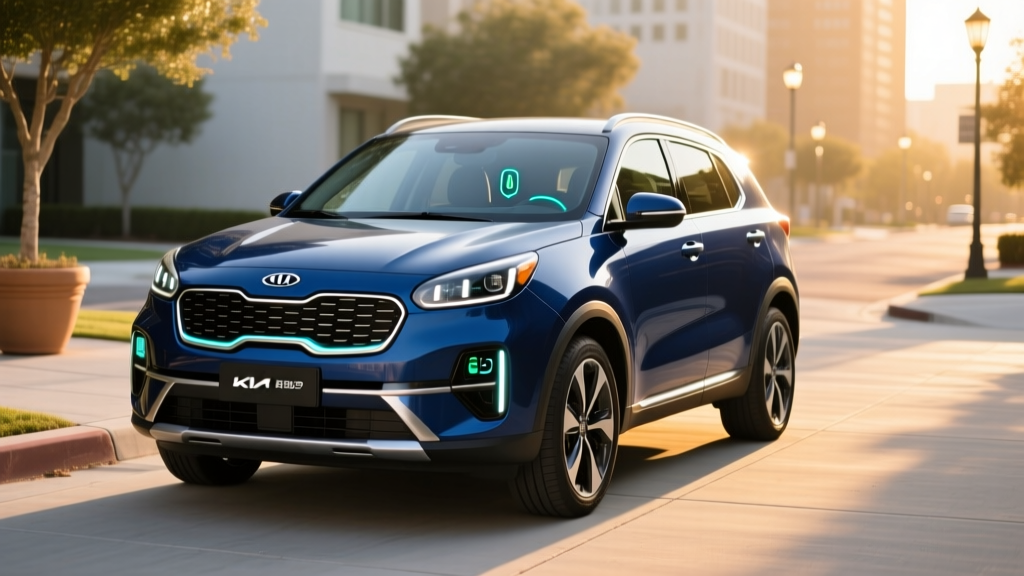
The 2027 Kia Sportage Hybrid slots into one of the most competitive segments in the small-SUV market, offering buyers a choice between a conventional hybrid (HEV) and a plug-in hybrid (PHEV). With the fifth-generation Sportage platform now mature, the 2027 lineup brings incremental efficiency improvements, updated infotainment, and Kia's proven 10-year/100,000-mile powertrain warranty. This guide breaks down every electrified Sportage variant with exact numbers so you can decide which powertrain fits your driving habits.
HEV vs PHEV: Which Sportage Hybrid Are You Buying?
Before comparing specs, it's critical to understand the two distinct powertrains Kia offers. Confusing them is the most common mistake hybrid shoppers make.
Conventional Hybrid (HEV)
The Sportage HEV uses a 1.6-liter turbocharged four-cylinder paired with an electric motor and a small battery (~1.49 kWh). You never plug it in. The battery recharges through regenerative braking and the engine. It's ideal for drivers without access to home or workplace charging who still want a fuel-economy boost over the gas-only Sportage.
Plug-In Hybrid (PHEV)
The Sportage PHEV pairs the same 1.6L turbo engine with a larger electric motor and a 13.8 kWh battery pack. You can plug it in to charge at home (Level 2) or at public stations. It delivers an estimated 34 miles of electric-only driving before the gas engine kicks in, making it viable as a daily EV commuter with no range anxiety for longer trips.
Fuel Economy: EPA MPG and Real-World Numbers
| Model | City MPG | Highway MPG | Combined MPG | MPGe (PHEV EV mode) |
|---|---|---|---|---|
| Sportage HEV FWD | 42 | 44 | 43 | — |
| Sportage HEV AWD | 38 | 38 | 38 | — |
| Sportage PHEV AWD | 36 (hybrid mode) | 35 (hybrid mode) | 35 (hybrid mode) | 84 MPGe |
Source: EPA fueleconomy.gov
Real-world expectations: The HEV FWD often exceeds its EPA combined rating in city driving, where regenerative braking recaptures energy at every stop. Owners regularly report 44–46 MPG in urban commuting. Highway efficiency drops slightly to 40–42 MPG at sustained 75+ mph speeds due to aerodynamic drag and reduced regen opportunity. The AWD HEV sacrifices about 5 MPG combined due to the rear-axle drivetrain losses.
For the PHEV, the 84 MPGe rating applies only while operating in electric mode with a charged battery. Once the battery depletes, the PHEV operates as a conventional hybrid at roughly 35 MPG combined — slightly less than the HEV because it carries approximately 300 lbs of additional battery weight.
PHEV Electric-Only Range and Charging
The 2027 Sportage PHEV carries a 13.8 kWh lithium-ion polymer battery pack, delivering an EPA-rated 34 miles of electric-only range. Total combined range (electric + gasoline) reaches approximately 430 miles with a full tank and full charge.
| Charging Method | Power (kW) | 0–100% Time | Notes |
|---|---|---|---|
| Level 1 (120V household outlet) | ~1.4 kW | ~11 hours | Overnight top-up only |
| Level 2 (240V home/public) | ~7.2 kW | ~2 hours | Recommended for daily use |
| DC Fast Charging | Not supported | — | CCS port is Level 2 only |
The Sportage PHEV does not support DC fast charging — a limitation common to most PHEVs in this class. The onboard charger maxes out at 7.2 kW on Level 2, which is sufficient for a full charge during a workday or overnight. If you rely on DC fast charging infrastructure for daily needs, a full BEV is the better choice.
Real-world electric range caveat: Expect 28–32 miles of electric-only range in cold weather (below 40°F) or during highway-speed driving above 65 mph. The electric-only range is optimized for city-speed commuting in moderate temperatures. Cabin heating in winter draws from the battery, reducing range by 10–15%.
Powertrain Specs: Horsepower and Performance
| Specification | Sportage HEV | Sportage PHEV |
|---|---|---|
| Engine | 1.6L Turbo I4 | 1.6L Turbo I4 |
| Engine HP | 178 hp | 178 hp |
| Electric Motor | 44 kW (59 hp) | 70 kW (94 hp) |
| Combined System HP | 227 hp | 261 hp |
| Combined Torque | 258 lb-ft | 258 lb-ft |
| Transmission | 6-speed automatic | 6-speed automatic |
| 0–60 mph (est.) | ~7.5 sec | ~7.0 sec |
| Drivetrain | FWD or AWD | AWD standard |
| Towing Capacity | 2,000 lbs | 2,000 lbs |
The PHEV's more powerful electric motor gives it a noticeable advantage in electric-only acceleration and low-speed responsiveness. Both models use a conventional 6-speed automatic rather than a CVT, which avoids the rubber-band feel some hybrid drivers dislike. The AWD system on the HEV is an on-demand setup that engages the rear axle only when slip is detected, minimizing efficiency loss.
Pricing, Trims, and Tax Credit Eligibility
| Trim | MSRP (est.) | Powertrain |
|---|---|---|
| LX HEV FWD | $31,490 | HEV |
| EX HEV AWD | $34,990 | HEV |
| SX-Prestige HEV AWD | $38,490 | HEV |
| X-Line PHEV AWD | $40,590 | PHEV |
| X-Line Prestige PHEV AWD | $43,890 | PHEV |
Federal tax credit update (2026 rules): Under current IRS §30D guidelines, the conventional Sportage HEV does not qualify for any federal tax credit — only plug-in vehicles with sufficient battery capacity are eligible. The Sportage PHEV may qualify for up to $3,750 of the federal credit, depending on battery component and critical-mineral sourcing requirements. The full $7,500 credit requires meeting both the battery components (10% threshold) and critical minerals thresholds, which many Korean-assembled PHEVs only partially satisfy.
- MSRP cap: SUVs must be under $80,000 — Sportage PHEV qualifies
- Income cap: Modified AGI ≤ $150,000 (single) or $300,000 (joint)
- Battery sourcing: Must meet critical-mineral and battery-component thresholds per IRS §30D rules
- Point-of-sale transfer: Eligible buyers can apply the credit at purchase to reduce the sale price
- North American assembly: The Sportage PHEV is assembled in South Korea — verify current eligibility as rules evolve
Consult a tax professional before relying on credit eligibility. Rules change frequently and final determination rests with the IRS at time of purchase.
Battery Warranty, Reliability, and Replacement Cost
Kia Hybrid Battery Warranty
- Hybrid/EV battery: 10 years / 100,000 miles (whichever comes first)
- Capacity retention threshold: Warranty covers repair/replacement if battery capacity drops below approximately 70% of original capacity
- Powertrain warranty: 10 years / 100,000 miles
- Bumper-to-bumper: 5 years / 60,000 miles
Kia's hybrid battery track record is strong. The 1.49 kWh battery in the HEV and the 13.8 kWh pack in the PHEV use lithium-ion polymer chemistry, which has demonstrated low degradation rates in real-world use. Based on data from earlier Sportage and Niro hybrid models, expect less than 10% capacity loss over 10 years of typical use.
Battery replacement cost: If the hybrid battery fails outside of warranty, replacement costs are estimated at $2,500–$3,500 for the HEV pack and $5,000–$7,000 for the PHEV pack (parts and labor). However, failures within the warranty period are covered at no cost to the owner, and Kia's 10-year window is among the longest in the industry.
Reliability outlook: Kia's 1.6L turbo hybrid powertrain has been in production since 2022 across the Sportage, Sorento, and Tucson platforms. IIHS testing of the Sportage platform has yielded top safety ratings. The hybrid system adds minimal mechanical complexity — the electric motor is integrated into the transmission housing, and there is no high-voltage system to service beyond the battery pack itself.
Hybrid vs PHEV vs Full EV: Decision Framework
Choose the Sportage HEV if:
- You don't have access to home or workplace Level 2 charging
- You want a fuel-economy upgrade with zero behavior change — no plugging in, no route planning
- Your budget is under $35,000 and you want AWD availability
- You drive mostly city miles where the HEV exceeds its EPA rating
Choose the Sportage PHEV if:
- You can install a Level 2 charger at home or charge reliably at work
- Your daily commute is under 34 miles round-trip (you'll rarely use gas)
- You want EV-like daily driving but need gas flexibility for road trips
- You want to reduce your household gasoline consumption by 60–80%
Choose a full BEV (e.g., Kia EV6, Hyundai Ioniq 5) if:
- You have reliable home Level 2 charging and access to DC fast charging networks
- You want zero tailpipe emissions and the lowest per-mile fuel cost
- You qualify for the full $7,500 federal tax credit on a BEV
- You're comfortable with 250–310 miles of EPA range and trip planning for longer drives
Pros and Cons at a Glance
Pros
- HEV achieves 43 MPG combined FWD — top of the compact SUV hybrid class
- PHEV delivers 34 miles electric-only, covering most commutes gas-free
- 10-year/100,000-mile hybrid battery and powertrain warranty
- Conventional 6-speed automatic avoids CVT drone
- Spacious interior with 39.5 cu ft cargo volume behind rear seats
- AWD available across both powertrains
Cons
- PHEV does not support DC fast charging
- AWD HEV drops to 38 MPG combined — significant penalty vs FWD
- PHEV starts at $40,590 — premium over HEV takes years to recoup in fuel savings
- Federal tax credit for PHEV likely capped at $3,750, not $7,500
- South Korean assembly may limit credit eligibility under current sourcing rules
- Regen braking feel is less aggressive than some competitors — limited one-pedal capability
Frequently Asked Questions
How many MPG does the 2027 Kia Sportage Hybrid get?
The Sportage HEV FWD achieves an EPA-rated 42 city / 44 highway / 43 combined MPG. The AWD HEV drops to 38 combined. The PHEV operates at approximately 35 MPG combined once the battery is depleted, plus 84 MPGe in electric-only mode.
How far can the Sportage PHEV go on electric only?
The EPA rates the Sportage PHEV at 34 miles of electric-only range. In real-world conditions — cold weather, highway speeds, or hilly terrain — expect 28–32 miles. This covers most daily commutes without using any gasoline.
Do I need to plug in the Sportage HEV?
No. The conventional hybrid (HEV) charges its battery entirely through regenerative braking and the gasoline engine. There is no plug and no electric-only driving mode of meaningful distance. Only the PHEV variant requires plugging in to access its electric range.
Does the 2027 Sportage Hybrid qualify for a federal tax credit?
The conventional HEV does not qualify for any federal tax credit. The PHEV may qualify for up to $3,750 under IRS §30D, depending on battery sourcing requirements, your income, and assembly location. Always verify current eligibility at irs.gov or with a tax professional before purchasing.
How long will the hybrid battery last and what does replacement cost?
Kia warranties the hybrid battery for 10 years or 100,000 miles, covering repair or replacement if capacity drops below approximately 70%. Based on Kia's hybrid track record, expect less than 10% degradation over a decade. Out-of-warranty replacement costs $2,500–$3,500 for the HEV and $5,000–$7,000 for the PHEV.
Is the Sportage Hybrid better than the gas-only model?
Yes, for most buyers. The gas-only Sportage 2.5L AWD achieves approximately 25 MPG combined. The HEV delivers 38–43 MPG for a $2,000–$3,000 price premium, which most drivers recoup in fuel savings within 3–4 years. The hybrid also provides smoother acceleration thanks to electric motor torque fill at low RPMs.
Can the Sportage PHEV tow?
Yes. Both the HEV and PHEV are rated for 2,000 lbs of towing capacity when properly equipped with the factory tow hitch. This is adequate for a small utility trailer, bike rack, or lightweight pop-up camper.
Final Assessment
The 2027 Kia Sportage Hybrid is one of the most practical hybrid compact SUVs available. The HEV variant is the value pick — 43 MPG combined, no charging required, starting under $32,000, and backed by Kia's class-leading warranty. The PHEV makes sense specifically for drivers with home charging and short commutes who want to minimize gasoline use without committing to a full EV. Neither variant breaks new ground in technology or performance, but both deliver exactly what hybrid buyers prioritize: measurable fuel savings, proven reliability, and low ownership risk.