Quick Verdict: The 2027 Highlander Hybrid at a Glance
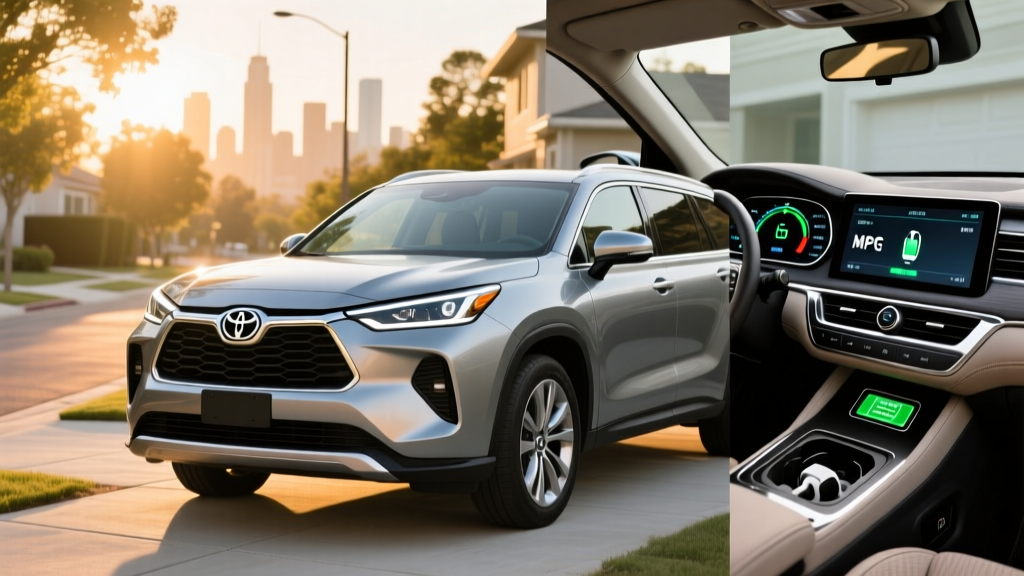
The 2027 Toyota Highlander Hybrid remains one of the most practical three-row family haulers that doesn't require a plug. With an EPA-estimated 36 MPG combined and seating for up to eight, it occupies a specific niche: buyers who want hybrid efficiency without the upfront cost, charging logistics, or range limitations of a full battery-electric vehicle. Toyota's fourth-generation hybrid system powers the Highlander with a 2.5-liter four-cylinder paired with front and rear electric motors, delivering 243 combined horsepower.
This guide breaks down real-world efficiency expectations, trim pricing, tax credit eligibility, and whether the Highlander Hybrid is the right choice versus a plug-in hybrid like the Toyota RAV4 Prime or a three-row EV like the Kia EV9.
| Specification | Value |
|---|---|
| Powertrain | 2.5L 4-cyl + 2 electric motors (FWD) / 3 motors (AWD) |
| Combined Horsepower | 243 hp |
| EPA MPG (Combined) | 36 MPG |
| EPA MPG (City / Highway) | 36 city / 35 highway (FWD) |
| Drivetrain | FWD or AWD (electronic rear motor) |
| Seating | 7 or 8 passengers |
| Cargo (behind 3rd / 2nd / 1st row) | 16.1 / 48.4 / 84.3 cu ft |
| Towing Capacity | 3,500 lbs |
| Starting MSRP (est.) | ~$42,500 |
| Battery Warranty | 10 years / 150,000 miles |
Note: The 2027 Highlander Hybrid is an announced model year carryover. Final EPA figures and MSRP may shift slightly at launch. Specs above reflect Toyota's current-generation platform and are subject to confirmation.
HEV vs PHEV: What the Highlander Hybrid Is (and Isn't)
A common point of confusion in the three-row SUV segment is the difference between a conventional hybrid (HEV) and a plug-in hybrid (PHEV). The Highlander Hybrid is a conventional hybrid (HEV). It does not plug in. You fuel it with gasoline like any other car, and the hybrid system recovers energy through regenerative braking and the engine to charge a small traction battery.
| Factor | HEV (Highlander Hybrid) | PHEV (e.g., RAV4 Prime) | BEV (e.g., Kia EV9) |
|---|---|---|---|
| Plugs in? | No | Yes (Level 1/2) | Yes (Level 1/2/DC) |
| Electric-only range | ~1 mile (low-speed creep) | 35–42 miles | 230–310 miles |
| Fuel/energy cost per mile | ~$0.10 (gas at $3.50/gal) | ~$0.04 (electric) / ~$0.10 (gas) | ~$0.04 (electric) |
| Home charging needed? | No | Recommended for benefit | Essential |
| Federal tax credit (§30D) | Not eligible | Up to $7,500 (if eligible) | Up to $7,500 (if eligible) |
| Upfront cost premium | ~$1,500–$2,500 over gas | ~$6,000–$8,000 over gas | ~$10,000+ over gas |
Choose the Highlander Hybrid (HEV) if: You want better fuel economy with zero behavior change. No plugs, no charging apps, no route planning. You fill up at any gas station and drive.
Choose a PHEV if: You have home charging access and a daily commute under 40 miles. You'll run mostly on electricity weekdays and use gas for longer weekend trips. Note: Toyota does not currently offer a Highlander PHEV in the US — the closest Toyota PHEV is the RAV4 Prime (two-row).
Choose a full EV if: You have reliable home Level 2 charging, want the lowest per-mile operating cost, and your typical trips fall within 250 miles or you're willing to plan DC fast-charging stops.
Fuel Economy: EPA Ratings and Real-World MPG
| Drivetrain | City | Highway | Combined |
|---|---|---|---|
| FWD (LE trim) | 36 MPG | 35 MPG | 36 MPG |
| AWD (LE trim) | 35 MPG | 34 MPG | 35 MPG |
| AWD (Limited/Platinum) | 35 MPG | 34 MPG | 35 MPG |
Source: fueleconomy.gov (EPA estimates for current-generation Highlander Hybrid; 2027 figures expected to carry over).
Real-World MPG: What Owners Actually See
Toyota hybrids tend to meet or slightly exceed EPA city estimates because stop-and-go driving maximizes regenerative braking and electric-motor usage. Highway driving is a different story. At sustained 70–80 MPH speeds, the gasoline engine does most of the work, and aerodynamic drag on a vehicle this size (4,500+ lbs curb weight) reduces efficiency.
- City driving (suburban, stoplights, 25–45 MPH): Expect 34–38 MPG. Many owners report exceeding the EPA city estimate by 1–2 MPG in warm weather.
- Highway driving (70+ MPH, flat terrain): Expect 30–33 MPG. The EPA highway number of 35 is optimistic for sustained interstate speeds.
- Cold weather (below 32°F): Expect a 10–15% drop. The engine runs more frequently to generate cabin heat, and battery efficiency decreases. Real-world winter combined MPG often falls to 30–32.
- Mountainous terrain / heavy cargo: Towing or hauling seven passengers up grades will drop instantaneous economy into the low-to-mid 20s. Regenerative braking on descents partially recovers this.
For a family SUV, 30–36 MPG combined is genuinely strong. Compare this to the non-hybrid 2027 Highlander with its turbocharged 2.4-liter four-cylinder, which returns an EPA-estimated 24 MPG combined — a roughly 50% efficiency gap.
Powertrain Deep Dive: How the Hybrid System Works
The Highlander Hybrid uses Toyota's fourth-generation hybrid synergy drive. Here's the mechanical breakdown:
- Gasoline engine: 2.5-liter inline-four, Atkinson cycle, producing 186 hp and 175 lb-ft of torque on its own. The Atkinson cycle sacrifices low-end torque for higher thermal efficiency (approximately 41%).
- Front electric motor (MG2): 134 hp, integrated into the transaxle. Provides initial acceleration and regenerative braking.
- Rear electric motor (AWD models): 54 hp, mounted on the rear axle. Engages automatically for traction and low-speed electric-only crawling. There is no mechanical driveshaft connecting the front and rear axles.
- Nickel-metal hydride (NiMH) traction battery: Approximately 1.6 kWh usable capacity, mounted under the second-row seats. This is a small buffer — it's not designed for sustained electric-only driving.
- Combined system output: 243 hp (Toyota's net system rating, which accounts for the fact that peak engine and peak motor output don't occur simultaneously).
The result is a 0–60 MPH time of approximately 7.8 seconds. That's adequate for merging and passing but noticeably slower than the Kia EV9 (7.0 seconds for dual-motor AWD) or the non-hybrid turbocharged Highlander (around 6.8 seconds). The hybrid prioritizes efficiency over acceleration.
Pricing, Trims, and Tax Credit Eligibility
The 2027 Highlander Hybrid is expected to carry over the current trim structure with modest price adjustments. Estimated MSRP by trim (including destination charge):
- LE (base, FWD): ~$42,500
- LE (AWD): ~$44,100
- XLE: ~$47,500
- Limited: ~$51,000
- Platinum: ~$54,500
Federal Tax Credit: Does the Highlander Hybrid Qualify?
No. The Highlander Hybrid is a conventional HEV, not a plug-in vehicle. Under IRS §30D rules, the federal clean vehicle credit (up to $7,500) applies only to battery-electric vehicles (BEVs) and plug-in hybrids (PHEVs) with a minimum battery capacity of 7 kWh that meet critical mineral and battery component sourcing requirements.
The Highlander Hybrid's ~1.6 kWh NiMH battery does not meet the threshold. There is currently no federal tax credit for conventional hybrids. Some states may offer minimal incentives for high-efficiency vehicles, but these vary widely by jurisdiction — check your state's energy office or department of revenue for specifics.
For current §30D eligibility rules, income caps ($150K single / $300K joint for new vehicles), and MSRP caps ($80K for SUVs), refer to IRS.gov's clean vehicle credit page.
Battery Warranty, Reliability, and Replacement Costs
Toyota Hybrid Battery Warranty: 10 years or 150,000 miles (whichever comes first), covering defects and capacity loss below a defined threshold. This warranty applies to all current Toyota hybrid models and is transferable to subsequent owners.
How Long Do Toyota Hybrid Batteries Actually Last?
Toyota's NiMH hybrid batteries have an excellent longevity track record. Data from owner surveys and fleet reports consistently show these batteries lasting 150,000–200,000+ miles before significant degradation. The Highlander Hybrid has been in production since the 2020 model year (current generation), so long-term fleet data is still maturing, but the Prius — which uses the same fundamental chemistry and management strategy — routinely sees original batteries past 200,000 miles.
Key factors that extend hybrid battery life:
- Shallow cycling: Toyota's battery management system never allows the NiMH pack to fully charge or fully discharge. It operates in a narrow 40–80% state-of-charge window, which dramatically reduces wear.
- Thermal management: The battery is cabin-temperature cooled (air from the HVAC system), avoiding the extreme heat exposure that accelerates degradation in some EV packs.
- Proven chemistry: NiMH is less energy-dense than lithium-ion but is extraordinarily tolerant of shallow charge/discharge cycles.
Battery Replacement Cost
If the hybrid battery does fail outside warranty, replacement costs have come down significantly:
- New OEM battery from Toyota: Approximately $3,000–$4,000 (parts + labor at a dealership)
- Refurbished/remanufactured battery: Approximately $1,500–$2,500 from independent hybrid specialists
- Individual cell replacement: Some specialists replace only the degraded cells for $500–$1,200
For context, this is far less than EV battery replacement, which typically runs $8,000–$20,000+ depending on pack size. The Highlander Hybrid's small battery keeps worst-case ownership costs manageable.
Reliability and Safety
Toyota's hybrid powertrains are among the most reliable in the industry. The e-CVT transaxle has no traditional gears or clutch packs to wear — it's a planetary gearset with two motor-generators, and failures are rare. The gasoline engine runs the Atkinson cycle at relatively low stress. J.D. Power and Consumer Reports consistently rank Toyota hybrids at or near the top for long-term dependability.
For crash-test performance, check the latest IIHS ratings for the Highlander and NHTSA safety data once the 2027 model year is tested. The current-generation Highlander has historically earned IIHS Top Safety Pick status and 5-star NHTSA overall ratings.
Who Should Buy the 2027 Highlander Hybrid?
Buy the Highlander Hybrid if:
- You need three rows and want the lowest fuel cost without plugging in
- You live in an apartment or lack home charging access (making a PHEV or EV impractical)
- You frequently drive 300+ mile road trips where EV charging stops would add time
- You value Toyota's long-term reliability reputation and strong resale value
- You want AWD capability (the rear electric motor provides confident traction in rain and light snow)
Look elsewhere if:
- You want meaningful electric-only driving — consider the Toyota RAV4 Prime (PHEV, 42-mile EV range) or a three-row EV like the Kia EV9
- You want maximum acceleration — the turbocharged gas Highlander or EV alternatives are quicker
- You want a federal tax credit — only PHEVs and BEVs qualify under §30D
- You need more than 84.3 cu ft of cargo space — the Highlander's third row limits utility vs. a minivan or larger SUV
Pros
- 36 MPG combined in a three-row SUV — best-in-class for the segment
- No plug-in required; zero behavior change from a gas car
- 10-year / 150,000-mile hybrid battery warranty
- Strong resale value and proven Toyota reliability
- AWD available with electronic rear motor (no mechanical complexity)
Cons
- No federal tax credit eligibility (HEV, not PHEV/BEV)
- 243 hp feels modest for a 4,500-lb vehicle — passing acceleration is adequate, not quick
- Highway MPG drops to ~30–33 at sustained 75+ MPH
- Third row is tight for adults on long trips
- No plug-in hybrid variant available for electric-only commuting
Frequently Asked Questions
How many MPG does the 2027 Highlander Hybrid get?
The EPA estimates 36 MPG combined (36 city / 35 highway) for front-wheel-drive models and 35 MPG combined for AWD models. Real-world city driving often matches or slightly exceeds these figures, while sustained highway driving at 70+ MPH typically yields 30–33 MPG.
Does the Highlander Hybrid need to be plugged in?
No. The Highlander Hybrid is a conventional hybrid (HEV). It charges its battery through regenerative braking and the gasoline engine. You refuel it at any gas station — no plug, no charging cable, no home charger installation required.
Is there a plug-in hybrid (PHEV) version of the Highlander?
As of the 2027 model year, Toyota does not offer a Highlander PHEV in the United States. The closest Toyota plug-in hybrid is the RAV4 Prime, which offers 42 miles of electric-only range but has only two rows of seats. If a three-row PHEV is essential, consider the Chrysler Pacifica PHEV (minivan) or the Mazda CX-90 PHEV.
How long will the Highlander Hybrid battery last?
Toyota's NiMH hybrid batteries routinely last 150,000–200,000+ miles based on fleet data from the Prius and Camry Hybrid platforms. The battery is covered by a 10-year / 150,000-mile warranty. If replacement is needed outside warranty, expect $1,500–$4,000 depending on whether you choose refurbished or new OEM.
Does the 2027 Highlander Hybrid qualify for a federal tax credit?
No. Under IRS §30D, the federal clean vehicle credit applies only to plug-in vehicles (BEVs and PHEVs) with a battery capacity of at least 7 kWh. The Highlander Hybrid's ~1.6 kWh battery does not qualify. Check your state's energy office for any local efficiency incentives, which vary by jurisdiction.
Hybrid vs EV for a family: which makes more sense?
If you have home Level 2 charging, a predictable commute under 250 miles, and want the lowest per-mile cost, a three-row EV like the Kia EV9 (310-mile range, eligible for up to $7,500 federal credit) may save more over five years. If you lack home charging, take frequent long road trips, or want a lower purchase price, the Highlander Hybrid's 36 MPG combined and zero-charging lifestyle is the more practical choice.
What is the towing capacity of the Highlander Hybrid?
The 2027 Highlander Hybrid is rated to tow up to 3,500 pounds when properly equipped. This is sufficient for a small boat trailer, utility trailer, or a pair of jet skis, but not for larger travel trailers. Note that towing will significantly reduce fuel economy — expect 20–25 MPG while towing on flat terrain.