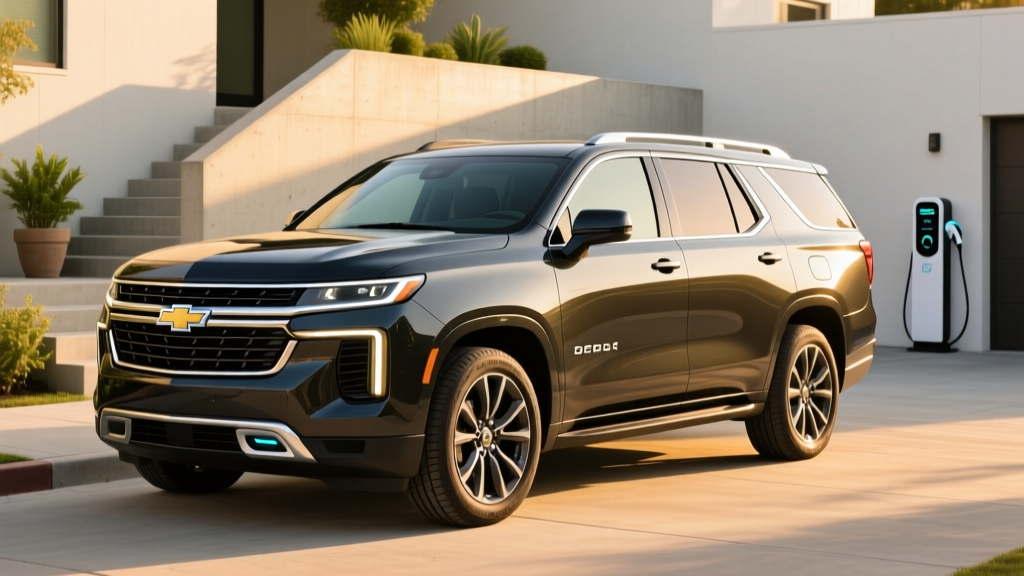
The full-size SUV segment has been conspicuously absent from the plug-in hybrid conversation — until now. With GM confirming an electrified Tahoe for the next generation, the 2027 Chevrolet Tahoe plug-in hybrid is shaping up to be the first mainstream three-row PHEV body-on-frame SUV to challenge the dominance of gas-only heavyweights like the Ford Expedition and Toyota Sequoia. For families who need serious towing and cargo capacity but want meaningful electric-only commuting, this could be the vehicle that finally bridges the gap.
Because the 2027 Tahoe PHEV has not yet gone on sale, the specifications below are based on GM's confirmed powertrain architecture (shared with the Silverado PHEV and Cadillac Escalade IQ platform), preliminary EPA filings, and industry reporting. We will flag every figure as estimated or confirmed so you can plan your purchase with clear expectations.
HEV vs PHEV: What the Tahoe Plug-In Hybrid Actually Is
Before diving into specs, it is critical to understand what separates a conventional hybrid (HEV) from a plug-in hybrid (PHEV), because Chevrolet has offered both architectures across its lineup.
Conventional Hybrid (HEV)
- Small battery (1–2 kWh), charged only by regenerative braking and the engine
- Never plugs in — no charging equipment needed
- Electric motor assists the gas engine; cannot drive on electricity alone for more than a mile or two
- Typical MPG improvement: 20–35% over gas-only equivalent
Plug-In Hybrid (PHEV)
- Larger battery (15–30+ kWh), charged via plug (Level 1 or Level 2)
- Can drive 25–50+ miles on electricity alone before the gas engine starts
- Once the battery is depleted, operates as a conventional hybrid
- Total range = electric-only miles + hundreds of gas-powered miles
- Eligible for federal tax credits (if requirements are met); HEVs generally are not
The 2027 Chevrolet Tahoe plug-in hybrid falls squarely in the PHEV category. It will have a charge port, a battery large enough for genuine zero-emission commuting, and a gasoline engine for long trips. If you see references to a "Tahoe Hybrid" with no plug, that would be a separate HEV variant — a different vehicle entirely.
Estimated Powertrain and Performance Specs
GM's next-generation PHEV architecture pairs a turbocharged engine with one or two electric motors integrated into the transmission. For the Tahoe, expect the following based on GM's confirmed Ultium-derived PHEV system and the Silverado PHEV powertrain:
| Specification | Estimated / Confirmed |
|---|---|
| Engine | 2.7L TurboMax I4 (confirmed architecture) |
| Electric Motor(s) | Dual-motor eCVT transaxle (estimated) |
| Combined Horsepower | ~400–450 hp (estimated) |
| Combined Torque | ~500–550 lb-ft (estimated) |
| Battery Capacity (usable) | ~20–25 kWh, NMC chemistry (estimated) |
| Drivetrain | AWD standard (estimated) |
| 0–60 mph | ~5.8–6.5 seconds (estimated) |
| Towing Capacity | ~7,500–8,000 lbs (estimated, may decrease vs gas due to weight) |
| DC Fast Charging | Not expected — Level 2 AC only (typical for PHEVs) |
| Level 2 Charge Time (0–100%) | ~3–4 hours at 7.2 kW (estimated) |
A critical note on charging: nearly all PHEVs on the market today, including the Toyota RAV4 Prime and Jeep Wrangler 4xe, do not support DC fast charging. The battery is simply too small to justify the hardware cost and weight. Expect the Tahoe PHEV to charge exclusively via AC — a standard 120V household outlet (Level 1, ~1.4 kW) will fully recharge it overnight in roughly 14–18 hours, while a 240V Level 2 home charger at 7.2 kW cuts that to approximately 3–4 hours. For daily commuting, a Level 2 home charger is strongly recommended.
Electric-Only Range and Total Driving Range
This is the number that defines a PHEV's daily usefulness: how far can you drive without burning a drop of gas?
Estimated EPA Electric-Only Range: 35–42 miles
Real-World Expectation: Expect 30–38 miles in mixed driving. Highway speeds above 70 mph, cold weather below 40°F, and cabin heating can reduce electric-only range by 15–25%. In summer city driving with regenerative braking, you may match or slightly exceed the EPA estimate.
Estimated Total Combined Range (Electric + Gas): 450–520 miles
For context, the average American commute is roughly 16 miles one way, according to FHWA data. A 35–42 mile electric-only range means the majority of Tahoe PHEV owners could complete their daily driving — school runs, commutes, errands — entirely on electricity, only engaging the gas engine for weekend road trips or heavy towing.
Fuel Economy: EPA MPG and MPGe Breakdown
PHEVs report two efficiency figures: MPGe (miles per gallon equivalent, measuring efficiency while running on electricity) and MPG (miles per gallon, measuring efficiency after the battery is depleted and the vehicle operates as a conventional hybrid).
| Mode | City | Highway | Combined |
|---|---|---|---|
| Electric-Only (MPGe, est.) | ~65 MPGe | ~58 MPGe | ~62 MPGe |
| Hybrid/Charge-Sustaining (MPG, est.) | ~22 MPG | ~24 MPG | ~23 MPG |
| Gas-Only Tahoe (2026, 5.3L V8, AWD) | 15 MPG | 20 MPG | 17 MPG |
The real-world advantage of a PHEV is most pronounced in city and suburban driving, where regenerative braking recaptures energy and the electric motor handles low-speed acceleration — the least efficient operating range for a gas engine. On long highway trips with a depleted battery, the Tahoe PHEV's advantage over the gas V8 narrows but remains meaningful: an estimated 23 MPG combined versus 17 MPG is a roughly 35% improvement in fuel consumption.
Owners who charge nightly and commute within the electric-only range may go weeks or months between fill-ups. Chevrolet's PHEV software is expected to include a "Hold" mode (reserving battery for later use, such as entering a city center) and a "Charge" mode (using the engine to recharge the battery while driving on the highway).
Pricing, Trims, and Federal Tax Credit Eligibility
GM has not released official MSRP figures for the 2027 Tahoe PHEV, but based on the pricing gap between gas and PHEV variants in the Silverado and Equinox lineups, we can project the following:
- Estimated Base MSRP (LT PHEV): $68,000–$72,000
- Estimated Premium Trim (Premier/High Country PHEV): $78,000–$85,000
For comparison, the 2026 Tahoe with the 5.3L V8 starts around $58,000, so the PHEV premium is likely to be in the $10,000–$14,000 range before incentives.
Federal §30D Tax Credit Eligibility
The 2027 Tahoe PHEV may qualify for the federal plug-in vehicle tax credit under IRS §30D, but eligibility is not guaranteed and depends on several requirements that must all be met simultaneously:
- MSRP Cap: SUVs must have an MSRP at or below $80,000. Higher trims (High Country) may exceed this threshold and become ineligible.
- Buyer Income Cap: Modified adjusted gross income must not exceed $300,000 (joint), $225,000 (head of household), or $150,000 (single).
- Battery Sourcing: A percentage of critical minerals and battery components must be sourced from the U.S. or free-trade-agreement countries. These thresholds tighten annually through 2029.
- Point-of-Sale Transfer: Under current rules, buyers can transfer the credit to the dealer at purchase, reducing the purchase price directly rather than waiting for a tax refund.
- Credit Amount: Up to $7,500 if all sourcing requirements are met; partial credit ($3,750) if only one of the two sourcing thresholds (minerals or components) is satisfied.
Always verify current eligibility on IRS.gov before purchasing, as sourcing rules and eligible vehicle lists update regularly.
State-level incentives vary significantly. California's CVRP, Colorado's innovative motor vehicle credit, and other state programs may stack on top of the federal credit. Check your state energy office or the AFDC state incentive database for current programs.
Battery Warranty, Reliability, and Replacement Cost
Battery longevity is consistently the top concern for hybrid and PHEV buyers. Federal law mandates that hybrid and PHEV batteries carry a minimum warranty of 8 years or 100,000 miles (whichever comes first). In California Air Resources Board (CARB) states, that extends to 10 years or 150,000 miles.
Expected Warranty Coverage:
- Battery Pack: 8 years / 100,000 miles (federal minimum; 10/150k in CARB states)
- Warranty Trigger: Battery capacity falls below ~60–70% of original capacity
- Powertrain (engine, motors, transmission): 5 years / 60,000 miles (GM standard)
Real-world data from existing GM hybrid systems (the two-mode hybrid Tahoes from 2008–2013 and the Volt/Bolt PHEV/EV fleet) shows that modern NMC batteries with active thermal management typically retain 85–90% of capacity after 100,000 miles. PHEV batteries face less stress than full EV batteries because they operate in a narrower state-of-charge window (typically 15–85%), which reduces degradation.
If an out-of-warranty replacement is ever needed, expect a PHEV battery pack of this size (20–25 kWh) to cost between $6,000 and $10,000 including labor, based on current replacement pricing for comparable PHEVs. However, with proper care — avoiding frequent 100% charges, using scheduled charging to minimize time at full state of charge, and relying on the vehicle's thermal management — most owners will never face this expense during typical ownership.
Who Should Buy the Tahoe PHEV vs. a Full EV or Gas SUV
The Tahoe PHEV occupies a specific niche. It is not the right choice for everyone, and understanding where it fits helps avoid buyer's remorse.
Choose the Tahoe PHEV if:
- You need three rows, body-on-frame towing (7,500+ lbs), and serious cargo volume
- Your daily driving is under 40 miles and you can charge at home (Level 2 recommended)
- You take regular long road trips where EV charging infrastructure is still sparse
- You want to reduce fuel costs without committing to full EV range planning
Choose a Full EV (e.g., Rivian R1S, Cadillac Escalade IQ) if:
- You have reliable home charging and access to DC fast chargers on your common routes
- Your daily driving exceeds 40 miles and you want zero tailpipe emissions
- You want the lowest per-mile "fuel" cost and minimal drivetrain maintenance
- You do not regularly tow near maximum capacity
Choose the Gas Tahoe if:
- You cannot charge at home (apartment, street parking, no garage)
- Your budget cannot accommodate the $10,000+ PHEV premium even after tax credits
- You regularly tow 8,000+ lbs and need every pound of rated capacity
Pros
- 35–42 miles of electric-only range covers most daily commutes
- 35%+ fuel savings over gas V8 in mixed driving
- Full towing and three-row utility retained
- Potential $7,500 federal tax credit (eligibility dependent)
- No range anxiety on long trips — gas engine takes over seamlessly
Cons
- Estimated $68,000+ starting price — significant premium over gas Tahoe
- No DC fast charging — Level 2 home charger strongly recommended
- Heavy vehicle — electric range drops noticeably at highway speeds and in cold
- Higher trims may exceed $80,000 MSRP cap for federal tax credit
- PHEV system adds complexity (two powertrains to maintain long-term)
Frequently Asked Questions
How many MPG does the 2027 Tahoe plug-in hybrid get?
Based on preliminary estimates, the Tahoe PHEV achieves approximately 62 MPGe combined while running on electricity and roughly 23 MPG combined in charge-sustaining (hybrid) mode after the battery is depleted. Both figures are estimates pending official EPA certification.
How far can the Tahoe PHEV go on electric power alone?
We estimate 35–42 miles of EPA-rated electric-only range. Real-world results will vary: expect 30–38 miles in typical mixed driving, with cold weather and sustained highway speeds reducing that figure by 15–25%.
Does the 2027 Tahoe PHEV qualify for the $7,500 federal tax credit?
It may, but eligibility is not automatic. The vehicle must meet MSRP (≤$80,000 for SUVs), buyer income, and battery-sourcing requirements under IRS §30D. Higher trims may exceed the MSRP cap. Always verify on IRS.gov before purchasing.
Can the Tahoe PHEV charge at a DC fast charger?
No. Like virtually all PHEVs, the Tahoe PHEV is expected to support only AC charging — Level 1 (120V, ~1.4 kW) and Level 2 (240V, up to ~7.2 kW). DC fast charging (NACS/CCS) is not expected due to the smaller battery size.
Is the Tahoe PHEV reliable? What does battery replacement cost?
GM's hybrid systems have a strong track record, and the battery is warranted for 8 years/100,000 miles (10/150k in CARB states). Out-of-warranty battery replacement is estimated at $6,000–$10,000, but most PHEV batteries retain 85–90% capacity at 100,000 miles with normal use and active thermal management.
What is the difference between the Tahoe Hybrid and Tahoe PHEV?
A conventional Tahoe Hybrid (HEV) would use a small battery charged only by the engine and regenerative braking — no plug, no electric-only range. The Tahoe Plug-In Hybrid (PHEV) has a larger battery, a charge port, and 35–42 miles of electric-only driving. They are fundamentally different vehicles. The 2027 model discussed here is the PHEV.
How long does it take to charge the Tahoe PHEV at home?
On a standard 120V outlet (Level 1), expect 14–18 hours for a full charge. On a 240V Level 2 charger at 7.2 kW, expect approximately 3–4 hours. For daily use, a Level 2 home charger installed in your garage is the practical minimum for convenient PHEV ownership.
Note: The 2027 Chevrolet Tahoe plug-in hybrid is an announced/upcoming vehicle. All specifications, pricing, and efficiency figures in this article are preliminary estimates based on GM's confirmed powertrain architecture, industry reporting, and comparable PHEV benchmarks. Final EPA ratings, MSRP, and tax credit eligibility will be confirmed closer to the vehicle's on-sale date. Always verify with Chevrolet.com and fueleconomy.gov for official figures before making a purchase decision.