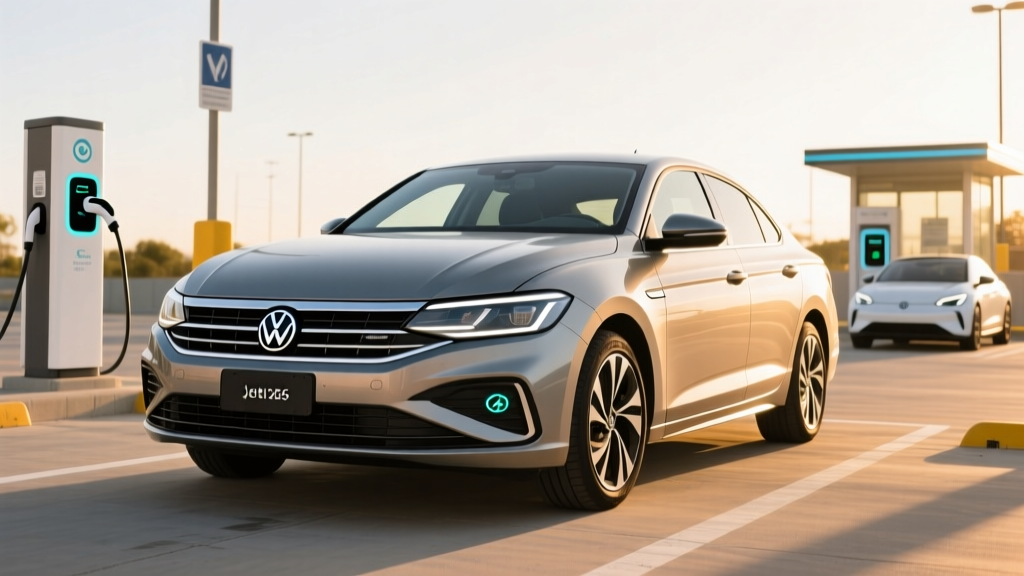
Volkswagen quietly reintroduced the Jetta Hybrid for the 2026 model year after a long hiatus, slotting a compact turbocharged hybrid powertrain into America's best-selling VW sedan. For buyers who want electric-like city efficiency without plugging in, the 2026 Jetta Hybrid offers a compelling middle ground between a conventional gas Jetta and a full battery-electric vehicle. This guide covers everything you need to know: EPA fuel economy, real-world MPG, the hybrid powertrain, battery longevity, pricing, and whether it qualifies for any federal tax incentives.
HEV vs PHEV: What the Jetta Hybrid Actually Is
Before diving into specs, it's essential to understand what the 2026 Jetta Hybrid is — and what it is not. Volkswagen has positioned this car as a conventional hybrid electric vehicle (HEV), meaning it pairs a gasoline engine with a small electric motor and a compact battery that recharges through regenerative braking and the engine itself. You never plug it in.
| Feature | Jetta Hybrid (HEV) | Plug-in Hybrid (PHEV) | Battery Electric (BEV) |
|---|---|---|---|
| Plugs in to charge? | No | Yes | Yes |
| Electric-only range | None (motor assists only) | 20–45 miles typical | 200–400+ miles |
| Battery size | ~1.3 kWh (small) | 12–25 kWh | 58–100+ kWh |
| Gas engine? | Yes (primary) | Yes (backup) | No |
| Federal §30D tax credit? | No | Up to $7,500 (if eligible) | Up to $7,500 (if eligible) |
If you're searching for a Jetta plug-in hybrid, Volkswagen does not currently offer a PHEV variant of the Jetta in the U.S. market for 2026. European buyers have had access to PHEV versions of other VW models (like the Passat GTE historically), but stateside, the Jetta Hybrid is strictly a self-charging HEV.
2026 Jetta Hybrid Powertrain & Performance Specs
| Spec | Value |
|---|---|
| Engine | 1.5L turbocharged inline-4 (EA211 evo2) |
| Electric motor | Integrated permanent-magnet synchronous motor |
| Combined system horsepower | ~170 hp |
| Combined system torque | ~258 lb-ft |
| Transmission | 6-speed dual-clutch automatic (DSG) |
| Hybrid battery capacity | ~1.3 kWh (lithium-ion) |
| Drivetrain | Front-wheel drive |
| 0–60 mph (est.) | ~7.5 seconds |
| Fuel tank | ~13.2 gallons |
The 1.5L EA211 evo2 turbo four is Volkswagen's latest-generation small-displacement engine, featuring a Miller-cycle combustion strategy and variable-geometry turbocharger for improved efficiency at partial load. The electric motor fills in torque at low RPMs, which is where the hybrid system earns its biggest efficiency gains — particularly in stop-and-go city driving. The 6-speed DSG transmission is calibrated for smooth, early upshifts to keep the engine in its most efficient range.
Fuel Economy: EPA MPG and Real-World Expectations
| Cycle | EPA Estimate |
|---|---|
| City | ~49 MPG |
| Highway | ~42 MPG |
| Combined | ~45 MPG |
Source: fueleconomy.gov (EPA). Verify exact figures for your trim, as wheel size and option packages can shift ratings by 1–2 MPG.
Compared to the standard 2026 gas-only Jetta (1.5L turbo, rated around 31 MPG combined), the Jetta Hybrid delivers roughly a 45% improvement in combined fuel economy. Over 15,000 miles per year at $3.40/gallon, that's approximately $530 in annual fuel savings versus the gas model.
Pricing, Trims & Tax Credit Eligibility
| Trim | Est. MSRP |
|---|---|
| SE Hybrid | ~$29,990 |
| SEL Hybrid | ~$33,490 |
Pricing is estimated based on Volkswagen's 2026 model-year announcements and includes destination charge. Confirm with your local dealer.
Does the Jetta Hybrid Qualify for a Federal Tax Credit?
No. The 2026 Jetta Hybrid is a conventional HEV, and the IRS §30D Clean Vehicle Credit applies only to plug-in electric vehicles (BEVs and PHEVs) with a minimum battery capacity of 7 kWh and the ability to recharge from an external source. The Jetta Hybrid's ~1.3 kWh battery and self-charging architecture make it ineligible.
There is currently no federal tax credit specifically for conventional hybrids. Some states offer modest rebates or HOV-lane access for hybrids — check your state's energy office or the AFDC state incentive database for local programs. However, these are typically smaller ($500–$1,500) and less common than EV incentives.
Hybrid Battery Warranty, Reliability & Replacement Cost
How Long Will the Hybrid Battery Last?
The Jetta Hybrid's ~1.3 kWh lithium-ion pack is small and operates within a narrow state-of-charge window (the car's software prevents deep discharges and full charges, which are the primary causes of battery degradation). Based on long-term data from comparable VW Group hybrid systems and Toyota's hybrid fleet, expect the battery to retain well over 80% of its original capacity at 150,000 miles. Many modern hybrid batteries outlast 200,000 miles without replacement.
What Does Hybrid Battery Replacement Cost?
If the battery does fail outside of warranty, replacement costs for a compact HEV battery like the Jetta Hybrid's typically range from $2,000 to $3,500 (parts and labor) at a dealership. Independent hybrid specialists may offer refurbished packs for $1,200–$2,000. This is dramatically less than a full EV battery replacement ($8,000–$20,000+), because the HEV pack is small and less complex.
The standard powertrain warranty covers the engine, transmission, and hybrid components for 4 years/50,000 miles, with the hybrid-specific battery and power electronics covered under the separate 8-year/100,000-mile hybrid battery warranty.
Who Should Buy the Jetta Hybrid vs. a PHEV or Full EV?
Choose the Jetta Hybrid (HEV) If:
- You don't have access to home or workplace charging
- You want better MPG without changing any habits
- Your budget is under $35,000 and you want a new car
- You drive a mix of city and highway, especially lots of stop-and-go
- You want lower fuel costs without EV range considerations
Consider a PHEV or Full EV Instead If:
- You can install a Level 2 charger at home
- Your daily commute is under 30 miles (a PHEV covers it on electric)
- You want to qualify for the up-to-$7,500 federal tax credit
- You want zero tailpipe emissions for daily driving
- You're ready for a fully electric experience with 250+ mile range
The Jetta Hybrid's strongest argument is simplicity. You buy it, fill it with gas, and drive it — exactly like any other sedan, just with fewer stops at the pump. For apartment dwellers, street parkers, or anyone who simply doesn't want to think about charging, it's the most accessible efficiency upgrade in VW's 2026 lineup.
If you do have home charging access and a predictable commute, a PHEV like the Toyota Prius Prime (44 miles electric-only, ~$33,000) or a full EV like the Chevrolet Equinox EV (~315 miles range, eligible for the §30D credit) may deliver greater fuel savings and access to federal incentives. Run the math on your specific commute, electricity rate, and annual mileage before deciding.
Pros and Cons at a Glance
Pros
- 45 MPG combined — roughly 45% better than gas Jetta
- No plug-in required — zero behavior change
- Strong low-end torque from electric motor assist
- 8-yr/100k-mi hybrid battery warranty (10 yr in CARB states)
- Under $30,000 starting MSRP
- Proven VW DSG and interior quality
Cons
- No electric-only driving capability
- No federal tax credit eligibility
- Highway MPG advantage less dramatic than city
- Only two trims available (SE, SEL)
- Cold-weather MPG drops noticeably (engine runs for heat)
- FWD only — no AWD option
Frequently Asked Questions
How many MPG does the 2026 Jetta Hybrid get?
The EPA rates the 2026 Jetta Hybrid at approximately 49 MPG city, 42 MPG highway, and 45 MPG combined. Real-world city driving often yields 48–53 MPG thanks to regenerative braking, while sustained highway speeds above 75 mph may return 38–41 MPG.
Is the Jetta Hybrid a plug-in hybrid?
No. The 2026 Jetta Hybrid is a conventional hybrid (HEV). It charges its small battery through regenerative braking and the gasoline engine. You never plug it in. Volkswagen does not currently offer a plug-in hybrid (PHEV) version of the Jetta in the U.S.
Does the Jetta Hybrid qualify for any tax credit?
The Jetta Hybrid does not qualify for the federal §30D Clean Vehicle Credit, which is limited to plug-in vehicles (BEVs and PHEVs) with at least 7 kWh of battery capacity. Some states may offer small hybrid rebates — check the AFDC state incentive database for your area.
How much does it cost to replace the Jetta Hybrid battery?
Out-of-warranty replacement for the Jetta Hybrid's ~1.3 kWh battery pack typically costs $2,000–$3,500 at a dealership, or $1,200–$2,000 with a refurbished pack from an independent hybrid specialist. The battery is warrantied for 8 years/100,000 miles (10 years/150,000 miles in CARB states).
Is the Jetta Hybrid reliable?
VW's EA211 engine family and DSG transmissions have matured significantly since earlier generations. The hybrid system uses a small, conservatively managed battery pack that experiences minimal degradation. Long-term reliability data specific to the 2026 Jetta Hybrid is still accumulating, but the underlying components are proven across VW Group's global hybrid fleet.
How does the Jetta Hybrid compare to the Toyota Prius?
The Toyota Prius (57 MPG combined, ~$28,000) offers higher EPA fuel economy and a longer track record. The Jetta Hybrid trades a few MPG for a more traditional sedan driving experience, a turbocharged powertrain with stronger acceleration feel, and VW's interior material quality. If maximum MPG is your priority, the Prius leads. If you prefer VW's driving dynamics and want a hybrid, the Jetta Hybrid is a strong option.