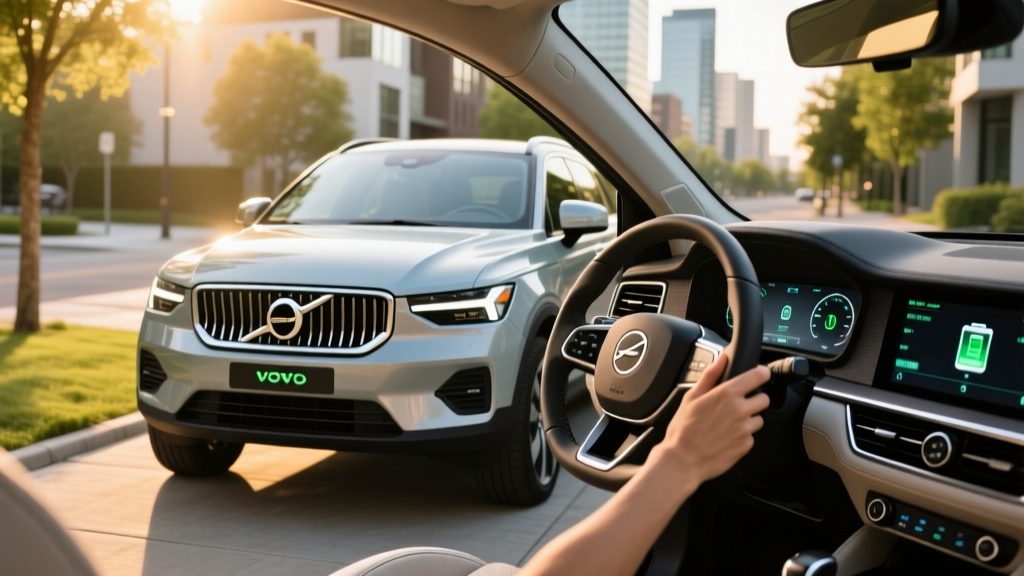
Quick Verdict: What the 2026 Volvo XC40 Mild Hybrid Actually Is
The 2026 Volvo XC40 mild hybrid carries over the B5 turbocharged four-cylinder powertrain paired with a 48-volt belt-driven integrated starter-generator (BISG). This is not a conventional hybrid (HEV) like a Toyota RAV4 Hybrid, and it is not a plug-in hybrid (PHEV). It is a mild hybrid (MHEV) — a system that recovers energy during braking, stores it in a small 48V lithium-ion battery, and uses that energy to assist the gas engine during acceleration and to smooth stop-start operation. You cannot plug it in, and it has no electric-only driving mode.
For 2026, Volvo continues to position the XC40 B5 as a premium compact SUV for buyers who want a touch of electrification without altering their refueling habits. If you're searching for the "2026 Volvo XC40 mild hybrid" and wondering whether it delivers hybrid-level fuel savings, the honest answer is: the gains are modest. Expect roughly 1–2 MPG improvement over a non-hybrid equivalent, not the 40+ MPG you'd see from a full hybrid system.
Powertrain and Performance Specs
The 2026 XC40 B5 mild hybrid powertrain pairs a 2.0-liter turbocharged four-cylinder engine with a 48-volt BISG system and a 7-speed dual-clutch automatic transmission. All-wheel drive is standard across all trims.
| Specification | Value |
|---|---|
| Engine | 2.0L turbocharged I4 + 48V BISG |
| Combined Horsepower | 247 hp (engine) + ~14 hp (BISG assist) |
| Combined Torque | 258 lb-ft |
| Transmission | 7-speed dual-clutch automatic |
| Drivetrain | AWD (standard) |
| 0–60 mph | 6.2 seconds |
| 48V Battery Capacity | ~0.5 kWh (not usable for EV driving) |
| Fuel Tank | 14.2 gallons |
| Towing Capacity | 3,500 lbs |
| Cargo Volume | 20.7 cu ft (rear seats up) / 47.2 cu ft (folded) |
| Base MSRP (Core trim) | $41,950 |
| Top Trim MSRP (Ultra) | $49,650 |
The BISG system's primary contribution is refinement, not raw performance. It fills in torque at low RPM before the turbo spools, smoothing out the initial launch from a stop. It also enables a more seamless engine stop-start experience — the engine restarts nearly imperceptibly when you release the brake. On deceleration, the BISG recovers kinetic energy to recharge the 48V battery, which in turn powers the vehicle's electrical systems and assists the engine on the next acceleration event.
Fuel Economy: EPA MPG and Real-World Expectations
The EPA rates the 2026 Volvo XC40 B5 AWD at 26 MPG city / 33 MPG highway / 29 MPG combined (source: fueleconomy.gov). These figures represent a modest improvement over the pre-mild-hybrid B5 models, which were rated around 23/30/25 MPG.
| Driving Scenario | EPA Estimate | Real-World Expectation |
|---|---|---|
| City | 26 MPG | 24–27 MPG |
| Highway | 33 MPG | 29–32 MPG |
| Combined | 29 MPG | 26–29 MPG |
Real-world context: Mild hybrids tend to perform closest to their EPA city estimates in stop-and-go traffic, where the BISG's regenerative braking and stop-start assistance are most active. On sustained highway driving at 70–80 mph, expect fuel economy to fall a few MPG below the sticker — the turbo engine is doing all the work with minimal hybrid assist. In cold weather (below 30°F), plan for a 5–10% reduction across the board due to increased engine warm-up time and denser air.
With the 14.2-gallon fuel tank and 29 MPG combined, real-world total range sits around 370–410 miles per tank, depending on driving style and conditions.
How the Mild Hybrid System Works (and What It Doesn't Do)
Understanding what a mild hybrid does — and does not do — is essential before comparing the XC40 B5 to competitors or to full EVs.
What the 48V BISG Does
- Recovers energy during braking and deceleration
- Assists the gas engine during acceleration (torque fill)
- Powers smoother, faster engine stop-start cycles
- Runs electrical accessories (A/C compressor, power steering) off the 48V system, reducing parasitic engine drag
- Improves fuel economy by ~1–2 MPG vs. a non-hybrid equivalent
What It Does NOT Do
- Drive the vehicle on electric power alone
- Provide any electric-only range
- Plug in to charge (no charging port)
- Qualify for federal EV or PHEV tax credits
- Deliver the 35–45+ MPG of a full hybrid (HEV) system
If you're cross-shopping and see terms like "HEV" (conventional hybrid, e.g., Toyota RAV4 Hybrid), "PHEV" (plug-in hybrid, e.g., Toyota RAV4 Prime), and "MHEV" (mild hybrid, like this XC40 B5), here's a quick breakdown:
| Feature | MHEV (XC40 B5) | HEV (RAV4 Hybrid) | PHEV (RAV4 Prime) | BEV (EX40) |
|---|---|---|---|---|
| Plugs in? | No | No | Yes | Yes |
| Electric-only range | 0 mi | ~1 mi at low speed | 42 mi | 248+ mi |
| Combined MPG / MPGe | 29 MPG | 39 MPG | 94 MPGe / 38 MPG | 103 MPGe |
| Federal tax credit | None | None | Up to $7,500* | Up to $7,500* |
| Battery size | ~0.5 kWh (48V) | ~1.6 kWh | 18.1 kWh | 82 kWh (usable ~79) |
*Federal tax credit eligibility under IRS §30D depends on MSRP caps, buyer income limits, battery component sourcing, and critical mineral requirements. Verify current rules at irs.gov.
Pricing, Trims, and Tax Credit Eligibility
The 2026 Volvo XC40 B5 mild hybrid is offered in three trims:
- Core: $41,950 — Includes 9-inch touchscreen with Google built-in, wireless Apple CarPlay, 12-inch digital instrument cluster, heated front seats, power liftgate, and Volvo's full suite of ADAS (adaptive cruise, lane-keeping, blind-spot monitoring, rear cross-traffic alert).
- Plus: $44,750 — Adds panoramic moonroof, 360° surround camera, wireless phone charging, leatherette/leather upholstery options, and pilot assist with lane-centering.
- Ultra: $49,650 — Adds Harman Kardon premium audio, head-up display, heated rear seats, heated steering wheel, and upgraded interior trim.
Tax credit reality check: The XC40 B5 mild hybrid does not qualify for the federal §30D Clean Vehicle Credit. That credit applies only to plug-in electric vehicles (PHEVs and BEVs) meeting battery sourcing, MSRP, and buyer income requirements. Mild hybrids, conventional hybrids (HEVs), and gas-only vehicles are excluded. Some states or utilities may offer small rebates for vehicles with stop-start or mild-hybrid systems, but these are uncommon and vary by jurisdiction — check your state energy office or utility provider for specifics.
Reliability, Battery Warranty, and Long-Term Costs
The 48-volt mild-hybrid system in the XC40 B5 is mechanically simpler than a full hybrid or PHEV powertrain. The BISG replaces the traditional alternator and is belt-driven, and the 48V lithium-ion battery pack is small (~0.5 kWh) and mounted under the front passenger seat. There are no high-voltage cables running through the cabin, no large traction battery to cool, and no electric drive axle.
- 48V Battery: 8 years / 100,000 miles (hybrid component warranty)
- Powertrain: 4 years / 50,000 miles (standard Volvo new-vehicle warranty)
- Bumper-to-Bumper: 4 years / 50,000 miles
- Roadside Assistance: 4 years / unlimited miles
Battery replacement cost: If the 48V battery fails out of warranty, replacement parts typically run $800–$1,500, with labor adding $200–$400. This is dramatically less than a full hybrid battery replacement ($2,000–$5,000) or a BEV traction battery ($10,000–$20,000+). The 48V system is one of the least expensive electrified components to service.
Reliability track record: Volvo's B5 mild-hybrid powertrain has been in production since the 2021 model year. The 48V system itself has proven durable, with no widespread failure patterns reported. The more common complaints in owner forums relate to the dual-clutch transmission's low-speed behavior (occasional hesitation or clunkiness in stop-and-go traffic) and infotainment software glitches — issues unrelated to the hybrid system. Volvo's overall reliability ratings from IIHS and Consumer Reports place it mid-pack among luxury brands.
Who Should Buy the XC40 Mild Hybrid (and Who Shouldn't)
Choose the XC40 B5 Mild Hybrid If...
- You want a premium compact SUV with a refined, smooth powertrain
- You can't charge at home or work and don't want a plug-in vehicle
- You value Volvo's safety tech and Scandinavian design
- You want slight fuel savings over a gas-only competitor without changing your habits
- You need AWD and 3,500-lb towing in a small luxury SUV
Look Elsewhere If...
- You want 35+ MPG — consider the RAV4 Hybrid (39 MPG) or a PHEV
- You want electric-only commuting — look at the Volvo EX40 (BEV) or a PHEV
- You want to qualify for the $7,500 federal tax credit — mild hybrids don't qualify
- Maximum fuel savings are your top priority
- You want one-pedal driving or regenerative braking strong enough to feel
Decision Framework: Hybrid vs. PHEV vs. EV
- Mild hybrid (XC40 B5): Best for buyers who want zero lifestyle change — no plugging in, no range planning — but appreciate a smoother, slightly more efficient gas engine. Think of it as a "better gas car," not an "electric car."
- Full hybrid (HEV): Best for high-mileage drivers who want 35–45 MPG without plugging in. The fuel savings are real and compound over time.
- Plug-in hybrid (PHEV): Best for drivers with home charging who commute 20–40 miles round-trip and want electric-only daily driving with gas-engine flexibility for road trips.
- Battery electric (BEV): Best for drivers with reliable home charging, daily commutes under 250 miles, and a desire to minimize fuel and maintenance costs long-term.
Pros and Cons
Pros
- Smooth, refined powertrain with excellent stop-start behavior
- Strong safety suite standard on all trims (ADAS, pilot assist available)
- Premium interior quality with Google built-in infotainment
- Standard AWD and 3,500-lb towing
- Low 48V battery replacement cost vs. full hybrid/BEV
- No charging infrastructure required
Cons
- 29 MPG combined is unimpressive vs. full hybrids (39+ MPG)
- No electric-only driving capability whatsoever
- No federal tax credit eligibility
- Dual-clutch transmission can be clunky at low speeds
- Premium pricing vs. non-luxury hybrid competitors
- Rear seat and cargo space tighter than some compact SUV rivals
Frequently Asked Questions
How many MPG does the 2026 Volvo XC40 mild hybrid get?
The EPA rates it at 26 city / 33 highway / 29 combined MPG. In real-world mixed driving, expect 26–29 MPG. Highway-only driving at 75+ mph may drop to 28–30 MPG, while city stop-and-go driving plays to the mild hybrid's strengths and may match or slightly exceed the 26 MPG city estimate.
Can the XC40 B5 mild hybrid drive on electric power alone?
No. The 48V BISG system assists the gas engine but cannot propel the vehicle independently. There is no electric-only mode, no EV range, and no plug-in capability. The engine is always running when the vehicle is moving (except during stop-start idle events).
Does the 2026 XC40 mild hybrid qualify for any tax credit?
No. The federal §30D Clean Vehicle Credit applies only to plug-in vehicles (PHEVs and BEVs). Mild hybrids are excluded. Check with your state energy office or utility for any local rebates, but these are rare for mild-hybrid vehicles.
Is the 48V mild-hybrid system reliable, and what does battery replacement cost?
The 48V system has proven reliable since its 2021 introduction, with no widespread failure patterns. The 48V battery is covered under Volvo's hybrid component warranty for 8 years / 100,000 miles. Out-of-warranty replacement costs approximately $1,000–$1,900 (parts + labor) — significantly less than a full hybrid or BEV battery.
How does the XC40 B5 compare to the fully electric Volvo EX40?
The EX40 (formerly XC40 Recharge) is a battery-electric SUV with an EPA range of 248+ miles, 402 hp (twin motor), and eligibility for the federal tax credit (subject to §30D rules). It starts around $53,550 before incentives. If you have home charging and your daily driving is under 200 miles, the EX40 delivers dramatically lower fuel and maintenance costs. The B5 mild hybrid makes sense only if you cannot charge at home or regularly drive beyond EV range.
Does the mild hybrid require premium fuel?
Volvo recommends premium unleaded (91 octane or higher) for the B5 engine. Using regular (87 octane) will not damage the engine but may slightly reduce performance and fuel economy. Factor premium fuel costs into your ownership budget.