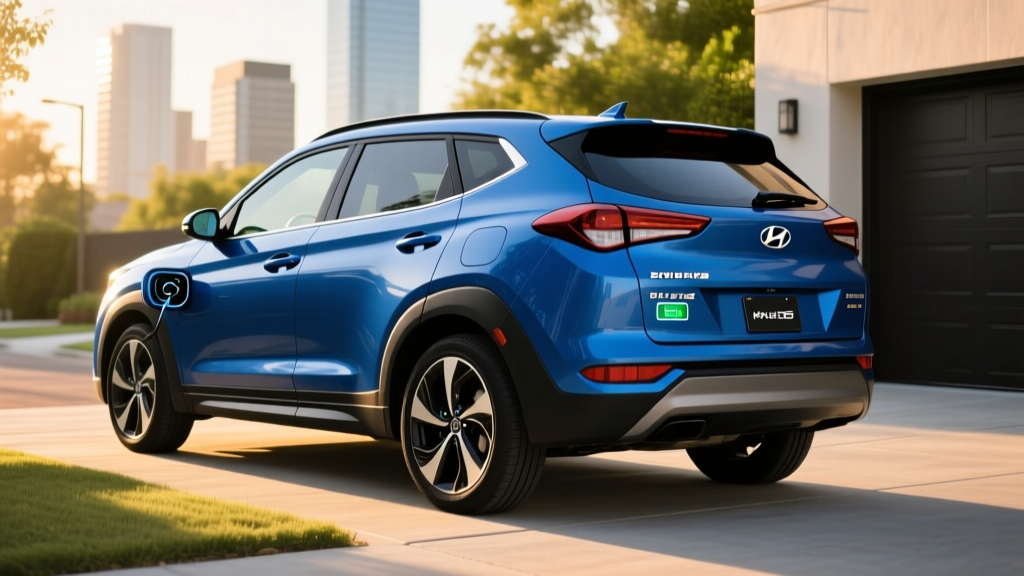
The 2026 Hyundai Tucson Hybrid Blue SE occupies a specific niche that many buyers are searching for but few automakers fill well: an all-wheel-drive compact SUV that returns nearly 40 MPG combined without ever needing a charging cable. As Hyundai's most affordable hybrid trim, the Blue SE strips away premium add-ons to deliver maximum fuel efficiency at the lowest entry price in the Tucson Hybrid lineup.
But with the Tucson also available as a plug-in hybrid (PHEV) and a conventional gas model — and with full EVs like the Ioniq 5 competing for the same buyer — where does the standard Tucson Hybrid actually fit? This guide breaks down every number that matters: EPA MPG, real-world fuel economy, powertrain output, warranty coverage, pricing, and tax-credit eligibility for the 2026 model year.
HEV vs PHEV: Understanding the Tucson Hybrid Lineup
Hyundai sells the 2026 Tucson in three powertrain flavors, and confusing them is the single most common mistake shoppers make. The Tucson Hybrid (HEV) — which includes the Blue SE trim — is a conventional self-charging hybrid. It has no plug, no electric-only driving mode, and no external charging port. A small lithium-ion battery (approximately 1.5 kWh) captures energy from regenerative braking and the gasoline engine, then deploys it to assist acceleration and enable brief low-speed electric creeping.
The Tucson Plug-In Hybrid (PHEV) is a fundamentally different vehicle. It carries a much larger 13.8 kWh battery pack, an external charge port (J1772/CCS), roughly 33 miles of EPA-rated electric-only range, and a total system output of 268 horsepower. You can plug it into a Level 2 home charger overnight and commute gas-free most days.
| Attribute | Tucson Hybrid (HEV) Blue SE | Tucson Plug-In Hybrid (PHEV) |
|---|---|---|
| Plug-in charging required? | No — self-charging | Yes — J1772 / CCS port |
| Battery capacity (usable) | ~1.5 kWh | 13.8 kWh |
| Electric-only range | None (EV assist only) | ~33 miles EPA |
| Combined horsepower | 232 hp | 268 hp |
| EPA combined MPG / MPGe | 38 MPG | 80 MPGe (elec) / 35 MPG (gas) |
| DC fast charging? | N/A | No — Level 2 AC only (~2 hrs) |
| Drivetrain | AWD (standard) | AWD (standard) |
| Federal §30D tax credit | Not eligible | Up to $7,500 (eligibility varies) |
| Starting MSRP (2026) | ~$33,550 | ~$40,650 |
The takeaway: if you cannot charge at home or at work, the HEV (Blue SE) is the correct choice. If you have reliable Level 2 charging access and a commute under 33 miles, the PHEV can eliminate most daily gasoline use — but it costs roughly $7,100 more before any tax credit.
Fuel Economy: EPA Ratings and Real-World MPG
The 2026 Hyundai Tucson Hybrid Blue SE carries the following EPA fuel-economy estimates, as published on fueleconomy.gov:
| Driving Cycle | EPA Estimate |
|---|---|
| City | 38 MPG |
| Highway | 38 MPG |
| Combined | 38 MPG |
That flat city/highway split is characteristic of Hyundai's hybrid system: the electric motor handles low-speed stop-and-go duty where a gasoline engine is least efficient, while the engine takes over at highway cruise. The result is that city and highway numbers converge.
Real-World MPG: What Owners Actually See
EPA stickers are a baseline, not a guarantee. Based on owner-reported data and independent testing of the Tucson Hybrid platform, here is what to expect in practice:
- City / suburban driving (under 45 mph): 39–42 MPG. Hybrids shine in stop-and-go traffic because regenerative braking recaptures energy and the engine shuts off at stops. Many owners report exceeding the EPA city estimate by 2–4 MPG on mixed suburban routes.
- Highway cruising (70–80 mph): 33–36 MPG. At sustained high speeds, aerodynamic drag dominates and the electric motor contributes less. Expect a 3–5 MPG drop below the EPA highway figure.
- Cold weather (below 32°F): 31–34 MPG combined. The engine runs longer to heat the cabin and the battery's charge/discharge efficiency drops in cold temperatures. A 10–15% reduction is typical for all hybrids in winter.
- Mountainous terrain: 28–32 MPG uphill; regenerative braking on descents partially offsets the loss.
For a driver with a mostly suburban commute and moderate highway use, 39–40 MPG combined is a realistic year-round expectation in temperate climates. That puts the Tucson Hybrid Blue SE ahead of nearly every AWD compact SUV on the market and within striking distance of FWD-only competitors.
Powertrain: 232 Horsepower, Turbocharged and Electrified
The Tucson Hybrid pairs a 1.6-liter turbocharged inline-4 gasoline engine with a 47.7 kW (64 hp) electric motor integrated into the 6-speed automatic transmission. Total system output is 232 horsepower and 271 lb-ft of torque, with torque available almost immediately thanks to the electric motor's contribution at low RPM.
| Specification | Value |
|---|---|
| Engine | 1.6L turbocharged I-4 (Smartstream) |
| Engine output | 178 hp @ 5,500 rpm / 195 lb-ft @ 1,500–4,500 rpm |
| Electric motor | 47.7 kW (64 hp) / 195 lb-ft |
| Combined system output | 232 hp / 271 lb-ft |
| Transmission | 6-speed automatic (conventional, not CVT) |
| Drivetrain | HTRAC AWD (standard on all Hybrid trims) |
| Battery type | Lithium-ion polymer (~1.5 kWh) |
| 0–60 mph (est.) | ~7.1 seconds |
| Towing capacity | 2,000 lbs |
| Fuel tank | 13.7 gallons |
| Total range (est.) | ~520 miles |
A notable engineering choice: Hyundai uses a conventional 6-speed automatic rather than the continuously variable transmission (CVT) found in the Toyota RAV4 Hybrid and Honda CR-V Hybrid. The result is more natural-feeling acceleration without the "rubber-band" drone associated with CVTs. The trade-off is marginally lower efficiency in some conditions, though the 38 MPG combined figure shows Hyundai has largely closed that gap.
The HTRAC all-wheel-drive system is standard on every Tucson Hybrid trim, including the Blue SE. Unlike mechanical AWD systems that sap fuel economy, Hyundai's hybrid AWD uses the electric motor to drive the rear axle only when slip is detected or during hard acceleration, minimizing parasitic losses.
Pricing, Trim Positioning, and Tax Credit Eligibility
The 2026 Hyundai Tucson Hybrid Blue SE starts at an MSRP of approximately $33,550, including destination charge. This positions it as the entry point into the Tucson Hybrid lineup:
- Blue SE: ~$33,550 — 18-inch alloy wheels, 8-inch touchscreen, wireless Apple CarPlay/Android Auto, cloth seats, SmartSense safety suite
- SEL Convenience: ~$36,200 — adds panoramic sunroof, 10.25-inch digital cluster, heated front seats, power liftgate
- Limited: ~$40,500 — leather, Bose audio, ventilated seats, Highway Driving Assist, surround-view monitor
Federal Tax Credit: The HEV Reality
Here is the straightforward answer many buyers need: the Tucson Hybrid (HEV) does not qualify for the federal §30D Clean Vehicle Credit. Under current IRS rules, only battery electric vehicles (BEVs) and plug-in hybrids (PHEVs) with sufficient battery capacity and compliant critical-mineral/battery-component sourcing are eligible for up to $7,500. Conventional hybrids like the Tucson HEV have too small a battery and no plug-in capability.
If the federal tax credit is a decisive factor in your purchase, you would need to step up to the Tucson Plug-In Hybrid, which may qualify for up to $3,750–$7,500 depending on your income, the vehicle's MSRP (must be under $80,000 for SUVs), and the battery's critical-mineral and component sourcing — all of which are subject to change. Consult a tax professional and verify current eligibility on the IRS website before counting on the credit.
Some states offer their own hybrid incentives (Colorado, for example, has offered credits for efficient vehicles), but these vary widely by jurisdiction and change frequently. Check your state energy office or department of revenue for current programs.
Battery Warranty, Reliability, and Replacement Costs
Hybrid battery longevity is consistently the top concern among first-time hybrid buyers. Hyundai addresses this with one of the strongest warranties in the industry:
| Component | Coverage |
|---|---|
| Hybrid battery pack | 10 years / 100,000 miles |
| Hybrid system components (motor, inverter, controller) | 10 years / 100,000 miles |
| Powertrain (engine, transmission) | 10 years / 100,000 miles |
| New vehicle limited warranty | 5 years / 60,000 miles |
| Roadside assistance | 5 years / unlimited miles |
The 10-year/100,000-mile hybrid battery warranty covers capacity loss below a manufacturer-defined threshold (typically around 70% state of health) as well as outright failure. For the original owner, this means a decade of protection during the period when most vehicles are owned.
Real-World Reliability and Replacement Cost
Hyundai's hybrid system has proven durable in the Tucson and its platform-mate, the Kia Sportage Hybrid. The 1.6L turbocharged engine uses a timing chain (not a belt), reducing long-term maintenance. The 6-speed automatic is a proven design shared across Hyundai's lineup.
If the hybrid battery does require replacement outside of warranty — typically at 150,000+ miles based on industry data for modern lithium-ion hybrid packs — expect a cost in the range of $2,000–$3,500 for the battery module plus labor. This is significantly less than a full EV battery replacement ($8,000–$20,000+) because the Tucson HEV's battery is small (~1.5 kWh). Third-party remanufactured batteries are increasingly available at lower cost.
For context, Toyota's hybrid batteries in the RAV4 Hybrid have demonstrated exceptional longevity, with many units lasting 200,000+ miles without significant degradation. Hyundai's track record is shorter (the Tucson Hybrid launched for the 2022 model year), but early data and the shared powertrain architecture with the well-regarded Kia Niro Hybrid suggest comparable durability.
Who Should Buy the Tucson Hybrid Blue SE — And Who Shouldn't
The Blue SE trim is deliberately positioned for buyers who want hybrid efficiency without paying for luxury features. Here is who it fits best and who should look elsewhere:
Choose the Tucson Hybrid Blue SE If:
- You want AWD and nearly 40 MPG without ever plugging in
- Your budget caps around $34,000–$35,000 for a new hybrid SUV
- You lack access to home or workplace EV charging
- You prefer a conventional automatic transmission over a CVT
- You value a 10-year/100,000-mile powertrain and hybrid warranty
- Your daily driving is a mix of city and highway (the HEV's sweet spot)
Look Elsewhere If:
- You want electric-only driving and have home Level 2 charging (consider the Tucson PHEV or Ioniq 5)
- You need more than 2,000 lbs of towing capacity
- You want premium features like ventilated seats, Bose audio, or a panoramic roof at this price point (step up to SEL or Limited)
- You qualify for the full $7,500 federal tax credit and want to maximize it (the PHEV or a BEV is required)
- You do mostly highway-only driving above 80 mph (highway MPG drops to the low 30s)
Hybrid vs PHEV vs Full EV: The Decision Framework
Choose the Tucson Hybrid (HEV) if: You want maximum simplicity — no plug, no charging apps, no range planning. You drive 12,000–15,000 miles per year in mixed conditions and want to cut fuel costs by roughly 30–40% versus a gas-only Tucson (26 MPG combined) without changing any habits.
Choose the Tucson Plug-In Hybrid (PHEV) if: You can install a Level 2 charger at home, your daily round-trip commute is under 33 miles, and you want to drive mostly on electricity while keeping the gas engine for road trips. The PHEV's higher MSRP (~$40,650) can be partially offset by a federal tax credit of up to $7,500, narrowing the gap with the HEV.
Choose a full EV (e.g., Hyundai Ioniq 5) if: You have reliable home charging, your daily driving is under 250 miles, you want the lowest per-mile fuel cost (electricity at ~$0.13/kWh equates to roughly $4.50 per 100 miles vs. ~$13 per 100 miles at 38 MPG and $3.50/gallon gas), and you want zero tailpipe emissions. The trade-off is higher upfront cost and the need to plan for longer road trips around DC fast charging.
Frequently Asked Questions
How many MPG does the 2026 Hyundai Tucson Hybrid Blue SE get?
The EPA rates the 2026 Tucson Hybrid Blue SE at 38 MPG city, 38 MPG highway, and 38 MPG combined. In real-world suburban driving, many owners report 39–42 MPG. Highway-only driving at 75+ mph typically yields 33–36 MPG, and cold-weather combined economy drops to roughly 31–34 MPG.
Does the Tucson Hybrid need to be plugged in?
No. The Tucson Hybrid (HEV) is a self-charging conventional hybrid. Its small battery is recharged by regenerative braking and the gasoline engine. There is no plug, no charging port, and no electric-only driving range. If you want plug-in capability, you need the separate Tucson Plug-In Hybrid (PHEV) model.
How far can the Tucson Plug-In Hybrid go on electric only?
The 2026 Tucson PHEV is EPA-rated for approximately 33 miles of electric-only range on a full charge of its 13.8 kWh battery. That covers most daily commutes. Once the battery is depleted, the PHEV operates as a conventional hybrid at roughly 35 MPG combined. Charging on a Level 2 (240V) home charger takes approximately 2 hours; DC fast charging is not supported.
Is the Tucson Hybrid reliable, and what does a battery replacement cost?
Hyundai's hybrid powertrain has shown strong early reliability since the Tucson Hybrid's 2022 launch. The hybrid battery is covered by a 10-year/100,000-mile warranty. Out-of-warranty replacement, typically needed only at very high mileage (150,000+), costs approximately $2,000–$3,500 — far less than an EV battery because the HEV pack is only ~1.5 kWh.
Does the 2026 Tucson Hybrid qualify for any federal tax credit?
No. The conventional Tucson Hybrid (HEV) does not qualify for the federal §30D Clean Vehicle Credit, which is reserved for plug-in electric vehicles (BEVs and PHEVs) meeting battery-sourcing and MSRP/income requirements. The Tucson PHEV may qualify for up to $7,500 depending on your tax situation and current IRS sourcing rules — verify at irs.gov. Some states offer separate hybrid incentives; check your state's energy office.
How does the Tucson Hybrid compare to the RAV4 Hybrid?
The 2026 Toyota RAV4 Hybrid is rated at 39 MPG combined (41 city / 38 highway) — 1 MPG above the Tucson Hybrid's 38 combined. The RAV4 Hybrid uses a CVT and produces 219 hp, compared to the Tucson's 232 hp and 6-speed automatic. The Tucson Hybrid offers more standard horsepower and a more traditional driving feel; the RAV4 Hybrid edges it out slightly on city fuel economy and has a longer reliability track record. Both carry excellent hybrid battery warranties (Toyota: 10 yr/150,000 mi; Hyundai: 10 yr/100,000 mi).
What is the total driving range of the Tucson Hybrid?
With a 13.7-gallon fuel tank and 38 MPG combined, the Tucson Hybrid Blue SE can travel approximately 520 miles on a full tank under mixed driving conditions. Highway-heavy trips at lower efficiency will reduce this to roughly 450–480 miles; city-heavy driving can extend it past 530 miles.
The 2026 Hyundai Tucson Hybrid Blue SE makes a clear, numbers-driven case for itself: 232 hp, standard AWD, 38 MPG combined, a sub-$34,000 starting price, and a decade of hybrid battery coverage. It will not qualify for federal EV tax credits and it will not drive on electricity alone. What it does is eliminate the complexity of plug-in ownership while delivering meaningful fuel savings over a gas-only SUV — exactly what a large segment of practical SUV buyers actually need.