Quick Verdict: The 2026 Toyota Highlander Hybrid Platinum at a Glance
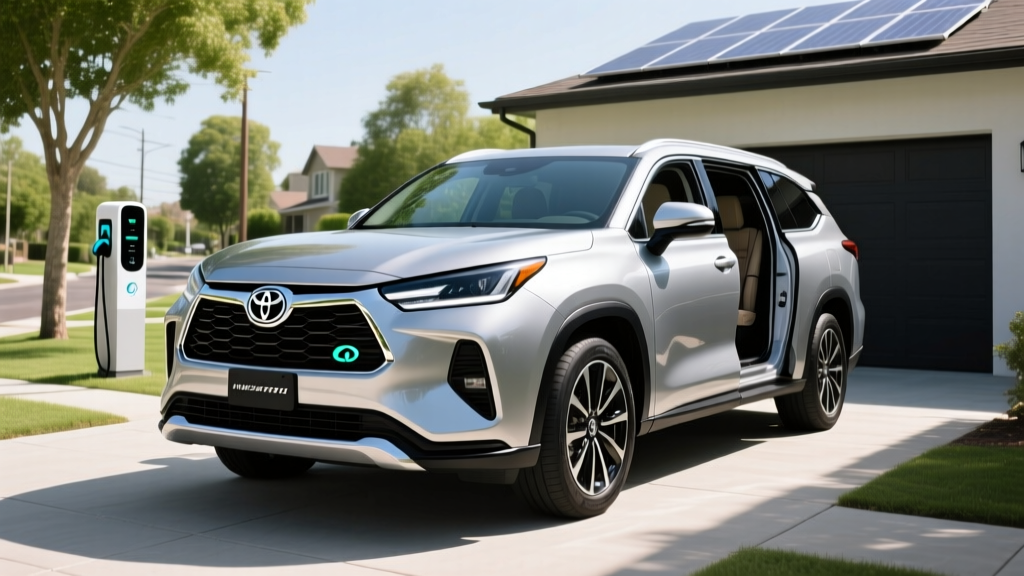
The 2026 Toyota Highlander Hybrid Platinum sits at the top of Toyota's three-row hybrid SUV lineup, pairing a 2.5-liter four-cylinder engine with a dual-motor hybrid system for 243 combined horsepower and an EPA-estimated 35 MPG combined. For families who need three rows, standard all-wheel drive, and zero plug-in hassle, the Platinum trim adds premium features — panoramic roof, heated and ventilated front seats, a 12.3-inch infotainment display, and Toyota Safety Sense 3.0 — while maintaining the fuel-sipping efficiency that defines the Highlander Hybrid line.
This is a conventional hybrid (HEV), not a plug-in hybrid (PHEV). You never plug it in; the battery charges through regenerative braking and the gasoline engine. If you need electric-only driving or federal tax credit eligibility, you'll want to look at a PHEV or full EV instead — more on that below.
| Spec | Value |
|---|---|
| Powertrain | 2.5L 4-cyl + dual electric motors (AWD-i) |
| Combined Horsepower | 243 HP |
| EPA MPG (City / Hwy / Combined) | 35 / 35 / 35 |
| Fuel Tank | 17.1 gallons |
| Total Range (est.) | ~598 miles |
| Drivetrain | Electronic On-Demand AWD (standard) |
| 0–60 mph | ~7.8 seconds |
| Towing Capacity | 3,500 lbs |
| Cargo (behind 3rd / 2nd / 1st row) | 16.1 / 48.4 / 84.3 cu ft |
| Hybrid Battery Warranty | 10 years / 150,000 miles |
| Base MSRP (Platinum AWD) | ~$54,070 |
How Many MPG Does the Highlander Hybrid Platinum Get?
The EPA rates the 2026 Highlander Hybrid at 35 MPG city, 35 MPG highway, and 35 MPG combined across all trims with AWD-i, including the Platinum. This uniformity is unusual — most vehicles lose efficiency in city driving, but Toyota's hybrid system recovers energy through regenerative braking, making stop-and-go traffic an efficiency advantage rather than a penalty.
| Driving Condition | EPA Estimate | Real-World Expectation |
|---|---|---|
| City | 35 MPG | 36–38 MPG (regen-heavy routes) |
| Highway (70 mph) | 35 MPG | 30–33 MPG (sustained high speed) |
| Combined | 35 MPG | 33–36 MPG (mixed driving) |
| Cold Weather (below 32°F) | — | 28–32 MPG (engine runs more for cabin heat) |
Real-world note: In mixed suburban and highway driving, owners commonly report 33–36 MPG combined. City-dominant commutes with frequent stops can push the number above the EPA estimate to 37 or even 38 MPG, thanks to aggressive regenerative braking. Sustained highway driving at 75–80 mph drops efficiency to roughly 30–33 MPG because the electric motors contribute less at constant speed and the 2.5L engine carries more of the load. In sub-freezing temperatures, expect a 10–15% reduction as the engine runs more frequently to provide cabin heat and maintain battery temperature.
At current national fuel prices (~$3.25/gallon for regular unleaded as of early 2026), filling the 17.1-gallon tank costs roughly $56 and delivers approximately 598 miles of range. That works out to about $0.093 per mile in fuel cost — a meaningful savings versus the non-hybrid turbocharged Highlander, which returns roughly 24 MPG combined and costs about $0.135 per mile to fuel.
HEV vs PHEV vs EV: Which Powertrain Fits Your Family?
The Highlander Hybrid is a conventional hybrid (HEV). Toyota does not currently offer a plug-in hybrid (PHEV) version of the Highlander in the U.S. market. Understanding the distinction is critical before you shop:
| Feature | HEV (Highlander Hybrid) | PHEV (e.g., RAV4 Prime) | BEV (e.g., Tesla Model X) |
|---|---|---|---|
| Plug in to charge? | No — self-charging | Yes — Level 1 or Level 2 | Yes — Level 2 or DC fast |
| Electric-only range | None (motor assists engine) | 20–42 miles typical | 250–350+ miles |
| Battery size | ~1.6 kWh (small buffer) | ~18 kWh usable | 75–100+ kWh |
| Federal tax credit (§30D) | Not eligible | Up to $7,500 (if eligible) | Up to $7,500 (if eligible) |
| Gasoline required? | Yes — primary fuel | Yes — backup after EV range | No |
| Home charging needed? | No | Recommended for EV range | Essential |
Choose the Highlander Hybrid (HEV) if:
- You lack access to home or workplace charging (apartment, street parking, no garage)
- You regularly take long road trips and don't want to plan around charging stops
- You want three rows and AWD with minimal complexity
- You want proven reliability with no new charging habits to learn
Choose a PHEV (like the Toyota RAV4 Prime or Hyundai Tucson PHEV) if:
- You can charge at home and most daily driving is under 30 miles
- You want electric-only commuting but still need gas for road trips
- You want to capture the §30D federal tax credit (income and sourcing rules apply)
Choose a full BEV (like the Kia EV9 or Tesla Model X) if:
- You have reliable Level 2 home charging
- You want the lowest per-mile fuel cost and zero tailpipe emissions
- Most trips are under 250 miles, or you're willing to use DC fast charging on road trips
Powertrain and Performance: 243 HP with AWD-i
The 2026 Highlander Hybrid uses Toyota's fourth-generation hybrid system. A 2.5-liter Atkinson-cycle four-cylinder engine produces 186 HP and is supplemented by two electric motor-generators — one driving the front axle and a second powering the rear axle via Toyota's AWD-i (electronic on-demand all-wheel drive). Combined system output is 243 horsepower.
The AWD-i system is fully electronic: there is no mechanical driveshaft connecting the front and rear axles. The rear electric motor engages automatically when slip is detected or when additional traction is needed, such as during acceleration from a stop or on wet pavement. This approach saves weight and reduces drivetrain losses compared to a traditional mechanical AWD system.
Acceleration to 60 mph takes approximately 7.8 seconds — adequate for highway merging and passing but not quick by the standards of turbocharged or electric competitors. The continuously variable transmission (eCVT) prioritizes smoothness and efficiency over sportiness. Under hard acceleration, the engine drones at high RPM, a common characteristic of Toyota's planetary-gear hybrid systems. In normal driving, the powertrain is refined and quiet, with seamless transitions between electric-only and hybrid modes at low speeds.
The Highlander Hybrid is rated to tow 3,500 pounds, sufficient for a small boat trailer or a pair of personal watercraft but not enough for a mid-size travel trailer. If you need 5,000-pound towing, the turbocharged non-hybrid Highlander or a body-on-frame SUV is a better fit.
Platinum Trim: What You Get for ~$54,070
The Platinum is the top-of-the-line Highlander Hybrid trim. For the 2026 model year, the MSRP starts at approximately $54,070 (including destination). Key Platinum-exclusive features include:
- Panoramic glass roof with power sunshade
- Heated and ventilated front seats; heated second-row seats
- 12.3-inch touchscreen with wireless Apple CarPlay and Android Auto
- 11-speaker JBL premium audio system
- Head-up display (HUD)
- 360-degree surround-view camera
- Digital rearview mirror
- Toyota Safety Sense 3.0 (pre-collision, lane tracing, adaptive cruise, road sign assist)
- 20-inch alloy wheels
The price premium over the mid-level Limited trim (~$50,070) is roughly $4,000 and is justified primarily by the panoramic roof, ventilated seats, and the upgraded camera and mirror systems. If those features aren't essential, the Limited delivers nearly identical fuel economy and powertrain performance at a lower entry point.
Tax Credits and Incentives: What Applies to the Highlander Hybrid?
The 2026 Toyota Highlander Hybrid is a conventional HEV and does not qualify for the federal §30D Clean Vehicle Credit, which requires a plug-in electric vehicle with a minimum battery capacity of 7 kWh. This means no $7,500 federal credit and no point-of-sale transfer at the dealer.
However, there are still financial considerations:
- State incentives: A handful of states offer rebates or tax credits for conventional hybrids, though these are increasingly rare as policy shifts toward PHEVs and BEVs. Check your state's energy or environmental agency website for current programs.
- Fuel savings: Compared to the non-hybrid Highlander (24 MPG combined), the Hybrid saves approximately $600–$800 per year in fuel costs at 15,000 miles annually and $3.25/gallon. Over a typical 7-year ownership period, that's $4,200–$5,600 in fuel savings.
- Insurance: Hybrid SUVs typically carry insurance premiums similar to their gas counterparts. The Highlander Hybrid is not subject to the premium surcharges that some high-performance EVs face.
If capturing the federal tax credit is a priority, consider the Toyota RAV4 Prime (PHEV, 42 miles electric-only, up to $7,500 credit if eligible) or a three-row BEV like the Kia EV9. Per the IRS §30D guidelines, PHEV and EV credit eligibility depends on buyer income caps, vehicle MSRP caps, and battery critical-mineral sourcing requirements that change annually.
Hybrid Battery Warranty, Lifespan, and Replacement Cost
Toyota Hybrid Battery Warranty: 10 years or 150,000 miles, whichever comes first. This covers the hybrid battery pack and related hybrid system components against defects and abnormal capacity loss.
Toyota's hybrid battery warranty is among the strongest in the industry and reflects decades of real-world data from the Prius, Camry Hybrid, and Highlander Hybrid lineages. The Highlander Hybrid uses a nickel-metal hydride (NiMH) battery pack — a mature, proven chemistry that Toyota has refined over 25+ years of hybrid production. Unlike the lithium-ion packs in PHEVs and BEVs, NiMH packs are less energy-dense but extremely durable under the shallow charge-discharge cycles that conventional hybrids use.
Real-world longevity: Data from fleet operators, taxi services, and long-term owners consistently shows Toyota NiMH hybrid batteries lasting 150,000–200,000+ miles with minimal degradation. The battery never fully charges or fully discharges — the hybrid system keeps it in a narrow state-of-charge window (roughly 40–80%) to minimize wear. Failures before 100,000 miles are uncommon.
Replacement cost if out of warranty: A new OEM hybrid battery pack for the Highlander Hybrid typically costs $3,000–$5,000 installed at a Toyota dealer. Refurbished or reconditioned packs from third-party suppliers run $1,500–$2,500 installed. Individual module replacement (if only one or two cells fail) can bring the cost below $1,000 at a hybrid-specialist shop. For context, this is far less than the $10,000–$20,000+ replacement cost for a large lithium-ion pack in a full EV.
According to Toyota's official warranty documentation, the hybrid battery warranty is fully transferable to subsequent owners, which supports strong resale value for the Highlander Hybrid in the used market.
Real-World Ownership: Daily Driving, Road Trips, and Practicality
The Highlander Hybrid Platinum excels in the scenarios where families spend most of their time: school runs, grocery trips, suburban commutes, and weekend road trips. Here's what ownership actually looks like:
Daily commuting: In stop-and-go traffic, the hybrid system is at its best. The electric motor handles low-speed movement silently, the engine shuts off at stops, and regenerative braking recaptures energy that a gas car would waste as heat. Expect 36–38 MPG on city-dominant routes.
Road trips: With ~598 miles of total range, the Highlander Hybrid can cover most single-day drives without refueling. On a 600-mile trip at highway speeds, expect two fuel stops and an observed average of 30–33 MPG. There is no range anxiety, no charging-station planning, and no wait times — you fill up in five minutes at any gas station, exactly like a conventional vehicle.
Three-row practicality: The third row accommodates children or smaller adults for short trips. Behind the third row, 16.1 cubic feet of cargo space is tight for a week's worth of family luggage — you'll need to fold the third row for larger hauling tasks. The second row slides and reclines for comfort, and the Platinum's heated second-row seats are a welcome feature in cold climates.
Cold-weather performance: The standard AWD-i system provides confident traction on snow and ice. In sub-freezing temperatures, the gasoline engine runs more frequently to provide cabin heat, which drops observed fuel economy to roughly 28–32 MPG. Unlike a BEV, there is no range loss from battery cold-soak — the engine simply burns a bit more fuel.
Pros
- 35 MPG combined in a three-row AWD SUV — best-in-class efficiency
- No plug-in charging required; zero lifestyle change from a gas car
- Proven hybrid system with 10-year / 150,000-mile battery warranty
- ~598 miles of total range eliminates road-trip fuel stops
- Strong resale value and low depreciation for the segment
- Toyota Safety Sense 3.0 standard on all trims
Cons
- 243 HP feels modest for a 4,500-lb SUV; passing acceleration is just adequate
- No federal tax credit eligibility (HEV, not PHEV or BEV)
- Third row is tight for adults on longer drives
- Platinum trim pushes past $54K with no luxury badge cachet
- eCVT drone under hard acceleration is noticeable
- Towing limited to 3,500 lbs (non-hybrid Highlander tows 5,000 lbs)
Frequently Asked Questions
How many MPG does the 2026 Toyota Highlander Hybrid Platinum get?
The EPA rates it at 35 MPG city, 35 MPG highway, and 35 MPG combined. In real-world driving, expect 33–36 MPG combined, with city-dominant routes reaching 36–38 MPG and sustained highway driving dropping to 30–33 MPG.
Does the Highlander Hybrid need to be plugged in?
No. The Highlander Hybrid is a conventional hybrid (HEV). The battery charges itself through regenerative braking and the gasoline engine. You never plug it in — you simply fill it with gasoline like any other car.
Is there a plug-in hybrid (PHEV) version of the Highlander?
Not in the U.S. market as of the 2026 model year. Toyota offers the RAV4 Prime as a PHEV with 42 miles of electric-only range, but the Highlander remains a conventional hybrid only. If you need three rows and plug-in capability, look at the Chrysler Pacifica PHEV (minivan) or the Kia EV9 (fully electric three-row SUV).
Does the Highlander Hybrid qualify for any federal tax credit?
No. The IRS §30D Clean Vehicle Credit requires a plug-in vehicle with a battery capacity of at least 7 kWh. The Highlander Hybrid's small NiMH pack does not meet this threshold. Only PHEVs and BEVs are eligible.
How long will the hybrid battery last, and what does replacement cost?
Toyota warranties the hybrid battery for 10 years or 150,000 miles. Real-world data shows these NiMH packs commonly lasting 150,000–200,000+ miles. If replacement is needed out of warranty, expect $3,000–$5,000 for a new OEM pack or $1,500–$2,500 for a refurbished unit, installed.
Is the Highlander Hybrid reliable?
Toyota's hybrid powertrain has an extensive track record spanning 25+ years. According to Consumer Reports and long-term owner surveys, the Highlander Hybrid consistently earns above-average reliability ratings. The hybrid system has fewer wear components than a conventional powertrain — no traditional starter motor, no alternator, and regenerative braking extends brake pad life significantly.
How does the Highlander Hybrid compare to a full electric SUV?
A BEV like the Tesla Model X or Kia EV9 offers lower per-mile fuel costs (~$0.04–$0.06/mile vs. ~$0.09/mile for the Hybrid), instant torque, and zero tailpipe emissions. However, BEVs require home charging infrastructure, cost more upfront, and require planning for road trips exceeding 250–300 miles. The Highlander Hybrid is the pragmatic choice for buyers who want efficiency without altering their fueling habits or who lack reliable charging access.
What is the towing capacity of the Highlander Hybrid?
The 2026 Highlander Hybrid is rated to tow 3,500 pounds across all trims. This is sufficient for a small utility trailer, a pair of jet skis, or a light pop-up camper, but not enough for most mid-size travel trailers. The non-hybrid turbocharged Highlander tows up to 5,000 pounds if heavy towing is a priority.