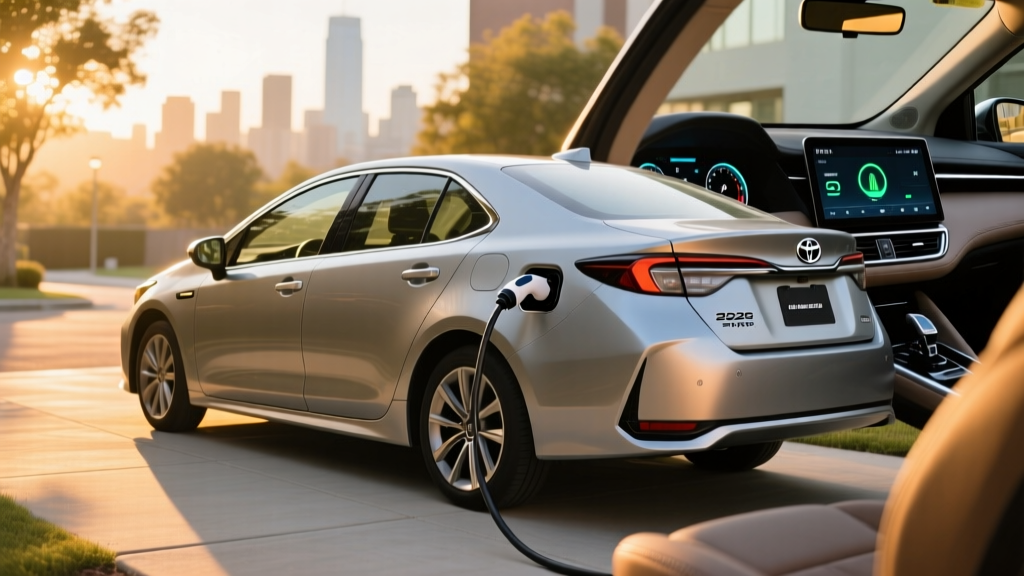
The 2026 Toyota Corolla Hybrid sedan occupies a precise niche: maximum fuel efficiency with zero plug-in complexity. It is a conventional hybrid electric vehicle (HEV), not a plug-in hybrid (PHEV), meaning you never plug it in — the gasoline engine and regenerative braking handle all battery charging. For buyers who want Prius-level efficiency in a traditional sedan silhouette with a sub-$25,000 starting price, the Corolla Hybrid remains one of the most data-compelling choices on the market.
This guide covers every number that matters: EPA fuel economy, real-world MPG expectations, powertrain output, battery warranty, pricing by trim, and a clear framework for deciding whether this HEV, a PHEV, or a full battery-electric vehicle (BEV) fits your driving life.
HEV vs PHEV: What the Corolla Hybrid Actually Is
Before examining specs, the distinction matters because it affects your daily routine, your fuel bill, and your tax situation.
| Feature | Corolla Hybrid (HEV) | Plug-In Hybrid (PHEV) Example | Battery Electric (BEV) |
|---|---|---|---|
| Plugs in? | No — self-charging | Yes — 120V or 240V | Yes — 120V, 240V, or DC fast |
| Electric-only driving | Very short bursts (~1 mi at low speed) | 25–45 miles typical | 200–400+ miles |
| Gasoline engine | Yes — primary power + charges battery | Yes — kicks in after battery depletes | No |
| Fueling | Gas station only | Gas station + electrical outlet/charger | Electrical outlet/charger only |
| Federal tax credit (§30D) | Not eligible | Up to $7,500 if eligible | Up to $7,500 if eligible |
| Best for | No home charging access; want simplicity | Home charging + short commutes | Home charging + willingness to plan |
The 2026 Corolla Hybrid is firmly in column one. Toyota does not offer a Corolla PHEV in the United States. If you need plug-in electric range in the Toyota lineup, the RAV4 Prime is the closest analog, but it is an SUV priced considerably higher. The Corolla Hybrid's value proposition is simplicity: fill up with gas, drive, and let the hybrid system optimize the rest.
EPA Fuel Economy and Real-World MPG
The headline number for the 2026 Corolla Hybrid is an EPA-estimated 50 MPG combined for the LE trim with front-wheel drive. Here is the full breakdown by trim and drivetrain:
| Trim / Drivetrain | City MPG | Highway MPG | Combined MPG |
|---|---|---|---|
| LE (FWD) | 53 | 46 | 50 |
| SE (FWD) | 50 | 43 | 47 |
| LE (AWD-e) | 47 | 41 | 44 |
| SE (AWD-e) | 45 | 38 | 42 |
Source: fueleconomy.gov — EPA estimates. Your mileage will vary.
Real-World MPG: What to Actually Expect
Hybrids consistently outperform their EPA city ratings in stop-and-go traffic because regenerative braking recovers energy that a gas car wastes as heat. In real-world driving, Corolla Hybrid owners frequently report 52–56 MPG in city and suburban conditions during moderate temperatures.
Highway driving is where hybrids lose their advantage. At sustained 70–80 mph speeds, the gasoline engine does most of the work, and aerodynamic drag dominates. Expect 40–44 MPG on the highway in the LE FWD — slightly below the EPA highway sticker. Cold weather (below 35°F) reduces efficiency by roughly 10–15% because the engine runs more often to provide cabin heat and because battery chemistry is less efficient at low temperatures.
For a driver averaging 12,000 miles per year with a mix of city and highway driving in the LE FWD, annual fuel consumption works out to approximately 240 gallons. At $3.40 per gallon, that is roughly $816 per year in fuel — compared to about $1,280 for a comparable gas-only compact sedan rated at 30 MPG combined.
Powertrain: Engine, Motors, and Horsepower
The 2026 Corolla Hybrid uses Toyota's fifth-generation hybrid system, pairing a 1.8-liter Atkinson-cycle four-cylinder engine with two motor-generators and a lithium-ion hybrid battery pack.
| Specification | Detail |
|---|---|
| Engine | 1.8L 4-cylinder Atkinson-cycle |
| Engine output | 96 hp / 105 lb-ft torque |
| Electric motor (FWD) | 94 hp / 139 lb-ft (MG2 drive motor) |
| Net combined system horsepower | 138 hp |
| AWD-e rear motor | 41 hp (engages automatically under acceleration/low traction) |
| Hybrid battery | ~0.9 kWh lithium-ion (bipolar NiMH on prior gens; Li-ion since 2023 refresh) |
| Transmission | Electronically controlled CVT (eCVT — planetary gearset, no belt) |
| 0–60 mph | ~9.2 seconds (FWD) |
| Drivetrain | FWD standard; AWD-e available |
The 138 combined horsepower figure is modest. The Corolla Hybrid is not a performance car — it is an efficiency optimizer. The eCVT uses a planetary gearset rather than a traditional belt-and-pulley CVT, which eliminates the rubber-band feeling common in older CVTs and contributes to Toyota's strong hybrid reliability record. The AWD-e system adds a separate rear-mounted electric motor that engages only when needed, avoiding the drivetrain losses of a mechanical AWD system.
Pricing, Trims, and Tax Credit Eligibility
For 2026, the Corolla Hybrid is offered in LE and SE trims. Pricing starts well under most compact competitors when you factor in fuel savings over time.
| Trim | MSRP (approx.) | Key Features |
|---|---|---|
| LE FWD | $24,595 | 8" touchscreen, wireless CarPlay/Android Auto, TSS 3.0, 16" alloy wheels |
| LE AWD-e | $25,995 | Same as LE FWD + electronic on-demand AWD |
| SE FWD | $26,495 | Sport-tuned suspension, 18" wheels, paddle shifters, sport seats |
| SE AWD-e | $27,895 | SE features + AWD-e |
Pricing includes destination charge. Verify current MSRP at toyota.com.
Does the Corolla Hybrid Qualify for a Federal Tax Credit?
No. The 2026 Corolla Hybrid is a conventional HEV, and the IRS §30D Clean Vehicle Credit applies only to plug-in electric vehicles (PHEVs and BEVs) with a minimum battery capacity of 7 kWh. The Corolla Hybrid's sub-1 kWh battery does not qualify. There is currently no federal tax credit for conventional hybrids.
Some states offer rebates or incentives for high-efficiency vehicles, but these vary by jurisdiction and change frequently. Check your state energy office or the Alternative Fuels Data Center for current local programs.
Battery Warranty, Lifespan, and Replacement Cost
Toyota Hybrid Battery Coverage
- Warranty: 10 years / 150,000 miles (whichever comes first), applicable in all 50 states since the 2020 model year.
- Capacity threshold: Toyota covers defects and abnormal capacity loss; minor gradual degradation is expected and not covered.
- Hybrid system components: The inverter, transaxle, and hybrid control module are covered under the same 10-year/150,000-mile hybrid system warranty.
How Long Do Toyota Hybrid Batteries Actually Last?
Toyota's hybrid battery packs have an extensive real-world track record spanning over two decades (since the 2001 Prius). Data from fleet operators and long-term owners shows that most Toyota hybrid batteries last 150,000–200,000+ miles before significant degradation. The lithium-ion pack in the current-generation Corolla Hybrid is more energy-dense and thermally stable than the nickel-metal hydride packs in earlier models.
The key longevity factor is that the Corolla Hybrid's battery operates in a narrow state-of-charge window — typically between 40% and 80% SoC. The hybrid system controller never allows full depletion or full charge, which dramatically reduces cycle wear compared to a BEV battery that regularly cycles from 10% to 90%.
Battery Replacement Cost
If a replacement is needed outside of warranty, a new OEM hybrid battery pack for the Corolla Hybrid costs approximately $2,500–$3,500 including labor at a Toyota dealer. Independent hybrid specialists often offer refurbished packs for $1,500–$2,200. Given that most failures occur well beyond the 10-year warranty window and that the vehicle's residual value at that age is typically $4,000–$7,000, the economics of replacement are generally favorable compared to scrapping the car.
Corolla Hybrid vs PHEV vs BEV: Which Fits You?
The decision between a conventional hybrid, a plug-in hybrid, and a full electric vehicle depends on three variables: your charging access, your daily mileage, and your budget.
Choose the Corolla Hybrid (HEV) if:
- You do not have access to home or workplace Level 2 charging.
- You want the lowest purchase price (under $25K base) with no behavioral changes.
- Your driving is a mix of city and highway with no single dominant pattern.
- You want a car you can drive cross-country without any route planning.
- You prefer a traditional sedan form factor over a hatchback or SUV.
Choose a PHEV (e.g., Toyota Prius Prime) if:
- You can install a Level 2 charger at home or have reliable workplace charging.
- Your daily commute is under 40 miles round-trip (covering most days on electricity).
- You still want the freedom to drive long distances without charging stops.
- You want to qualify for the §30D federal tax credit (up to $7,500, subject to income and sourcing rules — verify at irs.gov).
Choose a BEV (e.g., Tesla Model 3, Hyundai Ioniq 6) if:
- You have reliable home Level 2 charging and your daily driving is under 200 miles.
- You want zero tailpipe emissions and the lowest per-mile energy cost.
- You are comfortable with route planning for road trips using DC fast charging.
- You want maximum federal and state incentives (up to $7,500 federal, plus state rebates).
For a buyer who rents an apartment without charging access, drives 30 miles per day in mixed conditions, and wants to spend under $26,000, the Corolla Hybrid is the optimal choice. It requires zero infrastructure investment and delivers roughly half the fuel cost of a comparable gas-only sedan.
Reliability, Safety, and Long-Term Ownership
Toyota's hybrid powertrain is among the most proven in the industry. The eCVT planetary gearset has no belts, clutches, or torque converter to wear out, and the regenerative braking system significantly extends brake pad life — many owners report 80,000–100,000 miles on original brake pads because the motor handles most deceleration.
The 2026 Corolla Hybrid comes standard with Toyota Safety Sense 3.0, which includes:
- Pre-Collision System with Pedestrian Detection
- Full-Speed Range Dynamic Radar Cruise Control
- Lane Departure Alert with Steering Assist
- Lane Tracing Assist
- Automatic High Beams
- Road Sign Assist
These are SAE Level 1–2 driver-assistance features. They support the driver but do not replace active attention — you must keep your hands on the wheel and eyes on the road at all times. The Corolla Hybrid is not a self-driving vehicle.
For crash-test ratings, check the latest results from the NHTSA and IIHS. The previous-generation Corolla sedan earned top marks from both agencies, and the hybrid variant shares the same platform structure.
Pros and Cons at a Glance
Pros
- 50 MPG combined (LE FWD) — among the highest of any non-plug-in vehicle
- Under $25,000 starting MSRP — lowest cost of entry in the hybrid sedan segment
- No plug-in required — works with existing gas-station infrastructure
- 10-year/150,000-mile hybrid battery warranty
- Standard Toyota Safety Sense 3.0 across all trims
- AWD-e available for snow-belt buyers
- Proven eCVT planetary gearset — no belt to fail
- Extended brake pad life from regenerative braking
Cons
- No federal tax credit eligibility (HEV, not PHEV/BEV)
- Modest 138 hp — 0–60 in ~9.2 seconds is leisurely
- Highway MPG drops to low 40s at sustained 75+ mph
- Small ~0.9 kWh battery means no meaningful electric-only range
- Cold weather reduces efficiency by 10–15%
- SE trim with 18" wheels sacrifices ~3 MPG vs LE
- Cargo space (13.1 cu ft trunk) trails some hatchback hybrids
Frequently Asked Questions
How many MPG does the 2026 Toyota Corolla Hybrid get?
The EPA rates the Corolla Hybrid LE FWD at 53 city / 46 highway / 50 combined MPG. The SE FWD drops slightly to 50/43/47. AWD-e models range from 42–44 combined. In real-world city driving, many owners exceed the EPA city estimate by 2–6 MPG thanks to regenerative braking. Highway driving at 75+ mph typically yields 40–44 MPG in the LE.
Can the Corolla Hybrid drive on electric power only?
Only in very limited circumstances — roughly 0.5–1 mile at speeds below 25 mph, such as creeping through a parking lot. The hybrid battery is too small (~0.9 kWh) to sustain electric-only driving at normal road speeds. The gasoline engine is the primary power source. If you want meaningful electric-only range (25–45 miles), you need a PHEV like the Prius Prime.
Does the 2026 Corolla Hybrid qualify for any tax credit?
No federal tax credit is available. The IRS §30D Clean Vehicle Credit requires a minimum 7 kWh battery and plug-in capability, which the Corolla Hybrid does not have. Some states may offer rebates for high-efficiency vehicles, but these vary by location and are subject to change. Always verify current incentives through official state and IRS sources.
Is the Corolla Hybrid reliable, and what does battery replacement cost?
Toyota's hybrid system has one of the strongest long-term reliability records in the automotive industry, with over 20 years of real-world data from Prius and Camry Hybrid fleets. The hybrid battery is warranted for 10 years/150,000 miles. Most batteries last 150,000–200,000+ miles. If replacement is needed out of warranty, expect $2,500–$3,500 for a new OEM pack or $1,500–$2,200 for a refurbished unit from an independent specialist.
Should I buy the Corolla Hybrid or a full electric vehicle?
If you have home Level 2 charging, drive under 200 miles daily, and want the lowest per-mile energy cost plus federal tax credits, a BEV like the Tesla Model 3 or Chevrolet Equinox EV may save more over five years. If you lack charging access, regularly drive long distances, or want the lowest upfront price with zero behavioral changes, the Corolla Hybrid is the better fit. The hybrid eliminates range anxiety entirely while still cutting fuel costs roughly in half compared to a gas-only compact sedan.
Does the AWD-e system affect fuel economy significantly?
Yes. The AWD-e models are rated 3–6 MPG lower combined than their FWD counterparts (44 combined for LE AWD-e vs 50 for LE FWD). The rear electric motor adds weight and minor drivetrain losses. If you live in a region with mild winters and rarely encounter snow or ice, the FWD model is the more efficient choice. The AWD-e system engages automatically and only when needed — there is no driver-selectable mode.
How does the Corolla Hybrid compare to the Prius?
The 2026 Prius offers more power (194 hp FWD), slightly higher combined MPG (57 for LE), and a hatchback cargo area, but starts around $29,000 — roughly $4,500 more than the Corolla Hybrid LE. The Prius also offers the Prius Prime PHEV variant with ~44 miles of electric-only range. If budget is the primary constraint and you prefer a trunk over a hatchback, the Corolla Hybrid delivers nearly the same efficiency at a lower price point.