Quick Verdict: The AWD Hybrid That Actually Delivers 50 MPG
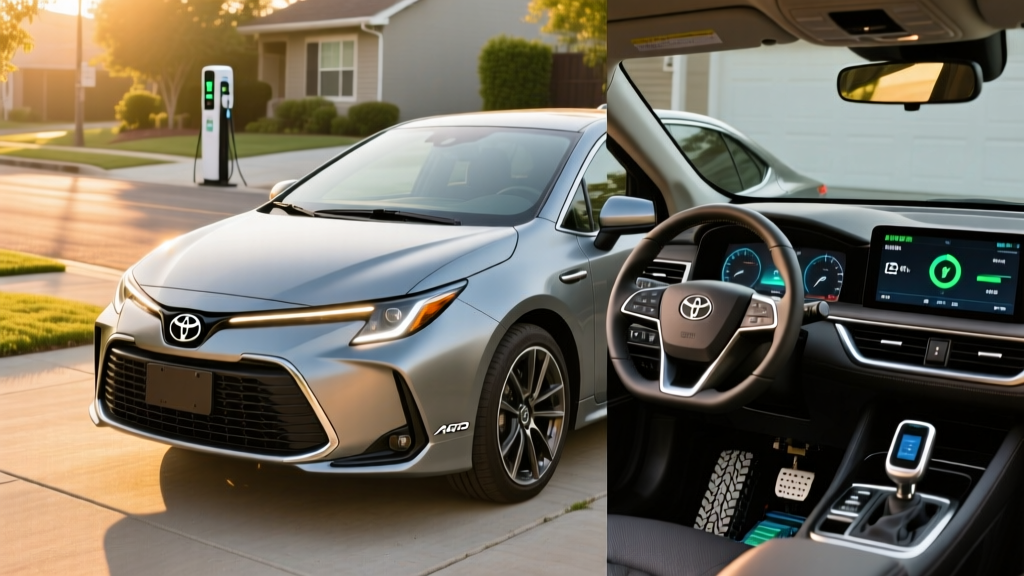
The 2026 Toyota Corolla Hybrid AWD occupies a narrow but highly practical lane in the electrified-vehicle market: it offers genuine all-wheel-drive traction, 50 MPG combined EPA fuel economy, and a starting MSRP under $25,000 — without ever needing to be plugged in. For buyers in snow-belt states who want hybrid efficiency but aren't ready for a full battery-electric vehicle or the plug-in logistics of a PHEV, the Corolla Hybrid AWD is arguably the most pragmatic compact sedan available.
This guide breaks down the exact specs, real-world fuel economy expectations, powertrain details, warranty coverage, and ownership costs you need to decide whether the 2026 Corolla Hybrid AWD fits your commute — or whether a PHEV or full BEV makes more sense.
| Spec | Value |
|---|---|
| Powertrain | 1.8L 4-cyl + dual electric motors (AWD-e) |
| Combined Horsepower | 138 hp (net system) |
| EPA MPG (City / Hwy / Combined) | 53 / 46 / 50 MPG |
| Fuel Tank Capacity | 11.4 gallons |
| Estimated Total Range | ~570 miles |
| Drivetrain | Electronic AWD (rear motor, on-demand) |
| 0-60 mph | ~9.0 seconds (est.) |
| Battery Type | Lithium-ion hybrid pack (~1.3 kWh) |
| Hybrid Battery Warranty | 10 years / 150,000 miles |
| Base MSRP (LE AWD) | $24,600 |
| Federal Tax Credit (§30D) | Not eligible (HEV, not PHEV/BEV) |
HEV vs. PHEV: Why the Corolla Hybrid Doesn't Plug In
One of the most common points of confusion for shoppers entering the electrified-vehicle space is the difference between a conventional hybrid (HEV) and a plug-in hybrid (PHEV). The 2026 Corolla Hybrid AWD is a conventional hybrid (HEV) — meaning it never plugs into a wall outlet or charging station. Its small lithium-ion battery pack recharges entirely through regenerative braking and the gasoline engine.
| Factor | HEV (Corolla Hybrid) | PHEV (e.g., Prius Prime) | BEV (e.g., Tesla Model 3) |
|---|---|---|---|
| Plug-in Required? | No | Yes (Level 1/2) | Yes (Level 2/DC) |
| Electric-Only Range | ~1 mile at low speed | 35-44 miles typical | 250-350+ miles |
| Gasoline Engine? | Yes | Yes | No |
| Federal Tax Credit | None | Up to $7,500 (§30D) | Up to $7,500 (§30D) |
| Home Charging Needed? | No | Recommended | Essential |
| Best For | No-plug commuters, AWD needs | Short EV commutes + road trips | Home chargers, low running costs |
If you're comparing the Corolla Hybrid to the Toyota Prius Prime (a PHEV), the trade-off is straightforward: the Prius Prime gives you 44 miles of electric-only driving per EPA estimates, but requires home charging access to realize those savings and starts at a higher MSRP. The Corolla Hybrid asks nothing of you beyond filling up with gas — and returns 50 MPG doing it.
Fuel Economy: EPA Numbers vs. Real-World MPG
The EPA rates the 2026 Corolla Hybrid AWD at 53 city / 46 highway / 50 combined MPG, according to fueleconomy.gov. These are among the highest combined figures of any AWD vehicle sold in the U.S.
| Driving Condition | EPA Rating | Real-World Expectation |
|---|---|---|
| City | 53 MPG | 52-58 MPG (hybrids often exceed EPA in stop-and-go) |
| Highway (70 mph) | 46 MPG | 42-47 MPG (aerodynamic drag and speed reduce hybrid advantage) |
| Combined | 50 MPG | 47-54 MPG depending on mix |
| Cold Weather (below 30°F) | — | 40-45 MPG (engine runs more for cabin heat, battery less efficient) |
Why city MPG beats highway MPG in a hybrid: The Corolla Hybrid's electric motors do the heavy work at low speeds and during acceleration — precisely where gasoline engines are least efficient. Regenerative braking recovers energy in stop-and-go traffic. On the highway, the gasoline engine carries most of the load, and aerodynamic drag increases exponentially above 65 mph, eroding the hybrid advantage.
Cold-weather reality: Expect a 10-15% fuel economy reduction in sustained sub-freezing temperatures. The engine must run more frequently to provide cabin heat (the Corolla Hybrid lacks a heat pump, which is a BEV/PHEV feature), and the hybrid battery operates less efficiently when cold. Owners in Minnesota or Maine should budget for 40-45 MPG in January, not 50.
Powertrain Deep Dive: How the AWD-e System Works
The 2026 Corolla Hybrid AWD uses Toyota's fifth-generation hybrid system, pairing a 1.8-liter Atkinson-cycle four-cylinder engine with two motor-generators up front and a separate rear-mounted electric motor for all-wheel drive.
- Gasoline engine: 1.8L inline-4, ~96 hp on its own
- Front electric motors: Two motor-generators (MG1 for starting/charging, MG2 for propulsion and regen)
- Rear electric motor (AWD-e): Independent 41-hp motor powering the rear axle on demand
- Net system horsepower: 138 hp
- Transmission: eCVT (planetary gearset, not a belt-driven CVT)
The AWD-e system is fully electronic — there is no mechanical driveshaft connecting the front and rear axles. The rear motor engages automatically during acceleration from a stop, in low-traction conditions (snow, rain, gravel), and during certain cornering scenarios. At steady highway cruising, the car operates as a front-wheel-drive hybrid to maximize efficiency. This is why the AWD penalty on fuel economy is minimal: the Corolla Hybrid AWD loses only about 2-3 MPG combined versus the FWD Corolla Hybrid.
Performance is adequate rather than quick. The 0-60 mph time sits around 9.0 seconds. This is a car optimized for efficiency and composure, not acceleration. Merging onto freeways requires planning, but the electric motor's instant torque gives responsive low-speed pull around town.
Pricing, Trims, and Tax Credit Reality
The 2026 Corolla Hybrid AWD is available in two trims:
- LE AWD: Starting at approximately $24,600 MSRP (includes destination)
- SE AWD: Starting at approximately $26,800 MSRP (sport-tuned suspension, 16" alloy wheels, paddle shifters)
At these prices, the Corolla Hybrid AWD undercuts most competing AWD hybrids and crossovers by thousands of dollars. For context, the Subaru Crosstrek Hybrid (a PHEV) starts above $36,000, and the Toyota RAV4 Hybrid AWD starts near $33,000.
Federal Tax Credit Eligibility
§30D Tax Credit Status: Not Eligible. The Corolla Hybrid is a conventional HEV, not a plug-in vehicle. Under current IRS §30D rules, only battery-electric vehicles (BEVs) and plug-in hybrids (PHEVs) with sufficient battery capacity qualify for the federal clean vehicle credit. The Corolla Hybrid's ~1.3 kWh battery pack is far below the 7 kWh minimum threshold for PHEV eligibility.
No federal income tax credit applies. However, some states offer rebates or HOV lane access for hybrids — check your state's energy office or DMV for local programs.
If the federal tax credit is a priority in your purchase decision, you would need to look at a PHEV like the Toyota Prius Prime (eligible for up to $7,500 under §30D, subject to income caps of $150K single / $300K joint, MSRP caps of $55K for sedans, and battery sourcing requirements) or a full BEV.
Battery Longevity, Warranty, and Replacement Costs
Hybrid battery lifespan is the single most cited concern among first-time hybrid buyers. Here's what the data shows for Toyota's hybrid systems:
Warranty: Toyota covers the 2026 Corolla Hybrid's battery pack for 10 years or 150,000 miles (whichever comes first) in all 50 states. This is one of the longest hybrid battery warranties in the industry and applies to capacity loss and defect.
Real-world longevity data: Toyota's hybrid battery packs — across the Prius, Camry Hybrid, RAV4 Hybrid, and Corolla Hybrid families — routinely last 150,000-200,000+ miles before significant degradation. The Corolla Hybrid's relatively small lithium-ion pack (~1.3 kWh usable) undergoes shallow charge/discharge cycles managed by the hybrid control system, which avoids the deep cycling that accelerates degradation in full EVs. Toyota deliberately keeps the state of charge in a narrow middle band (roughly 40-80%) to maximize cycle life.
Replacement cost if out of warranty: Based on current Toyota hybrid battery replacement pricing, expect approximately $2,500-$4,000 for a new or remanufactured hybrid battery pack, including labor. This is dramatically less than a BEV traction battery replacement ($10,000-$20,000+). Independent hybrid battery specialists also offer cell-level repairs for $500-$1,500, replacing only degraded modules rather than the entire pack.
Overall Reliability
Toyota's hybrid powertrain is among the most proven in the automotive industry, with over 25 years of continuous production since the original 1997 Prius. The eCVT transmission (a planetary gearset with no belts, clutches, or bands to wear out) is mechanically simpler and more durable than conventional automatic or belt-driven CVT transmissions. IIHS crash-test ratings and NHTSA data should be consulted for the latest safety scores as they become available for the 2026 model year.
Who Should Buy the Corolla Hybrid AWD — And Who Shouldn't
Choose the 2026 Corolla Hybrid AWD if:
- You live in a region with snow, ice, or frequent rain and want AWD traction without the fuel-economy penalty of a conventional AWD gas car
- You don't have access to home or workplace charging (apartment, street parking, no garage outlet)
- Your daily commute is under 50 miles and you want to minimize fuel costs without thinking about plugging in
- You want a proven, low-risk powertrain with a 10-year battery warranty and minimal maintenance
- Your budget is under $27,000 for a new AWD vehicle
Look elsewhere if:
- You want electric-only driving for short commutes — consider a PHEV like the Prius Prime or RAV4 Prime
- You want to eliminate gasoline entirely — a full BEV like the Chevrolet Equinox EV or Tesla Model 3 is the answer (with home charging)
- You need more than 138 hp for mountain driving or aggressive merging — the Corolla Hybrid is adequate, not quick
- You qualify for the full $7,500 federal tax credit and want to apply it — that benefit requires a PHEV or BEV
- You need cargo space for a family — the Corolla sedan's 13.1 cu-ft trunk is modest; consider the RAV4 Hybrid or a crossover
Ownership Costs: 5-Year Fuel Savings vs. a Gas Car
At 50 MPG combined, the Corolla Hybrid AWD's fuel cost advantage over a comparable gas-only AWD compact is significant. Here's a simplified 5-year/75,000-mile comparison using AAA's national average gas price of ~$3.30/gallon (as of early 2026):
| Vehicle | Combined MPG | Gallons Used | Total Fuel Cost |
|---|---|---|---|
| 2026 Corolla Hybrid AWD | 50 | 1,500 | $4,950 |
| 2026 Subaru Impreza AWD (gas) | 30 | 2,500 | $8,250 |
| Savings with Corolla Hybrid | $3,300 |
That $3,300 fuel savings over five years effectively closes the price gap between the Corolla Hybrid AWD and many gas-only AWD competitors. Factor in Toyota's strong resale values and low maintenance costs (no transmission fluid changes, no starter motor, no alternator — the hybrid system handles those functions), and total cost of ownership is highly competitive.
Pros and Cons at a Glance
Pros
- 50 MPG combined EPA — exceptional for an AWD vehicle
- Sub-$25,000 starting price for AWD hybrid
- No plug-in charging required — works with any gas station
- 10-year / 150,000-mile hybrid battery warranty
- Proven 5th-gen Toyota hybrid system reliability
- Standard Toyota Safety Sense 3.0 (ADAS suite)
- Low total cost of ownership
Cons
- 138 hp is modest — highway merging requires patience
- No federal tax credit (HEV, not PHEV/BEV)
- Compact sedan trunk (13.1 cu ft) limits cargo utility
- Cabin noise under hard acceleration (CVT drone)
- Rear seat space is tighter than competitors like the Hyundai Elantra
- No DC fast charging capability (not applicable to HEVs)
- Cold-weather MPG drops 10-15% without a heat pump
Frequently Asked Questions
How many MPG does the 2026 Corolla Hybrid AWD get in real-world driving?
The EPA rates it at 53 city / 46 highway / 50 combined. In real-world mixed driving, most owners report 47-54 MPG depending on conditions. City driving with frequent stops often exceeds the EPA city rating because regenerative braking recovers energy. Highway driving at 75+ mph will fall below the EPA highway estimate. In cold weather (below 30°F), expect 40-45 MPG.
Does the Corolla Hybrid AWD need to be plugged in?
No. The Corolla Hybrid is a conventional hybrid (HEV). Its battery recharges through regenerative braking and the gasoline engine. You fuel it exclusively at gas stations — no home charger, no public charging, no plug of any kind.
Does it qualify for any federal tax credit?
No. Under current IRS §30D rules, only plug-in vehicles (BEVs and PHEVs) with battery packs of at least 7 kWh qualify. The Corolla Hybrid's ~1.3 kWh pack makes it ineligible. If the federal tax credit matters to you, consider the Toyota Prius Prime PHEV, which qualifies for up to $7,500 (subject to income, MSRP, and sourcing requirements).
How long will the hybrid battery last, and what does replacement cost?
Toyota's hybrid battery packs routinely last 150,000-200,000+ miles based on long-term owner data across the Toyota hybrid lineup. The battery is warranted for 10 years / 150,000 miles. Out-of-warranty replacement costs approximately $2,500-$4,000 for a new or remanufactured pack. Cell-level repairs from independent shops can cost $500-$1,500.
Hybrid vs. PHEV vs. EV — which is right for me?
Choose the Corolla Hybrid (HEV) if you can't plug in at home and want maximum simplicity with strong MPG. Choose a PHEV (like the Prius Prime) if you have home charging and want 35-44 miles of electric-only commuting plus a gas engine for road trips. Choose a full BEV (like the Tesla Model 3 or Chevrolet Equinox EV) if you have reliable home charging, want to eliminate gas entirely, and qualify for the federal tax credit.
Is the AWD system always active?
No. The rear electric motor (AWD-e) engages on demand — during initial acceleration, low-traction conditions, and certain cornering scenarios. At steady cruising speeds on dry pavement, the car operates as front-wheel drive to preserve fuel economy. This on-demand approach is why the AWD MPG penalty is only 2-3 MPG versus the FWD Corolla Hybrid.
What are the main competitors to the Corolla Hybrid AWD?
Direct competitors are limited. The Hyundai Elantra Hybrid offers slightly higher MPG but is FWD only. The Subaru Impreza offers AWD but no hybrid option (30 MPG combined). The Toyota Prius AWD delivers similar MPG in a hatchback body. The RAV4 Hybrid AWD offers more space but starts $8,000+ higher. In the sub-$27K AWD hybrid segment, the Corolla Hybrid has few true rivals.