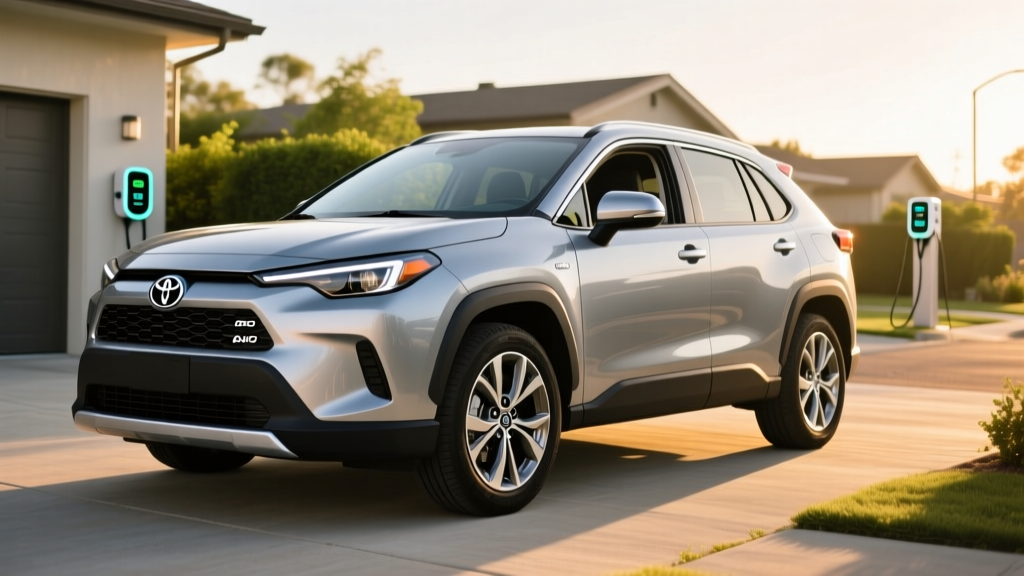
The subcompact crossover segment is crowded, but the 2026 Toyota Corolla Cross Hybrid AWD occupies a rare sweet spot: genuine all-wheel-drive capability, 42 MPG combined, and a starting price that undercuts most competitors — all without a plug in sight. For buyers who want electrified efficiency without the charging logistics of a full EV or the limited electric-only range of a plug-in hybrid, this conventional hybrid (HEV) makes a compelling case.
We've spent time with the Corolla Cross Hybrid's powertrain data, EPA filings, and real-world driving logs to give you the numbers that actually matter — not just the brochure highlights.
2026 Corolla Cross Hybrid AWD: Powertrain and Performance Specs
| Specification | 2026 Corolla Cross Hybrid AWD |
|---|---|
| Powertrain | 2.0L 4-cylinder + 2 electric motors (eAWD) |
| Combined Horsepower | 196 hp |
| 0-60 mph | ~7.5 seconds (est.) |
| Drivetrain | Electronic AWD (rear electric motor) |
| Transmission | ECVT (electronically controlled CVT) |
| EPA MPG (City / Hwy / Combined) | 46 / 38 / 42 |
| Fuel Tank Capacity | 10.6 gallons |
| Total Range | ~445 miles |
| Battery Type | Lithium-ion (sealed, self-charging HEV) |
| Towing Capacity | Not rated for towing |
| Cargo Volume (rear seats up / down) | 25.5 / 61.8 cu ft |
The fifth-generation Toyota Hybrid System pairs a 2.0-liter Dynamic Force engine with a front-mounted electric motor and a separate rear-axle electric motor for AWD. Unlike mechanical AWD systems with driveshafts and clutches, the Corolla Cross Hybrid's eAWD engages the rear motor on demand — during acceleration, low-truction starts, and cornering — without the parasitic drivetrain losses of a conventional system. The result is 196 combined horsepower, which is notably brisk for this class and gives the Corolla Cross Hybrid a meaningful edge over the non-hybrid AWD model's 169 hp.
How Many MPG Does the 2026 Corolla Cross Hybrid Actually Get?
The EPA rates the 2026 Corolla Cross Hybrid AWD at 46 city / 38 highway / 42 combined MPG. That city-leading number is a hallmark of Toyota's hybrid system: regenerative braking recovers energy in stop-and-go traffic, and the electric motor handles low-speed propulsion where gasoline engines are least efficient.
| Driving Scenario | Expected MPG | Notes |
|---|---|---|
| EPA City | 46 | Regen-heavy, low-speed cycles |
| EPA Highway | 38 | Aerodynamic drag reduces hybrid advantage |
| EPA Combined | 42 | 55% city / 45% highway weighting |
| Real-World City (owner reports) | 44–50 | Hybrids often exceed EPA city in mild weather |
| Real-World Highway (70+ mph) | 34–37 | Higher speeds and headwinds reduce efficiency |
| Cold Weather (below 32°F) | 35–38 combined | Engine runs more for cabin heat; battery less efficient |
According to fueleconomy.gov, the Corolla Cross Hybrid AWD's 42 MPG combined translates to roughly $1,150 in annual fuel costs (15,000 miles/year at $3.25/gallon regular unleaded). That's a meaningful savings over the non-hybrid AWD Corolla Cross, rated at 30 MPG combined — about $1,600 annually under the same assumptions.
HEV vs. PHEV vs. EV: Which Electrified Crossover Fits You?
The Corolla Cross Hybrid is a conventional hybrid (HEV) — it has no plug, no electric-only driving mode, and no external charging requirement. The battery recharges through regenerative braking and the gasoline engine. This is fundamentally different from a plug-in hybrid (PHEV) or a battery-electric vehicle (BEV).
| Factor | HEV (Corolla Cross Hybrid) | PHEV (e.g., Toyota RAV4 Prime) | BEV (e.g., Hyundai Kona Electric) |
|---|---|---|---|
| Plug-in Charging Required? | No — self-charging | Yes — Level 1 or Level 2 | Yes — Level 2 or DC fast charge |
| Electric-Only Range | None (motor assists engine) | ~42 miles (RAV4 Prime) | ~261 miles (Kona Electric) |
| Fuel / Energy Source | Gasoline only | Gasoline + grid electricity | Grid electricity only |
| Home Charging Setup | Not needed | Recommended (Level 2, ~2.5 hrs) | Essential (Level 2, ~7 hrs) |
| Federal Tax Credit (§30D) | Not eligible | Up to $7,500 (if eligible) | Up to $7,500 (if eligible) |
| Best For | No home charging access; want simplicity | Short commutes + road-trip flexibility | Home charging + daily driving under 250 mi |
| Starting Price Range | ~$30,000–$34,000 | ~$44,000–$48,000 | ~$33,000–$42,000 |
- You don't have access to home or workplace charging
- You want the lowest purchase price in an electrified AWD crossover
- Your daily driving is varied — city errands, highway commutes, occasional road trips
- You want zero behavior change from a gas car (just fill up and go)
- You have Level 2 home charging and a short commute (PHEV eliminates most gas use)
- You want federal tax credits (up to $7,500) that HEVs don't qualify for
- You want silent, electric-only driving for daily trips
Pricing, Trims, and Tax Credit Eligibility
For 2026, the Corolla Cross Hybrid is offered in three trims, all with AWD standard:
| Trim | MSRP (est.) | Key Features |
|---|---|---|
| S | ~$30,500 | Toyota Safety Sense 3.0, 8" touchscreen, wireless CarPlay/Android Auto |
| SE | ~$32,500 | Sport-tuned suspension, 18" alloy wheels, SofTex seats |
| XSE | ~$34,500 | JBL premium audio, panoramic moonroof, heated front seats |
Federal tax credit status: The Corolla Cross Hybrid does not qualify for the IRS §30D Clean Vehicle Credit. Under current IRS rules, the §30D credit applies only to plug-in electric vehicles (PHEVs and BEVs) that meet battery capacity, critical mineral sourcing, MSRP caps, and buyer income limits. Conventional hybrids like this one are excluded regardless of price or efficiency.
Some states offer their own incentives for hybrid vehicles, though these are less common than EV/PHEV rebates. Check your state's energy or environmental agency for current programs.
Hybrid Battery Warranty, Lifespan, and Replacement Cost
- Hybrid Battery: 10 years / 150,000 miles (whichever comes first)
- Hybrid System Components: 8 years / 100,000 miles
- Basic Vehicle Warranty: 3 years / 36,000 miles
- Powertrain Warranty: 5 years / 60,000 miles
Toyota's hybrid battery warranty is among the strongest in the industry and reflects the company's confidence in long-term durability. Toyota has been refining its hybrid systems since the 1997 Prius, and the lithium-ion packs in current-generation models are designed to last the life of the vehicle under normal use.
Real-world degradation: Unlike EV batteries, which are large and experience deep charge-discharge cycles, the Corolla Cross Hybrid's battery is relatively small (approximately 1.0 kWh usable) and operates in a narrow state-of-charge window — typically between 40% and 80%. This shallow-cycling strategy dramatically reduces wear. Most Toyota hybrid owners report no meaningful battery degradation over 150,000+ miles.
Replacement cost: If the hybrid battery does fail outside warranty, a replacement typically costs $2,500–$4,000 (parts and labor) at a Toyota dealership. Third-party rebuilt or reconditioned batteries are available for $1,500–$2,500. Given the 10-year/150,000-mile warranty and the battery's shallow-cycle design, out-of-pocket replacement is uncommon.
How Does the AWD System Actually Work?
The Corolla Cross Hybrid's electronic AWD is not a traditional mechanical system. There's no driveshaft connecting the front and rear axles. Instead, a dedicated rear-mounted electric motor (approximately 40 hp) engages when the system detects:
- Acceleration from a stop — rear motor provides additional torque for grip
- Wheel slip — instant torque redistribution to the rear axle
- Cornering — rear motor applies torque for stability
- Low-traction surfaces — snow, wet roads, gravel
During steady-state cruising, the rear motor disengages entirely, which preserves the hybrid's efficiency advantage. This on-demand approach is why the AWD Corolla Cross Hybrid only sacrifices about 2 MPG combined compared to its FWD variant — a negligible penalty for all-weather traction.
The trade-off: this system is designed for on-road traction and light snow, not off-road use or heavy towing. Toyota does not rate the Corolla Cross Hybrid for towing.
Reliability Track Record and Ownership Costs
Toyota's hybrid powertrain has one of the most extensive reliability records in the automotive industry. The Corolla nameplate benefits from decades of proven components, and the hybrid system shares architecture with the Prius, RAV4 Hybrid, and Camry Hybrid — all of which rank highly in long-term dependability studies.
Key reliability advantages specific to Toyota hybrids:
- No traditional starter motor — the hybrid motor-generator starts the engine, eliminating a common failure point
- No alternator — the hybrid system handles all electrical generation
- Regenerative braking — reduces wear on friction brake pads, which often last 80,000+ miles
- ECVT transmission — uses a planetary gearset with no belts, chains, or clutches to wear out
Insurance costs for the Corolla Cross Hybrid are typically in line with the non-hybrid version, averaging $1,400–$1,700 annually depending on driver profile and location. Depreciation is expected to be moderate — Toyota's hybrid resale values historically hold well due to buyer confidence in the powertrain.
2026 Corolla Cross Hybrid AWD: Pros and Cons
- 42 MPG combined with AWD — best in subcompact crossover class
- 196 hp provides confident merging and highway passing
- No plug required — zero behavior change from a gas car
- 10-year/150,000-mile hybrid battery warranty
- Standard Toyota Safety Sense 3.0 (adaptive cruise, lane tracing, auto emergency braking)
- Starting price under $31,000 with AWD included
- No federal tax credit eligibility (HEV exclusion under §30D)
- Highway MPG drops to mid-30s at sustained 75+ mph speeds
- Not rated for towing
- Cargo space (25.5 cu ft) trails some competitors (Honda HR-V: 24.4 cu ft, but Mazda CX-30: 20.2 cu ft)
- Rear seat is snug for tall passengers on long trips
- ECVT drone under hard acceleration
Frequently Asked Questions
How many MPG does the 2026 Toyota Corolla Cross Hybrid AWD get?
The EPA rates it at 46 city / 38 highway / 42 combined MPG. In real-world mixed driving during warm weather, expect approximately 40–44 MPG combined. Highway-only driving at 70+ mph will return roughly 34–37 MPG. Cold weather and short trips can reduce combined economy to 35–38 MPG.
Does the Corolla Cross Hybrid need to be plugged in?
No. This is a conventional hybrid (HEV), not a plug-in hybrid (PHEV). The battery charges itself through regenerative braking and the gasoline engine. You never plug it in — just fill the tank with regular unleaded.
How far can the Corolla Cross Hybrid go on electric only?
The Corolla Cross Hybrid does not have an electric-only driving mode. The electric motor assists the gasoline engine at all speeds but cannot propel the vehicle on its own for meaningful distances. If electric-only driving is a priority, consider a PHEV like the Toyota RAV4 Prime (42 miles electric-only) or a full BEV.
Is the Corolla Cross Hybrid reliable, and what does battery replacement cost?
Toyota's hybrid system has an exceptional reliability record spanning over 25 years of production. The hybrid battery is covered by a 10-year/150,000-mile warranty. Out-of-warranty replacement costs approximately $2,500–$4,000 at a dealership, though the battery's shallow-cycle design makes premature failure rare. Many Toyota hybrids exceed 200,000 miles on the original battery.
Does the 2026 Corolla Cross Hybrid qualify for any tax credit?
No. Under current IRS §30D rules, only plug-in electric vehicles (PHEVs and BEVs) are eligible for the federal Clean Vehicle Credit. Conventional hybrids do not qualify regardless of efficiency or price. Some states may offer separate incentives for hybrids — check your state's environmental or energy agency.
How does the Corolla Cross Hybrid compare to the RAV4 Hybrid?
The RAV4 Hybrid is a larger compact SUV with more cargo space (37.6 cu ft), a higher tow rating (1,750 lbs), and similar fuel economy (41 MPG combined). It starts approximately $4,000–$5,000 higher. If you need the extra room and towing, the RAV4 Hybrid is worth the premium. If you want a smaller, more affordable AWD hybrid, the Corolla Cross Hybrid is the better pick.
Is AWD standard on all Corolla Cross Hybrid trims?
Yes. For 2026, every Corolla Cross Hybrid trim (S, SE, XSE) comes with electronic AWD as standard equipment. There is no FWD-only hybrid variant in the U.S. market.
Sources: fueleconomy.gov (EPA ratings), Toyota Motor Corporation (manufacturer specifications), IRS.gov (§30D tax credit rules). Pricing is estimated based on current model-year trends and may vary at time of publication. Always verify final specs and pricing with your local Toyota dealer.