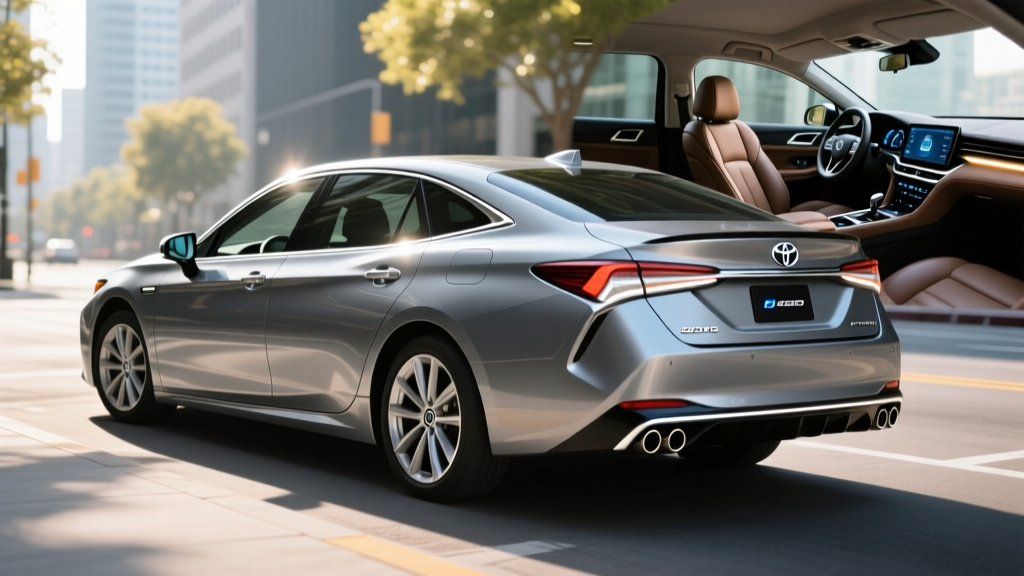
The 2026 Toyota Camry Hybrid sedan occupies a specific niche in the electrified-vehicle landscape: it requires zero change to your driving or fueling habits while delivering fuel economy that embarrasses most compact cars. Now in its ninth generation and exclusively offered as a hybrid since the 2025 redesign, the Camry Hybrid pairs a 2.5-liter four-cylinder engine with Toyota's fifth-generation hybrid system to produce 225 horsepower and up to 51 MPG combined. There is no plug-in hybrid variant—this is a conventional self-charging hybrid (HEV), meaning you simply fill it with gas and drive.
For buyers weighing whether to go full battery-electric, plug-in hybrid, or stick with a conventional hybrid, the Camry Hybrid sedan presents a compelling case for the latter. Here's the data-driven breakdown of what you're actually buying.
HEV vs. PHEV vs. EV: Where the Camry Hybrid Fits
Before examining specs, it's critical to understand what the Camry Hybrid is not. It is not a plug-in hybrid (PHEV) like the Toyota RAV4 Prime or Prius Prime. It has no electric-only driving range, no charge port, and no ability to run solely on battery power for meaningful distances. The small traction battery charges exclusively through regenerative braking and the gasoline engine.
Conventional Hybrid (HEV) vs. Plug-In Hybrid (PHEV) vs. Battery Electric (BEV)
| Attribute | HEV (Camry Hybrid) | PHEV (e.g., Prius Prime) | BEV (e.g., Tesla Model 3) |
|---|---|---|---|
| Plug-in charging required? | No | Yes (optional but recommended) | Yes (mandatory) |
| Electric-only range | ~1 mile at low speed | 25–44 miles | 250–400+ miles |
| Total range | 600+ miles | 400–500+ miles | 250–400+ miles |
| Fuel/energy | Gasoline only | Gasoline + electricity | Electricity only |
| Federal tax credit (§30D) | Not eligible | Up to $7,500 (if eligible) | Up to $7,500 (if eligible) |
| Home charger needed? | No | Recommended for EV range | Essential |
The Camry Hybrid is purpose-built for drivers who want maximum fuel efficiency without the infrastructure requirements of plug-in vehicles. If you live in an apartment without charging access, regularly drive 400+ miles between fill-ups, or simply don't want to think about charging, this is the architecture for you.
Fuel Economy: EPA Ratings and Real-World MPG
The 2026 Camry Hybrid's fuel economy varies by drivetrain. Front-wheel-drive (FWD) models achieve the highest ratings, while all-wheel-drive (AWD) trims sacrifice a small amount of efficiency for traction.
| Configuration | City MPG | Highway MPG | Combined MPG |
|---|---|---|---|
| FWD (LE trim) | 53 | 50 | 51 |
| FWD (SE/XSE trims) | 48 | 47 | 47 |
| AWD (all trims) | 51 | 49 | 50 |
Source: fueleconomy.gov
Real-World MPG: What Owners Actually See
Toyota's hybrid system excels in city and suburban driving, where regenerative braking recaptures energy at every stop and the electric motor handles low-speed propulsion. In real-world testing, Camry Hybrid owners frequently report exceeding EPA city estimates in stop-and-go traffic—55–58 MPG is achievable in warm weather on flat urban routes.
Highway driving tells a different story. At sustained 75–80 MPH speeds, the gasoline engine does most of the work and aerodynamic drag increases substantially. Expect 42–46 MPG on highway road trips, below the EPA highway sticker. Cold weather (below 40°F) further reduces efficiency by 5–10% as the engine runs more frequently to provide cabin heat and maintain battery temperature.
Real-World Range Expectation: With a 13.2-gallon fuel tank, the FWD LE's EPA combined 51 MPG yields a theoretical 673-mile range. In mixed real-world driving (city + highway + climate control), expect 560–620 miles between fill-ups. Highway-dominant trips in winter may drop to ~500 miles.
Powertrain and Performance Specs
The 2026 Camry Hybrid uses Toyota's fifth-generation Hybrid Synergy Drive, pairing a 2.5-liter Dynamic Force four-cylinder engine with one or two electric motor-generators (AWD models add a rear-mounted electric motor).
| Specification | Detail |
|---|---|
| Engine | 2.5L 4-cylinder Atkinson-cycle |
| Combined net horsepower | 225 hp (FWD) / 232 hp (AWD) |
| Engine output | 184 hp @ 5,700 rpm |
| Front electric motor | 134 hp |
| Rear electric motor (AWD) | 40 hp |
| Transmission | eCVT (planetary gearset) |
| 0–60 MPH | ~7.1 seconds (FWD) |
| Hybrid battery | ~1.1 kWh lithium-ion (bipolar) |
| Drivetrain | FWD or electronic AWD |
| Curb weight | ~3,550–3,680 lbs |
The 225-hp combined output makes the Camry Hybrid genuinely quick for a midsize sedan focused on efficiency. The eCVT operates without fixed gear ratios—the planetary gearset seamlessly blends engine and motor power, eliminating shift shock. The AWD system uses an independent rear electric motor rather than a mechanical driveshaft, engaging only when slippage is detected to minimize efficiency losses.
Pricing, Trims, and Tax Credit Eligibility
The 2026 Camry Hybrid sedan starts at $29,495 for the LE FWD trim (including destination), making it one of the most affordable hybrid midsize sedons available. Trim pricing breaks down as follows:
| Trim | Drivetrain | MSRP (incl. destination) |
|---|---|---|
| LE | FWD | $29,495 |
| LE | AWD | $30,995 |
| SE | FWD | $31,090 |
| SE | AWD | $32,590 |
| XLE | FWD | $34,190 |
| XLE | AWD | $35,690 |
| XSE | FWD | $35,090 |
| XSE | AWD | $36,590 |
Federal Tax Credit: Not Eligible
The Camry Hybrid is a conventional hybrid (HEV), which means it does not qualify for the federal §30D New Clean Vehicle Credit. Under current IRS rules, only plug-in electric vehicles (PHEVs and BEVs) with sufficient battery capacity are eligible for the up-to-$7,500 credit. The Camry Hybrid's ~1.1 kWh battery falls far below the 7 kWh minimum threshold.
However, the Camry Hybrid's lower MSRP and strong resale value partially offset the lack of incentive. A comparably equipped Tesla Model 3 or Hyundai Ioniq 6 may qualify for the credit but starts $8,000–$12,000 higher. The fuel-cost math still favors the Camry Hybrid for many buyers when factoring in home-charging installation costs and electricity rates.
Battery Warranty, Lifespan, and Replacement Cost
Hybrid battery longevity remains the top concern for first-time hybrid buyers. Toyota addresses this with robust warranty coverage and a proven track record of battery durability.
Toyota Hybrid Battery Warranty
- Coverage: 10 years / 150,000 miles (whichever comes first)
- Applies to: Hybrid traction battery, hybrid control module, inverter
- Transferable: Yes, to subsequent owners
- Capacity threshold: Toyota covers batteries that fall below functional performance standards
Real-World Battery Lifespan
Toyota's lithium-ion hybrid batteries in the fifth-generation system use a bipolar electrode design that improves thermal stability and charge/discharge efficiency. Based on data from prior-generation Camry Hybrids and Prius models, these batteries routinely last 150,000–200,000+ miles before significant degradation occurs. Many first-generation Prius taxis exceeded 300,000 miles on original batteries.
The hybrid system's battery management is intentionally conservative—it never allows the battery to fully charge or fully discharge, maintaining a state-of-charge window (typically 40–80%) that dramatically extends cycle life. This is fundamentally different from a BEV battery, which routinely cycles through wider SoC ranges.
Battery Replacement Cost
If replacement is needed outside warranty, a new Toyota Camry Hybrid traction battery costs approximately $2,500–$4,000 installed at a dealership. Refurbished/remanufactured units are available from third-party suppliers for $1,500–$2,500 installed. Individual module replacement (only the degraded cells) can reduce costs to $500–$1,200 at specialized hybrid repair shops. Given the 10-year/150,000-mile warranty and typical ownership cycles, most buyers will never face this expense.
Camry Hybrid vs. Full EV vs. Gas: Decision Framework
Choose the Camry Hybrid if:
- You lack reliable access to home or workplace charging
- You regularly drive 300+ miles in a single day without overnight stops
- Your budget is under $35,000 and you want minimal complexity
- You live in an area with sparse public charging infrastructure
- You want sedan comfort with 50+ MPG without behavioral changes
Choose a PHEV (e.g., Prius Prime) if:
- Your daily commute is under 40 miles round-trip and you can charge at home
- You want some electric-only driving but need gas-engine flexibility for road trips
- You qualify for the §30D tax credit and want to offset a higher purchase price
Choose a full BEV (e.g., Tesla Model 3, Hyundai Ioniq 6) if:
- You can install a Level 2 home charger and your daily driving is under 250 miles
- You want the lowest per-mile fuel cost (electricity vs. gasoline)
- You want zero tailpipe emissions and minimal drivetrain maintenance
- You qualify for the full $7,500 federal credit and any state incentives
Five-Year Cost of Ownership Snapshot
Comparing the Camry Hybrid LE ($29,495) against a comparable gas-only midsize sedan (30 MPG combined) at 15,000 miles/year and $3.30/gallon gas:
| Cost Factor | Camry Hybrid (51 MPG) | Gas Sedan (30 MPG) |
|---|---|---|
| Fuel cost (5 years / 75K mi) | $4,853 | $8,250 |
| Fuel savings vs. gas | $3,397 saved over 5 years | |
| Estimated maintenance (5 yr) | ~$2,800 | ~$3,200 |
| Insurance (avg. 5 yr) | ~$7,500 | ~$7,000 |
The Camry Hybrid recoups its modest price premium over gas competitors within 2–3 years through fuel savings alone, with no charging infrastructure investment required.
Pros and Cons at a Glance
Pros
- 51 MPG combined (FWD LE) — among the best of any non-plug-in midsize sedan
- No charging infrastructure needed — fill up at any gas station
- 225 hp provides confident acceleration and highway merging
- 10-year / 150,000-mile hybrid battery warranty
- Strong Toyota resale value and reliability track record
- Under $30,000 starting price for the LE trim
- Standard Toyota Safety Sense 3.0 (adaptive cruise, lane-keeping, auto emergency braking)
Cons
- No federal tax credit eligibility (HEV, not PHEV/BEV)
- No electric-only driving mode for zero-emission city trips
- Highway MPG drops to low-to-mid 40s at sustained 75+ MPH
- eCVT drone under hard acceleration (no simulated gear shifts)
- AWD models sacrifice 1 MPG combined vs. FWD
- Cannot precondition cabin on grid power like a PHEV or BEV
Frequently Asked Questions
How many MPG does the 2026 Camry Hybrid actually get?
The EPA rates the FWD LE at 53 city / 50 highway / 51 combined MPG. In real-world mixed driving, most owners see 47–53 MPG combined. City-dominant driving in warm weather can exceed 55 MPG, while sustained highway driving at 75+ MPH in winter may dip to the low 40s.
Does the Camry Hybrid need to be plugged in?
No. The Camry Hybrid is a conventional hybrid (HEV), not a plug-in hybrid. Its small lithium-ion battery charges exclusively through regenerative braking and the gasoline engine. You never plug it in—you simply refuel at a gas station as you would with any conventional car.
Is there a Camry Hybrid plug-in (PHEV) version?
Toyota does not offer a Camry PHEV. If you want a Toyota plug-in hybrid, the closest options are the Prius Prime (44 miles electric-only, up to 52 MPG combined as a hybrid) or the RAV4 Prime (42 miles electric-only, 38 MPG combined). Toyota has kept the Camry line exclusively as a conventional HEV.
Is the Camry Hybrid reliable, and what does a battery replacement cost?
Toyota's hybrid system is among the most proven in the industry, with decades of real-world data from millions of Prius, Camry, and Highlander Hybrids. The hybrid battery is warrantied for 10 years / 150,000 miles, and real-world lifespan typically exceeds 150,000–200,000 miles. Out-of-warranty replacement runs $2,500–$4,000 for a new OEM battery, or $1,500–$2,500 for a refurbished unit.
Does the 2026 Camry Hybrid qualify for any tax credit?
No. The federal §30D New Clean Vehicle Credit requires a plug-in vehicle with at least 7 kWh of battery capacity, per IRS guidelines. The Camry Hybrid's ~1.1 kWh battery does not qualify. Some states offer small rebates for efficient hybrids—check your state energy office or AFDC state incentive database for local programs.
How does the Camry Hybrid compare to a full EV like the Tesla Model 3?
The Model 3 offers far lower per-mile energy costs (~$0.04/mile on electricity vs. ~$0.065/mile on gas for the Camry Hybrid), instant torque, and zero tailpipe emissions. However, the Model 3 starts around $38,990, requires home charging infrastructure ($500–$2,000 installation), and has a ~340-mile range that requires planning on long road trips. The Camry Hybrid is the pragmatic choice for buyers who want efficiency without infrastructure investment or range-planning overhead.
What is the Camry Hybrid's total driving range?
With its 13.2-gallon fuel tank and EPA combined rating of 51 MPG (FWD LE), the theoretical maximum range is approximately 673 miles. In real-world mixed driving, expect 560–620 miles per tank. This exceeds virtually every BEV on the market and eliminates range anxiety entirely.