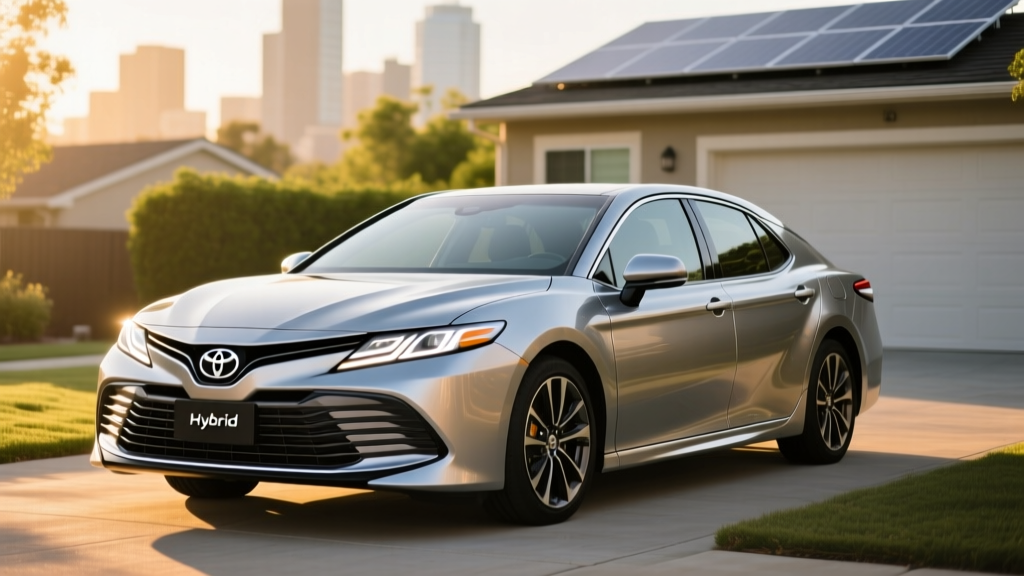
The Toyota Camry has been America's best-selling sedan for years, and for the 2025 model year, Toyota made a decisive move: every Camry is now a hybrid. That carries into the 2026 model year with the fifth-generation hybrid system, a 2.5-liter four-cylinder paired with electric motors delivering up to 225 horsepower. If you're researching the Camry Hybrid for your next purchase, this guide breaks down every spec that matters — EPA MPG by trim, real-world fuel economy, powertrain details, battery longevity, and whether it fits your garage better than a PHEV or full EV.
Every 2026 Camry Hybrid Is a Hybrid — Here's What That Means
Starting with the ninth-generation redesign (introduced for 2025), Toyota eliminated the gas-only Camry entirely. Every 2026 Camry uses Toyota's fifth-generation hybrid system. This is a conventional hybrid electric vehicle (HEV), not a plug-in hybrid (PHEV). You never plug it in. The car generates electricity through regenerative braking and the gasoline engine, storing it in a small lithium-ion battery that assists acceleration and enables brief low-speed electric-only driving.
- HEV (Camry Hybrid): No plug. Small battery (~1.1 kWh). Recharges via regen and engine. EPA 44–53 MPG combined.
- PHEV (e.g., Toyota RAV4 Prime): Plugs in. Larger battery (~18 kWh). 25–42 miles electric-only before the gas engine takes over.
- BEV (e.g., Tesla Model 3): Plugs in. Large battery (60–82 kWh). Zero gasoline. 250–360+ miles EPA range.
The Camry Hybrid is an HEV. It does not qualify for the federal §30D EV tax credit, and it does not have an electric-only range figure that meaningfully replaces gasoline driving.
EPA MPG and Real-World Fuel Economy by Trim
The 2026 Camry Hybrid's fuel economy varies by trim and drivetrain. Front-wheel-drive (FWD) models extract the most efficiency from the hybrid system, while electronic on-demand all-wheel-drive (AWD) trims trade a small MPG penalty for traction.
| Trim | Drivetrain | City MPG | Highway MPG | Combined MPG |
|---|---|---|---|---|
| LE | FWD | 53 | 50 | 52 |
| LE | AWD | 51 | 49 | 50 |
| SE | FWD | 48 | 47 | 47 |
| SE | AWD | 46 | 46 | 46 |
| XLE | FWD | 48 | 47 | 47 |
| XLE | AWD | 46 | 46 | 46 |
| XSE | AWD | 44 | 43 | 44 |
Source: EPA Fuel Economy
Real-World MPG: What Owners Actually See
Toyota's hybrid system excels in city driving, where regenerative braking recaptures energy at every stop. In real-world mixed driving, Camry Hybrid owners frequently report matching or slightly exceeding the EPA combined figure — particularly the LE FWD at 52 MPG combined. On sustained highway trips at 75+ mph, expect fuel economy to dip 3–5 MPG below the EPA highway number, as the electric motor contributes less at high steady-state speeds. In cold weather (below 30°F), the engine runs more frequently to maintain cabin heat and battery temperature, reducing city MPG by roughly 5–8%.
At $3.20/gallon (national average as of early 2026) and 52 MPG combined, the Camry Hybrid LE costs approximately $0.062 per mile in fuel — roughly half what a comparable 30 MPG gas sedan costs.
Powertrain Specs: Fifth-Generation Hybrid System
| Specification | Detail |
|---|---|
| Engine | 2.5L inline-4, Atkinson cycle |
| Engine Output | 184 hp / 163 lb-ft torque |
| Front Electric Motor | 100 kW (134 hp) |
| Rear Electric Motor (AWD) | 30 kW (40 hp) |
| Net Combined Horsepower | 225 hp (FWD) / 232 hp (AWD) |
| Transmission | eCVT (planetary gearset, no belt) |
| Hybrid Battery | Lithium-ion, ~1.1 kWh (usable) |
| 0–60 mph | ~7.1 seconds (FWD) |
| Fuel Tank | 13.2 gallons |
The combined output of 225 hp (FWD) or 232 hp (AWD) gives the Camry Hybrid legitimate passing power. The AWD system uses a dedicated rear electric motor rather than a mechanical driveshaft, engaging only when slip is detected or under hard acceleration. The eCVT is Toyota's proven planetary-gear design — there is no rubber belt or traditional stepped gearset to wear out, which contributes to the powertrain's long-term durability.
Pricing, Trims, and Tax Credit Eligibility
| Trim | Drivetrain | MSRP (incl. destination) |
|---|---|---|
| LE | FWD | $29,490 |
| LE | AWD | $30,890 |
| SE | FWD | $30,990 |
| SE | AWD | $32,390 |
| XLE | FWD | $33,490 |
| XLE | AWD | $34,890 |
| XSE | AWD | $36,190 |
Does the Camry Hybrid Qualify for a Federal Tax Credit?
No. The federal §30D Clean Vehicle Credit applies only to plug-in electric vehicles — battery electric vehicles (BEVs) and plug-in hybrids (PHEVs) with at least 7 kWh of battery capacity and the ability to charge from an external source. The Camry Hybrid is a conventional HEV with a ~1.1 kWh battery and no charge port. It does not qualify for the federal EV tax credit, the used EV credit (§25E), or the commercial clean vehicle credit (§45W).
Some states offer their own incentives for hybrids, though these have largely shifted toward PHEVs and BEVs. Check your state's energy office or department of revenue for current programs. Toyota's official Camry Hybrid page may list available regional incentives.
Hybrid Battery Warranty, Lifespan, and Replacement Cost
- Hybrid Battery: 10 years / 150,000 miles (whichever comes first)
- Hybrid System Components: 8 years / 100,000 miles
- Capacity Retention Threshold: Toyota covers the battery if it fails or degrades below functional performance levels — unlike BEV warranties, there is no published percentage threshold, as the HEV battery buffer management is handled entirely by the vehicle's ECU.
How Long Will the Camry Hybrid Battery Last?
Toyota's hybrid battery track record is among the best in the industry. The Prius, which shares hybrid-system DNA with the Camry, has demonstrated battery lifespans routinely exceeding 150,000–200,000 miles with original packs. The fifth-generation system uses a lithium-ion pack with more sophisticated thermal management than earlier nickel-metal-hydride designs, which should support comparable or better longevity.
The key difference from a BEV battery: the Camry Hybrid's ~1.1 kWh pack operates in a narrow state-of-charge window (roughly 40–80% SoC), managed by the vehicle computer. It never charges to full or drains to empty, which dramatically reduces cycle stress and calendar degradation.
Battery Replacement Cost
If the hybrid battery fails outside warranty, replacement costs typically fall between $2,500 and $4,500 including parts and labor at a Toyota dealer. Independent hybrid specialists often perform the same service for $1,800–$3,000. Refurbished or reconditioned battery packs are available for $1,200–$2,000. Given the 10-year/150,000-mile warranty and Toyota's reliability history, most owners will never face this expense during typical ownership.
Camry Hybrid vs. PHEV vs. Full EV: Which Is Right for You?
Camry Hybrid (HEV) Strengths
- No charging infrastructure needed — works with any gas station
- 52 MPG combined (LE FWD) cuts fuel cost in half vs. a 26 MPG sedan
- Lower MSRP than PHEVs or BEVs — starts at $29,490
- 600+ mile total range per tank
- Proven Toyota hybrid reliability with 10-year battery warranty
Limitations
- No electric-only highway driving — always uses gasoline
- No federal tax credit eligibility
- Cannot run zero-emission in a garage or during power outages
When to Consider a PHEV or BEV Instead
- PHEV (e.g., Toyota Prius Prime): You have home charging and a commute under 40 miles — you could drive months without buying gas, plus a $3,750–$7,500 federal credit (check IRS §30D eligibility)
- BEV (e.g., Tesla Model 3, Hyundai Ioniq 6): You want zero tailpipe emissions, have reliable home or workplace charging, and drive under 300 miles daily
- Choose the Camry Hybrid if: You lack access to home or workplace charging, want maximum simplicity, drive long highway miles, or need a sub-$35K sedan with low running costs.
- Choose a PHEV if: You can install a Level 2 charger at home, commute under 40 miles round-trip, and want to offset most daily driving with electricity while keeping gas for road trips.
- Choose a full EV if: You have reliable charging, want the lowest per-mile energy cost, qualify for the federal tax credit, and your longest regular trip fits within 250–300 miles of range.
Reliability, Safety, and Ownership Costs
Toyota's hybrid powertrain has accumulated over two decades of field data. The eCVT planetary gearset has no friction bands or clutches to wear, the electric motors have no brushes, and the Atkinson-cycle engine operates under less thermal stress than a conventional Otto-cycle design. IIHS testing of the current-generation Camry has earned it Top Safety Pick+ designation, with standard Toyota Safety Sense 3.0 (pre-collision, lane tracing, adaptive cruise, and road sign assist).
Five-Year Estimated Fuel Savings
Compared to a 28 MPG combined gas midsize sedan, the Camry Hybrid LE (52 MPG combined) saves approximately $3,400 in fuel costs over 5 years at 15,000 miles/year and $3.20/gallon. Against a 22 MPG combined competitor, savings grow to roughly $5,100. These savings partially offset the lack of a federal tax credit.
Frequently Asked Questions
How many MPG does the 2026 Camry Hybrid get?
The most efficient trim, the LE FWD, is EPA-rated at 53 city / 50 highway / 52 combined MPG. AWD trims and sport-tuned SE/XSE models range from 44 to 50 combined. Real-world city driving often matches or slightly exceeds EPA numbers due to aggressive regenerative braking, while sustained highway speeds above 75 mph may reduce economy by 3–5 MPG.
Does the Camry Hybrid need to be plugged in?
No. The Camry Hybrid is a conventional HEV. Its small lithium-ion battery recharges through regenerative braking and the gasoline engine. There is no charge port. You fuel it exclusively at a gas station.
How far can the Camry Hybrid drive on electric power only?
Under very light loads (parking-lot speeds, gentle acceleration from a stop), the Camry Hybrid can travel roughly 0.5–1 mile on battery alone before the engine engages. This is not a usable electric-only range for commuting — it's a low-speed assist function. If electric-only commuting is your goal, look at a PHEV like the Prius Prime (44 miles EPA electric-only) or a full BEV.
Is the Camry Hybrid reliable, and what does battery replacement cost?
Toyota's hybrid system is one of the most proven in the automotive industry, with a 10-year/150,000-mile hybrid battery warranty. Out-of-warranty battery replacement runs $2,500–$4,500 at a dealer, less at independent hybrid shops. Most original batteries last well beyond 150,000 miles based on Prius and prior-generation Camry Hybrid data.
Does the 2026 Camry Hybrid qualify for any tax credit?
It does not qualify for the federal §30D Clean Vehicle Credit, which is reserved for plug-in vehicles (BEVs and PHEVs). Some states may offer minor hybrid incentives — check your state energy office. The fuel savings versus a gas-only sedan ($3,400+ over five years) serve as the primary financial benefit.
AWD or FWD — which Camry Hybrid trim should I buy?
Choose FWD (LE or SE) for maximum MPG — the LE FWD hits 52 combined. Choose AWD if you regularly drive on snow, ice, or wet mountain roads. The AWD system adds a rear electric motor that engages automatically, costing only 2 MPG combined versus FWD. The $1,400 AWD premium pays for itself in resale value in northern climates.