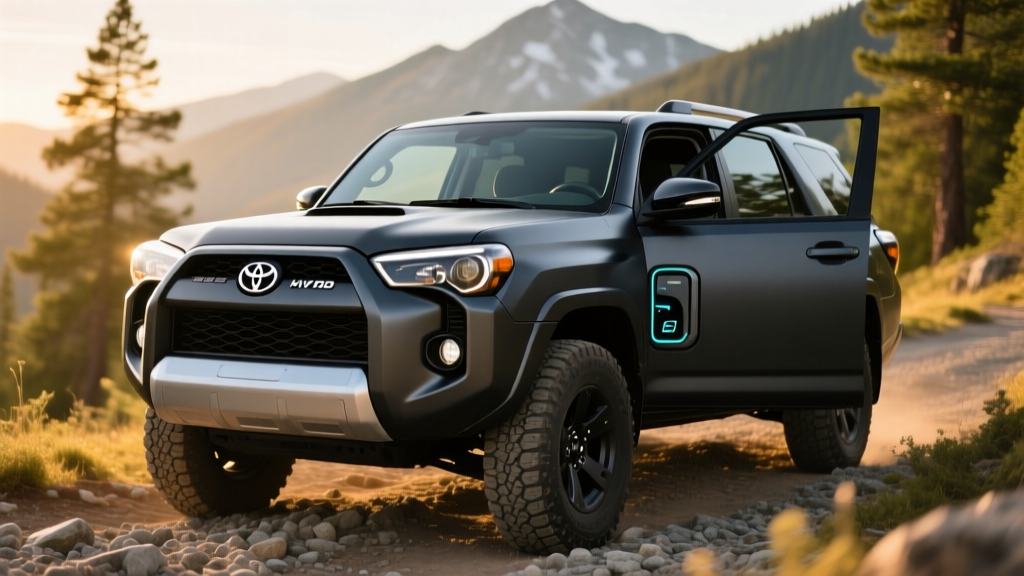
For decades, the Toyota 4Runner earned its reputation as a rugged, body-on-frame SUV with legendary off-road chops — and fuel economy best left unmentioned. That changes with the sixth-generation 4Runner, which introduced the i-FORCE MAX hybrid powertrain to the lineup. The 2026 Toyota 4Runner hybrid isn't a plug-in, and it doesn't pretend to be an EV. It's a conventional hybrid (HEV) designed to squeeze meaningful efficiency out of a truck-based platform without sacrificing the towing, ground clearance, and durability that 4Runner buyers demand.
If you've been searching for a hybrid 4Runner, this guide covers every number that matters: EPA MPG, real-world fuel economy, powertrain specs, trim pricing, battery warranty, and whether this HEV makes sense versus a full EV or a conventional gas SUV.
How the 4Runner Hybrid Powertrain Works
The 2026 4Runner hybrid uses Toyota's i-FORCE MAX powertrain — a turbocharged 2.4-liter inline-four engine paired with an electric motor integrated between the engine and the 8-speed automatic transmission. This is a conventional hybrid (HEV), not a plug-in hybrid (PHEV). You never plug it in. The small battery pack recharges through regenerative braking and engine power, just like a Toyota RAV4 Hybrid or Highlander Hybrid.
| Spec | Value |
|---|---|
| Engine | 2.4L turbocharged inline-4 |
| Electric Motor | Integrated motor-generator (between engine & transmission) |
| Combined Horsepower | 326 hp |
| Combined Torque | 465 lb-ft |
| Transmission | 8-speed automatic |
| Drivetrain | RWD or 4WD (trim dependent) |
| Battery Type | Nickel-metal hydride (NiMH), ~1.9 kWh |
| Plug-In Required? | No — conventional HEV |
| Max Towing Capacity | 6,000 lbs (4WD models) |
| Ground Clearance | Up to 9.6 inches (TRD Off-Road) |
The result is a combined 326 horsepower and a massive 465 lb-ft of torque — figures that make the hybrid the most powerful 4Runner you can buy. The electric motor fills in the torque curve at low RPMs, which means stronger initial acceleration and less turbo lag when pulling away from a stop or merging onto a highway.
2026 4Runner Hybrid MPG: EPA Numbers and Real-World Expectations
Fuel economy is the primary reason most buyers consider the hybrid 4Runner over the standard i-FORCE turbo gas model. Here's what the EPA says, followed by what you should actually expect.
| Powertrain | City MPG | Highway MPG | Combined MPG |
|---|---|---|---|
| i-FORCE MAX Hybrid (4WD) | 23 | 27 | 25 |
| i-FORCE MAX Hybrid (2WD) | 24 | 28 | 26 |
| i-FORCE Turbo Gas (4WD) | 20 | 24 | 22 |
| i-FORCE Turbo Gas (2WD) | 21 | 26 | 23 |
Source: fueleconomy.gov — verify exact figures by trim, as options and tire size can affect ratings.
Real-World MPG: What to Actually Expect
Hybrids typically outperform their EPA city ratings in stop-and-go driving, where regenerative braking recaptures the most energy. On the highway, the advantage narrows because the engine runs continuously. Based on early owner reports and testing patterns for the i-FORCE MAX platform:
- City driving: Expect 24–27 MPG — hybrids thrive here, and the 4Runner is no exception.
- Highway driving (70–80 mph): Expect 22–25 MPG. Aerodynamic drag on a boxy, body-on-frame SUV works against efficiency at speed.
- Cold weather (below 30°F): Expect a 5–10% reduction, bringing combined economy to roughly 22–23 MPG. The engine runs more frequently to provide cabin heat and maintain operating temperature.
- Towing: Expect 14–17 MPG when towing near the 6,000-lb max. The hybrid's low-end torque helps, but physics wins.
The hybrid 4Runner gains roughly 3–4 MPG combined over the gas-only model. Over 15,000 miles per year at $3.50/gallon, that translates to approximately $300–$400 in annual fuel savings. The hybrid powertrain typically carries a $2,000–$3,000 price premium depending on trim, so the payback period is roughly 5–8 years on fuel savings alone — though the performance upgrade (326 hp vs. 278 hp) is an immediate benefit.
HEV vs PHEV vs Full EV: Which Fits Your Lifestyle?
The 4Runner hybrid is an HEV. If you're cross-shopping electrified SUVs, it's critical to understand how these three categories differ.
| Feature | HEV (4Runner Hybrid) | PHEV (e.g., RAV4 Prime) | BEV (e.g., Rivian R1S) |
|---|---|---|---|
| Plug in to charge? | No | Yes (optional but beneficial) | Yes (required) |
| Electric-only range | None (motor assists only) | 30–42 miles typical | 250–400 miles |
| Home charging needed? | No | Recommended (Level 2) | Essential (Level 2) |
| Gas engine? | Yes — primary power | Yes — backup/extended range | No |
| Tax credit eligible? | No (§30D excludes HEVs) | Yes — if MSRP/income/sourcing rules met | Yes — if MSRP/income/sourcing rules met |
| Towing capability | 6,000 lbs | 1,500–3,500 lbs typical | 5,000–7,700 lbs |
| Off-road capability | Excellent (body-on-frame) | Limited (unibody) | Good (Rivian, Hummer EV) |
Choose the 4Runner HEV if: You want a rugged, truck-based SUV with strong towing and real off-road capability, you don't have access to home charging, and you want better fuel economy without changing your driving habits.
Choose a PHEV if: You have a short commute (under 35 miles), can install a Level 2 home charger, want electric-only daily driving with a gas engine for road trips, and don't need serious towing or off-road capability.
Choose a full EV if: You have reliable home charging, want the lowest per-mile energy cost, don't need body-on-frame towing, and want the smoothest, quietest driving experience.
2026 4Runner Hybrid Trims and Pricing
The i-FORCE MAX hybrid powertrain is available across several 4Runner trims for the 2026 model year. Pricing below reflects base MSRP before destination charges.
| Trim | MSRP (approx.) | Key Features |
|---|---|---|
| TRD Off-Road Hybrid | ~$53,000 | Crawl Control, Multi-Terrain Select, locking rear diff, 9.6" ground clearance |
| Limited Hybrid | ~$58,000 | Leather, 14" touchscreen, JBL audio, Adaptive Variable Suspension |
| TRD Pro Hybrid | ~$64,000 | FOX shocks, TRD skid plates, roof rack, IsoDynamic seats |
| Platinum Hybrid | ~$62,000 | Panoramic roof, 22" wheels, premium luxury package |
Pricing is approximate and subject to change. Verify current MSRP on Toyota.com or with a local dealer.
Does the 4Runner Hybrid Qualify for a Federal Tax Credit?
No. Under current IRS §30D rules, the federal clean vehicle tax credit applies only to plug-in electric vehicles (BEVs and PHEVs) with a battery capacity of at least 7 kWh. The 4Runner hybrid's small NiMH battery pack (~1.9 kWh) does not qualify. You cannot claim the up-to-$7,500 credit for this vehicle, and it is not eligible for the point-of-sale transfer.
If a federal tax credit is a dealbreaker, you'd need to look at a PHEV (like the Toyota RAV4 Prime) or a full EV. However, PHEVs and BEVs must still meet strict requirements under §30D, including:
- MSRP caps: Vans/SUVs/trucks must be under $80,000
- Buyer income limits: $150,000 single / $300,000 joint (modified AGI)
- Battery sourcing and critical mineral requirements (phased in through 2026)
See the full rules at IRS.gov §30D.
Battery Longevity, Warranty, and Replacement Costs
Hybrid battery anxiety is real, but Toyota's track record here is among the best in the industry. The 4Runner's hybrid battery is covered by a robust warranty, and the chemistry is proven.
4Runner Hybrid Battery Warranty
- Hybrid battery coverage: 10 years / 150,000 miles (whichever comes first)
- Hybrid system components: 8 years / 100,000 miles
- Capacity threshold: Toyota warrants the battery against defects and abnormal loss of capacity — if it drops below functional thresholds during the warranty period, Toyota replaces it at no cost.
How Long Will the Battery Actually Last?
Toyota's hybrid NiMH battery packs have a proven track record spanning two decades (the Prius first used this chemistry in 2001). Real-world data from high-mileage Toyota hybrids shows:
- Most Toyota hybrid batteries last 150,000–200,000+ miles before needing replacement.
- Unlike EV batteries, hybrid batteries are small and shallow-cycled — they rarely charge above 80% or below 40% State of Charge, which dramatically extends cycle life.
- Heat is the primary enemy. Owners in extreme-heat climates (Arizona, Texas) may see earlier degradation, typically around 120,000–150,000 miles.
Hybrid Battery Replacement Cost
If the battery fails outside the warranty window, here's what to budget:
- New OEM battery: $3,000–$4,500 (parts and labor at a Toyota dealer)
- Refurbished/reconditioned battery: $1,500–$2,500 (from independent hybrid specialists)
- Individual cell replacement: $500–$1,200 (if only a few cells are weak — not all shops offer this)
For context, a full EV battery replacement runs $10,000–$20,000+. The 4Runner's small hybrid battery is far less expensive to replace, and the likelihood of needing one within the first 150,000 miles is low.
Reliability and Ownership Considerations
Toyota's hybrid system is one of the most proven powertrains in automotive history. The i-FORCE MAX is newer to the 4Runner specifically, but it shares architecture with the Tundra and Sequoia hybrid systems that have been on the road since 2022.
Key reliability factors:
- No plug, no charging infrastructure dependency: The HEV system is self-contained. You fuel up at gas stations exactly as before.
- Regenerative braking extends brake life: Many Toyota hybrid owners report original brake pads lasting 80,000–100,000 miles because the electric motor handles much of the deceleration.
- The turbo engine adds complexity vs. the old V6: The previous 4.0L V6 was famously simple. The new turbo four-cylinder has more components (turbocharger, intercooler, direct injection). Long-term reliability data is still building, but Toyota's turbo hybrid platform in the Tundra has shown no systemic issues through its first three model years.
- Safety: The 2026 4Runner comes standard with Toyota Safety Sense 3.0 (pre-collision, lane departure, dynamic radar cruise control, lane tracing). Check NHTSA.gov for crash-test ratings once published.
Pros
- 326 hp / 465 lb-ft — most powerful 4Runner ever
- 3–4 MPG improvement over gas model (real-world city gains even larger)
- No plug-in required — zero lifestyle change
- 10-year / 150,000-mile hybrid battery warranty
- 6,000-lb towing capacity maintained
- Proven Toyota hybrid reliability
Cons
- No federal tax credit eligibility
- Still a body-on-frame SUV — 25 MPG combined isn't remarkable vs. unibody crossovers
- Turbo engine adds complexity vs. prior naturally aspirated V6
- Hybrid premium adds $2,000–$3,000 to MSRP
- Highway MPG advantage is modest
Who Should Buy the Hybrid 4Runner?
The 2026 4Runner hybrid is purpose-built for a specific buyer. Here's a decision framework:
Buy the 4Runner hybrid if:
- You want a truck-based SUV for off-road adventures, towing a boat or camper, or both
- You drive 12,000–20,000 miles per year and want to reduce fuel stops
- You don't have access to home or workplace charging (making a PHEV or EV impractical)
- You value the performance upgrade — 465 lb-ft of torque transforms highway merging and low-speed trail crawling
- You plan to keep the vehicle 8–10+ years (the hybrid battery warranty has you covered)
Look elsewhere if:
- You want a federal tax credit — you'll need a PHEV or BEV
- Your daily commute is short and you have home charging — a PHEV like the RAV4 Prime gives you 42 miles of electric-only driving
- You want maximum fuel economy above all else — a unibody hybrid crossover (RAV4 Hybrid at 39 MPG combined) will beat the 4Runner by a wide margin
- You want zero tailpipe emissions — consider a full EV like the Rivian R1S or Tesla Model X
Frequently Asked Questions
How many MPG does the 2026 4Runner hybrid get?
The EPA rates the 4Runner i-FORCE MAX hybrid at 23 city / 27 highway / 25 combined MPG (4WD). Real-world city driving often yields 24–27 MPG thanks to regenerative braking, while highway driving at 75+ mph may drop to 22–24 MPG. The 2WD model is rated slightly higher at 24/28/26.
Does the hybrid 4Runner need to be plugged in?
No. The 4Runner hybrid is a conventional HEV. Its small battery charges automatically through regenerative braking and the gas engine. You never plug it in — just fill up at a gas station as you would with any other vehicle.
How far can the 4Runner hybrid go on electric only?
It can't. Unlike a PHEV, the 4Runner hybrid has no electric-only driving mode. The electric motor assists the gas engine during acceleration and low-speed maneuvers, but the engine is always the primary power source. If you need electric-only range, you'd need a PHEV or a full EV.
Is the hybrid 4Runner reliable?
Toyota's hybrid system has an outstanding reliability record spanning 20+ years and millions of vehicles. The i-FORCE MAX turbo hybrid is newer, but shares proven architecture with the Tundra and Sequoia hybrids. The hybrid battery is warrantied for 10 years / 150,000 miles, and most Toyota hybrid batteries last well beyond that in real-world use.
What does it cost to replace the 4Runner hybrid battery?
A new OEM replacement battery costs approximately $3,000–$4,500 installed at a Toyota dealer. Refurbished options run $1,500–$2,500. However, replacement is rarely needed within the first 150,000+ miles, and the 10-year warranty covers premature failures.
Does the 4Runner hybrid qualify for a tax credit?
No. The federal §30D clean vehicle credit applies only to plug-in vehicles (BEVs and PHEVs) with at least 7 kWh of battery capacity. The 4Runner hybrid's ~1.9 kWh pack does not qualify. Some states may offer separate incentives for hybrids — check your state's energy or DMV website for current programs.
Is the hybrid 4Runner worth the extra cost over the gas model?
If you value the 48-horsepower and 130 lb-ft torque upgrade, the hybrid is worth it for the performance alone — the fuel savings are a bonus. The payback period on fuel savings alone is roughly 5–8 years. If you plan to keep the 4Runner long-term, the hybrid also reduces brake wear (thanks to regenerative braking) and offers the security of a 10-year battery warranty.