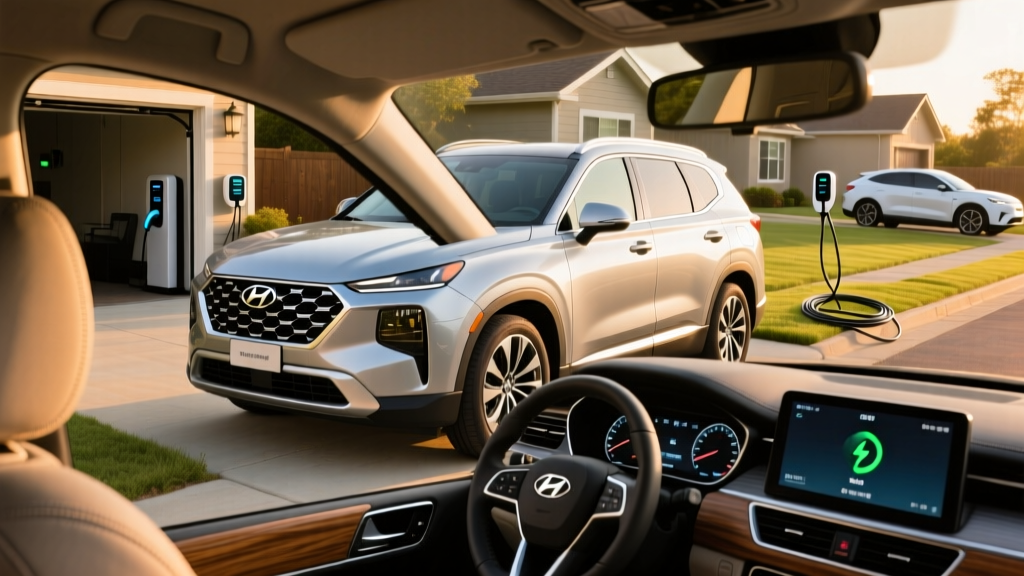
The midsize SUV segment is crowded, but the 2026 Hyundai Santa Fe Hybrid SEL occupies a specific niche that a lot of buyers are hunting for: three-row family hauler, standard all-wheel drive, and real-world fuel economy that undercuts its gasoline-only rivals by a wide margin — all without ever needing to plug in. If you've been cross-shopping the Toyota Highlander Hybrid, Kia Sorento Hybrid, and Ford Explorer Hybrid, this deep-dive on the Santa Fe Hybrid SEL trim will give you the exact numbers you need to make a decision.
This guide covers the conventional hybrid (HEV) version of the Santa Fe. Hyundai also offers a plug-in hybrid (PHEV) variant with a larger battery and electric-only driving capability — we'll clarify the differences where relevant so you can pick the right powertrain for your situation.
HEV vs PHEV: Which Santa Fe Hybrid Are We Talking About?
Before we get into the numbers, let's clear up a common source of confusion. Hyundai sells two electrified Santa Fe models:
Santa Fe Hybrid (HEV)
- Battery: ~1.49 kWh lithium-ion (small, self-charging)
- Plug-in required: No — regenerative braking and the engine recharge it
- Electric-only driving: Brief low-speed assist only (not sustained EV mode)
- Federal tax credit: Not eligible under IRS §30D (no plug)
- Best for: Drivers who want better MPG without changing habits
Santa Fe Plug-In Hybrid (PHEV)
- Battery: ~22.8 kWh lithium-ion
- Plug-in required: Yes — Level 2 (240V) charging recommended
- Electric-only range: EPA-estimated 30 miles
- Federal tax credit: Up to $7,500 under IRS §30D (subject to income, MSRP caps, and battery sourcing rules)
- Best for: Drivers with home charging and short commutes who want EV-like daily driving
This article focuses on the HEV. If you're considering the PHEV, the key decision factor is whether you can charge at home. Without home charging, the PHEV's larger battery becomes dead weight once its electric range is depleted, and you're carrying extra mass that slightly hurts fuel economy compared to the HEV.
EPA Fuel Economy: City, Highway, and Combined MPG
The 2026 Hyundai Santa Fe Hybrid SEL comes with standard HTRAC all-wheel drive. Here are the official EPA figures, as published on fueleconomy.gov:
| Driving Cycle | EPA Estimate |
|---|---|
| City | 33 MPG |
| Highway | 30 MPG |
| Combined | 32 MPG (estimated) |
For context, the non-hybrid Santa Fe with the 2.5L turbocharged engine and AWD returns roughly 20 city / 27 highway / 22 combined. That's a ~45% improvement in combined fuel economy with the hybrid powertrain — a meaningful difference when you're filling up a 17.7-gallon tank.
Real-World MPG: What to Actually Expect
Hybrids tend to outperform their EPA city ratings in stop-and-go traffic because regenerative braking recovers energy that a gas car would waste as heat. In mixed suburban driving with moderate traffic, owners of the current-generation Santa Fe Hybrid consistently report 34-37 MPG in city-heavy commutes.
Highway driving is a different story. Hybrids lose their advantage at sustained high speeds because the electric motor provides less assist and the engine does most of the work. On a 70-mph interstate run, expect 27-29 MPG — below the EPA highway sticker. Cold weather (below 30°F) will knock another 2-4 MPG off any hybrid due to reduced battery efficiency and increased engine idling for cabin heat.
Bottom line: If most of your driving is urban or suburban, the Santa Fe Hybrid will likely beat its EPA numbers. If you primarily drive highway miles, it will slightly underperform them.
Powertrain Specs: 277 HP Turbo Hybrid with AWD
The Santa Fe Hybrid's powertrain pairs a 1.6-liter turbocharged four-cylinder engine with an electric motor integrated into the transmission housing. Combined output lands at 277 horsepower and 277 lb-ft of torque — figures that put it well ahead of most competitors in the midsize hybrid SUV segment.
| Specification | 2026 Santa Fe Hybrid SEL |
|---|---|
| Engine | 1.6L turbocharged inline-4 |
| Electric Motor | 47.7 kW (64 hp), integrated in 6-speed auto |
| Combined Output | 277 hp / 277 lb-ft torque |
| Transmission | 6-speed automatic |
| Drivetrain | HTRAC AWD (standard) |
| Battery (traction) | ~1.49 kWh lithium-ion |
| 0-60 mph | ~7.4 seconds (estimated) |
| Towing Capacity | 2,000 lbs |
| Fuel Tank | 17.7 gallons |
| Total Driving Range | ~565 miles (combined) |
The 6-speed automatic is a deliberate choice by Hyundai. Unlike the CVT (continuously variable transmission) found in the Toyota Highlander Hybrid, the Santa Fe's conventional gearbox delivers more natural-feeling acceleration without the droning "rubber band" effect that some drivers dislike in CVT-equipped hybrids. The trade-off is marginally less seamless power delivery at low speeds — something most drivers won't notice.
Pricing: 2026 Santa Fe Hybrid SEL MSRP and Value
The SEL is the mid-level trim in the Santa Fe Hybrid lineup, sitting above the base SE Premium and below the Limited and Calligraphy trims. Based on current model-year pricing, expect the following:
- SEL AWD MSRP: ~$42,200 (including destination charge)
- SEL with Convenience Package: ~$44,500
- Limited AWD: ~$46,750
- Calligraphy AWD: ~$49,000
The SEL trim includes heated front seats, a power liftgate, wireless Apple CarPlay and Android Auto on a 12.3-inch infotainment display, Hyundai's Digital Key 2, and the full Hyundai SmartSense ADAS suite (forward collision-avoidance assist, lane keeping assist, blind-spot collision warning, rear cross-traffic collision-avoidance assist, and highway driving assist).
Does the Santa Fe Hybrid Qualify for a Federal Tax Credit?
The conventional Santa Fe Hybrid (HEV) does NOT qualify for the federal §30D clean vehicle tax credit. The IRS requires a vehicle to have plug-in capability and a minimum battery capacity of 7 kWh to be eligible. Since the HEV has a ~1.49 kWh battery and no charging port, it falls outside the credit's scope.
The Santa Fe Plug-In Hybrid may qualify for up to $7,500 under §30D, but eligibility depends on several factors that change regularly:
- Buyer adjusted gross income must not exceed $150,000 (single) / $300,000 (joint) — per IRS §30D rules
- Vehicle MSRP must not exceed $80,000 (SUVs/vans/pickups)
- Battery components and critical minerals must meet phased domestic sourcing thresholds
- The credit can be transferred to the dealer at point of sale as an upfront discount
Always verify current eligibility with your tax professional before counting on the credit in your purchase math.
Battery Warranty, Lifespan, and Replacement Cost
This is the question every hybrid buyer asks, and it deserves a direct answer.
Hyundai Hybrid Battery Warranty
Coverage: 10 years / 100,000 miles (whichever comes first)
What's covered: Hybrid battery pack, hybrid control unit, and related components against defects and capacity loss below a manufacturer-defined threshold
Transferable: Yes, to subsequent owners (though some states limit transferability — check your state's terms)
Additional coverage: 10-year/100,000-mile hybrid system component warranty covers the electric motor, inverter, and related electronics
How Long Will the Battery Actually Last?
Hybrid batteries are far less stressed than full EV batteries. The Santa Fe Hybrid's ~1.49 kWh pack operates within a narrow state-of-charge window — it never fully charges or fully depletes. This shallow cycling dramatically extends cell life. Based on data from Hyundai's hybrid fleet and comparable systems from Toyota and Kia, most hybrid batteries last 150,000-200,000+ miles before significant degradation.
Hyundai's hybrid systems have shown strong reliability in the current generation. The brand's 10-year/100,000-mile warranty is among the best in the industry and provides meaningful peace of mind.
Battery Replacement Cost
If the hybrid battery does fail outside of warranty, replacement costs for a midsize Hyundai hybrid battery pack typically range from $2,500 to $4,500 including labor, depending on the dealer and region. This is far less than a full EV battery replacement. Independent hybrid specialists can sometimes refurbish packs for $1,500-$2,500. For context, many owners never face this expense — the battery outlasts the vehicle.
Who Should Choose the Santa Fe Hybrid vs a PHEV or Full EV?
The Santa Fe Hybrid makes the most sense for a specific type of buyer. Here's a decision framework:
Choose the Santa Fe Hybrid (HEV) if:
- You don't have access to home or workplace charging
- You want significantly better MPG without changing any habits
- You regularly take long road trips and don't want to plan around charging stops
- You want AWD capability in a three-row SUV under $45,000
- You're upgrading from a gas-only midsize SUV and want a smooth transition
Choose the Santa Fe Plug-In Hybrid (PHEV) if:
- You can install a Level 2 charger at home
- Your daily commute is under 30 miles round-trip (you'll rarely use gas)
- You want to qualify for the §30D tax credit (up to $7,500)
- You want EV-like quietness for daily errands with gas backup for road trips
Choose a Full BEV (like the Hyundai Ioniq 5 or Kia EV9) if:
- You have reliable home charging and your daily driving is under 250 miles
- You want the lowest per-mile "fuel" cost and minimal maintenance
- You want the maximum federal tax credit and state EV incentives
- You're ready to plan road trips around DC fast-charging infrastructure
For families in areas with limited public charging infrastructure — or those who take frequent road trips to rural areas, ski resorts, or campgrounds — the HEV remains the most pragmatic electrified choice. You get the fuel savings without the infrastructure dependency.
Pros and Cons at a Glance
Pros
- Strong real-world city MPG — often exceeds the 33 EPA city estimate in stop-and-go driving
- 277 hp with AWD — confident highway merging and passing; no "slow hybrid" feeling
- No plug-in required — works with your existing routine, no charging infrastructure needed
- 10-year/100,000-mile hybrid battery warranty — industry-leading coverage
- Three-row seating with usable cargo space and a boxy, practical design
- Conventional 6-speed automatic — natural acceleration feel, no CVT drone
Cons
- No federal tax credit for the HEV — PHEV or BEV required for §30D eligibility
- Highway MPG dips below EPA estimate at sustained 70+ mph speeds
- 2,000-lb towing capacity — adequate for a small trailer, not for boats or campers
- Third row is tight for adults on longer trips — best suited for kids
- SEL trim skips some premium features (ventilated seats, head-up display) found on Limited/Calligraphy
Frequently Asked Questions
How many MPG does the 2026 Hyundai Santa Fe Hybrid SEL get?
The EPA estimates 33 MPG city, 30 MPG highway, and approximately 32 MPG combined for the AWD Santa Fe Hybrid. In real-world city-heavy driving, many owners report 34-37 MPG. Highway-only driving at 70+ mph typically yields 27-29 MPG.
Does the Santa Fe Hybrid need to be plugged in?
No. The Santa Fe Hybrid (HEV) is a conventional self-charging hybrid. Its small battery is recharged by regenerative braking and the gasoline engine. You simply fill it with gas like any other car. Only the Santa Fe Plug-In Hybrid (PHEV) requires plug-in charging.
How far can the Santa Fe Plug-In Hybrid go on electric only?
The Santa Fe PHEV has an EPA-estimated electric-only range of approximately 30 miles. After the battery is depleted, it operates as a conventional hybrid with an estimated 33-35 MPG combined. Total combined range (electric + gas) exceeds 400 miles. Note: this applies to the PHEV, not the HEV covered in this review.
Is the Hyundai Santa Fe Hybrid reliable?
Hyundai's hybrid system in the current-generation Santa Fe has demonstrated strong reliability. The 1.6L turbo engine is a proven design shared across Hyundai/Kia's lineup, and the hybrid components carry a 10-year/100,000-mile warranty. Hybrid batteries in general experience far less stress than EV batteries due to shallow charge cycling, and most last well beyond 150,000 miles.
What does a hybrid battery replacement cost?
Out-of-warranty replacement for the Santa Fe Hybrid's traction battery typically costs $2,500-$4,500 at a dealership, or $1,500-$2,500 through an independent hybrid specialist. Given the 10-year/100,000-mile warranty and the typical lifespan of 150,000-200,000+ miles, most owners will never face this expense.
Does the Santa Fe Hybrid qualify for any tax credit?
The conventional hybrid (HEV) does not qualify for the federal §30D clean vehicle credit — that credit requires plug-in capability and a battery of at least 7 kWh. Some states offer small rebates or HOV lane access for hybrids; check your state's energy office or Alternative Fuels Data Center for local incentives. The Santa Fe PHEV may qualify for up to $7,500 federally, subject to income, MSRP, and battery sourcing rules.
How does the Santa Fe Hybrid compare to the Toyota Highlander Hybrid?
The Highlander Hybrid (35-36 MPG combined, FWD; 34-35 AWD) edges out the Santa Fe Hybrid on fuel economy, but the Santa Fe offers more horsepower (277 vs 243), a more conventional driving feel with its 6-speed automatic, and Hyundai's longer warranty coverage. The Highlander also has a slightly roomier third row. Your choice will likely come down to which brand's driving dynamics, interior design, and dealer network you prefer.
The 2026 Hyundai Santa Fe Hybrid SEL is a well-rounded pick for families who want meaningful fuel savings, standard AWD, and three-row practicality — without taking on the complexity or infrastructure requirements of a plug-in vehicle. Its real-world city MPG routinely beats the EPA sticker, its 277-hp powertrain is genuinely quick for the class, and the 10-year hybrid warranty provides long-term confidence. If you can charge at home and want EV-like daily driving, look at the PHEV. If you just want to fill up less often and keep life simple, the HEV is the one to get.