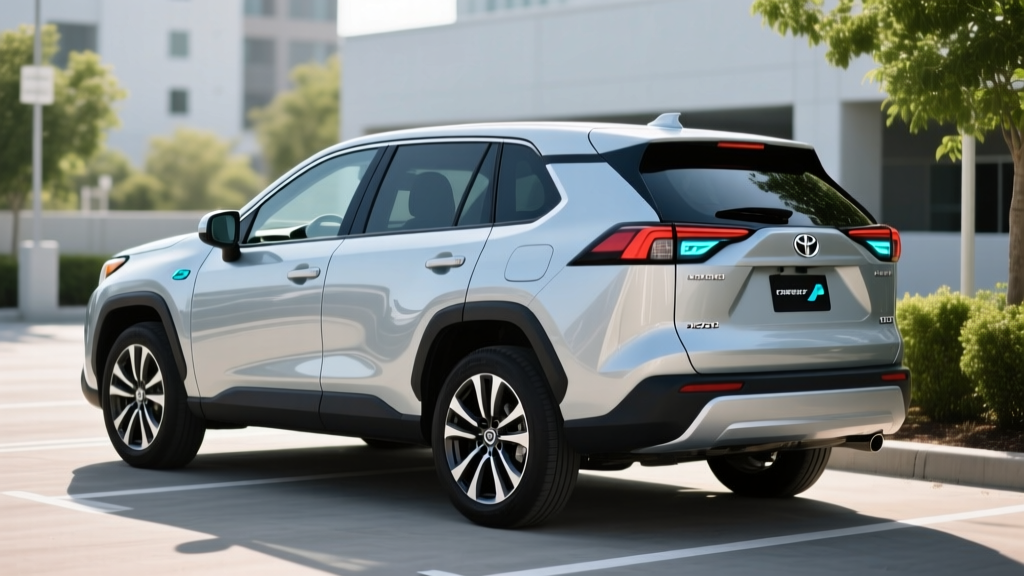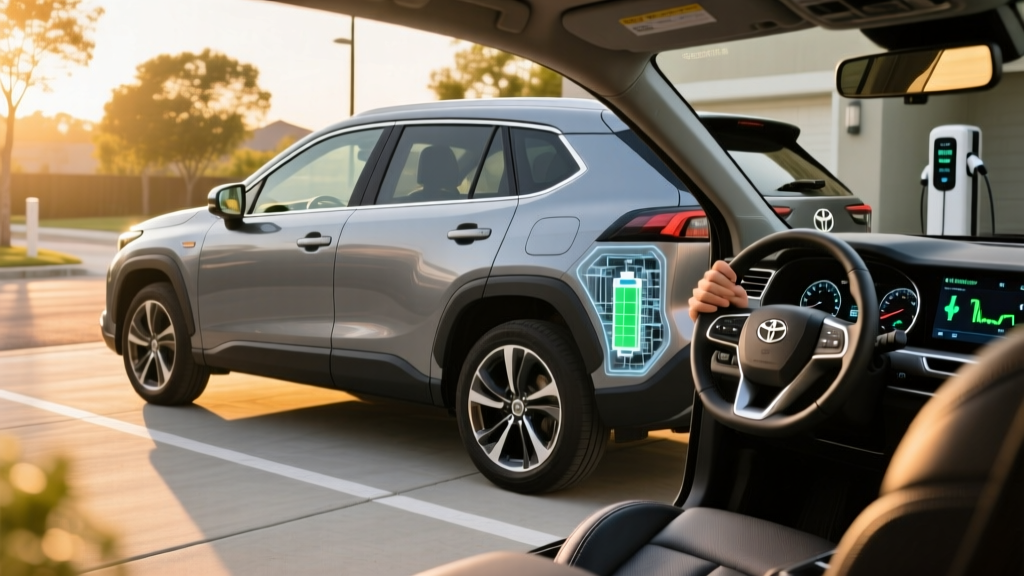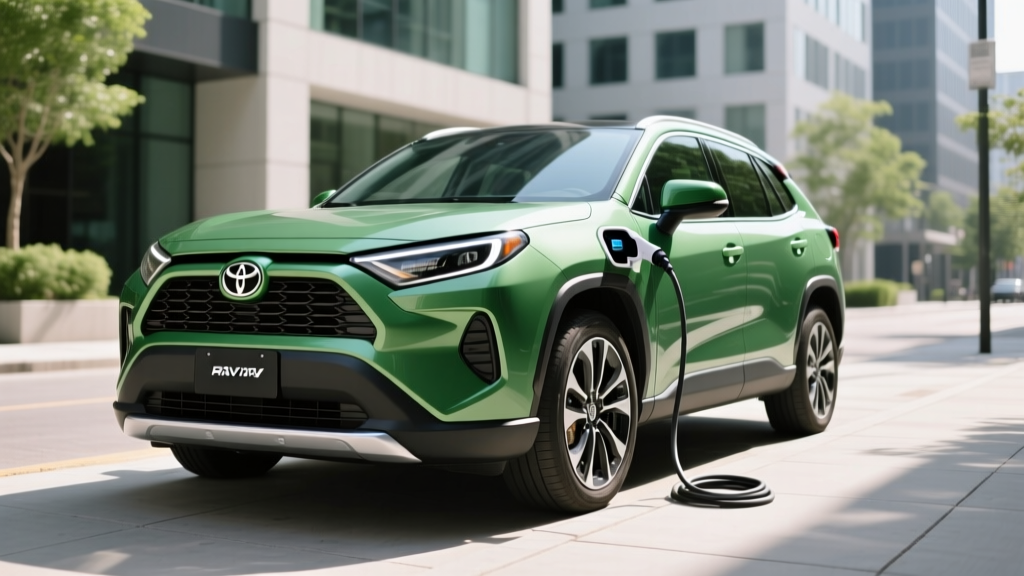
The Toyota RAV4 Prime has been the plug-in hybrid benchmark since its debut, and the 2026 RAV4 PHEV continues that legacy with a compelling formula: 42 miles of electric-only driving, 302 combined horsepower, and the versatility to road-trip without charging anxiety. For buyers not yet ready to commit to a full battery-electric vehicle but who want meaningful daily electric miles, the 2026 RAV4 Prime remains one of the strongest PHEVs in the compact SUV segment.
This guide covers everything you need to know — EPA range and MPG figures, charging times, powertrain specs, real-world efficiency, tax credit eligibility under current IRS §30D rules, and whether the RAV4 PHEV or its conventional hybrid sibling is the right call for your driveway.
HEV vs PHEV: Which RAV4 Is Right for You?
Toyota sells two electrified RAV4 variants, and confusing them is a common buyer mistake. Here is the fundamental difference:
RAV4 Hybrid (HEV)
- No plug required. The battery recharges through regenerative braking and the gasoline engine.
- 1.6 kWh battery (not usable as standalone electric range).
- EPA combined MPG: ~39-41 MPG depending on trim.
- Electric-only driving: Less than 1 mile at low speeds — not meaningful EV commuting.
- Starting MSRP: ~$33,500.
- Federal tax credit: Not eligible for §30D new clean vehicle credit.
RAV4 Prime (PHEV)
- Plug-in required for EV benefits. You charge it at home or public Level 2 stations to unlock electric range.
- 18.1 kWh battery (usable capacity ~14.5 kWh).
- 42 miles EPA electric-only range, then operates as a conventional hybrid.
- EPA combined MPG (hybrid mode): ~38 MPG; 94 MPGe combined when factoring electric driving.
- Starting MSRP: ~$44,590.
- Federal tax credit: Eligibility depends on battery sourcing and buyer income — see tax credit section below.
The bottom line: If you can charge at home and your daily commute is under 40 miles round-trip, the Prime lets you drive on electricity most days while keeping a gas tank for longer trips. If you lack home charging access or rarely drive less than 50 miles between stops, the standard RAV4 Hybrid delivers excellent efficiency without any plug-in hassle.
2026 RAV4 Prime Specs at a Glance
| Specification | 2026 RAV4 Prime (PHEV) | 2026 RAV4 Hybrid (HEV) |
|---|---|---|
| Powertrain | 2.5L 4-cyl + 2 electric motors (AWD) | 2.5L 4-cyl + 2 electric motors (AWD) |
| Combined Horsepower | 302 hp | 219 hp |
| 0-60 mph | 5.7 seconds | 7.4 seconds |
| Battery Capacity (Gross/Usable) | 18.1 kWh / ~14.5 kWh | 1.6 kWh |
| Battery Chemistry | Lithium-ion (NMC) | NiMH |
| EPA Electric-Only Range | 42 miles | N/A |
| EPA MPGe (Electric + Gas) | 94 MPGe | N/A |
| EPA MPG (Hybrid Mode, Combined) | 38 MPG | 39-41 MPG |
| Total Driving Range (Est.) | ~600 miles | ~580 miles |
| DC Fast Charge Capable | No | N/A |
| Level 2 Charge Time (0-100%) | ~2.5 hours (240V, 32A) | N/A |
| Level 1 Charge Time (120V) | ~9.5 hours | N/A |
| Drivetrain | AWD (standard) | AWD (standard) |
| Base MSRP (SE trim) | ~$44,590 | ~$33,500 |
Fuel Economy: EPA MPG and Real-World Results
| Driving Scenario | EPA Estimate | Real-World Expectation |
|---|---|---|
| Combined (Hybrid Mode) | 38 MPG | 36-40 MPG |
| City (Hybrid Mode) | 40 MPG | 40-45 MPG (hybrids excel in stop-and-go) |
| Highway (Hybrid Mode) | 36 MPG | 33-36 MPG |
| MPGe (Combined w/ EV driving) | 94 MPGe | Varies with charging frequency |
| Electric Energy Consumption | 36 kWh/100 mi | 34-40 kWh/100 mi |
According to fueleconomy.gov, the RAV4 Prime achieves 40 city / 36 highway / 38 combined MPG in hybrid mode, with 94 MPGe when electric driving is included.
Real-world MPG note: Like most Toyota hybrids, the RAV4 Prime tends to exceed its EPA city estimate in actual stop-and-go driving — regenerative braking is most effective at low speeds. Owners who charge nightly and commute under 42 miles may go weeks without visiting a gas station. On highway-heavy road trips where the battery depletes quickly, expect hybrid-mode MPG closer to 33-35, especially at speeds above 70 mph or in cold weather. Source: fueleconomy.gov
Electric Range, Charging, and What to Expect
The 2026 RAV4 Prime's 42-mile EPA electric range is one of the longest among compact PHEV SUVs, rivaling the Hyundai Tucson PHEV (33 miles) and exceeding the Subaru Crosstrek PHEV (17 miles). That 42 miles is enough to cover most daily commutes, school runs, and errands without burning a drop of gasoline.
Real-world electric range caveat: In cold weather (below 32°F), expect electric range to drop to approximately 30-35 miles due to battery efficiency loss and cabin heating demands. In mild weather with conservative driving, some owners report 44-46 miles. Highway-speed electric driving at 70+ mph will also reduce range below the EPA sticker.
Charging Details
- Level 1 (120V household outlet): ~9.5 hours for a full charge. Usable for overnight charging if you arrive home with partial depletion.
- Level 2 (240V, 32A home charger): ~2.5 hours for a full charge. This is the recommended setup — a standard 240V NEMA 14-50 outlet or hardwired Level 2 station covers daily needs easily.
- DC Fast Charging: Not supported. The RAV4 Prime uses a J1772 connector for Level 1 and Level 2 only. You will not find DC fast-charge capability on this vehicle.
The lack of DC fast charging is a trade-off. For a PHEV with an 18.1 kWh battery, it is less critical — a Level 2 top-up during a shopping trip or workday is sufficient. But it means you cannot use Electrify America or Tesla Supercharger stations for quick top-ups.
Powertrain and Performance
The 2026 RAV4 Prime pairs a 2.5-liter Atkinson-cycle four-cylinder engine with two electric motors (one front, one rear) to deliver a combined 302 horsepower and standard all-wheel drive. This makes it the quickest RAV4 in the lineup — and one of the quickest compact PHEV SUVs on the market.
- Gas engine: 177 hp, 165 lb-ft torque
- Front electric motor: 134 kW (180 hp)
- Rear electric motor: 40 kW (54 hp)
- Combined system output: 302 hp
- 0-60 mph: 5.7 seconds (Toyota estimate; independent tests have recorded 5.5-5.8 sec)
- Drivetrain: Electronic on-demand AWD (eAWD) — no mechanical connection between axles
In EV mode, the RAV4 Prime is quiet and responsive, with instant torque from the electric motors making city driving effortless. When the battery depletes, the transition to hybrid mode is seamless — most drivers will not notice the engine starting unless they are watching the power-flow display. The eAWD system provides confident traction in rain and light snow, though it is not a substitute for a dedicated off-road vehicle.
Pricing, Trims, and Tax Credit Eligibility
The 2026 RAV4 Prime is offered in two trims:
- SE: Starting at ~$44,590 (includes destination). Key features: SofTex seats, 9-inch touchscreen, wireless Apple CarPlay/Android Auto, heated front seats, 18-inch alloy wheels.
- XSE: Starting at ~$48,790. Adds: panoramic moonroof, 10.5-inch multimedia display, premium JBL audio, 19-inch wheels, ambient lighting, and available heated/ventilated front seats.
Both trims come with Toyota Safety Sense 3.0 (adaptive cruise control, lane-keeping assist, automatic emergency braking, blind-spot monitoring) and standard AWD.
Federal Tax Credit: Does the 2026 RAV4 Prime Qualify?
Under IRS §30D New Clean Vehicle Credit rules, the RAV4 Prime may qualify for a partial or full credit — but eligibility is not guaranteed and depends on several factors:
- MSRP cap: SUVs must have an MSRP at or below $80,000. The RAV4 Prime clears this threshold easily.
- Buyer income cap: Modified AGI must not exceed $150,000 (single), $225,000 (head of household), or $300,000 (joint filers).
- Battery component sourcing: A percentage of battery components must be manufactured or assembled in North America, and critical minerals must meet sourcing thresholds. These requirements tighten annually. Toyota's supply chain has historically struggled with this requirement for the Prime's battery.
- Point-of-sale transfer: If eligible, the credit can be transferred to the dealer at purchase, reducing your out-of-pocket cost immediately.
Important: Tax credit rules change frequently. As of the 2026 model year, consult the IRS clean vehicle credit page and a qualified tax professional to confirm your specific eligibility before purchasing.
Additionally, some states offer their own PHEV incentives (rebates, HOV lane access, reduced registration fees). These vary by jurisdiction — check your state energy office or the Alternative Fuels Data Center for current local programs.
Battery Warranty, Reliability, and Replacement Cost
Toyota Hybrid/PHEV Battery Warranty:
- Coverage: 10 years / 150,000 miles (whichever comes first) on the hybrid battery and hybrid system components.
- Capacity retention guarantee: Toyota warrants that the battery will retain sufficient capacity for normal PHEV operation. Specific degradation thresholds are defined in the warranty booklet.
- Transferability: The hybrid battery warranty is fully transferable to subsequent owners.
Toyota's hybrid battery track record is among the best in the industry. The Prius, now in its third decade, has demonstrated that well-managed nickel-metal hydride and lithium-ion hybrid batteries routinely last 150,000-200,000+ miles before significant degradation. The RAV4 Prime's lithium-ion pack benefits from Toyota's conservative battery management system, which maintains a substantial buffer (both top and bottom of the state-of-charge range) to reduce cell stress.
Battery replacement cost (out of warranty): A RAV4 Prime hybrid battery replacement typically ranges from $4,000 to $6,500 including parts and labor at a Toyota dealership. Third-party and refurbished options may reduce this to $2,500-$4,000. However, given the 10-year/150,000-mile warranty and Toyota's reliability history, most original owners will never face this expense.
General Reliability
The RAV4 Prime benefits from Toyota's reputation for mechanical durability. The 2.5L Dynamic Force engine is naturally aspirated and proven across the Toyota lineup. The eCVT (planetary gearset, not a belt-driven CVT) has no friction clutches or bands to wear out. Consumer Reports and J.D. Power have consistently rated the RAV4 hybrid platform above average for reliability. The main reported complaints center on infotainment software and limited cargo space versus the gas-only RAV4 — not powertrain issues.
Who Should Buy the 2026 RAV4 Prime vs Alternatives?
Pros
- 42-mile electric range covers most daily commutes
- 302 hp makes it genuinely quick (5.7 sec 0-60)
- No range anxiety — 600+ mile total range with gas backup
- Standard AWD for all-weather confidence
- 10-year/150,000-mile hybrid battery warranty
- Strong resale value and Toyota reliability reputation
Cons
- Premium pricing (~$44,590-$48,790+ before incentives)
- No DC fast charging capability
- Cargo space slightly reduced vs gas RAV4 (battery placement)
- Federal tax credit eligibility uncertain due to battery sourcing rules
- Waitlists and dealer markups remain common in many markets
- Electric range drops to ~30-35 miles in cold weather
Choose the RAV4 Prime (PHEV) if:
- You have access to home Level 2 charging (240V outlet or wallbox)
- Your daily driving is under 45 miles and you want to minimize gas use
- You take occasional road trips and do not want to plan around charging stations
- You want AWD and strong acceleration without going full EV
Choose the RAV4 Hybrid (HEV) if:
- You cannot charge at home (apartment, street parking, no garage)
- You want a lower purchase price (~$11,000 less than the Prime)
- Your daily commute exceeds 50 miles, reducing the PHEV advantage
- You prefer simplicity — no charging cables, no plug-in routine
Choose a Full EV (e.g., Tesla Model Y, Hyundai Ioniq 5) if:
- You want zero tailpipe emissions and no gasoline engine maintenance
- You have reliable home charging and access to DC fast chargers for road trips
- You want to maximize fuel cost savings (electricity is cheaper per mile than gas)
- You are comfortable with 250-330 miles of range and trip planning
Frequently Asked Questions
How many MPG does the 2026 RAV4 Prime get?
In hybrid mode (after the battery is depleted), the RAV4 Prime achieves an EPA-estimated 40 city / 36 highway / 38 combined MPG. In real-world city driving, many owners report 40-45 MPG thanks to regenerative braking. Highway mileage tends to track closer to the EPA estimate or slightly below at speeds over 70 mph. When factoring in electric-only driving, the combined rating is 94 MPGe.
How far can the RAV4 Prime go on electric only?
The EPA rates the RAV4 Prime at 42 miles of electric-only range. In mild weather with moderate speeds, you may see 44-46 miles. In cold weather (below freezing), expect 30-35 miles due to reduced battery efficiency and cabin heating energy use. Once the battery is depleted, the vehicle seamlessly transitions to hybrid mode — you are never stranded.
Does the RAV4 Prime qualify for the federal tax credit?
Possibly, but it depends on current-year IRS §30D rules regarding battery component sourcing, critical mineral requirements, and your income level. The RAV4 Prime's MSRP is well under the $80,000 SUV cap, but Toyota's battery supply chain has faced challenges meeting the North American sourcing thresholds. Check the IRS clean vehicle credit page and consult a tax professional before assuming eligibility.
Is the RAV4 Prime reliable, and what does battery replacement cost?
Toyota's hybrid platform has an outstanding reliability track record spanning over 25 years. The RAV4 Prime's hybrid battery is covered by a 10-year/150,000-mile warranty. Out-of-warranty replacement costs range from approximately $4,000-$6,500 at a dealership, though most owners will never need a replacement within the warranty period or typical ownership span.
Can the RAV4 Prime charge at a DC fast charger?
No. The RAV4 Prime supports only Level 1 (120V) and Level 2 (240V) charging via a J1772 connector. It cannot use DC fast chargers (CCS, NACS, or CHAdeMO). For a PHEV with an 18.1 kWh battery, Level 2 charging at ~2.5 hours for a full charge is practical for home and destination use.
How does the RAV4 Prime compare to a full EV like the Tesla Model Y?
The Model Y offers 260-330 miles of electric range, DC fast charging, and lower per-mile fuel costs, but requires commitment to charging infrastructure and trip planning. The RAV4 Prime gives you 42 electric miles for daily use plus unlimited gas-engine range for road trips. If you lack reliable home charging or frequently drive 300+ miles without stopping, the Prime is more practical. If you want maximum efficiency and lowest running costs, a full EV wins — provided you can charge at home.
What is the difference between kW and kWh for the RAV4 Prime?
kWh (kilowatt-hours) measures energy capacity — the RAV4 Prime's battery stores 18.1 kWh total, with roughly 14.5 kWh usable. kW (kilowatts) measures power — the rate of energy delivery or charging. The RAV4 Prime's Level 2 charging draws about 6.6 kW, meaning it takes roughly 2.5 hours to fill the usable battery capacity (14.5 kWh ÷ 6.6 kW ≈ 2.2 hours, plus tapering).
Final Verdict: Is the 2026 RAV4 Prime Worth It?
The 2026 RAV4 Prime occupies a rare sweet spot: genuine electric commuting for most drivers, a proven and powerful hybrid powertrain for longer trips, and Toyota's reliability and resale value. At $44,590 to $48,790 before incentives, it carries a significant premium over the standard RAV4 Hybrid — roughly $11,000 more. The math works if you can charge at home, drive under 42 miles most days, and value the 302-hp performance boost and standard AWD.
If federal tax credit eligibility aligns (confirm with the IRS and your tax professional), the effective price drops meaning. Even without the credit, the RAV4 Prime's combination of electric daily driving, 600-mile total range, and long-term reliability make it one of the most practical PHEVs available in 2026. For buyers who want electric driving without range anxiety, it remains the segment benchmark.