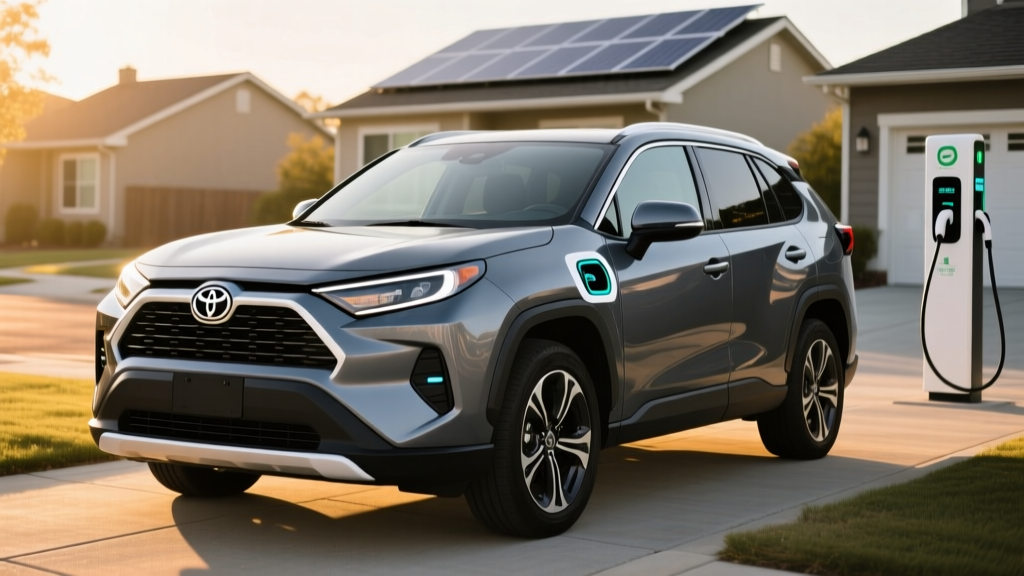
The Toyota RAV4 Prime has held its ground as one of the most capable plug-in hybrid SUVs on the market since its debut, and the 2026 model year continues that tradition. For buyers searching for an suv plug in that bridges the gap between daily electric commuting and gas-powered road-trip freedom, the RAV4 Prime (officially the RAV4 Plug-In Hybrid in Toyota's current naming) remains a benchmark. It delivers meaningful electric-only range, strong combined horsepower, and the practicality of the RAV4 platform — all without the range anxiety that still deters some buyers from full battery-electric vehicles.
This guide breaks down the 2026 RAV4 Prime's real-world efficiency, charging behavior, powertrain specs, pricing, and federal tax credit eligibility so you can decide whether it fits your garage — or whether a conventional hybrid or full BEV makes more sense.
2026 RAV4 Prime: Core Specs at a Glance
| Specification | Value |
|---|---|
| EPA Electric-Only Range | 42 miles |
| EPA Combined MPGe (EV mode) | 94 MPGe |
| EPA Combined MPG (hybrid mode) | 38 MPG |
| EPA City / Highway MPG (hybrid) | 40 city / 36 highway |
| Total Combined Range (EV + gas) | ~490 miles |
| Battery Capacity (gross / usable) | 18.1 kWh / ~14.5 kWh usable |
| Battery Chemistry | Lithium-ion (NMC) |
| Level 2 AC Charge Rate | 3.3 kW (SE); 6.6 kW (XSE) |
| Level 2 Charge Time (0–100%) | ~4.5 hrs (3.3 kW) / ~2.5 hrs (6.6 kW) |
| DC Fast Charging | Not available |
| Combined Horsepower | 302 hp |
| 0–60 mph | 5.7 seconds |
| Drivetrain | AWD (electronic rear motor) |
| Cargo Volume (rear seats up) | 33.5 cu ft |
| Base MSRP (SE trim) | $44,665 |
| XSE Trim MSRP | $47,975 |
| Hybrid Battery Warranty | 10 years / 150,000 miles |
| Powertrain Warranty | 5 years / 60,000 miles |
HEV vs PHEV: What's the Difference — and Which RAV4 Is Right for You?
Toyota sells two electrified RAV4 variants. Understanding the distinction is essential before you buy:
- RAV4 Hybrid (HEV): A conventional hybrid that never plugs in. It uses a small battery recharged by regenerative braking and the gas engine. EPA-rated at 39 MPG combined. No electric-only driving beyond very low-speed creep. No tax credit eligibility. Base MSRP around $33,000.
- RAV4 Prime (PHEV): A plug-in hybrid with a much larger 18.1 kWh battery and more powerful electric motors. Delivers 42 miles of electric-only range at highway-capable speeds. You plug it in at home (Level 1 or Level 2) to recharge the battery. When the battery depletes, it operates as a conventional hybrid at 38 MPG. Eligible for potential federal tax credits under §30D.
The critical difference: A conventional HEV never needs a plug — it generates all its own electricity. A PHEV benefits enormously from plugging in; without regular charging, you're carrying 800+ lbs of dead battery weight and only getting hybrid-mode MPG.
Electric-Only Range: 42 Miles EPA, But What About the Real World?
EPA Electric-Only Range: 42 miles
Real-world expectation: In mild weather (60–80°F) on mixed suburban roads, most owners report 38–45 miles on a full charge, with some hypermilers squeezing past 45. On the highway at 70+ mph, expect 32–36 miles. In cold weather (below 35°F), plan for 25–32 miles due to battery chemistry limitations and cabin heating demand. The RAV4 Prime does not have a dedicated heat pump — it uses a resistive PTC heater in EV mode, which draws significantly from the battery.
For most American commutes — the U.S. Census Bureau puts the average one-way commute at roughly 16 miles — 42 miles of electric range covers a full round trip without burning a drop of gasoline. This is where the PHEV value proposition crystallizes: you drive electric Monday through Friday, then take a 400-mile road trip on Saturday with zero charging stops.
The total combined range (full battery plus a full 14.5-gallon tank) lands around 490 miles. That's competitive with the most efficient gas-only crossovers, but you're doing a large chunk of it on cheaper electricity.
Charging the RAV4 Prime: Level 1, Level 2, and the 6.6 kW Upgrade
The RAV4 Prime does not support DC fast charging. This is a deliberate engineering choice shared with most PHEVs — the battery is small enough that DC fast-charging hardware would add cost and weight without meaningful benefit. All charging is AC:
| Charging Level | Power (kW) | Time (0–100%) | Practical Notes |
|---|---|---|---|
| Level 1 (120V household outlet) | ~1.4 kW | ~10.5 hours | Adequate for overnight; use the included mobile cord |
| Level 2 (240V, SE trim 3.3 kW) | 3.3 kW | ~4.5 hours | Good for overnight; slower daytime top-up |
| Level 2 (240V, XSE trim 6.6 kW) | 6.6 kW | ~2.5 hours | Full recharge during work hours or errands; worth the trim upgrade if you can't charge overnight |
Practical advice: The SE trim's 3.3 kW onboard charger is fine if you charge overnight at home — 4.5 hours easily covers a night. But if you want to recharge midday (say, at a workplace Level 2 station), the XSE's 6.6 kW charger cuts that time nearly in half. Over a few years of ownership, that convenience can be the difference between driving on electricity 90% of the time versus 60%.
A dedicated Level 2 home charger (240V, 32A circuit) typically costs $500–$800 for the unit plus $800–$2,000 for professional electrician installation, depending on your panel capacity and conduit run. If your electrical panel is maxed out, a panel upgrade can add $1,500–$3,000. According to Energy.gov's home charging guide, most homes with a 200A panel can accommodate a Level 2 charger without an upgrade.
Powertrain Performance: 302 hp and the Quickest RAV4 Toyota Sells
The RAV4 Prime's powertrain pairs a 2.5-liter four-cylinder Atkinson-cycle engine (177 hp on its own) with two electric motors — one on the front axle (134 kW / 180 hp) and one on the rear (40 kW / 54 hp). Combined system output is 302 horsepower, making it the most powerful RAV4 in the lineup and one of the quickest compact SUVs in its class.
The 0–60 mph sprint takes 5.7 seconds, per Toyota. That's not sports-car territory, but it's meaningfully quicker than the RAV4 Hybrid (7.4 seconds) and most turbocharged gas rivals. The electronic AWD system engages the rear motor on demand, providing confident traction without a mechanical driveshaft.
In EV mode, the front motor alone handles acceleration up to about 84 mph — enough for highway merging without waking the gas engine. When you floor it in hybrid mode, all power sources combine for confident passing. The regenerative braking system offers moderate one-pedal feel, though it doesn't come to a full stop like a true one-pedal EV system.
Real-World MPG: Does the RAV4 Prime Beat Its EPA Numbers?
| Mode | EPA Rating | Real-World Expectation |
|---|---|---|
| EV mode (MPGe) | 94 MPGe | 85–100 MPGe depending on temperature and driving style |
| Hybrid mode — City | 40 MPG | 38–44 MPG (hybrids often exceed EPA city figures in stop-and-go driving) |
| Hybrid mode — Highway | 36 MPG | 33–37 MPG (aerodynamic drag and sustained speeds reduce efficiency) |
| Hybrid mode — Combined | 38 MPG | 35–40 MPG |
Per fueleconomy.gov, the RAV4 Prime achieves 38 MPG combined in hybrid mode. In practice, owners who charge nightly and drive mostly suburban routes report using very little gasoline — some logging thousands of miles between fill-ups. If you don't plug in regularly, you'll operate exclusively in hybrid mode and see 35–39 MPG, which is still excellent for a 4,200-lb AWD SUV but negates the PHEV's primary advantage.
Cold-weather note: Below freezing, the gas engine may start automatically to provide cabin heat even when the battery is charged. Toyota's climate control logic prioritizes passenger comfort over EV-mode purity. This is common across most PHEVs and can reduce electric-only range by 25–35% in sustained winter conditions.
Pricing, Trims, and Federal Tax Credit Eligibility
The 2026 RAV4 Prime starts at $44,665 for the SE trim and $47,975 for the XSE. Both trims come well-equipped: the SE includes an 8-inch touchscreen, wireless Apple CarPlay/Android Auto, heated front seats, and Toyota Safety Sense 3.0 (adaptive cruise, lane-keeping, automatic emergency braking). The XSE adds the 6.6 kW onboard charger, a 9-inch display, synthetic leather upholstery, and a panoramic moonroof option.
Does the RAV4 Prime qualify for the federal §30D tax credit? Under current IRS rules (verify at IRS.gov), PHEV eligibility requires:
- Battery capacity: At least 7 kWh — the RAV4 Prime's 18.1 kWh pack qualifies.
- MSRP cap: SUVs must be under $80,000 — both RAV4 Prime trims clear this easily.
- Buyer income cap: AGI must not exceed $150,000 (single) / $300,000 (joint) / $225,000 (head of household).
- Critical minerals and battery component sourcing: The vehicle must meet phased-in percentages for North American battery component manufacturing and critical mineral sourcing. These thresholds tighten annually. Check the DOE's eligible vehicle list for the current model year's status.
- Point-of-sale transfer: As of 2024, the credit can be transferred to the dealer at purchase, reducing your out-of-pocket cost immediately rather than waiting for tax filing.
Important: Tax credit eligibility changes frequently based on battery sourcing rules. Always confirm with your dealer and a tax professional before purchasing. Some buyers may also qualify for state-level PHEV incentives (e.g., California's CVRP, Colorado's state credit) — check your state energy office for current programs.
If the RAV4 Prime qualifies for the full $7,500 federal credit, the effective price drops to roughly $37,165 (SE) or $40,475 (XSE) — placing it in direct competition with well-equipped gas-only compact SUVs once you factor in fuel savings.
Reliability and Battery Longevity: What Owners Should Expect
Hybrid Battery Warranty: Toyota covers the RAV4 Prime's high-voltage battery for 10 years or 150,000 miles (whichever comes first) against defects and excessive capacity loss. This applies in all 50 states, not just CARB states.
Expected battery lifespan: Toyota's hybrid battery packs have an excellent longevity track record. The PHEV battery operates within a conservative state-of-charge window (roughly 15–85%), which reduces degradation. Most RAV4 Primes should retain 85–90% of original battery capacity after 100,000 miles based on data from earlier Toyota PHEV platforms.
Replacement cost (out of warranty): A full high-voltage battery replacement currently runs $6,000–$9,000 at a Toyota dealer, including parts and labor. Third-party refurbishment shops offer reconditioned packs for $3,500–$5,500. Given Toyota's track record and the 10-year warranty, most original owners will never face this expense.
The RAV4 platform consistently earns strong reliability marks from J.D. Power and Consumer Reports. The 2.5-liter Atkinson-cycle engine is a proven design shared across Toyota's hybrid lineup with millions of units in service. The e-CVT transmission has no traditional gears or clutch packs to wear out, contributing to long-term durability.
RAV4 Prime vs Full EV vs Gas SUV: Which Should You Choose?
Choose the RAV4 Prime (PHEV) if:
- You can charge at home (Level 1 or 2) and your daily driving is under 40 miles.
- You take regular road trips of 200+ miles and don't want to plan around DC fast chargers.
- You live in an area with limited public charging infrastructure.
- You want one vehicle that does electric commuting and gas-powered long-distance without compromise.
Choose a full EV (like the Tesla Model Y or Hyundai Ioniq 5) if:
- You have reliable home Level 2 charging and your daily driving rarely exceeds 200 miles.
- You want zero tailpipe emissions and the lowest per-mile fuel cost.
- You're comfortable planning road trips around DC fast-charging networks.
- You want to eliminate oil changes, spark plugs, and transmission fluid entirely.
Choose the RAV4 Hybrid (conventional HEV) if:
- You cannot charge at home (apartment, street parking, no garage).
- You want a lower purchase price and don't want to manage charging routines.
- Your driving pattern is mixed highway and city with no predictable short-commute days.
Pros and Cons: An Honest Assessment
Pros
- 42 miles of electric-only range covers most daily commutes entirely
- 302 hp makes it the quickest RAV4; genuinely satisfying acceleration
- 38 MPG in hybrid mode is excellent even without plugging in
- 10-year / 150,000-mile hybrid battery warranty provides peace of mind
- Standard AWD without a mechanical driveshaft — efficient and capable
- Strong cargo space (33.5 cu ft) unchanged from gas RAV4
- Proven Toyota reliability and strong resale value
Cons
- No DC fast charging — limits utility of public charging stations
- SE trim's 3.3 kW onboard charger is slow for midday top-ups
- Starting price near $45K is steep before incentives (though credit can offset significantly)
- No heat pump — cold-weather EV range drops noticeably
- Dealer markups remain common due to high demand and limited supply
- Infotainment system lags behind rivals in responsiveness and UI polish
- Rear-seat legroom is slightly tighter than some competitors due to battery placement
Frequently Asked Questions
How many MPG does the RAV4 Prime get?
In hybrid mode (after the battery is depleted), the 2026 RAV4 Prime achieves an EPA-rated 40 city / 36 highway / 38 combined MPG. In EV mode, it's rated at 94 MPGe. Real-world hybrid MPG often reaches 38–44 in city driving, where regenerative braking recovers the most energy.
How far can the RAV4 Prime go on electric only?
The EPA rates it at 42 miles of electric-only range. Real-world results vary: expect 38–45 miles in mild conditions, 32–36 on the highway, and 25–32 in freezing weather. The gas engine may start in very cold temperatures to provide cabin heat.
Does the RAV4 Prime qualify for a tax credit?
It may qualify for up to $7,500 under the federal §30D clean vehicle credit, subject to buyer income limits ($150K single / $300K joint), battery sourcing requirements, and MSRP caps (under $80K for SUVs). Eligibility can change as sourcing rules tighten. Always verify on the IRS clean vehicle credit page and with your tax professional.
Is the RAV4 Prime reliable, and what does a battery replacement cost?
Toyota's hybrid systems have an industry-leading reliability record spanning two decades. The RAV4 Prime's battery is warrantied for 10 years / 150,000 miles. Out-of-warranty replacement costs $6,000–$9,000 at a dealer or $3,500–$5,500 from a third-party refurbisher, though most owners will never need one.
Do I have to plug in the RAV4 Prime?
You don't have to — it operates as a conventional hybrid when the battery is empty. But you'll miss the entire point of the PHEV. Without regular charging, you're carrying extra weight and paying a premium for battery capacity you never use. If you can't plug in at home or work, the conventional RAV4 Hybrid (at ~$10,000 less) is the smarter buy.
Can the RAV4 Prime DC fast charge?
No. The RAV4 Prime only accepts AC charging — Level 1 (120V) or Level 2 (240V). There is no CCS or NACS port for DC fast charging. This is typical for PHEVs; the battery is small enough that Level 2 charging refills it in 2.5–4.5 hours.
How does the RAV4 Prime compare to the Hyundai Tucson PHEV or Kia Sportage PHEV?
The RAV4 Prime offers more electric range (42 mi vs. 33 mi for the Tucson, 34 mi for the Sportage), more horsepower (302 vs. 261 and 261), and a longer battery warranty. The Korean rivals offer DC fast charging (on some trims) and more modern infotainment, but the RAV4 Prime leads in efficiency, performance, and proven reliability.