Quick Verdict: What the 2026 RAV4 Hybrid Actually Tow
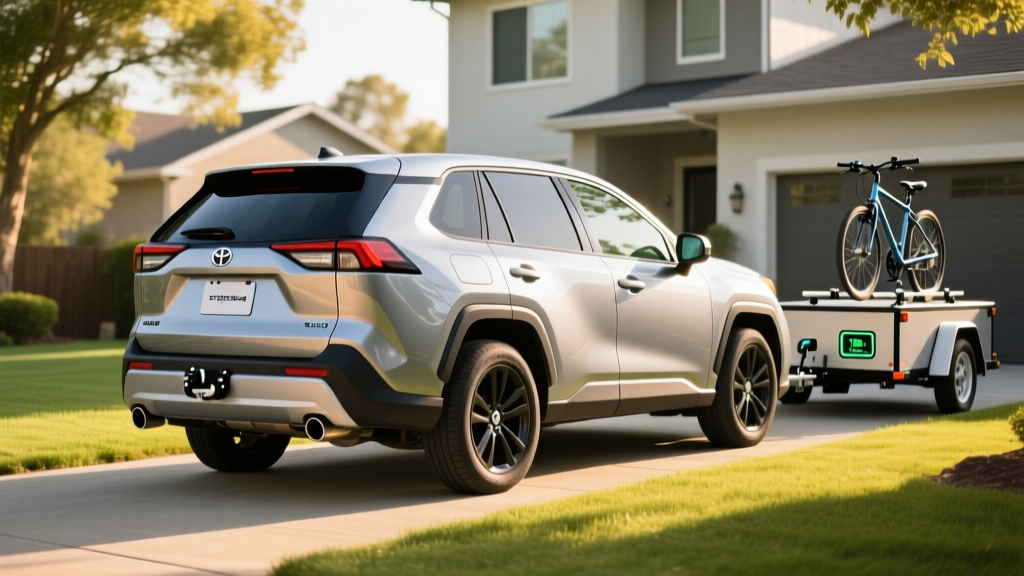
If you're researching the 2026 RAV4 hybrid towing capacity, the headline number is straightforward: Toyota rates the conventional RAV4 Hybrid (HEV) at 1,750 pounds across all trims when properly equipped. That's enough for a lightweight pop-up camper, a small utility trailer, or a pair of personal watercraft — but it falls well short of the 3,500-pound rating you'll find on some V6 midsize SUVs or the RAV4 Adventure/TRD Off-Road gas trims.
The plug-in hybrid RAV4 Prime variant shares the same 1,750-pound tow rating for 2026. Neither hybrid version is a heavy-hauler, but for buyers who want daily efficiency and occasional light-duty towing, the RAV4 Hybrid occupies a practical middle ground. Below, we break down the full powertrain, real-world fuel economy, battery longevity, and whether this hybrid fits your garage better than a full EV or a gas-only alternative.
HEV vs. PHEV: Which RAV4 Hybrid Are We Talking About?
Toyota sells two distinct electrified RAV4 models for 2026. Confusing them is the single most common mistake shoppers make, so let's separate them clearly:
| Attribute | RAV4 Hybrid (HEV) | RAV4 Prime (PHEV) |
|---|---|---|
| Powertrain type | Self-charging hybrid — no plug | Plug-in hybrid — charges via outlet or station |
| Combined horsepower | 219 hp | 302 hp |
| Electric-only range | N/A (motor assists engine only) | 42 miles (EPA) |
| Battery capacity | 1.6 kWh (nickel-metal hydride) | 18.1 kWh (lithium-ion) |
| DC fast charging | No | No (Level 2 AC only) |
| Towing capacity | 1,750 lbs | 1,750 lbs |
| Starting MSRP | ~$33,500 | ~$44,500 |
| Federal tax credit (§30D) | Not eligible | Up to $7,500 (subject to income, MSRP, and sourcing rules) |
The conventional HEV generates its own electricity through regenerative braking and the gas engine — you never plug it in. The Prime PHEV has a much larger battery that you can charge at home or at a public Level 2 station, giving you a meaningful electric-only commute before the gas engine kicks in. Both share the same 2.5-liter four-cylinder engine and electronic all-wheel-drive (eAWD) architecture, but the Prime's larger battery and more powerful electric motors deliver substantially more total system output.
Fuel Economy: EPA Ratings and Real-World MPG
Efficiency is where the RAV4 Hybrid justifies its existence over the gas-only model. Here are the official EPA figures for the 2026 model year:
| Model | City MPG | Highway MPG | Combined MPG |
|---|---|---|---|
| RAV4 Hybrid (eAWD) | 41 | 38 | 39 |
| RAV4 Prime (PHEV, hybrid mode) | 40 | 36 | 38 |
| RAV4 Prime (electric mode, MPGe) | 94 MPGe combined | ||
| RAV4 Gas (AWD, baseline) | 27 | 34 | 30 |
Source: fueleconomy.gov (U.S. EPA)
Real-World MPG: What Owners Actually See
Toyota's hybrid system excels in stop-and-go driving, where the electric motor handles low-speed propulsion and regenerative braking recaptures energy. In real-world city and suburban driving, many RAV4 Hybrid owners report 40–43 MPG, slightly exceeding the EPA city estimate. Highway driving at sustained 70–80 mph speeds typically yields 34–37 MPG, as the gas engine carries the full load with less electric assist.
Cold weather reduces fuel economy by roughly 5–10% due to increased engine idling for cabin heat and reduced battery efficiency. If you tow near the 1,750-pound limit, expect combined MPG to drop into the 28–32 range depending on terrain and speed — towing always costs efficiency, hybrid or not.
Powertrain and Towing Specs Explained
The 2026 RAV4 Hybrid pairs a 2.5-liter Atkinson-cycle four-cylinder engine with two electric motors (one front, one rear) for standard electronic all-wheel drive. Here's the full spec breakdown:
| Specification | RAV4 Hybrid (HEV) | RAV4 Prime (PHEV) |
|---|---|---|
| Engine | 2.5L I4 Atkinson-cycle | 2.5L I4 Atkinson-cycle |
| Engine output | 176 hp / 163 lb-ft | 177 hp / 165 lb-ft |
| Front motor | 118 hp / 149 lb-ft | 174 hp / 199 lb-ft |
| Rear motor | 54 hp / 89 lb-ft | 67 hp / 89 lb-ft |
| Net combined output | 219 hp | 302 hp |
| 0–60 mph | ~7.4 seconds | ~5.7 seconds |
| Transmission | eCVT | eCVT |
| Drivetrain | eAWD (standard) | eAWD (standard) |
| Towing capacity | 1,750 lbs | 1,750 lbs |
| Payload capacity | ~900–1,010 lbs | ~905–980 lbs |
The 1,750-pound tow rating requires the factory tow prep package (dealer-installed hitch receiver and wiring harness). Toyota does not offer a factory-installed tow hitch on all trims, so confirm availability with your dealer. The RAV4 Hybrid's eCVT — which uses a planetary gearset rather than a traditional belt-and-pulley CVT — is well-suited to towing because it avoids the heat buildup and slippage associated with conventional CVTs under load.
What Can You Actually Tow at 1,750 Pounds?
- Lightweight teardrop trailer (800–1,200 lbs)
- Pop-up/folding camping trailer (1,000–1,500 lbs)
- Small utility trailer with landscaping equipment
- Two personal watercraft on a single-axle trailer
- One lightweight motorcycle on a trailer
Anything exceeding 1,750 pounds — including most hard-sided travel trailers, boat trailers for vessels over 16 feet, or horse trailers — requires stepping up to a vehicle with a higher rating, such as the Toyota Highlander Hybrid (3,500 lbs) or a body-on-frame SUV.
RAV4 Prime PHEV: Electric-Only Range and Charging
If you opt for the RAV4 Prime, the 18.1 kWh lithium-ion battery delivers an EPA-rated 42 miles of electric-only range. That covers most daily commutes without the gas engine engaging at all. Once the battery depletes, the Prime operates as a conventional hybrid, returning the 38 MPG combined noted above. Total combined range (electric + gas) exceeds 600 miles.
Charging the RAV4 Prime
The Prime does not support DC fast charging. Charging is limited to Level 1 and Level 2 AC:
- Level 1 (120V household outlet): ~12 hours from empty to full using the included cord. Practical for overnight top-ups if your daily drive is under 30 miles.
- Level 2 (240V, 32A): ~2.5 hours from empty to full with the upgraded onboard charger (standard on most 2026 trims). This is the recommended home setup.
The absence of DC fast charging is a deliberate Toyota decision — the relatively small 18.1 kWh battery doesn't warrant the added cost and weight of DC fast-charge hardware. For a PHEV designed to charge overnight and run electric during the day, Level 2 is sufficient. If you need rapid road-trip charging, a full BEV is the better tool.
Pricing, Trims, and Tax Credit Eligibility
The 2026 RAV4 Hybrid lineup spans several trims, with pricing that reflects the premium over the gas-only RAV4:
- RAV4 Hybrid LE: ~$33,500 MSRP
- RAV4 Hybrid XLE: ~$35,000 MSRP
- RAV4 Hybrid SE: ~$36,500 MSRP
- RAV4 Hybrid XSE: ~$37,800 MSRP
- RAV4 Hybrid Limited: ~$40,500 MSRP
The RAV4 Prime starts higher:
- RAV4 Prime SE: ~$44,500 MSRP
- RAV4 Prime XSE: ~$48,000 MSRP
Federal Tax Credit: Does the RAV4 Hybrid Qualify?
The conventional RAV4 Hybrid (HEV) does not qualify for the IRS §30D federal clean vehicle tax credit. Only plug-in vehicles with sufficient battery capacity are eligible, and self-charging hybrids don't meet that threshold.
The RAV4 Prime (PHEV) may qualify for up to $7,500 under §30D, but eligibility depends on several conditions that change with IRS guidance:
- Income caps: Modified AGI must not exceed $150,000 (single), $225,000 (head of household), or $300,000 (joint filers).
- MSRP cap: The vehicle's MSRP must not exceed $80,000 for SUVs (the RAV4 Prime clears this easily).
- Battery sourcing: A percentage of critical minerals and battery components must be sourced from the U.S. or free-trade-agreement countries. Toyota's supply chain has evolved, but exact 2026 compliance should be verified on IRS.gov or with your tax professional before purchase.
- Point-of-sale transfer: Eligible buyers can transfer the credit to the dealer at purchase, reducing the upfront price rather than waiting for a tax refund.
Always confirm current-year eligibility with your tax advisor — sourcing requirements have tightened annually since 2023, and some previously qualifying PHEVs have lost partial or full credit eligibility.
Battery Longevity, Warranty, and Replacement Cost
Toyota Hybrid Battery Warranty (2026): 10 years / 150,000 miles (whichever comes first) for the hybrid battery pack in both the RAV4 Hybrid and RAV4 Prime. This applies nationwide regardless of state emissions regulations.
Toyota's hybrid battery warranty is among the strongest in the industry. The conventional RAV4 Hybrid uses a proven nickel-metal hydride (NiMH) pack that has demonstrated exceptional longevity — data from prior-generation RAV4 Hybrids and the Prius family shows most hybrid batteries lasting well beyond 150,000 miles with minimal capacity loss. The Prime's lithium-ion pack carries the same warranty terms.
What Does Replacement Cost?
If a hybrid battery does fail outside warranty, here's what to expect:
- RAV4 Hybrid (NiMH): ~$2,500–$4,000 for a new OEM replacement, including labor. Refurbished packs are available for $1,500–$2,500.
- RAV4 Prime (Li-ion, 18.1 kWh): ~$6,000–$9,000 for OEM replacement. The larger lithium-ion pack is more expensive, though failures remain rare within the first decade.
For context, the hybrid system's electric motors, inverter, and eCVT are also covered under Toyota's hybrid system warranty (8 years / 100,000 miles). Real-world failure rates for Toyota hybrid components are low — this is a powertrain architecture with over 25 years of production refinement.
Who Should Choose the RAV4 Hybrid vs. a Full EV or Gas SUV?
Choose the RAV4 Hybrid (HEV) if:
- You want maximum fuel efficiency without changing your fueling habits — just fill up with gas and go.
- You don't have reliable access to home or workplace charging.
- You need AWD and light towing (1,750 lbs) for weekend trips.
- You plan to keep the vehicle 10+ years and value Toyota's long-term reliability record.
- Your budget is under $40,000 and you don't want to navigate tax-credit complexity.
Choose the RAV4 Prime (PHEV) if:
- Your daily commute is under 40 miles and you can charge at home (Level 2 recommended).
- You want to drive mostly electric on weekdays but need gas flexibility for long road trips.
- You qualify for the §30D tax credit, effectively reducing the Prime's price closer to the Hybrid Limited.
- You value the 302-hp performance advantage — the Prime is the quickest RAV4 in the lineup.
Choose a full EV (e.g., Tesla Model Y, Hyundai Ioniq 5) if:
- You have reliable home Level 2 charging and your typical trips fall within 250–300 miles.
- You want to eliminate gas purchases entirely and minimize drivetrain maintenance.
- You need a higher tow rating (Model Y: 3,500 lbs) or more cargo volume.
- You want access to DC fast charging for road trips (20–30 minute stops).
Stick with the gas RAV4 if:
- Your budget is tight — the gas RAV4 LE starts around $29,500, roughly $4,000 less than the Hybrid.
- You drive mostly highway miles where the hybrid's city efficiency advantage narrows.
- You need the 3,500-lb tow rating available on certain gas-only Adventure/TRD Off-Road trims.
Pros and Cons at a Glance
Pros
- 39 MPG combined (HEV) — class-leading for a compact AWD SUV
- Standard eAWD across all hybrid trims
- 10-year / 150,000-mile hybrid battery warranty
- Proven, reliable Toyota hybrid powertrain with decades of refinement
- 1,750-lb towing sufficient for light recreational use
- RAV4 Prime offers 42 miles EV-only + 302 hp
Cons
- 1,750-lb tow rating trails gas-only Adventure trim (3,500 lbs)
- RAV4 Prime does not support DC fast charging
- Conventional HEV is not eligible for any federal tax credit
- Prime's price premium (~$11,000 over Hybrid LE) requires tax-credit eligibility to justify
- Engine noise under hard acceleration (eCVT drone) is noticeable
- Cargo space slightly reduced in Prime due to larger battery
Frequently Asked Questions
How many MPG does the 2026 RAV4 Hybrid get?
The EPA rates the 2026 RAV4 Hybrid at 41 city / 38 highway / 39 combined MPG. In real-world driving, city and suburban commuters often see 40–43 MPG, while sustained highway driving at 75+ mph typically returns 34–37 MPG. Towing near the max rating will reduce combined efficiency to roughly 28–32 MPG.
How far can the RAV4 Prime go on electric only?
The 2026 RAV4 Prime delivers an EPA-rated 42 miles of electric-only range on a full charge. At highway speeds above 65 mph or in very cold weather, expect that to drop to roughly 33–38 miles. Once the battery is depleted, the Prime operates as a conventional hybrid returning 38 MPG combined.
Is the RAV4 Hybrid reliable, and what does battery replacement cost?
Toyota's hybrid system is one of the most proven in the industry, with over 25 years of production history. The hybrid battery is covered for 10 years / 150,000 miles. Out-of-warranty NiMH replacement runs ~$2,500–$4,000 for the conventional Hybrid; the Prime's larger lithium-ion pack costs ~$6,000–$9,000. Failures before 150,000 miles are uncommon based on historical data from Toyota's hybrid lineup.
Does the RAV4 Hybrid qualify for any tax credit?
The conventional RAV4 Hybrid (HEV) does not qualify for the federal §30D clean vehicle credit — only plug-in vehicles are eligible. The RAV4 Prime (PHEV) may qualify for up to $7,500, depending on your income, the vehicle's battery sourcing compliance, and current IRS rules. Verify eligibility at IRS.gov and consult a tax professional before purchasing.
Can I increase the RAV4 Hybrid's towing capacity with aftermarket parts?
No. The 1,750-pound rating is determined by Toyota based on the vehicle's cooling capacity, suspension tuning, drivetrain limits, and braking performance. Aftermarket hitches or suspension upgrades do not change the manufacturer's rated capacity. Exceeding it voids warranty coverage and compromises safety. If you need more than 1,750 pounds, look at the gas-only RAV4 Adventure (3,500 lbs) or a larger SUV.
Hybrid vs. PHEV vs. full EV — which RAV4 should I buy?
It depends on your charging access and driving patterns. If you can't charge at home, the conventional Hybrid is the clear choice — no behavior change required, excellent MPG. If you can install a Level 2 charger and your commute is under 42 miles, the Prime lets you drive electric daily while keeping gas flexibility. A full EV like the Tesla Model Y or Hyundai Ioniq 5 makes sense only if you have reliable home charging, rarely exceed 300 miles in a day, and want to eliminate gasoline entirely. See our decision framework above for a detailed breakdown.