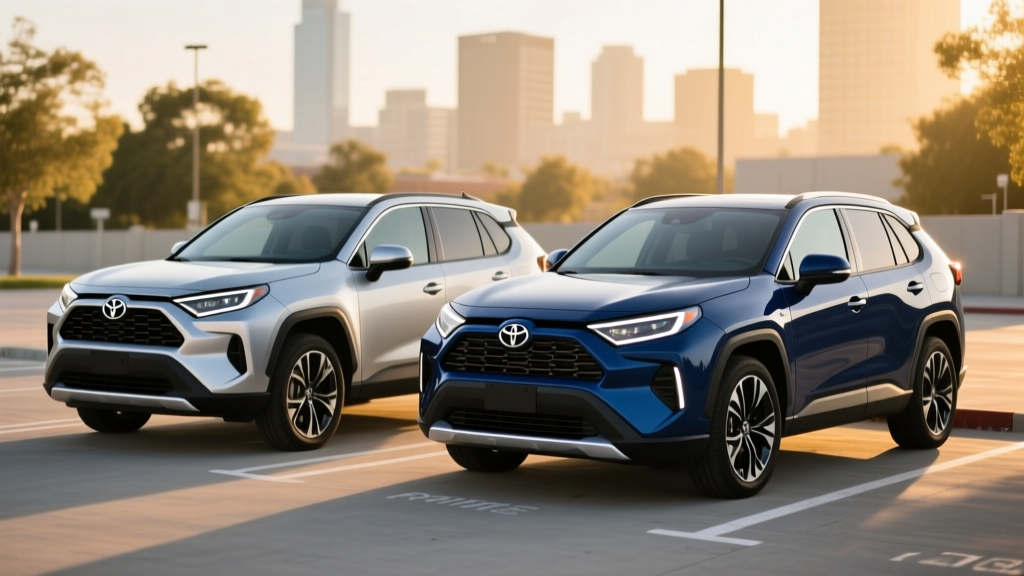
The Toyota RAV4 remains America's best-selling non-truck, and for 2026 it offers two electrified powertrains that confuse many shoppers: the conventional RAV4 Hybrid (HEV) and the plug-in RAV4 Prime (PHEV). Both pair a 2.5-liter four-cylinder with electric motors, but their daily driving experience, fuel economy, and purchase economics diverge sharply. This guide breaks down exact EPA numbers, real-world expectations, and the ownership math so you can pick the right one.
HEV vs PHEV: What's the Actual Difference?
Before comparing specs, the distinction matters for your wallet and routine:
RAV4 Hybrid (HEV)
- Self-charging — regenerative braking and the gas engine replenish a small ~1.6 kWh battery
- No plug, no charging routine required
- Electric motor assists the engine; cannot drive on electricity alone for meaningful distances
- Lower upfront cost, no home charger needed
RAV4 Prime (PHEV)
- Larger 18.1 kWh battery you plug in to charge (Level 1 or Level 2)
- 42 miles of pure electric driving before the gas engine engages
- Once the battery depletes, operates as a conventional hybrid
- Higher MSRP but eligible for federal and state incentives
If you can charge at home and your daily commute falls under 40 miles round-trip, the Prime can operate as an EV most days while retaining hybrid flexibility for road trips. If you lack charging access or drive long highway miles daily, the standard Hybrid delivers strong efficiency without behavioral change.
2026 RAV4 Hybrid: EPA MPG and Real-World Efficiency
The conventional RAV4 Hybrid uses Toyota's fifth-generation hybrid system, pairing the 2.5L Dynamic Force engine with front and rear electric motors for standard electronic AWD (eAWD).
| Trim / Drivetrain | City MPG | Highway MPG | Combined MPG |
|---|---|---|---|
| LE / XLE (eAWD) | 41 | 38 | 39 |
| XLE Premium / Limited (eAWD) | 41 | 38 | 39 |
| Woodland Edition (eAWD) | 38 | 35 | 37 |
Real-world note: Toyota hybrids consistently exceed EPA city estimates in stop-and-go driving because regenerative braking recovers energy that gas cars waste as heat. Owners routinely report 42–45 MPG in urban commuting. Highway efficiency drops closer to 34–36 MPG at sustained 75+ mph speeds, where the engine carries more load and aerodynamic drag dominates. Expect a combined real-world average of 37–41 MPG depending on your driving mix. Source: fueleconomy.gov.
2026 RAV4 Prime PHEV: Electric Range, MPGe, and Charging
The RAV4 Prime is one of the most powerful RAV4 variants Toyota sells, and it doubles as a short-range EV for daily driving.
| Specification | Value |
|---|---|
| Electric-only range (EPA) | 42 miles |
| Combined MPGe (electric + gas) | 94 MPGe |
| Gas-only mode (battery depleted) | 38 MPG combined |
| Total combined range | ~600 miles |
| Battery capacity | 18.1 kWh (lithium-ion) |
| Combined system horsepower | 302 hp |
| 0–60 mph | 5.7 seconds |
| Level 1 charging (120V, 12A) | ~12 hours (0–100%) |
| Level 2 charging (240V, 32A) | ~2.5 hours (0–100%) |
| DC fast charging | Not supported |
| Drivetrain | eAWD (standard) |
Electric-Only Range in Practice
The EPA's 42-mile electric estimate assumes moderate temperatures and mixed driving. In real-world use:
- Summer city driving (65–80°F): 40–44 miles achievable with gentle acceleration
- Highway at 70 mph: 30–35 miles before the engine kicks in
- Winter (below 32°F): 25–32 miles due to battery chemistry slowdown and cabin heating load
The Prime does not support DC fast charging. This is typical for PHEVs — the battery is small enough that Level 2 overnight or workplace charging fully replenishes it. If you only have a standard 120V outlet, plan on plugging in each evening for a full overnight charge.
Powertrain and Performance Comparison
| Attribute | RAV4 Hybrid (HEV) | RAV4 Prime (PHEV) |
|---|---|---|
| Engine | 2.5L 4-cyl + 2 electric motors | 2.5L 4-cyl + 2 electric motors (higher output) |
| Combined horsepower | 219 hp | 302 hp |
| 0–60 mph | 7.4 sec | 5.7 sec |
| Drivetrain | eAWD (standard) | eAWD (standard) |
| Towing capacity | 1,750 lbs | 2,500 lbs |
| Battery size | ~1.6 kWh | 18.1 kWh |
The Prime's 302 hp makes it the quickest RAV4 in the lineup — quicker than most turbocharged gas crossovers in this class. The standard Hybrid's 219 hp is adequate for merging and passing but not sporty. Both use Toyota's eCVT, which prioritizes smoothness over simulated gear shifts.
Pricing, Trims, and Federal Tax Credit Eligibility
Pricing reflects 2026 MSRP before destination charges:
| Model / Trim | MSRP |
|---|---|
| RAV4 Hybrid LE | $33,425 |
| RAV4 Hybrid XLE | $35,350 |
| RAV4 Hybrid Limited | $40,550 |
| RAV4 Prime SE | $44,990 |
| RAV4 Prime XSE | $48,490 |
Federal Tax Credit (§30D) for the RAV4 Prime
The RAV4 Prime qualifies for a partial federal tax credit under current IRS §30D rules — but eligibility depends on several factors that change periodically:
- MSRP cap: SUVs must be under $80,000 — all RAV4 Prime trims qualify
- Buyer income cap: AGI must not exceed $150,000 (single), $225,000 (head of household), or $300,000 (joint filing)
- Battery sourcing: Critical mineral and battery component requirements phase in annually; the exact credit amount ($3,750 or $7,500) depends on current-year sourcing compliance — verify at IRS.gov qualified vehicles list
- Point-of-sale transfer: You can transfer the credit to the dealer at purchase to reduce your out-of-pocket cost, rather than waiting to claim it on your tax return
The standard RAV4 Hybrid (HEV) does not qualify for the §30D federal EV credit because it is not a plug-in vehicle. Some states offer separate hybrid rebates — check your state energy office for current programs.
Battery Warranty Coverage
Toyota covers the hybrid battery in both the RAV4 Hybrid and RAV4 Prime for 10 years or 150,000 miles (whichever comes first) in all 50 states. This applies from the 2020 model year onward and covers defects and capacity loss below a defined threshold. The hybrid powertrain components (inverter, control module, transaxle motor) carry the same 10-year/150,000-mile coverage.
Reliability and Battery Replacement Costs
Toyota's hybrid system is among the most proven in the industry, with over 25 years of production data dating to the original Prius. The RAV4 Hybrid and Prime share the same fundamental architecture.
Track record: Toyota hybrid batteries in the RAV4 and Highlander have demonstrated median lifespans exceeding 200,000 miles with proper maintenance. Failures before 150,000 miles are uncommon and typically covered under warranty.
Replacement cost if out of warranty:
- RAV4 Hybrid (1.6 kWh battery): $2,500–$3,500 for a new OEM battery pack, plus ~$500 labor
- RAV4 Prime (18.1 kWh battery): $8,000–$11,000 for a new OEM pack, plus labor
Refurbished and aftermarket hybrid batteries are available at 40–60% of OEM cost. Individual cell or module replacement is sometimes possible at specialist shops for $500–$1,500 if only a portion of the pack has degraded.
The Prime's larger battery carries higher replacement risk, but it also benefits from more conservative charge management — Toyota buffers a significant portion of the 18.1 kWh to prevent deep cycling, which extends longevity.
Who Should Choose Which RAV4?
RAV4 Hybrid (HEV) Pros & Cons
Pros:
- 39 MPG combined without any charging routine
- Lower MSRP — starts ~$11,500 less than the Prime
- Proven reliability with lower battery replacement cost
- No home electrical upgrades needed
Cons:
- No electric-only driving capability
- 219 hp — adequate but not quick
- No federal tax credit eligibility
RAV4 Prime (PHEV) Pros & Cons
Pros:
- 42 miles electric — covers most commutes gas-free
- 302 hp — genuinely quick for a compact SUV
- Partial or full federal tax credit (income/sourcing dependent)
- 94 MPGe when charged regularly
Cons:
- $11,500+ MSRP premium over the Hybrid
- No DC fast charging — Level 2 only
- Heavier — slightly less cargo space due to battery
- Higher battery replacement cost long-term
The Decision Framework
Choose the RAV4 Hybrid if: You lack reliable home charging, drive more than 60 miles daily (mostly highway), want the lowest purchase price, or plan to keep the vehicle 10+ years and want minimal battery cost exposure.
Choose the RAV4 Prime if: You can install a Level 2 charger at home, your daily round-trip commute is under 40 miles, you qualify for the federal tax credit (which narrows the price gap significantly), and you value the performance upgrade to 302 hp.
Consider a full EV (like the bZ4X or Tesla Model Y) if: Your daily driving rarely exceeds 250 miles, you want zero gas engine maintenance, and you have reliable home and workplace charging access.
Frequently Asked Questions
How many MPG does the 2026 RAV4 Hybrid get?
The EPA rates most RAV4 Hybrid trims at 41 city / 38 highway / 39 combined MPG. The Woodland Edition drops to 38/35/37 MPG due to all-terrain tires and suspension tuning. Real-world city driving often yields 42–45 MPG thanks to regenerative braking, while sustained highway driving at 75+ mph returns 34–36 MPG.
How far can the RAV4 Prime go on electric only?
The EPA rates the RAV4 Prime at 42 miles of electric-only range. In practice, expect 40–44 miles in warm city driving, 30–35 miles at highway speeds, and 25–32 miles in freezing temperatures. Once the battery depletes, the Prime operates as a conventional hybrid rated at 38 MPG combined.
Does the RAV4 Hybrid or Prime qualify for a tax credit?
The conventional RAV4 Hybrid does not qualify for any federal tax credit because it cannot plug in. The RAV4 Prime may qualify for up to $7,500 under IRS §30D, depending on your income, the vehicle's battery component and critical mineral sourcing compliance, and current-year rules. Check the IRS qualified plug-in vehicles page for the latest eligibility.
Is the RAV4 Hybrid reliable, and what does battery replacement cost?
Toyota's hybrid system has over 25 years of production history with strong longevity data. The hybrid battery is warrantied for 10 years/150,000 miles. Out-of-warranty replacement runs $2,500–$3,500 for the Hybrid and $8,000–$11,000 for the Prime's larger pack. Most owners never need a replacement within typical ownership periods.
Hybrid vs PHEV vs full EV — which is right for me?
The HEV (standard Hybrid) suits drivers who want maximum efficiency with zero charging hassle. The PHEV (Prime) fits those with home charging and short commutes who want EV-like daily driving plus gas-engine flexibility for road trips. A full BEV makes sense if your daily range needs stay under 250 miles, you want to eliminate gas entirely, and you have dependable charging access. The Prime is the bridge option — it rewards home charging without penalizing you if you skip it.
Can I charge the RAV4 Prime at a public DC fast charger?
No. The RAV4 Prime does not have a DC fast charging port. It charges via Level 1 (120V household outlet) in about 12 hours or Level 2 (240V) in approximately 2.5 hours. This is standard for PHEVs — the 18.1 kWh battery is small enough that overnight Level 2 charging is sufficient.