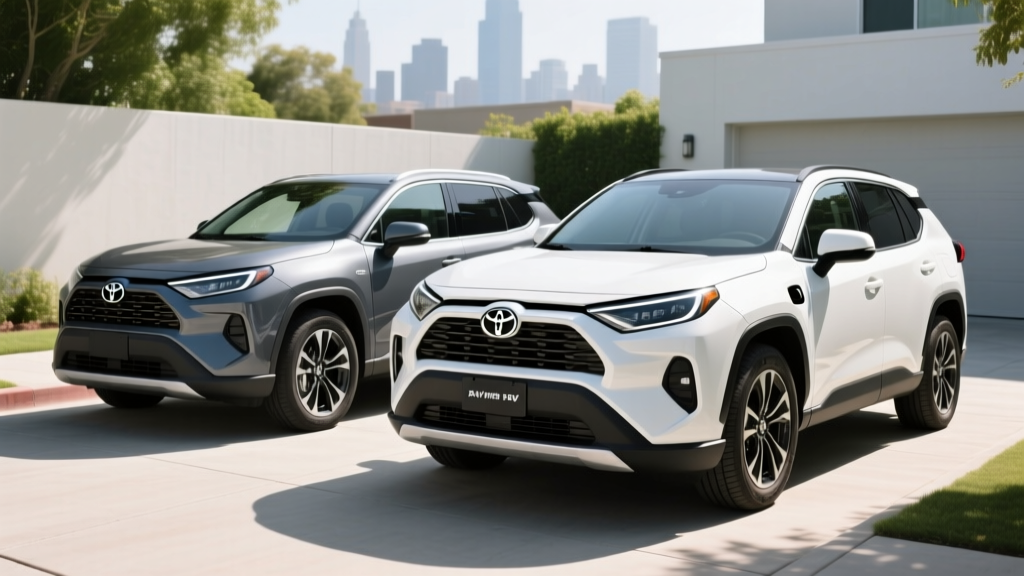
The Toyota RAV4 has been America's best-selling non-truck for years, and its electrified variants now account for a significant share of those sales. For 2026, Toyota continues to offer the RAV4 in two distinct hybrid flavors: the conventional Rav4 Hybrid (HEV) and the plug-in RAV4 Prime (PHEV). They share a body, a nameplate, and a 2.5-liter four-cylinder foundation — but the powertrains, efficiency profiles, pricing, and tax-credit eligibility diverge sharply.
If you're cross-shopping the 2026 RAV4 hybrids, this guide breaks down every number that matters: EPA MPG, electric-only range, battery capacity, horsepower, charging logistics, and total cost of ownership. No fluff, just the data you need to pick the right one.
HEV vs PHEV: What's the Actual Difference?
Before comparing trims, let's clarify the fundamental architecture split. This distinction is the single most important decision point for RAV4 hybrid buyers.
RAV4 Hybrid (HEV)
- No plug required — the battery charges via regenerative braking and the gas engine
- Smaller battery (~1.6 kWh usable) — purely a buffer for electric-motor assist
- Cannot drive on electricity alone for meaningful distances
- Lower MSRP, simpler ownership, no charging infrastructure needed
RAV4 Prime (PHEV)
- Plugs in — charge from a wall outlet or Level 2 station
- Larger battery (~18.1 kWh) enabling 42 miles of electric-only driving
- Operates as an EV for short commutes, then seamlessly switches to hybrid mode
- Higher MSRP, but eligible for federal/state incentives and far more horsepower
The short version: the HEV is a more fuel-efficient gas car that never needs plugging in. The Prime is a part-time EV that eliminates most daily gasoline use if your commute is under 42 miles round-trip — and when the battery depletes, it reverts to a highly efficient hybrid.
Fuel Economy: EPA MPG and Real-World Numbers
Here's how the 2026 RAV4 hybrids stack up on the EPA cycle, per fueleconomy.gov data:
| Model | City MPG | Highway MPG | Combined MPG | MPGe (EV Mode, Prime Only) |
|---|---|---|---|---|
| RAV4 Hybrid (AWD) | 41 | 38 | 39 | N/A |
| RAV4 Hybrid (FWD LE) | 27 | 35 | 30 | N/A |
| RAV4 Prime (AWD PHEV) | 40 (hybrid mode) | 36 (hybrid mode) | 38 (hybrid mode) | 94 MPGe |
Real-world MPG reality check: Toyota's hybrid system excels in stop-and-go city driving, where the electric motor handles low-speed propulsion and regenerative braking recaptures energy. Many owners report exceeding the 41 MPG city EPA figure on the Hybrid AWD in urban conditions — 43–45 MPG is common in warm weather with moderate traffic. Highway driving is the opposite: sustained 75+ mph speeds reduce efficiency to roughly 33–35 MPG on the Hybrid AWD, below the EPA highway sticker. Expect a blended real-world average of 36–40 MPG for the Hybrid AWD depending on your driving mix.
For the Prime, once the 42-mile EV range depletes, the vehicle operates as a heavy hybrid (it carries ~350 lbs of extra battery mass). Real-world hybrid-mode MPG typically lands around 35–37 combined — slightly below the standard Hybrid because of that weight penalty. But if your daily driving stays under 42 miles and you charge nightly, you may go months without visiting a gas station.
RAV4 Prime: Electric-Only Range and Charging
The 2026 RAV4 Prime carries an 18.1 kWh lithium-ion battery pack (NMC chemistry), of which approximately 15.5 kWh is usable — Toyota reserves a buffer top and bottom to protect long-term battery health.
Real-world expectation: 35–40 miles in warm weather with mixed driving; 28–33 miles in freezing temperatures with cabin heat on. Highway-speed EV driving (65+ mph) will reduce range to roughly 30–34 miles.
Charging the Prime from empty to full:
| Charging Level | Power (kW) | Time (0–100%) | Notes |
|---|---|---|---|
| Level 1 (120V household outlet) | ~1.4 kW | ~12 hours | Works, but slow — fine for overnight if your daily EV need is under 30 mi |
| Level 2 (240V, 16A) | ~3.3 kW (standard onboard charger) | ~5.5 hours | Standard on most Prime trims |
| Level 2 (240V, 32A) | ~6.6 kW (premium onboard charger) | ~2.5 hours | Available on higher trims / as option; requires 32A-capable EVSE |
| DC Fast Charging | N/A | N/A | The RAV4 Prime does NOT support DC fast charging |
The lack of DC fast charging is a deliberate engineering choice: the Prime's battery is small enough that Level 2 charging covers overnight replenishment, and adding DC fast-charge hardware would increase cost, weight, and packaging complexity. For a PHEV with 42 miles of range, this is a reasonable trade-off — but if you were hoping to top up at a highway Electrify America station, that's not an option here.
Connector: The RAV4 Prime uses a standard J1772 connector for Level 1 and Level 2 AC charging. If you own a Tesla Wall Connector (NACS), you'll need a J1772 adapter (Tesla sells one, and third-party options exist).
Powertrain and Performance Specs
| Specification | RAV4 Hybrid (AWD) | RAV4 Prime (AWD PHEV) |
|---|---|---|
| Engine | 2.5L 4-cyl Atkinson-cycle | 2.5L 4-cyl Atkinson-cycle |
| Combined System Horsepower | 219 hp | 302 hp |
| Electric Motors | Front + rear (eAWD) | Front (stronger) + rear (eAWD) |
| 0–60 mph | ~7.4 seconds | ~5.7 seconds |
| Drivetrain | AWD (electronic rear axle) | AWD (electronic rear axle) |
| Battery Capacity (usable) | ~1.6 kWh | ~15.5 kWh |
| Battery Chemistry | NiMH (hybrid buffer) | NMC lithium-ion |
| Towing Capacity | 1,750 lbs | 2,500 lbs |
| Cargo Volume (behind 2nd row) | 37.5 cu ft | 33.5 cu ft (battery intrusion) |
The Prime's 302 combined horsepower is the sleeper story here. It's the quickest RAV4 Toyota sells — faster than the V6-era models — and the instant electric torque makes it feel even quicker in around-town driving. The standard Hybrid's 219 hp is adequate for merging and passing but won't excite anyone. Both use Toyota's eAWD system, where a rear electric motor provides all-wheel-drive traction without a mechanical driveshaft, improving packaging and efficiency.
Note the cargo-volume penalty on the Prime: the larger battery pack sits under the rear floor, reducing cargo space by about 4 cubic feet and raising the load floor slightly. For most buyers this is minor, but if you regularly haul bulky gear, it's worth measuring against your needs.
Pricing, Trims, and Tax Credit Eligibility
Here's the 2026 MSRP landscape for RAV4 hybrids, reflecting Toyota's current pricing:
| Model / Trim | MSRP (approx.) | Federal §30D Tax Credit |
|---|---|---|
| RAV4 Hybrid LE (AWD) | $33,500 | Not eligible (HEV) |
| RAV4 Hybrid XLE (AWD) | $35,500 | Not eligible (HEV) |
| RAV4 Hybrid Woodland Edition | $37,000 | Not eligible (HEV) |
| RAV4 Prime SE (AWD PHEV) | $45,500 | Up to $7,500* |
| RAV4 Prime XSE (AWD PHEV) | $49,000 | Up to $7,500* |
*Federal §30D tax credit rules for 2026 (per IRS.gov):
- Vehicle type: Must be a plug-in electric vehicle with ≥7 kWh battery capacity — the RAV4 Prime qualifies (18.1 kWh). The standard Hybrid does not.
- MSRP cap: SUVs/vans must be ≤$80,000 MSRP — both Prime trims clear this easily.
- Buyer income cap: Modified AGI ≤$150,000 (single), ≤$300,000 (joint), ≤$225,000 (head of household).
- Battery sourcing & critical minerals: The credit is split into two halves ($3,750 + $3,750). Eligibility for each half depends on where battery components and critical minerals are sourced. These requirements tighten annually — check the IRS qualified vehicle list for the specific model year and build date.
- Point-of-sale transfer: As of 2024+, you can transfer the credit to the dealer at purchase, reducing your out-of-pocket cost immediately rather than waiting for tax filing.
Critical caveat: Toyota's battery supply chain sourcing determines how much of the $7,500 credit the Prime actually qualifies for in any given production batch. Some build periods may qualify for the full $7,500; others may only qualify for $3,750 or potentially $0 if sourcing requirements aren't met. Always verify current eligibility on the IRS qualified vehicles list before purchasing. Consult a tax professional for your specific situation.
After the maximum federal credit, a RAV4 Prime SE could effectively cost around $38,000 — bringing it much closer to a well-equipped Hybrid XLE. Add any state or utility PHEV rebates (California's CVRP, Colorado's state credit, etc.), and the gap narrows further. This is where the Prime's value proposition becomes compelling.
Battery Longevity, Warranty, and Replacement Cost
Toyota Hybrid Battery Warranty
RAV4 Hybrid (HEV): 10 years / 150,000 miles (whichever comes first) on the hybrid battery and all hybrid-system components.
RAV4 Prime (PHEV): 10 years / 150,000 miles on the high-voltage lithium-ion battery and plug-in hybrid components.
Capacity retention guarantee (Prime): Toyota warrants that the Prime's battery will retain at least 70% of its original capacity during the warranty period. If it drops below 70% (meaning EV range falls below ~29 miles), Toyota will repair or replace it at no cost.
Is the RAV4 hybrid reliable? Toyota's hybrid powertrains are among the most proven in the industry. The Prius platform has accumulated billions of real-world miles since 1997, and the eAWD hybrid system in the RAV4 shares core architecture. The standard Hybrid uses a nickel-metal hydride (NiMH) buffer battery, which is exceptionally durable and tolerant of deep cycling. Failure rates within the warranty period are low based on long-term owner data and Consumer Reports reliability surveys, which consistently rate Toyota hybrids at or near the top of their segments.
Battery replacement cost (out of warranty):
- RAV4 Hybrid (HEV) NiMH battery: $2,000–$3,500 (parts + labor at a dealer). Independent hybrid specialists often perform this for $1,500–$2,500.
- RAV4 Prime (PHEV) lithium-ion battery: $6,000–$9,000 estimated (parts + labor). The larger, more complex pack is significantly more expensive. However, given the 10-year/150,000-mile warranty and typical degradation curves for NMC chemistry in Toyota's conservative thermal management system, most owners will never face this cost.
Degradation reality: Real-world data from earlier-generation Toyota PHEVs (Prius Prime) suggests high-voltage battery degradation of roughly 8–12% over the first 100,000 miles when properly maintained. Toyota's thermal management system is conservative — it doesn't push the battery to extreme states of charge or temperature, which is the primary factor in lithium-ion longevity. Expect the Prime to deliver 35–38 miles of EV range at 100,000 miles, down from the original 42.
Hybrid vs PHEV vs Full EV: Which RAV4 Is Right for You?
Choose the RAV4 Hybrid (HEV) if:
- You don't have access to home or workplace charging (apartment, street parking, no garage)
- You want the simplest ownership experience — fill up with gas and go
- Your budget is under $38,000 and you don't qualify for PHEV tax credits
- You prioritize cargo space (no battery intrusion)
- You drive mostly highway miles, where the hybrid advantage is smallest
Choose the RAV4 Prime (PHEV) if:
- Your daily round-trip commute is under 42 miles and you can charge at home overnight
- You want EV-like daily driving without range anxiety on road trips
- You value the 302 hp performance advantage
- You qualify for the federal §30D credit and/or state PHEV incentives, narrowing the price gap
- You want to tow more (2,500 lbs vs 1,750 lbs)
Consider a full EV (e.g., Tesla Model Y, Hyundai Ioniq 5) instead if:
- Your daily driving regularly exceeds 42 miles but stays under 250 miles
- You have reliable home Level 2 charging and want zero gasoline expenses
- You want the lowest per-mile fuel cost and minimal maintenance (no oil changes, no gas engine)
- You qualify for the full $7,500 federal credit on an eligible BEV
The RAV4 Prime occupies a unique niche: it's the bridge vehicle for buyers who want EV-like commuting but aren't ready to commit to full electric — whether due to apartment living, frequent road trips to charging-desert regions, or a single-vehicle household that can't risk a 30-minute DC fast-charge stop on a tight schedule. The standard Hybrid is the pragmatic choice for anyone who simply wants better fuel economy with zero behavioral change.
Pros and Cons at a Glance
RAV4 Hybrid (HEV) — Pros
- 39 MPG combined (AWD) with no plug-in required
- Lower entry price starting ~$33,500
- Proven, ultra-reliable Toyota hybrid system
- Full cargo space (37.5 cu ft)
- Strong resale value
RAV4 Hybrid (HEV) — Cons
- No electric-only driving capability
- No federal tax credit eligibility
- Modest 219 hp — adequate but not quick
- Highway MPG drops to ~33–35 real-world
RAV4 Prime (PHEV) — Pros
- 42 miles EV range covers most commutes gas-free
- 302 hp — quickest RAV4 available
- Up to $7,500 federal tax credit (verify eligibility)
- 2,500 lb towing capacity
- 94 MPGe in EV mode — extremely low per-mile cost when electric
RAV4 Prime (PHEV) — Cons
- $45,500+ MSRP before incentives
- No DC fast charging
- Reduced cargo space (33.5 cu ft)
- Heavier vehicle reduces hybrid-mode MPG vs standard Hybrid
- High demand can lead to dealer markups and limited availability
Frequently Asked Questions
How many MPG does the 2026 RAV4 Hybrid get?
The RAV4 Hybrid AWD is EPA-rated at 41 city / 38 highway / 39 combined MPG. In real-world driving, expect 36–40 MPG combined depending on your city/highway mix and climate. City driving often exceeds the EPA figure; sustained highway speeds reduce it.
How far can the RAV4 Prime go on electric only?
The EPA rates the 2026 RAV4 Prime at 42 miles of electric-only range. Real-world range varies: expect 35–40 miles in warm weather with mixed driving, and 28–33 miles in freezing conditions with cabin heat active. Highway-speed EV driving (70+ mph) will also reduce range to roughly 30–34 miles.
Does the RAV4 Prime qualify for a tax credit?
The RAV4 Prime qualifies for the federal §30D clean vehicle credit — potentially up to $7,500 — because it's a plug-in hybrid with an 18.1 kWh battery. However, the actual credit amount depends on battery-component and critical-mineral sourcing requirements, which tighten annually. Your personal eligibility also depends on income caps ($150K single / $300K joint). Check the current IRS qualified vehicle list and consult a tax professional. The standard RAV4 Hybrid (HEV) does not qualify for any federal EV credit.
Is the RAV4 Hybrid battery reliable and expensive to replace?
Toyota's hybrid batteries are among the most reliable in the industry, backed by a 10-year / 150,000-mile warranty. The standard Hybrid uses proven NiMH chemistry; the Prime uses NMC lithium-ion with conservative thermal management. Out-of-warranty replacement costs range from $2,000–$3,500 for the Hybrid and $6,000–$9,000 for the Prime. Most owners will never need a replacement based on historical degradation data.
Do I need to plug in the standard RAV4 Hybrid?
No. The standard RAV4 Hybrid (HEV) charges its small battery entirely through regenerative braking and the gas engine. You simply fuel it like a conventional car. Only the RAV4 Prime (PHEV) benefits from plugging in.
Can the RAV4 Prime DC fast charge?
No. The RAV4 Prime supports Level 1 (120V) and Level 2 (240V) AC charging only, using a J1772 connector. With the available 6.6 kW onboard charger, a full Level 2 charge takes approximately 2.5 hours. DC fast charging is not available on any current RAV4 Prime.