Quick Verdict: The RAV4 Hybrid Still Sets the Compact SUV Efficiency Bar
The 2026 Toyota RAV4 Hybrid remains one of the most fuel-efficient compact SUVs you can buy without plugging in. With an EPA-estimated 41 MPG city and 38 MPG highway (40 MPG combined on LE/XLE trims), it delivers real-world fuel economy that frequently exceeds its sticker numbers in stop-and-go driving — the exact scenario where conventional hybrids shine brightest. For buyers who want SUV practicality, all-wheel drive, and sub-30 MPG fuel bills without ever thinking about charging infrastructure, the RAV4 Hybrid is a compelling default choice.
But the RAV4 lineup also includes the RAV4 Plug-In Hybrid (formerly Prime), which adds 42 miles of electric-only range and a much larger battery. This guide breaks down the exact MPG figures, powertrain specs, pricing, tax-credit eligibility, and long-term reliability data for both the conventional hybrid (HEV) and plug-in hybrid (PHEV) — so you can decide which version fits your driving pattern.
HEV vs. PHEV: What's the Difference?
Conventional Hybrid (RAV4 Hybrid): Uses a small battery (~1.6 kWh) charged entirely by the gas engine and regenerative braking. You never plug it in. The electric motor assists the engine to reduce fuel consumption, yielding 39-41 MPG combined.
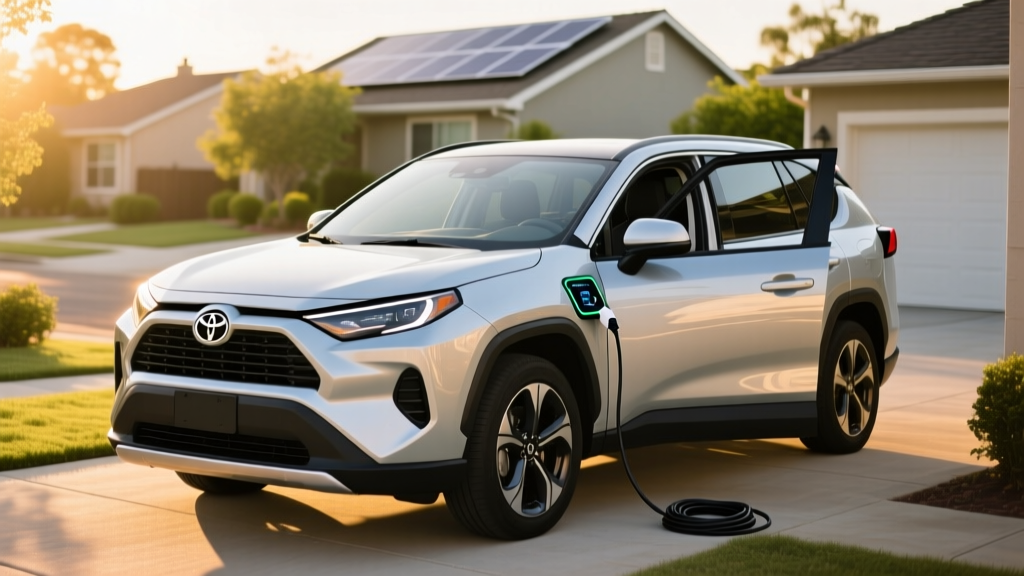
Plug-In Hybrid (RAV4 Plug-In Hybrid): Carries a much larger battery (~18.1 kWh usable) that you charge via a wall outlet or Level 2 charger. It can drive up to 42 miles on electricity alone before the gas engine kicks in, functioning as a conventional hybrid afterward.
2026 RAV4 Hybrid MPG: EPA Ratings and Trim Breakdown
The 2026 RAV4 Hybrid pairs a 2.5-liter four-cylinder engine with Toyota's fifth-generation hybrid system and standard electronic all-wheel drive (AWD). EPA fuel economy ratings vary slightly by trim due to wheel size and weight differences.
| Trim | City MPG | Highway MPG | Combined MPG | Drivetrain |
|---|---|---|---|---|
| LE | 41 | 38 | 40 | AWD |
| XLE | 41 | 38 | 40 | AWD |
| SE / XSE | 40 | 36 | 38 | AWD |
| Woodland Edition | 38 | 35 | 37 | AWD |
| Limited | 40 | 36 | 38 | AWD |
Source: EPA Fuel Economy (fueleconomy.gov)
How many MPG does the 2026 RAV4 Hybrid actually get?
The EPA rates the most popular trims (LE, XLE) at 41 city / 38 highway / 40 combined MPG. Sport-oriented trims with larger 19-inch wheels drop to 38 combined.
Real-World MPG: What Owners Actually Report
EPA estimates are a baseline, not a guarantee. Toyota's hybrid system has a well-documented real-world advantage: it frequently beats EPA city ratings in actual stop-and-go traffic because regenerative braking recovers energy that a gas car wastes as heat.
Real-World MPG Expectations
City driving (commute, errands): 40-44 MPG — the hybrid system excels here, with the electric motor handling low-speed acceleration and regen recovering braking energy.
Highway driving (70-80 mph sustained): 34-38 MPG — aerodynamic drag dominates at speed, and the gas engine does most of the work. Expect the lower end at 80 mph or with a full cargo load.
Cold weather (below 30°F): 33-37 MPG combined — the engine runs more frequently to generate cabin heat and warm the catalytic converter, reducing electric-motor assist time.
Mixed driving (annual average): 38-42 MPG — most owners tracking on Fuelly and similar platforms report averages near or slightly above the EPA combined figure.
For context, a comparable gas-only compact SUV averages 25-28 MPG combined. The RAV4 Hybrid's ~40 MPG combined translates to roughly $1,100-$1,300 per year in fuel costs at 15,000 miles and $3.40/gallon regular unleaded — about $700-$900 less annually than a gas-only competitor.
Powertrain Specs: How the Hybrid System Works
| Specification | RAV4 Hybrid (HEV) | RAV4 Plug-In Hybrid (PHEV) |
|---|---|---|
| Engine | 2.5L 4-cyl Dynamic Force | 2.5L 4-cyl Dynamic Force |
| Combined Horsepower | 219 hp | 302 hp |
| 0-60 mph | 7.6 sec | 5.7 sec |
| Hybrid Battery | ~1.6 kWh (NiMH/Li-ion) | ~18.1 kWh usable (Li-ion) |
| Electric-Only Range | N/A (motor assist only) | 42 miles (EPA) |
| Total Range | ~580 miles | ~600 miles (EV + gas) |
| Plug-In Charging | No — self-charging | Yes — Level 1 / Level 2 |
| Level 2 Charge Time | N/A | ~2.5 hours (240V, 3.3 kW) |
| DC Fast Charging | N/A | No |
| Drivetrain | AWD (e-AWD, electronic rear motor) | AWD (e-AWD, electronic rear motor) |
| Towing Capacity | 1,750 lbs | 1,750 lbs |
The conventional RAV4 Hybrid uses Toyota's Series-Parallel hybrid architecture: the 2.5L Atkinson-cycle engine and front electric motor can drive the wheels independently or together, while a separate rear-axle electric motor provides AWD traction without a mechanical driveshaft. This "e-AWD" system engages the rear motor during acceleration, low-traction conditions, and certain cornering scenarios — then disconnects to minimize drag during steady-state cruising.
The PHEV version uses the same architecture but with a significantly more powerful electric motor system and a larger lithium-ion battery pack, producing 302 combined horsepower. That makes it the quickest RAV4 variant short of a hypothetical GR model, with a 5.7-second 0-60 time that outpaces many sport-turbo compact SUVs.
RAV4 Plug-In Hybrid: Electric-Only Range and Charging
For buyers considering the PHEV variant, the key question is: how far can it go on electric only?
The 2026 RAV4 Plug-In Hybrid delivers an EPA-estimated 42 miles of electric-only range and an EPA-rated 94 MPGe when operating in EV mode. Once the battery depletes, the vehicle seamlessly transitions to conventional hybrid operation, returning approximately 38 MPG combined on gas alone.
Charging the PHEV:
- Level 1 (120V household outlet): ~10-12 hours for a full charge. Practical for overnight top-ups if your daily electric commute is under 40 miles.
- Level 2 (240V, 16A/3.3 kW onboard charger): ~2.5 hours for a full charge. A dedicated home Level 2 station is the practical choice for daily PHEV use.
- DC fast charging: Not available. The RAV4 PHEV's 3.3 kW onboard charger and battery size don't support DC fast charging — this is typical for PHEVs in this class.
The 42-mile EV range covers the average American's daily round-trip commute (roughly 35-40 miles per the U.S. Census Bureau), meaning many PHEV owners can run on electricity for weekday driving and use gas only for longer weekend trips. If you have home charging access and a sub-40-mile commute, the PHEV can operate as a de facto EV most of the time while eliminating range anxiety entirely.
Pricing, Trims, and Tax Credit Eligibility
Here's where the HEV vs. PHEV decision gets financial:
| Model / Trim | MSRP (approx.) | Federal Tax Credit |
|---|---|---|
| RAV4 Hybrid LE | ~$33,500 | None |
| RAV4 Hybrid XLE | ~$35,000 | None |
| RAV4 Hybrid Limited | ~$41,000 | None |
| RAV4 Plug-In Hybrid SE | ~$45,500 | Up to $7,500* |
| RAV4 Plug-In Hybrid XSE | ~$48,500 | Up to $7,500* |
*Federal tax credit subject to IRS §30D eligibility requirements. See details below.
Does the RAV4 Hybrid qualify for a tax credit?
The conventional RAV4 Hybrid (HEV) does not qualify for the federal §30D Clean Vehicle Credit. This credit applies only to plug-in electric vehicles (BEVs and PHEVs) with sufficient battery capacity and qualifying battery sourcing.
The RAV4 Plug-In Hybrid may qualify for up to $7,500 under current IRS rules, but eligibility depends on several factors:
- Income caps: Modified AGI must not exceed $150,000 (single), $225,000 (head of household), or $300,000 (joint filers).
- MSRP cap: The vehicle's MSRP must not exceed $80,000 for SUVs (RAV4 PHEV clears this easily).
- Battery sourcing: The $7,500 credit splits into two $3,750 halves — one for critical minerals sourcing and one for battery component manufacturing. Qualifying percentages change annually under IRS §30D rules. Verify current-year battery sourcing compliance on Toyota's website or with your dealer before purchase.
- Point-of-sale transfer: As of 2024, qualifying buyers can transfer the credit to the dealer at purchase, reducing the sale price directly rather than waiting for a tax refund.
- Assembly: The vehicle must undergo final assembly in North America. The RAV4 PHEV is assembled in Japan, which may affect eligibility — confirm with your dealer and consult a tax professional.
Bottom line: Do not assume you'll receive $7,500. The battery-sourcing and North American assembly requirements have disqualified several Toyota PHEVs in prior model years. Check the fueleconomy.gov tax credit lookup for the specific 2026 RAV4 PHEV trim before committing.
Battery Warranty, Reliability, and Replacement Cost
Toyota Hybrid Battery Warranty
Coverage: 10 years / 150,000 miles (whichever comes first) on the hybrid battery pack, applicable in all 50 states.
What's covered: Defects in materials and workmanship, and capacity loss below a defined threshold (typically ~60-70% of original capacity during the warranty period).
Transferable: Yes — the hybrid battery warranty transfers to subsequent owners, which supports resale value.
Is the RAV4 Hybrid reliable?
Toyota's hybrid powertrain is among the most proven in the industry, with over 25 years of continuous production since the original Prius. The RAV4 Hybrid specifically benefits from Toyota's fifth-generation hybrid transaxle, which has been incrementally refined for durability and efficiency.
Key reliability considerations:
- Hybrid battery longevity: Toyota's nickel-metal hydride and lithium-ion hybrid batteries routinely last 150,000-200,000+ miles in real-world use. Failures before 100,000 miles are uncommon based on owner forums and repair databases.
- Hybrid battery replacement cost: If replacement is needed out of warranty, expect $2,500-$4,500 for a new OEM hybrid battery pack (HEV), depending on the specific pack and labor. Refurbished packs are available for $1,500-$2,500. The PHEV's larger lithium-ion pack is more expensive — roughly $8,000-$12,000 for full replacement.
- Brake wear: Hybrids often see extended brake pad life (60,000-100,000 miles) because regenerative braking handles much of the deceleration load.
- No plug-in required: The conventional RAV4 Hybrid charges its own battery. There is no charging cable, no charging port, and no need for home electrical work.
HEV vs. PHEV vs. Full EV: Which RAV4 Fits You?
Decision Framework
Choose the RAV4 Hybrid (HEV) if:
- You lack access to home or workplace charging
- You want maximum simplicity — no plugs, no charging apps, no behavior changes
- Your budget starts around $33,000-$41,000
- You drive 12,000-18,000 miles per year and want 38-42 MPG without thinking about it
- You live in an apartment or street-park and can't install a charger
Choose the RAV4 Plug-In Hybrid (PHEV) if:
- You have home Level 2 charging (or can install it)
- Your daily round-trip commute is under 42 miles
- You want EV-like daily driving with gas-engine freedom for road trips
- You may qualify for the federal tax credit, effectively closing the price gap with the HEV
- You value the 302 hp performance upgrade (5.7 sec 0-60)
Choose a full EV (like the Toyota bZ4X or Hyundai Ioniq 5) if:
- You have reliable home charging and your daily driving is under 250 miles
- You want zero tailpipe emissions and minimal drivetrain maintenance
- You're eligible for the full $7,500 federal credit on a qualifying BEV
- You're comfortable planning road-trip charging stops
Pros and Cons at a Glance
✓ Pros
- 40-41 MPG combined (LE/XLE) — among the best in the compact SUV segment
- Standard AWD on every hybrid trim with no MPG penalty vs. FWD
- Strong reliability track record; 10yr/150k-mile hybrid battery warranty
- No plug-in charging required (HEV) — works with any lifestyle
- Spacious cargo area (~37.6 cu ft behind rear seats)
- Competitive starting price for the hybrid segment
✗ Cons
- Conventional hybrid (HEV) does not qualify for federal EV tax credit
- RAV4 PHEV assembled in Japan — may not meet §30D North American assembly requirement
- No DC fast charging on PHEV variant
- Engine noise under hard acceleration (CVT drone)
- Infotainment system functional but not class-leading in responsiveness
- Towing limited to 1,750 lbs
Frequently Asked Questions
How many MPG does the 2026 Toyota RAV4 Hybrid get?
The EPA rates the 2026 RAV4 Hybrid LE and XLE at 41 city / 38 highway / 40 combined MPG. Sport trims (SE, XSE) and the Limited drop slightly to 38 combined. Real-world owners typically report 38-44 MPG depending on driving mix, with city-heavy commutes often exceeding the EPA city rating.
Does the RAV4 Hybrid need to be plugged in?
No. The conventional RAV4 Hybrid is a self-charging hybrid (HEV). Its small battery is charged by the gas engine and regenerative braking. You never plug it in — you simply refuel with gasoline at any station. Only the RAV4 Plug-In Hybrid variant requires (and benefits from) plug-in charging.
How far can the RAV4 Plug-In Hybrid drive on electric only?
The 2026 RAV4 Plug-In Hybrid delivers an EPA-estimated 42 miles of electric-only range. After the battery depletes, the vehicle continues as a conventional hybrid, achieving approximately 38 MPG combined on gasoline. Total combined range (EV + gas) exceeds 600 miles.
Is the RAV4 Hybrid battery expensive to replace?
Out-of-warranty replacement for the conventional RAV4 Hybrid battery runs approximately $2,500-$4,500 for a new OEM pack. However, Toyota's hybrid batteries routinely last 150,000-200,000+ miles, and the factory warranty covers 10 years / 150,000 miles. Many first owners will never face a battery replacement.
Does the 2026 RAV4 Hybrid qualify for any tax credit?
The conventional RAV4 Hybrid (HEV) does not qualify for the federal §30D Clean Vehicle Credit, which is limited to plug-in vehicles. The RAV4 Plug-In Hybrid may qualify for up to $7,500, but eligibility depends on IRS battery-sourcing requirements, buyer income caps, and North American final assembly rules — the RAV4 PHEV is built in Japan, which has complicated eligibility in prior years. Verify current-year status on IRS.gov and with your dealer before purchase.
RAV4 Hybrid vs. a full EV — which makes more sense?
If you have home charging, a commute under 250 miles, and want minimal maintenance, a full EV offers lower per-mile energy costs and zero tailpipe emissions. If you lack charging access, frequently drive 300+ miles in a day, or want the simplest possible ownership experience, the RAV4 Hybrid delivers excellent efficiency without any infrastructure dependency. The PHEV splits the difference — EV daily, gas for road trips — if you can charge at home.
What is the real-world annual fuel cost for the RAV4 Hybrid?
At 15,000 miles per year, $3.40/gallon regular unleaded, and 40 MPG combined, expect roughly $1,275 per year in fuel costs. That compares to approximately $2,040 for a gas-only compact SUV averaging 25 MPG combined — a savings of about $765 per year, or $3,825 over five years.