Quick Verdict: The 2026 RAV4 Hybrid's Fuel Economy at a Glance
The Toyota RAV4 Hybrid remains one of the best-selling hybrid SUVs in America for a reason: it delivers genuine fuel savings without requiring you to change a single habit. No plugging in, no range anxiety, no charging apps. You just drive it like any other SUV and watch the fuel bills drop.
For the 2026 model year, the RAV4 Hybrid continues with Toyota's proven fourth-generation hybrid powertrain, rated by the EPA at 41 MPG city / 38 MPG highway / 39 MPG combined across most trims. The rugged Woodland Edition drops slightly to 37 MPG combined due to all-terrain tires and a lifted suspension. In our experience with Toyota's hybrid system, real-world city driving often exceeds the EPA sticker — a rarity among vehicles — while sustained highway cruising at 75+ mph may fall a few MPG short.
- City/Suburban: 40–44 MPG (hybrids thrive in stop-and-go with regenerative braking)
- Highway (65 mph): 37–39 MPG (electric motor assist tapers at sustained speed)
- Highway (75+ mph): 34–37 MPG (aerodynamic drag dominates)
- Cold weather (below 32°F): Expect 3–5 MPG reduction (engine runs more to heat cabin and battery)
HEV vs PHEV: Which RAV4 Is Right for You?
Toyota offers the RAV4 in two electrified flavors for 2026, and confusing them is one of the most common buyer mistakes we see. Here's the distinction:
| Attribute | RAV4 Hybrid (HEV) | RAV4 Prime (PHEV) |
|---|---|---|
| Powertrain Type | Conventional hybrid — self-charging, no plug | Plug-in hybrid — charges via outlet + gas engine |
| EPA MPG / MPGe | 39 MPG combined | 94 MPGe (electric) / 38 MPG (gas-only) |
| Electric-Only Range | Not applicable (electric assist only) | 42 miles EV-only |
| Battery Capacity | ~1.6 kWh (small buffer battery) | 18.1 kWh lithium-ion |
| Combined Horsepower | 219 hp | 302 hp |
| Charging Required? | No — never plug in | Yes — plug in for EV range; drives as hybrid without |
| DC Fast Charge? | No | No (Level 2 AC only, ~2.5 hours to full) |
| Starting MSRP (2026) | ~$33,500 | ~$45,500 |
| Federal Tax Credit (§30D) | Not eligible | May qualify — subject to sourcing, income, and MSRP caps |
The bottom line: The RAV4 Hybrid (HEV) is the right call if you want effortless fuel savings without lifestyle changes. The RAV4 Prime (PHEV) is ideal if you have home charging, a commute under 42 miles, and want to drive mostly on electricity while keeping a gas engine for road trips.
2026 RAV4 Hybrid EPA Fuel Economy by Trim
Fuel economy varies slightly by trim due to wheel size, weight, and tire selection. Here's the full EPA breakdown per fueleconomy.gov:
| Trim Level | City MPG | Highway MPG | Combined MPG | Annual Fuel Cost* |
|---|---|---|---|---|
| LE / XLE / XLE Premium | 41 | 38 | 39 | ~$1,550 |
| SE / XSE | 41 | 38 | 39 | ~$1,550 |
| Limited | 41 | 38 | 39 | ~$1,550 |
| Woodland Edition | 38 | 35 | 37 | ~$1,650 |
*Based on 15,000 miles/year at $3.50/gallon regular unleaded. Your costs will vary with local fuel prices and driving habits.
For context, the gas-only 2026 RAV4 (2.5L four-cylinder, FWD) is rated at 27 city / 35 highway / 30 combined. The hybrid delivers a 30% improvement in combined fuel economy — and that gap widens in city driving where the hybrid system recaptures energy through regenerative braking.
Powertrain Deep Dive: How the RAV4 Hybrid Makes 219 HP
The 2026 RAV4 Hybrid pairs a 2.5-liter Dynamic Force four-cylinder engine (176 hp, 163 lb-ft) with two electric motor-generators — one on the front axle and one on the rear (Toyota's eAWD system). Combined system output is 219 horsepower.
Unlike some hybrid systems that feel sluggish, Toyota's eCVT (electronically controlled continuously variable transmission) delivers smooth, linear acceleration. The 0-60 mph time is approximately 7.4 seconds — quick enough for confident highway merging. The rear electric motor provides on-demand all-wheel drive without a mechanical driveshaft, improving traction in rain and light snow while adding minimal weight.
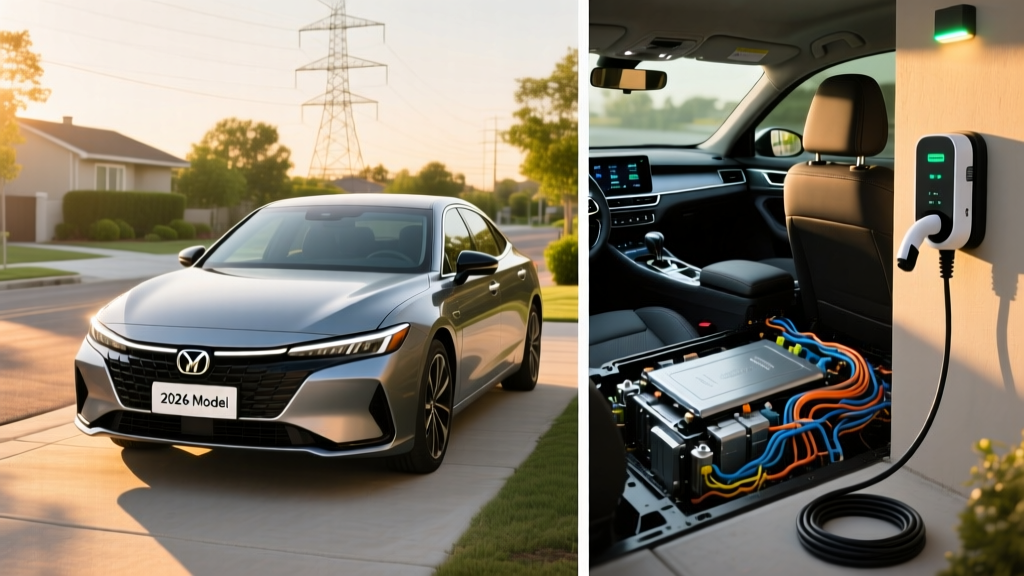
The hybrid battery is a compact lithium-ion pack mounted under the rear seats. It stores roughly 1.6 kWh — far too small for electric-only driving at speed, but sufficient to enable short EV-mode bursts at low speed (parking lots, residential streets) and to smooth out the engine's stop-start transitions.
RAV4 Prime PHEV: Electric-Only Range and Charging
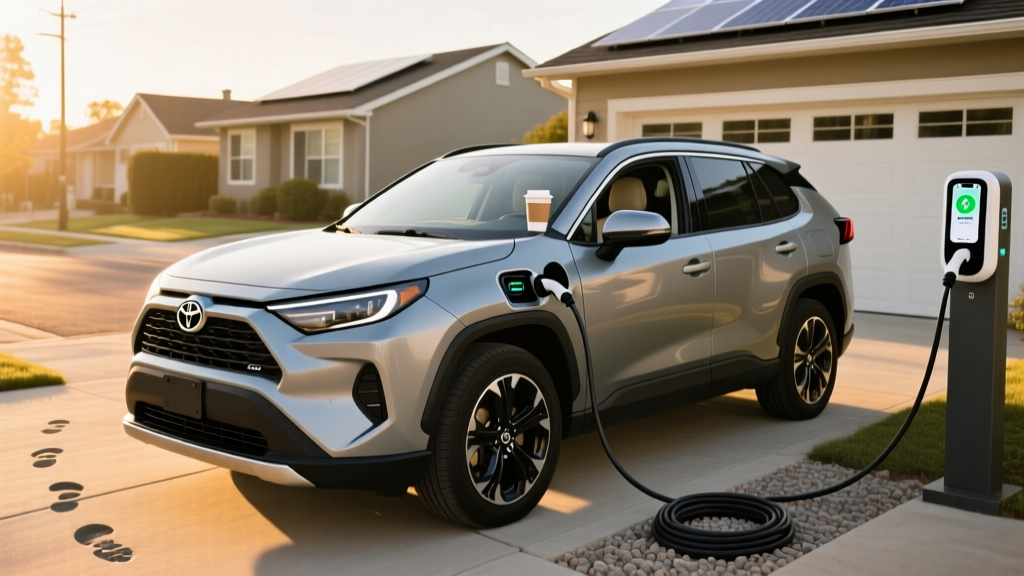
If you're considering the plug-in RAV4 Prime, here's what you need to know about its electric capabilities:
- Electric-only range: 42 miles EPA — enough for most daily commutes round-trip
- Total combined range: ~600+ miles (42 EV + ~560 on gas)
- Battery: 18.1 kWh lithium-ion
- Level 1 charging (120V household outlet): ~12 hours to full — impractical for daily use
- Level 2 charging (240V): ~2.5 hours to full with a 6.6 kW onboard charger
- DC fast charging: Not supported — Toyota did not equip the Prime with DC capability
Toyota warrants the hybrid battery in both the RAV4 Hybrid and RAV4 Prime for 10 years or 150,000 miles (whichever comes first) in all 50 states. This covers capacity loss below a defined threshold and manufacturing defects. The broader hybrid system (inverter, motor-generators, control electronics) carries an 8-year / 100,000-mile warranty.
Replacement cost if out of warranty: A refurbished RAV4 hybrid battery currently runs $2,000–$3,500 installed; a new OEM unit is $4,000–$5,500. However, Toyota's hybrid batteries have an excellent longevity track record — many first-generation RAV4 Hybrids from 2006 are still running on original packs past 200,000 miles.
Pricing, Trims, and Tax Credit Eligibility
Here's the 2026 RAV4 Hybrid lineup at a glance:
| Trim | MSRP | Key Features | §30D Tax Credit |
|---|---|---|---|
| LE | $33,500 | Toyota Safety Sense 3.0, 8" touchscreen, wireless CarPlay/Android Auto | Not eligible |
| XLE | $35,200 | Blind-spot monitoring, dual-zone climate, smart key | Not eligible |
| XLE Premium | $37,000 | SofTex seats, sunroof, power liftgate | Not eligible |
| SE | $36,500 | Sport-tuned suspension, 19" wheels, paddle shifters | Not eligible |
| Limited | $40,500 | Leather, 12.3" display, JBL audio, panoramic roof | Not eligible |
| Woodland Edition | $37,500 | TRD-tuned suspension, all-terrain tires, roof rails | Not eligible |
Tax credit reality check: The conventional RAV4 Hybrid (HEV) does not qualify for the federal §30D clean vehicle credit — that credit applies only to plug-in electric vehicles (BEVs and PHEVs). If you want the credit, you need the RAV4 Prime (PHEV) or a fully electric vehicle.
For the RAV4 Prime, eligibility under current IRS §30D rules depends on:
- MSRP cap: SUVs must be under $80,000 — the Prime qualifies
- Buyer income cap: AGI must not exceed $150,000 (single) / $300,000 (joint)
- Battery sourcing: Critical minerals and battery components must meet phased-in domestic/FSTA content requirements — check Toyota's current certification, as this changes annually
- Point-of-sale transfer: Eligible buyers can apply the credit as an upfront discount at the dealer
The RAV4 Prime may qualify for up to $7,500 if all sourcing requirements are met, but some model years have received only partial credit ($3,750) depending on battery component sourcing. Always verify with your dealer and a tax professional before purchase.
Real-World Ownership: MPG, Maintenance, and Long-Term Costs
One of the RAV4 Hybrid's strongest selling points is that it requires less maintenance than a gas-only vehicle, not more. The hybrid system actually reduces wear on several components:
- Brake pads last longer — regenerative braking handles most deceleration, sparing the friction brakes. Many owners report 80,000+ miles on original pads.
- No starter motor wear — the hybrid system starts the engine via the motor-generator, eliminating a common failure point.
- Engine runs less — at low speeds and in stop-and-go traffic, the engine shuts off entirely, reducing oil contamination and wear.
- Transmission simplicity — Toyota's eCVT has no traditional gears, belts, or clutches to replace. It's one of the most reliable transmissions in the industry.
Over five years and 75,000 miles, the RAV4 Hybrid (39 MPG) saves approximately $2,800–$3,500 in fuel costs compared to the gas-only RAV4 (30 MPG combined), assuming $3.50/gallon. Factor in slightly lower maintenance costs and the hybrid's modest price premium ($1,500–$2,000 over equivalent gas trims) pays for itself within 2–3 years for most drivers.
Hybrid vs PHEV vs Full EV: Which Should You Choose?
- You can't charge at home (apartment, street parking, no garage)
- You want zero behavior change — no plugging in, no apps, no route planning
- Your budget is under $40,000
- You drive 10,000–15,000 miles/year and want lower fuel costs
- You have Level 2 charging at home or work
- Your daily commute is under 42 miles round-trip (you'll rarely use gas)
- You want to drive on electricity daily but need gas flexibility for road trips
- You qualify for the §30D tax credit, which narrows the price gap significantly
- You have reliable home charging
- You want zero tailpipe emissions and the lowest per-mile fuel cost
- You're ready to plan longer trips around DC fast-charging stops
- You want to eliminate oil changes and engine maintenance entirely
Reliability and Safety Ratings
Toyota's hybrid powertrain is among the most proven in the industry, with over 25 years of production history dating back to the original Prius. The RAV4 Hybrid specifically has been in continuous production since 2006 (second generation) and consistently earns top marks for dependability from sources like Consumer Reports and J.D. Power.
For safety, the 2026 RAV4 comes standard with Toyota Safety Sense 3.0, which includes:
- Pre-Collision System with Pedestrian Detection
- Lane Departure Alert with Steering Assist
- Full-Speed Range Dynamic Radar Cruise Control
- Lane Tracing Assist (a Level 2 SAE driver-assist feature — not self-driving; you must keep hands on the wheel)
- Road Sign Assist
The RAV4 has historically earned the IIHS Top Safety Pick+ designation and a 5-Star overall rating from NHTSA. We recommend checking the latest test results for the 2026 model year as they become available.
Frequently Asked Questions
How many MPG does the 2026 RAV4 Hybrid get?
The EPA rates most 2026 RAV4 Hybrid trims at 41 city / 38 highway / 39 combined MPG. The Woodland Edition, with its all-terrain tires, drops to 38/35/37. In real-world city driving, many owners report exceeding 40 MPG thanks to regenerative braking.
Does the RAV4 Hybrid need to be plugged in?
No. The RAV4 Hybrid (HEV) is a conventional, self-charging hybrid. The battery recharges through regenerative braking and the gas engine. You never plug it in. Only the RAV4 Prime (PHEV) requires plugging in to access its 42-mile electric-only range.
How long will the RAV4 Hybrid battery last?
Toyota warrants the hybrid battery for 10 years or 150,000 miles. In practice, many Toyota hybrid batteries from earlier generations have lasted 200,000+ miles without replacement. If replacement is ever needed out of warranty, expect to pay $2,000–$5,500 depending on whether you choose refurbished or new OEM.
Does the 2026 RAV4 Hybrid qualify for a tax credit?
The conventional RAV4 Hybrid (HEV) does not qualify for the federal §30D clean vehicle tax credit — only plug-in vehicles (PHEVs and BEVs) are eligible. The RAV4 Prime (PHEV) may qualify for up to $7,500 depending on battery sourcing requirements, your income, and the vehicle's MSRP. Some states offer additional hybrid or PHEV rebates — check your local programs.
Is the RAV4 Hybrid better than the gas-only RAV4?
For most buyers, yes. The hybrid costs $1,500–$2,000 more upfront but delivers 30% better fuel economy (39 vs 30 MPG combined), standard all-wheel drive (the gas model's AWD is optional and less efficient), and smoother acceleration. The payback period is typically 2–3 years at current fuel prices, after which you're saving money every fill-up.
How does the RAV4 Hybrid compare to competitors?
The Honda CR-V Hybrid (40 MPG combined) is the closest rival and matches the RAV4 in efficiency. The Hyundai Tucson Hybrid (38 MPG combined) offers more cargo space but slightly lower MPG. The RAV4 Hybrid's edge is its long track record of reliability, strong resale value, and the breadth of its trim lineup — from the $33,500 LE to the adventure-oriented Woodland Edition.
Pros
- 39 MPG combined — among the best in the compact SUV class
- Standard eAWD across all trims
- 10-year / 150,000-mile hybrid battery warranty
- No plug-in required — zero lifestyle change
- Strong resale value and proven reliability
- Toyota Safety Sense 3.0 standard on every trim
Cons
- No federal tax credit (HEV ineligible for §30D)
- Infotainment interface lags behind competitors
- Cabin noise under hard acceleration (eCVT drone)
- Limited trim availability — high demand can mean dealer markups
- Woodland Edition sacrifices 2 MPG for off-road styling