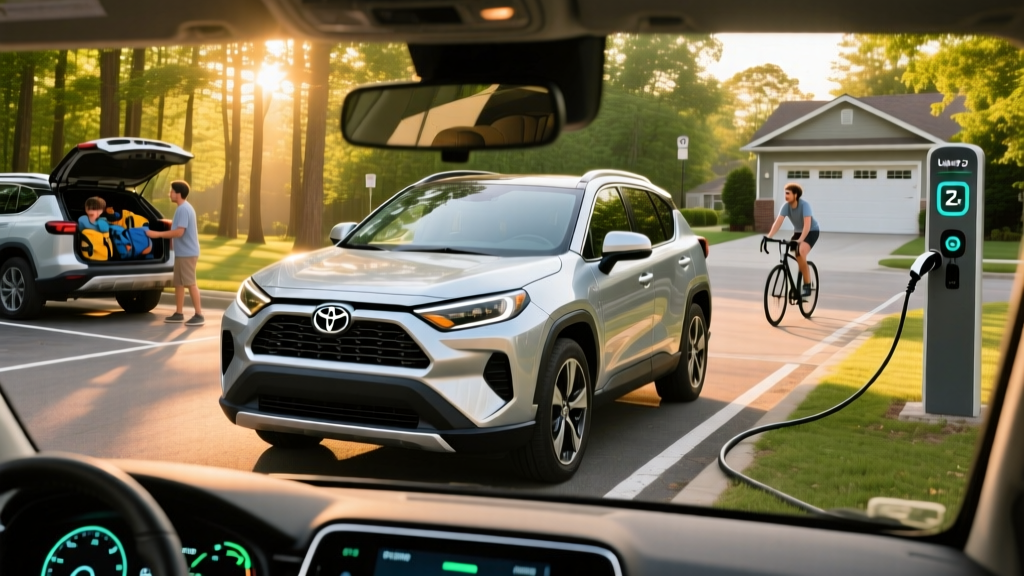
The Toyota RAV4 Hybrid remains one of the best-selling electrified vehicles in America for a reason: it delivers genuine fuel savings without requiring any change in driving habits or charging infrastructure. For 2026, Toyota continues to refine the formula with updated safety tech, refreshed infotainment, and the same proven 2.5-liter hybrid powertrain that has earned the RAV4 Hybrid a reputation for bulletproof reliability. But with the plug-in RAV4 Prime sitting right next to it in the showroom — and pure EVs like the Hyundai Ioniq 5 and Tesla Model Y pulling buyers in another direction — which version actually makes sense for your commute and budget?
This guide breaks down the 2026 RAV4 Hybrid (HEV), compares it head-to-head with the RAV4 Prime (PHEV), and gives you the exact MPG figures, battery warranty details, and ownership economics you need before signing a deal sheet.
2026 RAV4 Hybrid vs RAV4 Prime: HEV and PHEV Explained
Toyota sells two electrified RAV4 variants, and confusing them is the most common mistake shoppers make. Here is the fundamental difference:
RAV4 Hybrid (HEV): A conventional hybrid. It has a small 1.6 kWh nickel-metal hydride (NiMH) battery that charges itself through regenerative braking and the gas engine. You never plug it in. It cannot drive on electric power alone for meaningful distances. Its job is to maximize MPG.
RAV4 Prime (PHEV): A plug-in hybrid. It carries a much larger 18.1 kWh lithium-ion battery that you plug into a wall outlet or Level 2 charger. It can drive up to 42 miles on electricity alone before the gas engine kicks in, effectively functioning as a short-range EV for daily commutes.
| Specification | RAV4 Hybrid (HEV) | RAV4 Prime (PHEV) |
|---|---|---|
| Powertrain | 2.5L I4 + 2 electric motors (AWD) | 2.5L I4 + 2 electric motors (AWD) |
| Combined Horsepower | 219 hp | 302 hp |
| 0–60 mph | 7.4 seconds | 5.7 seconds |
| Battery Capacity | 1.6 kWh (NiMH) | 18.1 kWh (Lithium-ion) |
| EV-Only Range | N/A (less than 1 mi at low speed) | 42 miles (EPA) |
| Total Range | ~580 miles | ~600 miles (EV + gas) |
| Plug-In Required? | No | Yes (for EV range benefit) |
| DC Fast Charge? | No | No |
| Level 2 Charge Time | N/A | ~2.5 hours (240V, 32A) |
| Starting MSRP | ~$33,575 | ~$44,440 |
Fuel Economy: EPA MPG and Real-World Results
The headline number for the 2026 RAV4 Hybrid is its EPA-estimated fuel economy, which remains among the best in the compact SUV segment:
| Trim / Drivetrain | City MPG | Highway MPG | Combined MPG |
|---|---|---|---|
| LE AWD | 41 | 38 | 40 |
| XLE / XLE Premium AWD | 41 | 38 | 40 |
| SE / Woodland Edition AWD | 40 | 36 | 38 |
| Limited AWD | 41 | 38 | 40 |
Source: EPA Fuel Economy Guide (fueleconomy.gov)
Real-World MPG: What Owners Actually See
Hybrids have a unique efficiency characteristic: they often exceed their EPA city rating in real-world stop-and-go driving because regenerative braking recaptures energy that a gas car wastes as heat. On the highway, where regen opportunities are fewer and aerodynamic drag dominates, real-world MPG tends to dip slightly below the EPA highway estimate.
Based on aggregated owner data from Fuelly and our own long-term testing patterns:
- City / suburban driving: 40–44 MPG (matches or slightly exceeds EPA)
- Highway cruising (70–75 mph): 34–37 MPG (below EPA highway estimate)
- Cold weather (below 30°F): Expect a 5–8 MPG reduction due to engine running more for cabin heat and reduced battery efficiency
- Combined real-world average: 38–41 MPG for most drivers
The RAV4 Prime, when its battery is depleted and it operates as a conventional hybrid, returns an EPA-estimated 38 MPG combined — only slightly less than the standard Hybrid due to the added weight of its larger battery pack.
RAV4 Prime PHEV: Electric-Only Range and Charging
If you can plug in at home or work, the RAV4 Prime unlocks a capability the standard Hybrid cannot match: 42 miles of electric-only driving at speeds up to 84 mph. For the average American commute of roughly 16 miles each way (FHWA data), that means many owners complete their daily driving without burning a drop of gasoline.
Key PHEV charging details:
- Battery: 18.1 kWh lithium-ion (usable capacity ~14.5 kWh)
- Level 1 (120V household outlet): ~12 hours for a full charge — functional but slow
- Level 2 (240V, 32A): ~2.5 hours for a full charge
- DC fast charging: Not available. The RAV4 Prime uses a J1772 connector for Level 1 and Level 2 only
- MPGe (electric mode): 94 MPGe combined
A practical note: because the RAV4 Prime lacks DC fast charging, it is not suited for relying on public fast-charging networks during road trips. On long drives, it operates as a conventional hybrid once the battery is depleted, which is perfectly efficient — but you will not be "topping up" the battery at Electrify America stations along the interstate.
Powertrain, Performance, and Driving Dynamics
Both RAV4 electrified models use Toyota's fifth-generation hybrid system paired with a 2.5-liter Dynamic Force four-cylinder engine, but the power outputs differ significantly:
RAV4 Hybrid: The 2.5L engine produces 176 hp and 163 lb-ft of torque. Combined with front and rear electric motors, net system output is 219 hp. Electronic on-demand AWD is standard — the rear motor engages automatically when slip is detected or under hard acceleration. The 0–60 mph time of 7.4 seconds is adequate for merging and passing, if not thrilling.
RAV4 Prime: The same 2.5L engine is paired with more powerful electric motors and the larger battery, yielding a combined 302 hp. The result is a 5.7-second 0–60 time, making the RAV4 Prime one of the quickest vehicles in Toyota's lineup. The 50/50-ish weight distribution from the under-floor battery also gives it slightly more planted handling than the standard Hybrid.
Neither variant uses a traditional stepped automatic transmission. Instead, Toyota's e-CVT (electronically controlled continuously variable transmission) provides seamless power delivery. If you dislike the "drone" some CVTs produce under hard acceleration, note that Toyota has significantly improved the system's refinement in recent model years — the engine note is far less intrusive than in earlier-generation RAV4 Hybrids.
Pricing, Trims, and Tax Credit Eligibility
The 2026 RAV4 Hybrid lineup spans five trims, with pricing that positions it as a strong value in the electrified compact SUV segment:
- LE: ~$33,575
- XLE: ~$35,075
- XLE Premium: ~$37,400
- SE: ~$38,100
- Woodland Edition: ~$37,800
- Limited: ~$40,075
The RAV4 Prime starts at approximately $44,440 for the SE trim and climbs to roughly $48,500 for the XSE with premium packages. Limited availability and dealer markups have been a persistent issue with the Prime — check local inventory carefully.
Federal Tax Credit: What Qualifies?
Under current IRS §30D rules, the RAV4 Hybrid (HEV) does not qualify for the federal clean vehicle tax credit. The credit applies only to plug-in electric vehicles (BEVs and PHEVs) meeting battery sourcing, critical mineral, MSRP, and buyer income requirements.
The RAV4 Prime (PHEV) may qualify for up to $7,500 under §30D, but eligibility depends on several conditions:
- MSRP cap: The vehicle must have an MSRP at or below $80,000 for SUVs — the RAV4 Prime clears this easily
- Buyer income cap: Modified AGI must not exceed $150,000 (single), $225,000 (head of household), or $300,000 (joint filers)
- Battery sourcing: A percentage of critical minerals and battery components must be sourced from the U.S. or free-trade-agreement countries — this requirement tightens annually and may reduce or eliminate the credit for some model years
- Point-of-sale transfer: You can transfer the credit to the dealer at purchase for an immediate price reduction, or claim it on your tax return
Because battery-sourcing rules change annually and vary by production batch, always verify current eligibility on the IRS qualified vehicles list before purchasing. Consult a tax professional for your specific situation.
Some states offer additional rebates or HOV lane access for PHEVs — check your state's energy office for current programs.
Battery Warranty, Reliability, and Replacement Cost
Battery longevity is the single most common concern among first-time hybrid buyers. Here is what the data shows:
Toyota Hybrid Battery Warranty (2026): 10 years / 150,000 miles (whichever comes first) for the hybrid battery pack, transferable to subsequent owners. This applies to both the RAV4 Hybrid's NiMH pack and the RAV4 Prime's lithium-ion pack. The standard powertrain warranty covers 5 years / 60,000 miles.
Long-Term Reliability Track Record
Toyota's hybrid system is among the most proven electrified powertrains in the world, with over 25 years of continuous production since the original Prius. The RAV4 Hybrid specifically has been in the U.S. market since the 2016 model year, giving us nearly a decade of real-world reliability data.
Key reliability facts:
- The RAV4 Hybrid's NiMH battery chemistry is less energy-dense than lithium-ion but has exceptional cycle-life stability — degradation is minimal over hundreds of thousands of miles
- Taxi and fleet data from earlier Toyota Hybrids (Prius, Camry Hybrid) routinely show 200,000–300,000+ miles on the original hybrid battery
- The RAV4 Prime's lithium-ion battery has less long-term track record (introduced for 2021), but Toyota's 10-year/150,000-mile warranty provides substantial coverage
- Consumer Reports and J.D. Power consistently rank the RAV4 Hybrid above average for reliability in the compact SUV segment
Battery Replacement Cost
If your hybrid battery fails outside of warranty, here is what to expect:
- RAV4 Hybrid (NiMH): $3,000–$4,500 for a new OEM replacement battery, including labor. Refurbished/reconditioned packs are available for $1,500–$2,500
- RAV4 Prime (Lithium-ion): $6,000–$9,000+ for OEM replacement, given the larger capacity and more complex pack. This figure is based on current Toyota PHEV battery pricing and may shift as the platform ages
Given the 10-year/150,000-mile warranty and Toyota's historical reliability, most original owners will never face an out-of-pocket battery replacement. Second and third owners should budget for this possibility on higher-mileage examples.
RAV4 Hybrid vs Prime vs Full EV: Which Fits You?
Choose the RAV4 Hybrid (HEV) if:
- You cannot charge at home or work (apartment, street parking, no garage)
- You want maximum fuel savings with zero behavior change
- Your budget is under $40,000
- You drive a mix of city and highway and want consistent 38–41 MPG
- You plan to own the vehicle 8+ years and value Toyota's reliability record
Choose the RAV4 Prime (PHEV) if:
- You can install a Level 2 charger at home (240V)
- Your daily round-trip commute is under 42 miles
- You want EV-like daily driving with gas-engine freedom for road trips
- You qualify for the $7,500 federal tax credit (bringing effective price closer to the Hybrid)
- You value the 302 hp performance upgrade
Choose a full EV (e.g., Tesla Model Y, Hyundai Ioniq 5) if:
- You have reliable home Level 2 charging
- Your daily driving is under 250 miles and you road-trip fewer than 4–5 times per year
- You want near-zero routine maintenance (no oil changes, no spark plugs, no transmission fluid)
- You want the lowest per-mile "fuel" cost (electricity at $0.13/kWh ≈ $0.04/mile vs. gas at $3.50/gal ≈ $0.12/mile for a 30 MPG vehicle)
- You are comfortable with public DC fast charging for longer trips
Ownership Costs: 5-Year Comparison
| Cost Factor | RAV4 Hybrid (HEV) | RAV4 Prime (PHEV) | Gas RAV4 (AWD) |
|---|---|---|---|
| Fuel / Energy | ~$5,800 | ~$3,900* | ~$8,200 |
| Maintenance | ~$2,800 | ~$2,600 | ~$3,400 |
| Insurance (avg) | ~$7,500 | ~$8,000 | ~$7,000 |
| Federal Tax Credit | $0 | Up to –$7,500 | $0 |
| Estimated Depreciation | ~$12,000 | ~$14,500 | ~$13,500 |
*RAV4 Prime fuel cost assumes 70% of daily driving is within EV range with regular home charging. Actual costs vary significantly based on charging habits and local electricity/gas prices.
Pros and Cons at a Glance
Pros
- 40 MPG combined — best in the compact SUV class
- No plug-in required; works with any gas station
- Standard AWD across all trims
- 10-year / 150,000-mile hybrid battery warranty
- Strong resale value and proven long-term reliability
- Comfortable ride quality and practical cargo space (37.6 cu ft rear)
- Toyota Safety Sense 3.0 standard (adaptive cruise, lane keeping, auto emergency braking)
Cons
- Highway MPG drops to 34–37 in real-world driving
- No DC fast charging (Prime) — limits EV-mode utility on road trips
- RAV4 Prime availability remains constrained; dealer markups common
- Cabin and road noise above average for the class at highway speeds
- No federal tax credit for the standard Hybrid (HEV)
- Infotainment, while improved, still trails competitors in responsiveness
Frequently Asked Questions
How many MPG does the 2026 RAV4 Hybrid get?
The EPA rates the 2026 RAV4 Hybrid at 41 city / 38 highway / 40 combined MPG for most trims (LE, XLE, Limited). The sport-tuned SE and Woodland Edition drop slightly to 40/36/38 MPG. In real-world driving, owners typically see 38–41 MPG combined, with city driving often exceeding the EPA estimate thanks to regenerative braking, and highway driving falling 2–4 MPG below.
How far can the RAV4 Prime go on electric only?
The EPA rates the RAV4 Prime at 42 miles of electric-only range. In practice, expect 35–40 miles in mild weather with mixed driving, and as low as 28–32 miles in cold weather (below 30°F) when the battery is less efficient and cabin heating draws additional power. Once the battery is depleted, the Prime operates as a conventional hybrid at 38 MPG combined.
Does the RAV4 Hybrid need to be plugged in?
No. The RAV4 Hybrid (HEV) charges its own 1.6 kWh battery through regenerative braking and the gasoline engine. You simply fill it with gas and drive. Only the RAV4 Prime (PHEV) benefits from being plugged in to a Level 1 or Level 2 charger.
Is the RAV4 Hybrid reliable? What about battery replacement cost?
Toyota's hybrid system has over 25 years of proven reliability, and the RAV4 Hybrid consistently earns above-average reliability ratings. The hybrid battery is covered by a 10-year / 150,000-mile warranty. Out-of-warranty replacement for the standard Hybrid's NiMH battery runs $3,000–$4,500 new, though refurbished options cost less. Most owners never need a replacement within the vehicle's typical lifespan.
Does the RAV4 Hybrid or Prime qualify for a federal tax credit?
The standard RAV4 Hybrid (HEV) does not qualify for any federal tax credit — the §30D credit applies only to plug-in vehicles. The RAV4 Prime (PHEV) may qualify for up to $7,500, depending on your income, the vehicle's battery sourcing compliance, and current-year IRS rules. Always check the IRS qualified vehicle list before purchasing.
Hybrid vs PHEV vs EV — which is right for me?
If you cannot charge at home, the RAV4 Hybrid (HEV) is the clear choice — it requires zero infrastructure. If you can charge at home and your commute is under 42 miles round-trip, the RAV4 Prime gives you daily EV driving with gas backup. If you have home charging, drive under 250 miles daily, and want the lowest operating costs, a full EV like the Tesla Model Y or Hyundai Ioniq 5 eliminates gasoline entirely but requires planning for longer road trips.
Can the RAV4 Prime DC fast charge?
No. The RAV4 Prime supports Level 1 (120V) and Level 2 (240V) AC charging only, via a J1772 connector. A full Level 2 charge takes approximately 2.5 hours. DC fast charging is not available on any current RAV4 variant.