The Toyota RAV4 Hybrid remains one of the best-selling electrified vehicles in the U.S., and for the 2026 model year, Toyota has refined the cabin technology and materials while preserving the fuel-sipping powertrain that made it popular. If you've been searching for details on the 2026 RAV4 Hybrid interior, you've likely noticed that most coverage stops at surface-level impressions. This guide goes deeper — pairing the interior walkthrough with the exact MPG figures, powertrain data, battery warranty terms, and ownership economics you need before signing a purchase agreement.
Before we get into the cabin, let's clear up a common point of confusion: the RAV4 Hybrid is a conventional hybrid (HEV). It does not plug in. If you want electric-only driving from a RAV4, you need the RAV4 Prime, which is a plug-in hybrid (PHEV). We'll cover both below.
HEV vs. PHEV: RAV4 Hybrid vs. RAV4 Prime at a Glance
| Attribute | 2026 RAV4 Hybrid (HEV) | 2026 RAV4 Prime (PHEV) |
|---|---|---|
| Plugs in? | No — self-charging via regenerative braking and engine | Yes — 18.1 kWh battery, Level 1/2 charging |
| Electric-only range | N/A (motor assists engine at all speeds) | 42 miles EPA |
| Total combined range | ~580 miles | ~600 miles (electric + gas) |
| Combined horsepower | 219 hp | 302 hp |
| EPA combined MPG / MPGe | 39–41 MPG | 94 MPGe (electric) / 38 MPG (gas-only) |
| Battery capacity | ~1.6 kWh (NiMH, small buffer) | 18.1 kWh (lithium-ion) |
| DC fast charging | N/A | No — AC only (Level 2 max ~6.6 kW) |
| Federal tax credit (§30D) | Not eligible | Eligible up to $7,500 (see rules below) |
| Base MSRP (2026) | $33,855 (LE AWD) | $44,905 (SE) |
The distinction matters enormously for your wallet and daily routine. The HEV is a fill-up-and-forget proposition — no charger, no behavior change. The PHEV rewards you with 42 miles of electric commuting but demands access to a plug (ideally a home Level 2) to realize its efficiency advantage.
2026 RAV4 Hybrid Interior: Materials, Tech, and Cargo
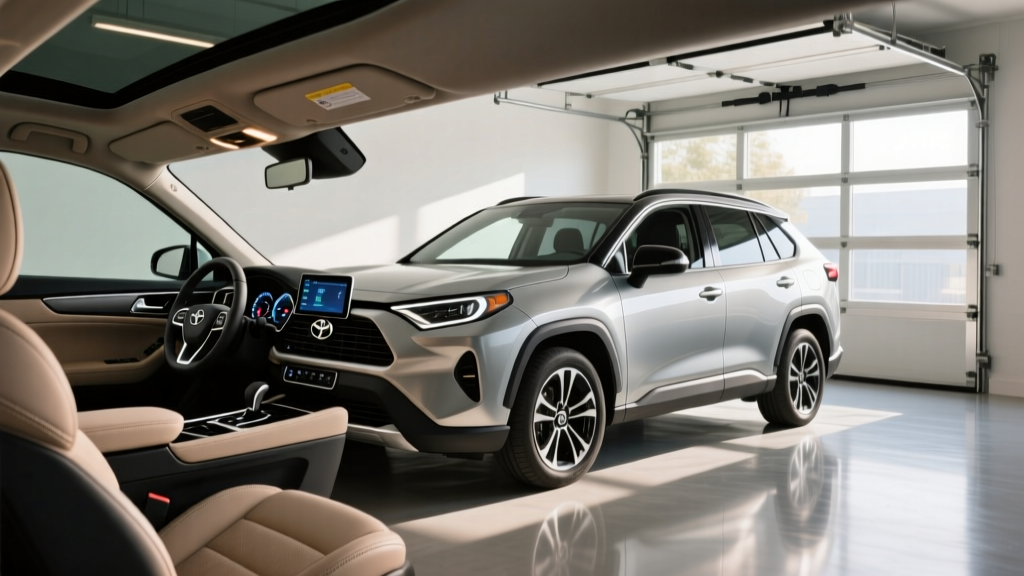
Toyota reworked the RAV4's cabin layout in the current generation, and the 2026 model carries forward with incremental upgrades. Here's what you'll find inside, broken down by what matters to daily drivers.
Infotainment and Displays
Every 2026 RAV4 Hybrid comes with Toyota's latest Audio Multimedia system on an 8-inch touchscreen (LE, XLE) or a 10.5-inch unit (XLE Premium, Woodland Edition, Limited). Wireless Apple CarPlay and Android Auto are standard across all trims. The Limited adds a 12.3-inch digital instrument cluster with a hybrid-specific energy flow display — useful for drivers who want to monitor real-time regen and engine-on/off cycling.
Seating and Materials
Base LE trims use a durable fabric upholstery that holds up well against pet claws and kid messes. XLE and above get SofTex synthetic leather, which Toyota has improved for 2026 with a softer hand feel and better breathability. The Limited steps up to heated and ventilated front seats with a heated steering wheel. Rear-seat legroom is 37.8 inches — competitive with the Honda CR-V Hybrid and noticeably roomier than the Mazda CX-50 Hybrid.
Cargo and Utility
Cargo volume behind the second row is 37.5 cubic feet, expanding to 69.8 cu ft with the rear seats folded. The hybrid battery pack is mounted under the rear seat, so there's no cargo-floor intrusion — a detail Toyota got right years ago and continues to maintain. The Woodland Edition adds all-weather floor liners and a cargo tray as standard, which is worth noting if you plan to use this as an outdoor-activity vehicle.
Driver Assistance
Toyota Safety Sense 3.0 is standard on every trim. This includes adaptive cruise control with lane centering (a Level 2 driver-assist system — you must keep your hands on the wheel), automatic emergency braking with pedestrian detection, lane departure alert, and automatic high beams. It's one of the more competent Level 2 suites in the segment, though it does not offer hands-free highway driving like Ford's BlueCruise or GM's Super Cruise.
MPG Breakdown: EPA Ratings and Real-World Expectations
Fuel economy is the headline reason most buyers choose the RAV4 Hybrid over the gas-only RAV4. Here's the official EPA data by trim configuration, per fueleconomy.gov:
| Trim / Drivetrain | City MPG | Highway MPG | Combined MPG |
|---|---|---|---|
| LE / XLE (AWD, standard hybrid) | 41 | 38 | 40 |
| XLE Premium / Limited (AWD) | 41 | 38 | 39 |
| Woodland Edition (AWD, off-road tires) | 38 | 35 | 37 |
Real-World MPG: What Owners Actually See
Toyota's hybrid system excels in stop-and-go city driving, where regenerative braking recaptures energy and the engine shuts off frequently. In real-world city and suburban use, many owners report 42–45 MPG — exceeding the EPA city estimate. This is the opposite of most gas cars, which get worse mileage in traffic.
Highway driving tells a different story. At sustained 70–80 mph speeds, the electric motor provides less assistance and the 2.5-liter four-cylinder engine carries the load. Expect 34–37 MPG on the highway in real-world conditions. In cold weather (below 35°F), the engine runs more frequently to maintain cabin heat and battery temperature, which can drop combined real-world MPG to the low-to-mid 30s on short trips.
Real-World Range Expectation: With a 14.5-gallon fuel tank and a realistic 38 MPG combined average, expect approximately 550 miles per tank in mixed driving. Highway-heavy road trips will yield closer to 500 miles; city-heavy commutes may stretch past 600.
Powertrain Specs: Engine, Motors, and Performance
| Specification | 2026 RAV4 Hybrid |
|---|---|
| Engine | 2.5L 4-cylinder Atkinson cycle |
| Engine output | 176 hp / 163 lb-ft torque |
| Front electric motor | 118 hp / 149 lb-ft |
| Rear electric motor (AWD) | 54 hp / 89 lb-ft |
| Net combined horsepower | 219 hp |
| 0–60 mph | 7.4 seconds |
| Drivetrain | Electronic AWD (eAWD) — standard on all trims |
| Transmission | eCVT (planetary gearset, not a belt CVT) |
| Towing capacity | 1,750 lbs |
The eAWD system is worth explaining. Unlike a mechanical AWD system with a driveshaft, the RAV4 Hybrid uses a dedicated rear electric motor that engages the rear wheels when the system detects slip, during hard acceleration, or in low-traction conditions. It's not a rock-crawling system, but it handles snow, rain, and gravel roads competently. The Woodland Edition adds a TRD-tuned suspension and all-terrain tires for more off-road capability at the cost of 2–3 MPG.
Battery Warranty, Lifespan, and Replacement Cost
Hybrid battery longevity is consistently one of the top concerns buyers raise — and it's where Toyota's track record is strongest in the industry.
Toyota Hybrid Battery Warranty (2026): 10 years / 150,000 miles, whichever comes first. This covers the hybrid battery pack against defects and capacity loss below a defined threshold. The standard new-vehicle warranty is 3 years / 36,000 miles, and the powertrain warranty is 5 years / 60,000 miles.
How Long Do RAV4 Hybrid Batteries Last?
Toyota's hybrid battery packs are designed to last the life of the vehicle. The RAV4 Hybrid uses a relatively small nickel-metal hydride (NiMH) battery (~1.6 kWh usable) that is never fully charged or fully depleted — the system keeps it in a narrow state-of-charge window (roughly 40–80%) to minimize degradation. Real-world data from high-mileage Prius and RAV4 Hybrid fleets shows batteries routinely lasting 200,000–300,000 miles before any significant capacity loss.
Replacement Cost If It Fails Out of Warranty
If you do face a hybrid battery replacement after the warranty period, expect to pay between $2,500 and $4,500 for a new OEM pack including labor. Third-party refurbished packs are available for $1,500–$2,500. For context, this is dramatically less than a full EV battery replacement, which can exceed $10,000–$15,000. The RAV4 Prime's larger 18.1 kWh lithium-ion pack would be more expensive to replace — likely in the $8,000–$12,000 range out of warranty.
Pricing, Trims, and Tax Credit Eligibility
Here's the 2026 RAV4 Hybrid trim lineup with MSRP (destination charge included):
- LE: $33,855
- XLE: $35,350
- XLE Premium: $37,275
- Woodland Edition: $37,645
- Limited: $40,655
Does the RAV4 Hybrid Qualify for a Federal Tax Credit?
No. The conventional RAV4 Hybrid (HEV) does not qualify for the federal §30D Clean Vehicle Credit. That credit is reserved for plug-in electric vehicles (BEVs and PHEVs) that meet battery sourcing, critical minerals, MSRP cap, and buyer income requirements as defined by the IRS.
If tax-credit eligibility is a priority, the RAV4 Prime (PHEV) may qualify for up to $7,500 depending on your income, the vehicle's MSRP (must be ≤$80,000 for SUVs), and battery-component/critical-mineral sourcing requirements. These rules are subject to change — consult a tax professional and verify current-year eligibility on irs.gov before purchasing.
Some states and municipalities offer their own incentives for conventional hybrids or PHEVs. Check your state's energy office or AFDC incentive database for local programs.
RAV4 Hybrid vs. RAV4 Prime vs. Full EV: Which Fits You?
Choose the RAV4 Hybrid (HEV) if:
- You don't have access to home or workplace charging
- You want maximum simplicity — no plugs, no apps, no behavior change
- Your budget is under $40,000
- You drive a mix of city and highway and want 40 MPG without thinking about it
Choose the RAV4 Prime (PHEV) if:
- You can install a Level 2 charger at home (or have reliable workplace charging)
- Your daily commute is under 42 miles round-trip (you'll rarely use gas)
- You want 302 hp and the quickest RAV4 in the lineup
- You want to hedge against a future transition to full electric without committing fully
Choose a full EV (e.g., Tesla Model Y, Hyundai Ioniq 5) if:
- You have reliable home Level 2 charging
- You want to eliminate gas entirely and minimize maintenance
- Your typical trips fit within a 250–320 mile range, or you're comfortable with road-trip DC fast charging
- You want the lowest per-mile energy cost (electricity vs. gasoline)
Pros and Cons: 2026 RAV4 Hybrid
Pros
- 40+ MPG combined with no plug-in requirement — simplest path to high fuel economy
- Standard eAWD on every trim — rare at this price point
- Toyota's 10-year / 150,000-mile hybrid battery warranty is best-in-class
- 37.5 cu ft cargo with no battery-pack intrusion
- Strong resale value — RAV4 Hybrid holds value better than most competitors
- Toyota Safety Sense 3.0 standard on all trims
Cons
- No federal tax credit eligibility (HEV)
- Highway MPG drops below EPA estimate at sustained 75+ mph
- Cold-weather short-trip MPG can dip into the low 30s
- 1,750-lb towing capacity is below rivals like the Hyundai Tucson Hybrid
- Base LE interior materials are functional but not premium-feeling
- No hands-free highway driving assist (unlike BlueCruise/Super Cruise competitors)
Frequently Asked Questions
How many MPG does the 2026 RAV4 Hybrid get?
The EPA rates the 2026 RAV4 Hybrid at 41 city / 38 highway / 40 combined for LE and XLE trims. Real-world city driving often yields 42–45 MPG thanks to regenerative braking. Highway-heavy trips at 75+ mph typically return 34–37 MPG. The Woodland Edition, with its all-terrain tires, is rated slightly lower at 37 combined.
Does the RAV4 Hybrid need to be plugged in?
No. The RAV4 Hybrid is a conventional hybrid (HEV). Its small battery recharges through regenerative braking and the gasoline engine. You simply fill it with gas like any other car. If you want plug-in capability, look at the RAV4 Prime (PHEV).
How far can the RAV4 Prime go on electric only?
The 2026 RAV4 Prime delivers 42 miles of EPA-rated electric-only range on a full charge of its 18.1 kWh lithium-ion battery. That covers most daily commutes without using any gasoline. Once the battery is depleted, it operates as a conventional hybrid at 38 MPG combined. Total range (electric + gas) is approximately 600 miles.
Is the RAV4 Hybrid reliable, and what does battery replacement cost?
Toyota's hybrid system has over two decades of proven reliability. The hybrid battery is warrantied for 10 years / 150,000 miles, and real-world data shows these packs commonly lasting 200,000+ miles. If replacement is needed out of warranty, expect $2,500–$4,500 for a new OEM pack. The eCVT transmission has no belts or friction clutches — it's a planetary gearset with very low failure rates.
Does the 2026 RAV4 Hybrid qualify for any tax credit?
The conventional RAV4 Hybrid (HEV) does not qualify for the federal §30D Clean Vehicle Credit — that credit applies only to plug-in vehicles. The RAV4 Prime (PHEV) may qualify for up to $7,500, subject to buyer income limits, MSRP caps, and battery-sourcing requirements. Verify current eligibility at irs.gov and consult a tax professional. Some states offer separate hybrid incentives.
How does the 2026 RAV4 Hybrid interior compare to competitors?
Compared to the Honda CR-V Hybrid, the RAV4 offers similar rear-seat legroom (37.8" vs. 41.0" for Honda) but slightly less cargo space (37.5 vs. 39.3 cu ft). The Hyundai Tucson Hybrid offers a more premium-feeling interior at similar pricing but falls short on long-term reliability track record. The RAV4's advantage is the combination of standard AWD, proven hybrid system longevity, and strong resale value — factors that don't show up in a showroom sit-in but matter at the five-year ownership mark.
What is the RAV4 Hybrid's 0–60 time?
The 2026 RAV4 Hybrid reaches 60 mph in 7.4 seconds — adequate for highway merging and passing. The RAV4 Prime, with its 302 combined horsepower, does it in 5.7 seconds, making it the quickest RAV4 variant short of a hypothetical performance model.