If you've been searching for 2026 Toyota RAV4 Hybrid colors and trim configurations, you're likely narrowing down one of the best-selling hybrid SUVs in America. The RAV4 Hybrid has held its position as a top choice for buyers who want serious fuel economy without plugging in, and the 2026 model year carries forward the proven fifth-generation architecture with updated paint options and refined packaging.
But color is only one piece of the decision. This guide covers every 2026 RAV4 Hybrid exterior color by trim, plus the exact EPA fuel economy figures, powertrain specifications, battery warranty terms, real-world MPG expectations, and pricing — so you can configure your RAV4 Hybrid with confidence.
2026 Toyota RAV4 Hybrid Exterior Colors by Trim
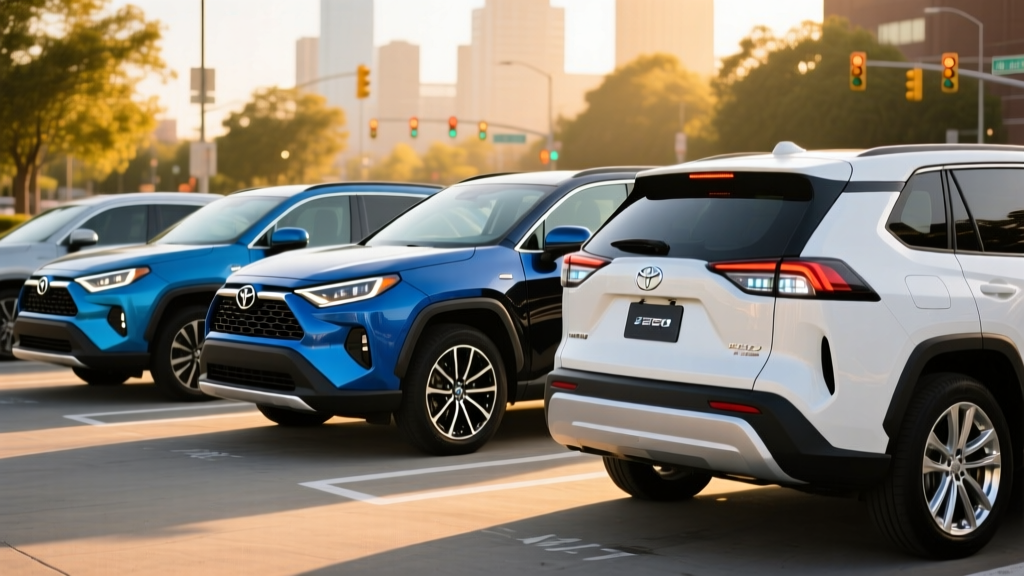
Toyota offers the 2026 RAV4 Hybrid across four primary trims — LE, XLE, XLE Premium, and Limited — plus the rugged Woodland Edition. Not every color is available on every trim, and some premium paints add cost. Here is the full color matrix based on Toyota's published specifications:
| Color Name | LE | XLE | XLE Premium | Woodland Edition | Limited | Cost |
|---|---|---|---|---|---|---|
| Celestial Silver Metallic | ✓ | ✓ | ✓ | — | ✓ | Standard |
| Ice Cap (White) | ✓ | ✓ | ✓ | — | ✓ | Standard |
| Magnetic Gray Metallic | ✓ | ✓ | ✓ | ✓ | ✓ | Standard |
| Midnight Black Metallic | ✓ | ✓ | ✓ | ✓ | ✓ | Standard |
| Ruby Flare Pearl | ✓ | ✓ | ✓ | — | ✓ | +$425 |
| Blueprint | — | ✓ | ✓ | — | ✓ | +$425 |
| Cavalry Blue | — | — | — | ✓ | — | Standard |
| Wind Chill Pearl | — | ✓ | ✓ | — | ✓ | +$425 |
Two-tone options: The XLE Premium, Woodland Edition, and Limited trims offer available two-tone roof combinations (typically a black roof paired with Ice Cap, Celestial Silver, Cavalry Blue, or Wind Chill Pearl). Two-tone packages generally add $500 to the MSRP.
Woodland Edition note: This trim is positioned as the adventure-oriented variant and limits its palette to three rugged, earth-toned colors. Cavalry Blue is exclusive to the Woodland Edition for 2026.
2026 RAV4 Hybrid Powertrain & Performance Specs
The 2026 RAV4 Hybrid uses Toyota's fifth-generation hybrid system (THS V), pairing a 2.5-liter Dynamic Force four-cylinder engine with front and rear electric motors for standard electronic all-wheel drive (AWD-e). This is a conventional hybrid (HEV) — it charges its battery through regenerative braking and the gasoline engine. You never plug it in.
| Specification | 2026 RAV4 Hybrid |
|---|---|
| Engine | 2.5L 4-cylinder Atkinson-cycle |
| Combined System Horsepower | 219 hp |
| Front Motor Output | 88 kW (118 hp) |
| Rear Motor Output | 40 kW (54 hp) |
| Hybrid Battery | 1.6 kWh lithium-ion (sealed NiMH on base LE in some configurations) |
| Drivetrain | Electronic AWD (AWD-e), standard on all trims |
| Transmission | eCVT (planetary gearset, no belt) |
| 0–60 mph | 7.4 seconds |
| Towing Capacity | 1,750 lbs |
| Cargo Volume (rear seats up) | 37.5 cu ft |
| Cargo Volume (rear seats folded) | 69.8 cu ft |
The AWD-e system uses the rear electric motor to power the rear axle when needed — there is no mechanical driveshaft connecting front and rear. This reduces weight and drivetrain loss while providing confident traction in rain and light snow. The rear motor engages automatically during acceleration from a stop and in low-traction conditions up to approximately 43 mph.
EPA Fuel Economy: Real-World MPG Breakdown
Fuel economy is where the RAV4 Hybrid separates itself from competitors. According to fueleconomy.gov, the EPA rates the 2026 RAV4 Hybrid (AWD-e, all trims) as follows:
| Driving Cycle | EPA MPG | Real-World Expectation |
|---|---|---|
| City | 41 MPG | 39–44 MPG (hybrids often exceed EPA in city due to regen braking) |
| Highway | 38 MPG | 34–37 MPG (sustained 70–80 mph driving reduces hybrid advantage) |
| Combined | 39 MPG | 36–41 MPG depending on driving mix and climate |
RAV4 Hybrid vs. RAV4 Prime (PHEV): Which Is Right for You?
Toyota also sells the RAV4 Prime, which is a plug-in hybrid electric vehicle (PHEV). The naming is confusing, so here is the critical distinction:
| Feature | RAV4 Hybrid (HEV) | RAV4 Prime (PHEV) |
|---|---|---|
| Plugs in? | No — self-charging via regen + engine | Yes — 18.1 kWh battery, Level 1 or Level 2 charging |
| Electric-only range | None (EV mode is ~1 mile at low speed) | 42 miles EPA electric-only |
| Combined horsepower | 219 hp | 302 hp |
| 0–60 mph | 7.4 sec | 5.7 sec |
| EPA combined MPG (hybrid mode) | 39 MPG | 38 MPG (after battery depletes) |
| MPGe (electric mode) | N/A | 94 MPGe |
| DC fast charging? | N/A | No — Level 2 AC only (6.6 kW onboard charger) |
| Level 2 charge time (0–100%) | N/A | ~2.5 hours at 240V/32A |
| Total combined range | ~580 miles (14.5-gal tank) | ~600 miles (42 mi EV + 558 mi gas) |
| Base MSRP (2026) | $33,575 | $44,990 |
| Federal tax credit (§30D) | Not eligible | Up to $7,500 (subject to income, sourcing, and MSRP caps) |
Choose the RAV4 Hybrid (HEV) if: You don't have reliable access to a home Level 2 charger, you want a lower purchase price, your daily driving exceeds 42 miles, or you simply want excellent MPG without changing your fueling habits.
Choose the RAV4 Prime (PHEV) if: You can install a Level 2 home charger, your daily commute is under 42 miles (meaning you rarely burn gas), you want the performance boost (302 hp), and you qualify for the federal tax credit — which can bring the effective price gap down to roughly $4,000–$6,000.
Pricing, Trims & Tax Credit Eligibility
The 2026 RAV4 Hybrid is positioned as an accessible hybrid SUV. Here is the MSRP breakdown by trim (destination charge of $1,395 included):
| Trim | MSRP (incl. destination) | Key Additions |
|---|---|---|
| LE | $33,575 | 8" touchscreen, Toyota Safety Sense 3.0, AWD-e, 17" alloy wheels |
| XLE | $35,675 | Blind-spot monitor, dual-zone climate, smart key, 18" wheels |
| XLE Premium | $38,125 | SofTex seats, power liftgate, panoramic roof option, two-tone available |
| Woodland Edition | $37,425 | TRD-tuned suspension, all-terrain tires, rugged styling, roof rails |
| Limited | $41,025 | Leather, 10.5" display, JBL audio, panoramic roof, heated/ventilated front seats |
Does the RAV4 Hybrid Qualify for a Federal Tax Credit?
No. The conventional RAV4 Hybrid (HEV) does not qualify for the federal §30D Clean Vehicle Credit. This credit applies only to plug-in electric vehicles — battery electric vehicles (BEVs) and plug-in hybrids (PHEVs) with at least 7 kWh of battery capacity. Since the RAV4 Hybrid uses a small ~1.6 kWh battery and cannot be plugged in, it is ineligible.
The RAV4 Prime (PHEV) may qualify for up to $7,500 under §30D, but eligibility depends on several factors that change periodically. Per the IRS, the buyer must meet income caps ($150,000 single / $300,000 joint), the vehicle must be under the MSRP cap ($80,000 for SUVs), and the battery must meet critical-mineral and component-sourcing requirements. Always verify current-year rules with a tax professional before purchasing.
State incentives: Some states offer rebates or HOV lane access for hybrids. California's Clean Vehicle Rebate Project (CVRP), for example, has historically focused on BEVs and PHEVs rather than conventional hybrids. Check your state's energy office or DMV for current programs.
Battery Warranty, Reliability & Replacement Cost
Hybrid battery longevity is consistently the top concern among first-time hybrid buyers. Here is what Toyota provides:
• Duration: 10 years / 150,000 miles (whichever comes first)
• Coverage: Defects and capacity loss below functional threshold
• Transferable: Yes, to subsequent owners
• Hybrid system components: Also covered under 8-year/100,000-mile hybrid system warranty (inverter, motor, control module)
How Long Do RAV4 Hybrid Batteries Actually Last?
Toyota's hybrid batteries have an excellent longevity track record. The RAV4 Hybrid uses a relatively small lithium-ion pack (approximately 1.6 kWh usable) that is never fully charged or fully discharged — the hybrid system keeps the battery in a narrow state-of-charge window (roughly 40–80%) to minimize stress. This shallow-cycling strategy is the same principle that extends laptop battery life.
Based on data from Toyota's Prius fleet (which uses similar chemistry and management), hybrid batteries routinely exceed 150,000 miles before significant degradation. Many first-generation Prius taxis have logged 300,000+ miles on original batteries. For the RAV4 Hybrid, which entered its current generation in 2019, real-world failure data remains sparse — a positive signal.
Battery Replacement Cost
If your hybrid battery does fail outside warranty, Toyota dealer replacement currently runs approximately $3,000–$4,500 (parts and labor). Independent hybrid-specialty shops can often source refurbished or new modules for $1,800–$2,800. This is dramatically less than a full EV battery replacement ($8,000–$20,000+), because the hybrid pack is small and modular.
Toyota's reliability record for the hybrid powertrain is among the best in the industry. The IIHS has historically awarded the RAV4 family top safety ratings, and the hybrid variant shares the same structural platform.
Who Should Buy the 2026 RAV4 Hybrid?
✓ Strong Fit
- Daily commuters driving 20–60 miles/day who want 39+ MPG without lifestyle changes
- Apartment dwellers or renters who cannot install a home charger
- Families needing AWD and cargo space with lower fuel costs
- Buyers prioritizing Toyota reliability and low cost of ownership
- Those in states without strong EV charging infrastructure
✗ Consider Alternatives
- If your commute is under 30 miles and you have home charging — the RAV4 Prime PHEV lets you drive gas-free most days
- If you want zero tailpipe emissions — a BEV like the Hyundai Ioniq 5 or Tesla Model Y eliminates gasoline entirely
- If you need more than 1,750 lbs towing — consider a body-on-frame hybrid or a truck
- If you want third-row seating — look at the Toyota Highlander Hybrid or Kia Sorento Hybrid
RAV4 Hybrid vs. Competitors: Quick Comparison
| Spec | 2026 Toyota RAV4 Hybrid | 2026 Honda CR-V Hybrid | 2026 Hyundai Tucson Hybrid |
|---|---|---|---|
| EPA Combined MPG | 39 MPG | 40 MPG (FWD) / 37 MPG (AWD) | 38 MPG (AWD) |
| Combined HP | 219 hp | 204 hp | 226 hp |
| AWD Standard? | Yes (all trims) | No (optional on Sport) | Yes (all trims) |
| 0–60 mph | 7.4 sec | 7.6 sec | 7.1 sec |
| Cargo (seats up) | 37.5 cu ft | 36.3 cu ft | 38.7 cu ft |
| Base MSRP (AWD) | $33,575 | $36,350 | $34,485 |
| Battery Warranty | 10 yr / 150k mi | 8 yr / 100k mi | 10 yr / 100k mi |
The RAV4 Hybrid's key advantage is that AWD-e comes standard on every trim — Honda charges extra for AWD on the CR-V Hybrid, and only the Sport trims get it. Toyota also leads in battery warranty mileage coverage at 150,000 miles.
Frequently Asked Questions
How many MPG does the 2026 RAV4 Hybrid get?
The EPA rates the 2026 RAV4 Hybrid at 41 MPG city, 38 MPG highway, and 39 MPG combined. In real-world mixed driving, most owners report 36–41 MPG combined, with city driving often exceeding the EPA estimate thanks to regenerative braking.
Do I need to plug in the RAV4 Hybrid?
No. The RAV4 Hybrid is a conventional hybrid (HEV). It charges its own battery through regenerative braking and the gasoline engine. You fuel it like any other car at a gas station. Only the RAV4 Prime (PHEV) requires plugging in for its 42-mile electric range.
Is the RAV4 Hybrid reliable, and what does a battery replacement cost?
Toyota's hybrid system is one of the most proven in the industry, with two decades of refinement. The hybrid battery is warranted for 10 years / 150,000 miles. Out-of-warranty replacement costs approximately $3,000–$4,500 at a dealer, or $1,800–$2,800 at an independent hybrid shop. Real-world data suggests most batteries last well beyond the warranty period.
Which 2026 RAV4 Hybrid color is the most popular?
Historically, Ice Cap (white) and Midnight Black Metallic are Toyota's highest-volume colors across the RAV4 lineup. Celestial Silver and Magnetic Gray follow closely. Premium colors like Ruby Flare Pearl and Blueprint tend to have longer wait times at dealers due to lower production volume. Cavalry Blue is exclusive to the Woodland Edition and is popular among buyers seeking a distinctive look.
Does the RAV4 Hybrid qualify for any tax credit?
The conventional RAV4 Hybrid does not qualify for the federal §30D Clean Vehicle Credit, which is reserved for plug-in vehicles. The RAV4 Prime PHEV may qualify for up to $7,500 depending on buyer income, battery sourcing, and MSRP caps. Some states or utilities offer separate hybrid incentives — check your local programs.
Hybrid vs. PHEV vs. full EV — which should I choose?
Hybrid (HEV): Best if you can't charge at home, drive long distances regularly, or want the lowest upfront cost with strong MPG.
PHEV (RAV4 Prime): Best if you have home charging, commute under 42 miles daily, and want to drive mostly on electricity while keeping a gas engine for road trips.
Full EV (e.g., Tesla Model Y, Hyundai Ioniq 5): Best if you want zero tailpipe emissions, have reliable home charging, drive under 250 miles daily, and want the lowest per-mile fuel cost (electricity at ~$0.12/kWh averages roughly $0.04/mile vs. $0.12–$0.15/mile for the RAV4 Hybrid on gas).