Quick Verdict: The 2026 Prius Hybrid Still Sets the Efficiency Benchmark
Toyota's fifth-generation Prius continues into the 2026 model year with the same striking redesign that shocked the automotive world when it debuted. The 2026 Prius hybrid (HEV) returns up to 57 MPG combined on the LE trim, while the plug-in Prius Prime delivers 44 miles of electric-only range before the gas engine engages. Both variants pair a 2.0-liter four-cylinder engine with Toyota's fifth-generation hybrid transaxle, producing a combined 196 horsepower in the HEV and 220 horsepower in the Prime PHEV.
The 2026 Prius lineup starts at $29,445 for the base LE hybrid and climbs to $40,445 for the Prime XSE Premium. The Prius Prime qualifies for a federal tax credit of up to $3,750 under current IRS §30D rules — a significant offset that narrows the price gap with the conventional hybrid. For buyers who want maximum efficiency without committing to a full battery-electric vehicle, the 2026 Prius remains the default answer.
2026 Prius Hybrid vs. Prius Prime: HEV and PHEV Explained
Conventional Hybrid (HEV) — Prius LE, XLE, Limited: The gas engine and electric motor work together seamlessly. The battery recharges through regenerative braking and the engine — you never plug it in. Ideal for drivers without home charging access who want maximum MPG with zero behavior change.
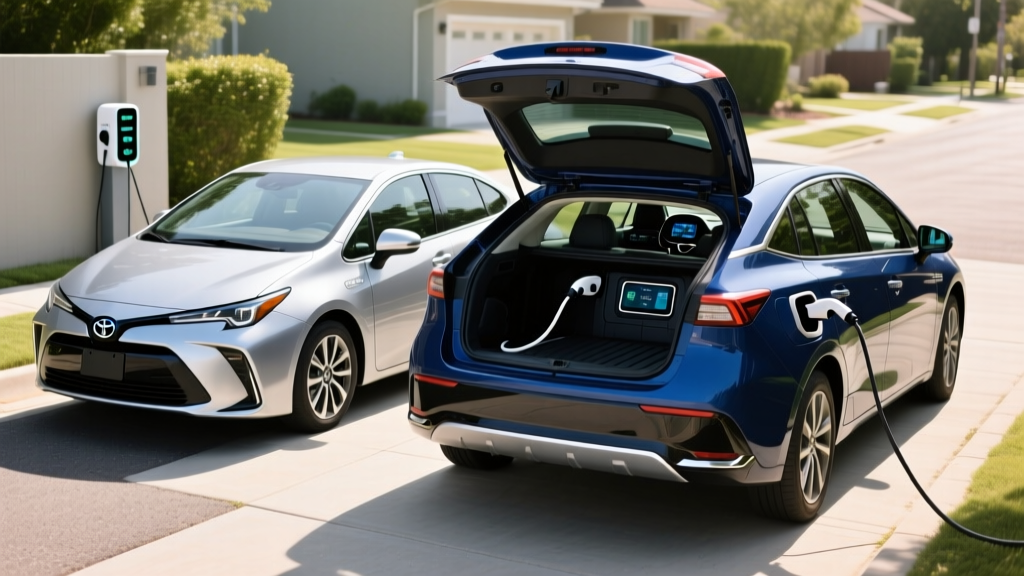
Plug-in Hybrid (PHEV) — Prius Prime SE, XSE, XSE Premium: A larger battery allows 44 miles of pure electric driving. You plug in at home (Level 2) or at public chargers to replenish the battery. Once the electric range depletes, it operates as a conventional hybrid. Best for drivers with home charging and short daily commutes.
| Specification | Prius Hybrid (HEV) | Prius Prime (PHEV) |
|---|---|---|
| Powertrain | 2.0L I4 + electric motor (196 hp combined) | 2.0L I4 + electric motor (220 hp combined) |
| Battery Capacity | ~1.0 kWh (lithium-ion) | 13.6 kWh usable (lithium-ion) |
| EPA Combined MPG | 57 MPG (LE) / 52 MPG (XLE/Limited) | 52 MPG combined (gas mode) / 127 MPGe (electric+gas) |
| EPA City / Highway | 57 city / 56 highway (LE) | 50 city / 47 highway (gas) / 127 MPGe combined |
| Electric-Only Range | N/A — not a plug-in | 44 miles (SE) / 40 miles (XSE/XSE Premium) |
| Total Combined Range | ~620 miles | ~440 miles (electric + gas combined) |
| 0–60 mph | 7.2 seconds | 6.6 seconds |
| Level 2 Charging Time | N/A | ~4 hours (240V) |
| DC Fast Charging | N/A | Not available |
| Starting MSRP | $29,445 (LE) | $34,395 (SE) |
Fuel Economy Breakdown: EPA Numbers and Real-World MPG
| Trim | City MPG | Highway MPG | Combined MPG | MPGe (PHEV only) |
|---|---|---|---|---|
| Prius LE (HEV) | 57 | 56 | 57 | — |
| Prius XLE (HEV) | 52 | 52 | 52 | — |
| Prius Limited (HEV) | 52 | 52 | 52 | — |
| Prius Prime SE (PHEV) | 50 | 47 | 52 | 127 |
| Prius Prime XSE (PHEV) | 50 | 47 | 52 | 127 |
| Prius Prime XSE Premium | 50 | 47 | 52 | 127 |
Real-world MPG reality check: Toyota's hybrid system excels in city driving where regenerative braking recaptures energy at every stop. According to fueleconomy.gov, the Prius LE's 57 MPG combined is achievable in mixed suburban driving. On sustained highway trips at 75+ mph, expect 48–52 MPG as aerodynamic drag reduces the hybrid system's advantage. In cold weather (below 30°F), the engine runs more frequently to maintain cabin heat, dropping observed MPG by 5–10%. Many owners report exceeding the EPA city estimate in stop-and-go traffic — a rare case where the sticker number is conservative.
For the Prius Prime, the 127 MPGe figure applies when you're operating within the electric range and recharging regularly. If you never plug in and drive it purely as a hybrid, you'll see the 52 MPG combined gas figure — still excellent, but you're leaving the Prime's core advantage on the table.
Prius Prime PHEV: Electric-Only Range and Charging Details
The 2026 Prius Prime's 13.6 kWh usable battery delivers 44 miles of electric-only range on the SE trim (40 miles on XSE and XSE Premium due to larger 19-inch wheels and additional weight). This covers the daily round-trip commute for the majority of American drivers — the FHWA National Household Travel Survey puts the average daily driving distance at roughly 37 miles.
Charging the Prime is straightforward but limited to Level 1 and Level 2 AC charging:
- Level 1 (120V household outlet): ~10–11 hours from empty to full. Plug in overnight and wake up with a full battery.
- Level 2 (240V home charger or public station): ~4 hours from empty to full using the onboard 3.3 kW charger.
- DC fast charging: Not supported. The Prius Prime does not have a CCS or CHAdeMO port.
The 3.3 kW onboard charger is the Prime's main charging limitation. While competitors like the Chrysler Pacifica PHEV offer faster Level 2 charging, the Prius Prime's smaller battery means 4 hours is typically sufficient for overnight replenishment. The lack of DC fast charging is a deliberate engineering choice — Toyota prioritized cabin and cargo space over fast-charge hardware.
Performance and Powertrain: 196 HP Meets 57 MPG
The previous-generation Prius was criticized for sluggish acceleration. The fifth-generation platform corrected that. The 2026 Prius hybrid pairs a 2.0-liter Atkinson-cycle four-cylinder engine with a permanent-magnet synchronous motor through Toyota's e-CVT transaxle, producing 196 combined horsepower. The result is a 0–60 mph time of 7.2 seconds — genuinely quick for a vehicle that returns 57 MPG.
The Prius Prime bumps output to 220 combined horsepower thanks to a more powerful electric motor and tuned power management, cutting the 0–60 time to 6.6 seconds. Both variants come standard with front-wheel drive; all-wheel drive (AWD-e) is available on the hybrid LE and XLE trims, adding a rear-mounted electric motor for improved traction at the cost of roughly 3 MPG combined.
Ride quality is firm but composed. The low center of gravity from the battery placement under the rear seat contributes to planted handling that defies the Prius's economy-car reputation. Road noise is well-managed at highway speeds, though the e-CVT drone under hard acceleration remains a characteristic of Toyota's hybrid system.
Pricing, Trims, and Federal Tax Credit Eligibility
The 2026 Prius lineup spans six trims across the HEV and PHEV variants:
- Prius LE (HEV): $29,445 — 17-inch wheels, Toyota Safety Sense 3.0, 8-inch touchscreen
- Prius XLE (HEV): $32,695 — 19-inch alloy wheels, synthetic leather, wireless charging, 12.3-inch display
- Prius Limited (HEV): $36,365 — heated/ventilated front seats, panoramic roof, JBL audio, digital key
- Prius Prime SE (PHEV): $34,395 — 17-inch wheels, maximum 44-mile EV range
- Prius Prime XSE (PHEV): $37,395 — 19-inch wheels, sport-tuned suspension, heated front seats
- Prius Prime XSE Premium (PHEV): $40,445 — panoramic roof, JBL audio, advanced park assist, digital rearview mirror
Federal Tax Credit for the 2026 Prius Prime
Under current IRS §30D clean vehicle credit rules, the 2026 Prius Prime PHEV may qualify for a federal tax credit of up to $3,750. Eligibility depends on:
- Buyer income limits: Modified AGI must not exceed $150,000 (single), $225,000 (head of household), or $300,000 (joint filers).
- MSRP cap: The vehicle MSRP must not exceed $55,000 for sedans — all Prius Prime trims qualify.
- Battery sourcing: Critical minerals and battery component requirements phase in annually. The exact credit amount ($3,750 or the full $7,500) depends on whether the battery meets the current-year critical-minerals and battery-component thresholds.
- Point-of-sale transfer: Eligible buyers can transfer the credit to the dealer at purchase, reducing the out-of-pocket price immediately rather than waiting for a tax refund.
Important: The conventional Prius hybrid (HEV) does not qualify for the §30D federal tax credit — it is not a plug-in vehicle. Always confirm current eligibility on the IRS website or with a tax professional before purchasing.
Battery Warranty, Reliability, and Long-Term Ownership Costs
Toyota Hybrid Battery Warranty
Toyota covers the 2026 Prius hybrid battery with a 10-year / 150,000-mile warranty (whichever comes first) in all 50 states. This applies to both the HEV traction battery and the Prius Prime's larger PHEV battery. The hybrid system components (inverter, transaxle, control modules) carry the same 10-year/150,000-mile coverage. The basic vehicle warranty is 3 years/36,000 miles, with a 5-year/60,000-mile powertrain warranty.
Toyota's hybrid battery longevity is among the best-documented in the industry. Fourth-generation Prius taxis and fleet vehicles routinely surpass 200,000 miles on the original hybrid battery. The fifth-generation lithium-ion pack is more energy-dense and runs cooler than the older nickel-metal-hydride units, further supporting long-term durability.
If a hybrid battery does require replacement out of warranty, expect the following approximate costs:
- Prius HEV battery replacement: $2,000–$3,500 (refurbished or new from Toyota)
- Prius Prime PHEV battery replacement: $5,000–$8,000 (larger capacity, higher cost)
Third-party refurbishers and independent hybrid specialists often offer replacement at the lower end of these ranges. Toyota's hybrid battery warranty is among the most generous in the segment, and the brand's reliability track record with the Prius nameplate is a primary reason it remains the best-selling hybrid in America.
Insurance costs for the 2026 Prius are moderate. Average annual premiums range from $1,400–$1,800 depending on trim, location, and driver profile — slightly above compact sedan averages due to higher repair costs for hybrid-specific components, but well below most full EVs.
Who Should Buy the 2026 Prius — And Who Should Look Elsewhere
Choose the 2026 Prius Hybrid (HEV) if:
- You want maximum MPG with zero behavior change — no plugging in, no charging apps, no route planning.
- You lack access to home or workplace Level 2 charging.
- Your daily driving exceeds 50 miles, making PHEV electric range less impactful.
- You want the lowest starting price ($29,445) and proven long-term reliability.
Choose the 2026 Prius Prime (PHEV) if:
- You have access to Level 2 charging at home or work and a daily commute under 44 miles.
- You want to drive mostly on electricity but need the gas engine for longer weekend trips.
- You qualify for the up-to-$3,750 federal tax credit, narrowing the price gap with the HEV.
- You value the 220 hp powertrain and quicker 6.6-second 0–60 time.
Choose a Full EV (BEV) instead if:
- You have reliable home Level 2 charging and want zero tailpipe emissions and minimal maintenance.
- Your daily driving stays under 250 miles and you're comfortable with DC fast charging on road trips.
- You want the full $7,500 federal tax credit available on qualifying BEVs like the Tesla Model 3 or Hyundai Ioniq 5.
Pros
- Class-leading 57 MPG combined (LE hybrid)
- 44-mile electric-only range on Prius Prime SE
- 10-year / 150,000-mile hybrid battery warranty
- Quick acceleration: 7.2s (HEV) and 6.6s (Prime) 0–60
- Striking design that stands out in the compact segment
- Toyota Safety Sense 3.0 standard on all trims
- AWD-e available on hybrid trims
Cons
- No DC fast charging on Prius Prime
- Slow 3.3 kW onboard Level 2 charger on Prime
- Cargo space reduced vs. conventional hatchbacks (23.8 cu ft behind rear seats)
- AWD-e not available on Prius Prime
- Rear-seat headroom is tight for taller passengers due to sloping roofline
- e-CVT drone under hard acceleration
Frequently Asked Questions
How many MPG does the 2026 Prius hybrid get?
The 2026 Prius LE achieves an EPA-estimated 57 MPG combined (57 city / 56 highway). The XLE and Limited trims with larger 19-inch wheels are rated at 52 MPG combined. Real-world highway driving at sustained speeds above 70 mph typically yields 48–52 MPG, while city driving often matches or exceeds the EPA estimate thanks to regenerative braking.
How far can the 2026 Prius Prime go on electric only?
The Prius Prime SE delivers an EPA-estimated 44 miles of electric-only range. The XSE and XSE Premium trims, which ride on larger 19-inch wheels and carry additional equipment, are rated at 40 miles. Once the battery depletes, the Prime operates as a conventional hybrid returning 52 MPG combined.
Hybrid vs. PHEV vs. EV — which fits my lifestyle?
If you can't charge at home and drive more than 50 miles daily, the conventional Prius hybrid (HEV) is the simplest, most cost-effective choice. If you have home charging and a commute under 44 miles, the Prius Prime (PHEV) lets you drive electric daily while keeping a gas engine for longer trips. A full EV (BEV) makes sense if you have reliable charging, want zero tailpipe emissions, and are comfortable planning DC fast-charge stops on road trips. The PHEV is the bridge option — it rewards charging without punishing you for forgetting.
Is the 2026 Prius reliable, and what does a battery replacement cost?
The Prius is one of the most reliable nameplates in Toyota's lineup, backed by two decades of hybrid system refinement. Toyota covers the hybrid battery for 10 years or 150,000 miles. Out-of-warranty replacement costs approximately $2,000–$3,500 for the HEV battery and $5,000–$8,000 for the Prime's larger PHEV battery. Real-world data shows most Prius hybrid batteries last well beyond 150,000 miles.
Does the 2026 Prius qualify for a federal tax credit?
The conventional Prius hybrid (HEV) does not qualify for the §30D federal clean vehicle credit — it is not a plug-in vehicle. The Prius Prime (PHEV) may qualify for up to $3,750, depending on current-year battery sourcing requirements and your income level. Check the IRS clean vehicle credit page for the most current eligibility details, or consult a tax professional before purchasing.
Can I DC fast charge the Prius Prime?
No. The 2026 Prius Prime only supports Level 1 (120V) and Level 2 (240V) AC charging. There is no DC fast-charging port. A full charge on Level 2 takes approximately 4 hours using the 3.3 kW onboard charger.
Is AWD available on the 2026 Prius?
Yes, Toyota's electronic on-demand AWD (AWD-e) is available on the Prius hybrid LE and XLE trims. It adds a rear-axle electric motor for improved traction in snow and rain. AWD-e is not available on the Prius Prime or the hybrid Limited trim. Adding AWD-e reduces combined MPG by approximately 3 MPG (from 57 to 54 on the LE).