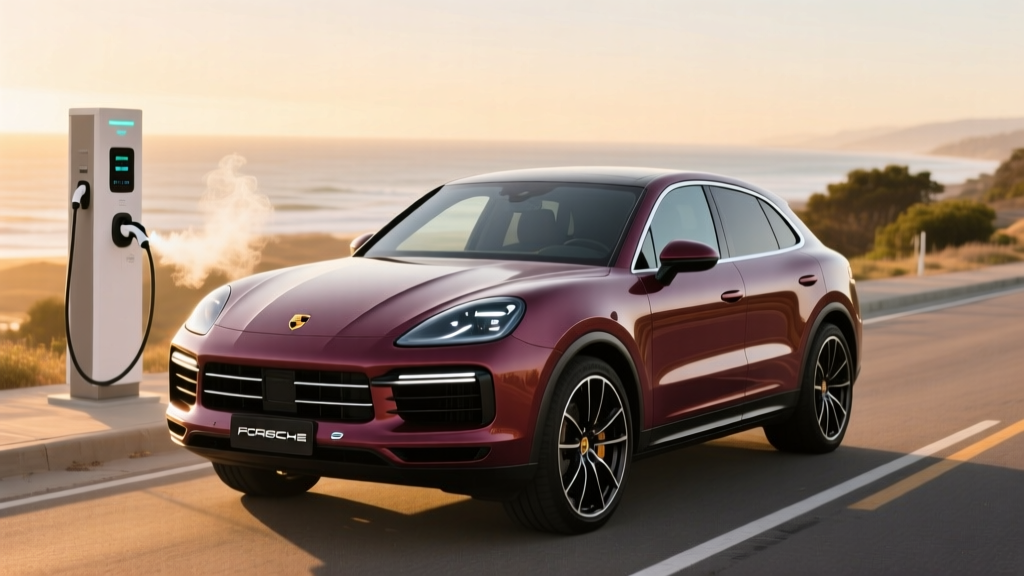
The 2026 Porsche Cayenne E-Hybrid occupies a narrow but compelling lane in the luxury SUV market: it pairs a turbocharged V6 with a substantially upgraded electric motor and a larger battery than its predecessor, delivering sports-car acceleration alongside meaningful electric-only commuting range. For buyers weighing a high-performance plug-in hybrid (PHEV) against a full battery-electric vehicle (BEV) or a conventional hybrid (HEV), the Cayenne E-Hybrid demands a close look at the numbers — not just the badge.
This guide breaks down every specification that matters for a purchase decision: EPA-estimated MPGe and electric range, battery capacity and chemistry, charging speeds (Level 2 and whether DC fast charging is available), powertrain output, real-world efficiency expectations, warranty coverage, federal tax credit eligibility under current IRS §30D rules, and total pricing by trim. We also address the question every PHEV shopper eventually faces: is a plug-in hybrid the right bridge technology for your driving pattern, or should you commit to a full EV or stick with a conventional hybrid?
HEV vs PHEV: Where the Cayenne E-Hybrid Fits
Before examining specifications, it's essential to distinguish between the two hybrid architectures available in the broader market, because Porsche only offers the plug-in variant for the Cayenne lineup.
| Feature | Conventional Hybrid (HEV) | Plug-In Hybrid (PHEV) |
|---|---|---|
| Plug-in charging | No — charges via regenerative braking and engine | Yes — plug in to charge the larger battery |
| Battery size | 1–2 kWh (small buffer) | 15–30+ kWh (substantial electric range) |
| Electric-only range | 0–2 miles at low speed | 20–50+ miles depending on model |
| Gas engine role | Primary power source, assisted by motor | Backup and highway supplement; electric-first for short trips |
| Federal tax credit | Generally not eligible under §30D | Potentially eligible (battery ≥7 kWh, sourcing rules apply) |
The 2026 Cayenne E-Hybrid is a PHEV. It requires access to a Level 2 home charger (or at minimum a 120V Level 1 outlet) to realize its electric-range benefits. If you cannot charge at home or work, the E-Hybrid still functions as a heavy conventional hybrid once the battery depletes — but you'll forfeit its primary efficiency advantage and pay a weight penalty for carrying a large battery you never replenish from the grid.
2026 Cayenne E-Hybrid Powertrain and Performance Specs
Porsche has revised the Cayenne E-Hybrid powertrain for the 2025–2026 model cycle, increasing both battery capacity and electric motor output over the prior generation. Here is the complete specification set:
| Specification | 2026 Porsche Cayenne E-Hybrid |
|---|---|
| Engine | 3.0L turbocharged V6 |
| Electric motor | Integrated into 8-speed automatic transmission |
| Combined system output | 463 hp / 479 lb-ft torque (estimated) |
| 0–60 mph | 4.6 seconds (manufacturer estimated) |
| Battery capacity (gross / usable) | 25.9 kWh gross / ~21.5 kWh usable (NMC chemistry) |
| EPA electric-only range | ~32 miles (EPA estimated) |
| EPA MPGe (electric + gas combined) | ~46 MPGe (estimated) |
| EPA MPG (gas-only, charge-depleted) | ~21 combined (19 city / 24 highway) |
| Total combined range (electric + gas) | ~410 miles (estimated, 18.7-gallon tank) |
| Onboard charger (AC Level 2) | 7.2 kW |
| DC fast charging | Not available |
| Drivetrain | All-wheel drive (AWD) |
| Towing capacity | 7,700 lbs (braked, with factory tow package) |
A few notes on these figures. The combined 463 hp represents the system peak when the V6 and electric motor deliver maximum simultaneous output — this is not simply the sum of each component's individual rating, because peak output curves differ. The 4.6-second 0–60 time benefits from the electric motor's instant torque fill at low RPM, which eliminates the turbo lag inherent to the V6 alone.
Electric-Only Range and Charging: The Daily Commute Question
The EPA-estimated 32 miles of electric-only range is the headline figure, but real-world results depend heavily on conditions. In mild weather (60–75°F) at city speeds under 45 mph, owners report achieving 30–34 miles before the gas engine engages. On highway trips at 70+ mph, expect that figure to drop to 22–26 miles due to aerodynamic drag and the energy density demands of higher speeds. In cold weather (below 32°F), battery chemistry limitations and cabin heating loads can reduce electric range to 18–22 miles.
EPA electric range: ~32 miles
Real-world expectation: 28–34 miles (city, mild weather) / 22–26 miles (highway) / 18–22 miles (cold weather below freezing)
Charging the 25.9 kWh battery from empty to full on a Level 2 home charger (240V, 32A circuit delivering 7.2 kW to the vehicle) takes approximately 3.5 hours. This is practical for overnight replenishment but means the Cayenne E-Hybrid is not designed for mid-day top-ups on road trips. Crucially, Porsche does not offer DC fast charging on the Cayenne E-Hybrid — there is no CCS or NACS port for 50+ kW rapid charging. This is a deliberate engineering trade-off: adding DC fast-charge hardware increases weight, cost, and packaging complexity, and Porsche has determined that the target buyer charges primarily at home overnight.
On a standard 120V Level 1 household outlet (approximately 1.4 kW delivery), a full charge takes roughly 15–17 hours. This is viable for owners who drive less than 20 miles daily and can leave the vehicle plugged in continuously, but it is not practical as a primary charging strategy for most buyers.
Fuel Economy: EPA Estimates vs Real-World MPG
Once the battery is depleted and the Cayenne E-Hybrid operates as a conventional hybrid (engine primary, motor assist during acceleration and regeneration during braking), EPA-estimated fuel economy falls to approximately 21 MPG combined. This figure requires context:
| Driving Scenario | EPA Estimated | Real-World Expectation |
|---|---|---|
| City (charge-depleted, hybrid mode) | 19 MPG | 18–21 MPG |
| Highway (charge-depleted, hybrid mode) | 24 MPG | 22–25 MPG |
| Combined (charge-depleted) | 21 MPG | 20–23 MPG |
| Combined MPGe (with regular charging) | ~46 MPGe | Varies widely by charging frequency |
The MPGe figure (miles per gallon equivalent) is only meaningful if you charge regularly. MPGe converts the energy in electricity to a gasoline-equivalent figure, allowing comparison with gas vehicles. If you charge nightly and drive 30 miles or fewer per day, you may use almost no gasoline for weeks. If you never charge, you are simply driving a 5,200-pound V6 SUV and should expect fuel economy near the charge-depleted figures above — which is unremarkable for the segment.
For comparison, the non-hybrid 2026 Porsche Cayenne (base turbocharged V6) achieves an EPA-estimated 19 combined MPG. The E-Hybrid's advantage only materializes with plug-in discipline.
Battery Warranty, Degradation, and Replacement Cost
The high-voltage battery in the 2026 Cayenne E-Hybrid uses NMC (nickel-manganese-cobalt) chemistry, which offers higher energy density than LFP (lithium iron phosphate) but is more susceptible to long-term capacity loss if routinely charged to 100% and stored at high state-of-charge in hot climates.
Porsche high-voltage battery warranty: 8 years / 100,000 miles (whichever comes first), covering defects and capacity loss below 70% of original capacity.
Hybrid component warranty: 8 years / 100,000 miles for the electric motor, power electronics, and related hybrid-system components.
Estimated out-of-warranty battery replacement cost: $12,000–$18,000 (parts and labor, based on comparable Porsche and Volkswagen Group PHEV battery pricing). This figure may decrease as battery costs decline industry-wide, but it remains a significant long-term ownership consideration for second owners.
NMC degradation data from the broader Volkswagen Group PHEV fleet (which shares cell suppliers with Porsche) suggests approximately 8–12% capacity loss over 8 years of typical use, assuming owners avoid habitual 100% charging and extreme heat exposure. Porsche's onboard battery management system (BMS) includes a top and bottom buffer — the usable 21.5 kWh is drawn from a 25.9 kWh gross capacity — which protects the cells from the most damaging charge extremes. Setting the charge limit to 80–90% for daily use and reserving 100% for planned long electric-only trips will extend battery health meaningfully.
Pricing, Trims, and Federal Tax Credit Eligibility
The 2026 Porsche Cayenne E-Hybrid starts at an MSRP of approximately $95,100 (including destination charge). The Cayenne E-Hybrid Coupe variant, with its sloped roofline, starts around $99,600. Options packages — Premium Plus, Sport Chrono, adaptive air suspension upgrades, and the full leather interior — can push a well-equipped build to $115,000–$125,000.
Federal tax credit eligibility under IRS §30D is the most complex aspect of purchasing this vehicle, and the rules are strict:
- Battery capacity requirement: The Cayenne E-Hybrid's 25.9 kWh battery exceeds the 7 kWh minimum. ✓
- MSRP cap: SUVs must have an MSRP at or below $80,000 to qualify. The Cayenne E-Hybrid's base price of ~$95,100 exceeds this cap. ✗ The Cayenne E-Hybrid does NOT qualify for the federal §30D new-vehicle tax credit.
- Buyer income cap: Even if the MSRP were within range, modified adjusted gross income must not exceed $150,000 (single) / $300,000 (joint). This is moot given the MSRP disqualification.
- Battery sourcing and critical minerals: Additional requirements on where battery components and critical minerals are sourced. Again, moot given MSRP.
Some states offer their own PHEV incentives that are not bound by the federal MSRP cap. California's Clean Vehicle Rebate Project (CVRP), for example, has historically offered rebates for PHEVs, though income limits and funding availability vary. Check your state's energy or environmental agency website for current programs. Always consult a tax professional before making purchase decisions based on incentive eligibility.
For authoritative federal credit rules, refer to the IRS Clean Vehicle Credit page.
Who Should Choose the Cayenne E-Hybrid — And Who Shouldn't
The Cayenne E-Hybrid serves a specific buyer profile well, and poorly serves others. Here is a decision framework:
Choose the Cayenne E-Hybrid if:
- Your daily commute is under 30 miles round-trip and you can charge at home every night — you'll drive on electricity most weekdays and use gasoline only for longer weekend trips.
- You want Porsche performance (sub-5-second 0–60, sport-tuned suspension, AWD) but are not ready to commit to a full BEV due to road-trip charging concerns or lack of reliable public charging in your area.
- You need towing capability (7,700 lbs) that current luxury electric SUVs in this price range cannot match.
- You live in a region with extreme cold where BEV range loss (30–40% below freezing) makes a PHEV's gas-engine backup a practical safety net.
Choose a full BEV (like the Porsche Taycan Cross Turismo, BMW iX, or Tesla Model X) if:
- You have reliable Level 2 home charging and access to a DC fast-charging network (Tesla Supercharger, Electrify America) for road trips.
- Your priority is minimizing operating cost — electricity per mile is typically one-third to one-half the cost of premium gasoline.
- You want to eliminate all tailpipe emissions and reduce maintenance (no oil changes, fewer brake replacements due to regenerative braking).
Choose a conventional HEV (like the Toyota Highlander Hybrid or Lexus RX 500h) if:
- You cannot charge at home or work — a conventional hybrid requires no behavioral change and still delivers 30–36 MPG combined.
- Your budget is below $60,000 and you prioritize fuel savings over performance branding.
Pros and Cons at a Glance
Pros
- 463 hp combined output delivers genuine Porsche acceleration (4.6s 0–60)
- ~32 miles electric-only range covers most daily commutes when charged nightly
- 7,700-lb towing capacity exceeds most luxury BEV SUVs
- AWD and adaptive suspension provide all-weather confidence
- No range anxiety on road trips — gas engine provides 410+ total miles of range
- Build quality, interior materials, and infotainment are segment-leading
Cons
- $95,100+ base price exceeds the $80,000 federal tax credit MSRP cap — no §30D credit
- No DC fast charging — road-trip electric replenishment is not possible
- Charge-depleted fuel economy (~21 MPG combined) is unremarkable for a $95K SUV
- 5,200+ lb curb weight impacts handling feel vs. non-hybrid Cayenne variants
- Battery replacement cost ($12K–$18K out of warranty) is a long-term ownership risk
- Level 2 charge time of ~3.5 hours means no practical mid-day top-up
Frequently Asked Questions
How many MPG does the 2026 Porsche Cayenne E-Hybrid get?
When operating in hybrid mode with a depleted battery, the EPA estimates approximately 21 MPG combined (19 city / 24 highway). When regularly charged and driven within its electric range, the combined rating is approximately 46 MPGe. Your actual fuel consumption depends entirely on how often you plug in — owners who charge nightly and commute under 30 miles may go weeks between fill-ups.
How far can the Cayenne E-Hybrid go on electric power alone?
The EPA estimates approximately 32 miles of electric-only range. In real-world driving, expect 28–34 miles in mild city conditions, 22–26 miles at highway speeds, and 18–22 miles in freezing temperatures. Once the battery depletes, the V6 engine engages seamlessly and the vehicle continues as a conventional hybrid with no driver intervention required.
Does the Cayenne E-Hybrid support DC fast charging?
No. The 2026 Cayenne E-Hybrid charges exclusively via AC power — either Level 1 (120V household, ~1.4 kW) or Level 2 (240V, up to 7.2 kW via the onboard charger). A full Level 2 charge takes approximately 3.5 hours. There is no CCS or NACS DC fast-charge port. This is a deliberate design choice by Porsche, and it means the E-Hybrid is not suited for mid-trip electric replenishment on long road trips.
Is the Cayenne E-Hybrid reliable, and what does battery replacement cost?
Porsche's hybrid system has proven reasonably reliable across the Panamera and Cayenne PHEV lineages since 2014, with no widespread systemic failures reported by NHTSA or major reliability surveys. The high-voltage battery is warranted for 8 years / 100,000 miles against defects and capacity loss below 70%. Out-of-warranty replacement is estimated at $12,000–$18,000, which is a meaningful cost for second owners or those who plan to keep the vehicle beyond the warranty period. For long-term reliability data, consult NHTSA.gov owner complaint records for the Cayenne E-Hybrid.
Does the 2026 Cayenne E-Hybrid qualify for any federal tax credit?
No. Under current IRS §30D rules, new SUVs must have an MSRP at or below $80,000 to qualify for the federal clean vehicle credit. The Cayenne E-Hybrid's base MSRP of approximately $95,100 exceeds this cap, making it ineligible regardless of buyer income or battery sourcing. Some state-level incentives may still apply — check your state's energy agency for current programs. Always consult a tax professional for personalized guidance. Refer to the IRS §30D guidelines for the definitive rules.
Hybrid vs PHEV vs EV — which is right for me?
If you can charge at home and your daily driving is under 35 miles, the Cayenne E-Hybrid (PHEV) lets you commute on electricity while retaining gas-engine range for road trips — ideal if you lack confidence in public charging infrastructure. A full BEV (like the BMW iX or Tesla Model X) offers lower operating costs and zero tailpipe emissions but requires commitment to charging logistics on long trips. A conventional HEV (no plug) makes sense only if you cannot charge at home at all. The PHEV is the bridge technology: it rewards charging discipline with electric efficiency but doesn't strand you when the battery is empty.
What is the total driving range of the Cayenne E-Hybrid?
With a full battery and the 18.7-gallon fuel tank, total combined range is approximately 410 miles (32 miles electric + ~378 miles on gasoline in hybrid mode). This eliminates range anxiety on long trips entirely — you refuel at any gas station in under five minutes and continue driving.