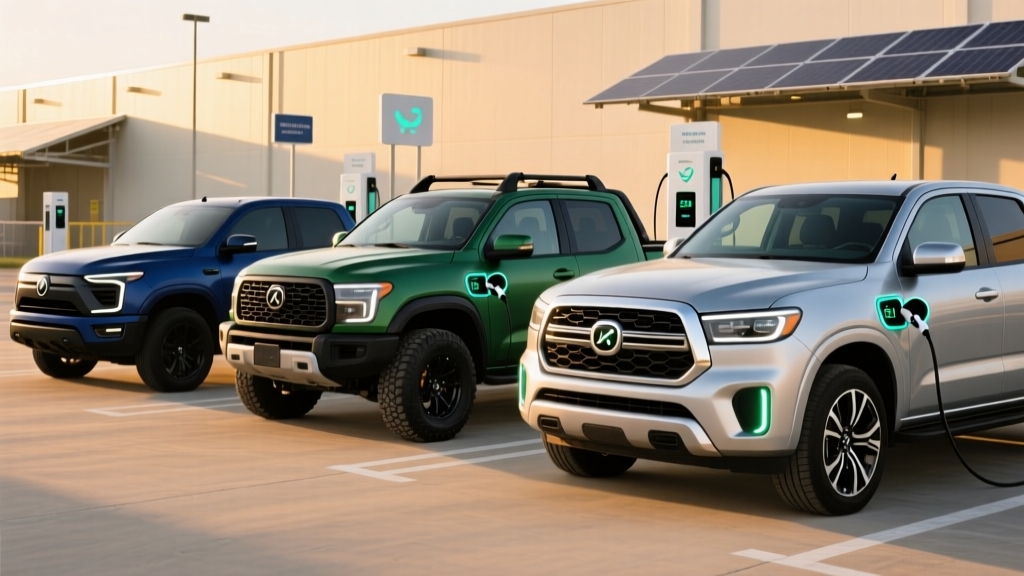
The plug-in hybrid pickup truck segment remains surprisingly thin in 2026. While fully electric pickups like the Ford F-150 Lightning and Rivian R1T have proliferated, and conventional hybrids (HEVs) have expanded across truck lineups, the middle ground—trucks with a plug and meaningful electric-only range—has proven difficult for automakers to crack. If you're searching for a plug-in hybrid pickup, you need to know exactly what exists, what's coming, and whether a PHEV, HEV, or full EV truck actually fits your driving pattern.
The Current 2026 Plug-In Hybrid Pickup Landscape
As of early 2026, there is effectively one mainstream plug-in hybrid pickup available for purchase in the United States: the Jeep Gladiator 4xe. Stellantis introduced the Gladiator 4xe for the 2025 model year, carrying forward into 2026 with the same powertrain architecture as the well-established Wrangler 4xe. Beyond that, the landscape shifts to conventional hybrids and full electrics.
The anticipated Ram 1500 Ramcharger—an extended-range electric vehicle (EREV) with a gasoline generator rather than a traditional PHEV drivetrain—has faced repeated delays and remains in pre-production status. Ram has not confirmed a firm on-sale date. If you need a truck today, your plug-in options are extremely limited.
2026 Jeep Gladiator 4xe — Key Specifications
| Spec | Value |
|---|---|
| Powertrain | 2.0L turbo I4 + electric motor (PHEV) |
| Combined Horsepower | 375 hp / 470 lb-ft torque |
| Battery (usable) | 17.3 kWh (NMC lithium-ion) |
| EPA Electric-Only Range | ~22 miles (estimated, based on Wrangler 4xe platform) |
| Total Combined Range | ~370 miles (electric + gasoline) |
| EPA MPGe (electric mode) | ~49 MPGe |
| MPG (gas-only, combined) | ~20 MPG combined |
| Level 2 Charging (240V) | ~7.2 kW; full charge in ~2.5 hours |
| DC Fast Charging | Not supported |
| Towing Capacity | ~5,500 lbs (reduced vs. gas Gladiator) |
| Base MSRP | ~$52,000 (Willys 4xe trim) |
| Federal Tax Credit (§30D) | Up to $3,750 (battery sourcing dependent) |
Sources: fueleconomy.gov, Jeep Gladiator 4xe specs.
HEV vs. PHEV: What's the Difference in a Pickup?
Before going further, let's clarify terminology—because automakers and dealers often blur these lines.
| Feature | Conventional Hybrid (HEV) | Plug-In Hybrid (PHEV) |
|---|---|---|
| Plug Required? | No — charges via regenerative braking and engine | Yes — plug in to access electric-only range |
| Battery Size | Small (1–2 kWh) | Larger (15–25 kWh typical) |
| Electric-Only Range | None (motor assists engine only) | 20–50 miles typical |
| Fuel Economy Benefit | 15–30% improvement over gas-only | Major savings if daily driving fits within EV range |
| Example Trucks (2026) | Ford F-150 PowerBoost, Toyota Tundra i-FORCE MAX | Jeep Gladiator 4xe |
| Federal Tax Credit | None | Potential (up to $7,500, subject to §30D rules) |
A conventional hybrid like the Ford F-150 PowerBoost (3.5L V6 hybrid) delivers an EPA-estimated 25 MPG combined—roughly 5 MPG better than the non-hybrid 3.5L EcoBoost. You never plug it in; it simply uses a small battery and electric motor to assist the engine and capture braking energy. The Toyota Tundra i-FORCE MAX hybrid follows the same philosophy, returning around 20–22 MPG combined depending on configuration.
A PHEV like the Gladiator 4xe offers something different: the ability to drive roughly 22 miles on electricity alone before the gasoline engine engages. For short commutes, school runs, or grocery trips, you might burn zero gasoline for weeks. But once the battery depletes, you're driving a heavy truck with a smaller, less efficient engine—hence the mediocre 20 MPG gas-only figure.
Real-World MPG: What to Actually Expect
EPA numbers tell part of the story. Real-world fuel economy in a plug-in hybrid pickup depends almost entirely on your charging discipline.
Gladiator 4xe — Real-World Fuel Economy Scenarios
| Driving Pattern | Effective MPG / MPGe | Notes |
|---|---|---|
| Daily commute under 20 miles, plug in nightly | 100+ MPGe effective | Rarely uses gasoline; engine may start for cabin heat in winter |
| 30–40 mile commute, plug in nightly | ~35–45 MPGe effective | Some gas use after battery depletes |
| Never plug in, drive as conventional hybrid | ~18–21 MPG | Carrying dead battery weight; worse than a dedicated HEV |
| Highway road trip (70+ mph) | ~17–19 MPG | Aerodynamic drag dominates; electric range drops to ~15 mi |
| Cold weather (below 30°F), short trips | Variable, often 25–35 MPGe | Engine starts for cabin heat; battery capacity reduced ~20% |
The critical insight: a PHEV pickup only delivers its fuel-economy promise if you plug it in regularly. If your routine doesn't include reliable access to a Level 1 (120V) or Level 2 (240V) outlet, a conventional hybrid like the F-150 PowerBoost will deliver more consistent savings without behavioral change.
Also worth noting: hybrid trucks often exceed their EPA city MPG in stop-and-go traffic because regenerative braking recaptures energy that a gas truck wastes as heat. The F-150 PowerBoost's 25 MPG combined can stretch to 27–28 in heavy urban driving. Conversely, highway fuel economy tends to fall slightly below EPA estimates due to the added weight of hybrid components.
Charging a Plug-In Hybrid Pickup: What You Need to Know
The Gladiator 4xe's 17.3 kWh battery is small by EV standards, which makes charging straightforward but also reveals limitations.
| Charging Level | Power | Time (0–100%) | Notes |
|---|---|---|---|
| Level 1 (120V household outlet) | ~1.4 kW | ~12 hours | Plausible for overnight; slow if you drive a lot |
| Level 2 (240V home charger) | ~7.2 kW | ~2.5 hours | Recommended; full charge during workday or overnight |
| DC Fast Charging | N/A | N/A | Not supported on Gladiator 4xe |
The lack of DC fast charging is standard for PHEVs—the battery is simply too small to justify the hardware cost and weight. A Level 2 home charger (roughly $500–$1,200 installed, depending on your electrical panel) is the practical charging solution. Most PHEV owners charge overnight on Level 1 or Level 2 and never use public charging infrastructure.
One important note on kW vs. kWh: the 7.2 kW figure is the charging rate (power), while 17.3 kWh is the battery capacity (energy). Think of kW as how fast water flows from a hose, and kWh as the size of the bucket. A 7.2 kW charger fills a 17.3 kWh bucket in about 2.5 hours (with some losses).
Who Should Buy a Plug-In Hybrid Pickup (and Who Shouldn't)?
Choose a PHEV Pickup If:
- Your daily driving is under 25 miles and you can charge at home every night
- You want electric commuting but need a truck bed and towing for weekend projects
- You live in an area with unreliable public EV charging and want gasoline backup
- You value off-road capability (the Gladiator 4xe retains solid axles and Jeep's 4WD systems)
Choose a Conventional Hybrid (HEV) Pickup If:
- You can't charge at home (apartment, no garage, no outdoor outlet access)
- Your daily commute exceeds 40 miles and you want consistent MPG without plugging in
- You need maximum towing capacity (HEV trucks like the F-150 PowerBoost tow up to 12,700 lbs vs. the Gladiator 4xe's ~5,500 lbs)
- You want a full-size truck (no PHEV full-size pickups exist in 2026)
Choose a Full EV Pickup If:
- You have reliable Level 2 home charging and your daily driving is under 250 miles
- You want the lowest per-mile operating cost (electricity is typically $0.04–$0.06/mile vs. $0.15–$0.20/mile for gas)
- You want maximum performance and instant torque for towing (within range limits)
- You're willing to plan charging stops on longer road trips
Pricing, Tax Credits, and Ownership Costs
The 2026 Jeep Gladiator 4xe starts around $52,000 for the Willys 4xe trim and climbs to roughly $60,000+ for the Rubicon 4xe and higher trims. That positions it at a significant premium over a gas-powered Gladiator (starting ~$38,000) and even the F-150 PowerBoost hybrid (starting ~$54,000 for XLT trim).
Federal Tax Credit (§30D) for PHEV Trucks — 2026 Rules
The Gladiator 4xe may qualify for a partial federal tax credit under IRS §30D, but eligibility is not guaranteed and depends on several factors:
- Battery sourcing requirements: Critical minerals and battery components must meet escalating domestic-content thresholds. As of 2026, the Gladiator 4xe qualifies for up to $3,750 (half credit), as some battery components do not meet the full sourcing threshold. Verify current status at irs.gov.
- MSRP cap: Pickup trucks must have an MSRP at or below $80,000. The Gladiator 4xe clears this cap.
- Buyer income cap: Modified adjusted gross income must not exceed $150,000 (single) / $300,000 (joint). Above these limits, no credit.
- Point-of-sale transfer: You can transfer the credit to the dealer at purchase, reducing your out-of-pocket cost immediately rather than waiting for tax filing.
Tax rules change frequently. Consult a tax professional and verify eligibility at irs.gov before purchasing.
For comparison, the F-150 PowerBoost HEV qualifies for no federal tax credit (conventional hybrids are ineligible under §30D). The fully electric F-150 Lightning may qualify for up to $7,500, subject to the same income and sourcing rules.
Battery Reliability, Warranty, and Replacement Costs
Hybrid & PHEV Battery Warranty Summary
| Vehicle | Battery Warranty | Capacity Threshold |
|---|---|---|
| Jeep Gladiator 4xe (PHEV) | 8 years / 100,000 miles | Replacement if capacity drops below ~70% of original |
| Ford F-150 PowerBoost (HEV) | 8 years / 100,000 miles | Same threshold; smaller battery = less degradation concern |
| Toyota Tundra i-FORCE MAX (HEV) | 10 years / 150,000 miles | Toyota's extended hybrid battery warranty |
Hybrid and PHEV battery reliability has improved dramatically over the past decade. Toyota's hybrid systems in particular have demonstrated exceptional longevity, with many Prius and Camry Hybrid batteries lasting 200,000+ miles with minimal degradation. The Gladiator 4xe's battery is larger and cycles more deeply (because it's used for electric-only driving), which introduces somewhat more wear—but the 8-year/100,000-mile warranty provides substantial coverage.
If a PHEV battery needs replacement out of warranty, expect costs in the $8,000–$14,000 range for the Gladiator 4xe, based on Wrangler 4xe replacement pricing. Conventional hybrid batteries are smaller and cheaper to replace—typically $2,000–$5,000 for HEV trucks—and they rarely need replacement within the vehicle's normal lifespan.
Real-world degradation data for the Wrangler 4xe platform (which shares the Gladiator 4xe's powertrain) suggests approximately 8–12% capacity loss over the first 5 years under normal use patterns. This means a truck that originally delivered 22 miles of electric range might deliver 19–20 miles after five years—a noticeable but manageable decline.
The Ramcharger and Future PHEV Pickups
The most anticipated entrant in this space is the Ram 1500 Ramcharger, which Stellantis describes as an extended-range electric vehicle (EREV). Unlike a traditional PHEV, the Ramcharger's gasoline engine does not drive the wheels—it functions solely as a generator to recharge the battery while driving. The result is an all-wheel-drive electric feel with gasoline-extended range.
Announced specifications (preliminary, subject to change):
- Battery: ~92 kWh (significantly larger than any current PHEV)
- Electric-only range: ~145 miles (EPA estimate pending)
- Total range with generator: ~690 miles
- Combined output: ~663 hp / 615 lb-ft torque
- DC fast charging: Supported (unlike typical PHEVs)
- Estimated MSRP: ~$60,000–$75,000
The Ramcharger is not yet available for purchase as of early 2026. Ram has cited supply-chain and production-timeline challenges. If it reaches market, it would effectively create a new category—bridging the gap between PHEV and full EV with a much larger battery than any existing plug-in hybrid truck.
Frequently Asked Questions
How many MPG does a plug-in hybrid pickup get?
The 2026 Jeep Gladiator 4xe achieves approximately 49 MPGe when operating in electric mode and roughly 20 MPG combined on gasoline alone after the battery is depleted. Your real-world economy depends entirely on how often you charge. If you plug in nightly and drive under 22 miles per day, you may use very little gasoline. If you never plug in, you'll get worse fuel economy than a conventional hybrid like the Ford F-150 PowerBoost (25 MPG combined) because you're hauling around a heavy, unused battery.
How far can a plug-in hybrid pickup go on electric only?
The Gladiator 4xe delivers approximately 22 miles of EPA-estimated electric-only range. In real-world driving—especially at highway speeds or in cold weather—expect 15–18 miles. The upcoming Ram 1500 Ramcharger (not yet on sale) is projected to offer ~145 miles of electric range, which would be transformative for the segment, but remains unconfirmed.
Do conventional hybrid trucks need to be plugged in?
No. Conventional hybrids (HEVs) like the Ford F-150 PowerBoost and Toyota Tundra i-FORCE MAX charge their small batteries entirely through regenerative braking and the gasoline engine. There is no plug, no charging cable, and no electric-only driving mode. The electric motor simply assists the gas engine to improve fuel economy.
Does a plug-in hybrid pickup qualify for a tax credit?
The Gladiator 4xe may qualify for up to $3,750 under the federal §30D clean vehicle credit, depending on battery sourcing compliance, your income level (under $150,000 single / $300,000 joint), and the vehicle's MSRP (must be under $80,000 for trucks). Conventional hybrids like the F-150 PowerBoost do not qualify for any federal tax credit. Always verify current eligibility at irs.gov and consult a tax professional.
Is a hybrid pickup truck reliable, and what does battery replacement cost?
Modern hybrid systems are among the most reliable powertrains on the market. Toyota's hybrid technology has a 25-year track record of durability, and Ford's PowerBoost system has performed well since its 2021 introduction. PHEV batteries are covered by 8-year/100,000-mile warranties (10 years/150,000 miles for Toyota HEVs). Out-of-warranty PHEV battery replacement for the Gladiator 4xe would likely cost $8,000–$14,000; conventional hybrid battery replacement runs $2,000–$5,000 but is rarely needed within a truck's normal service life.
Should I buy a plug-in hybrid, conventional hybrid, or full EV pickup?
It depends on your charging access and driving pattern. If you can charge at home daily and your routine driving is under 25 miles, a PHEV gives you electric commuting with gas-truck versatility. If you can't charge at home or drive longer distances, a conventional HEV delivers consistent MPG improvement with zero behavior change. If you have reliable home charging, drive under 250 miles daily, and want the lowest operating cost, a full EV like the F-150 Lightning or Rivian R1T offers the best long-term economics—provided you can plan for road-trip charging.