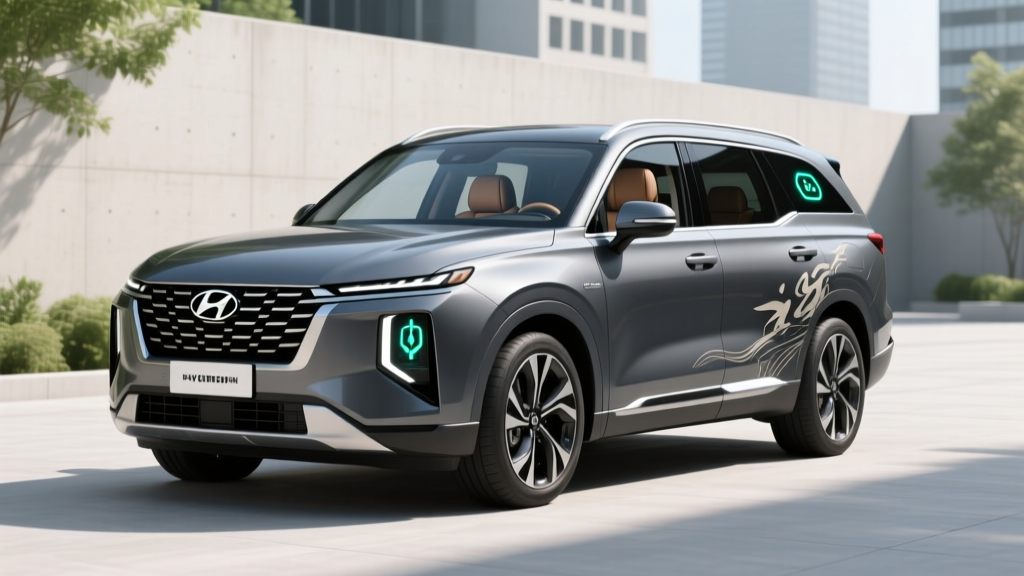
The three-row SUV segment has been slow to embrace electrification, but the 2026 Hyundai Palisade Calligraphy Hybrid aims to change that by pairing Hyundai's proven turbocharged hybrid powertrain with the brand's most luxurious trim level. For families who want three rows, premium features, and meaningful fuel savings without committing to a plug, this is one of the most compelling options on the market.
Before we dig into the specs, let's clear up a critical distinction that trips up many buyers: the Palisade Hybrid is a conventional hybrid (HEV), not a plug-in hybrid (PHEV). It charges its own battery through regenerative braking and the gasoline engine. You never plug it in. If you're looking for electric-only driving, you'll need a PHEV like the Hyundai Tucson PHEV or a full battery-electric vehicle (BEV).
2026 Palisade Calligraphy Hybrid: Quick Specs
| Specification | Detail |
|---|---|
| Powertrain | 2.5L turbocharged 4-cyl + electric motor (HEV) |
| Combined Horsepower | ~329 hp (system net) |
| Transmission | 6-speed automatic |
| Drivetrain | HTRAC AWD standard on Calligraphy |
| EPA MPG (City / Hwy / Combined) | Est. 27 / 28 / 27 MPG* |
| Hybrid Battery | ~1.5 kWh lithium-ion (self-charging, no plug) |
| Fuel Tank | ~18.8 gallons |
| Total Driving Range | Est. ~500 miles |
| 0–60 mph | Est. ~7.2 seconds |
| Towing Capacity | Up to 5,000 lbs (when properly equipped) |
| Seating | 7-passenger (captain's chairs) or 8 (bench) |
| Calligraphy MSRP (est.) | ~$55,000–$57,500 |
| Hybrid Battery Warranty | 10 years / 100,000 miles |
*EPA estimates are preliminary for the 2026 model year. Final figures will be published on fueleconomy.gov. Numbers based on the carryover 2.5T hybrid powertrain introduced with the redesigned Palisade.
A conventional hybrid (HEV) like the Palisade Hybrid uses a small battery (~1–2 kWh) that recharges via regenerative braking and the gas engine. You never plug it in, and there is no electric-only range to speak of — the electric motor simply assists the engine for better efficiency and smoother acceleration.
A plug-in hybrid (PHEV) has a much larger battery (typically 12–30 kWh), can be plugged into a wall outlet or Level 2 charger, and offers 20–50 miles of electric-only driving before the gas engine kicks in. The Palisade is currently offered only as an HEV in the U.S. market.
Fuel Economy: How Many MPG Does the Palisade Hybrid Get?
The headline number for any hybrid buyer is fuel economy. The 2026 Palisade Calligraphy Hybrid's 2.5-liter turbocharged four-cylinder paired with an electric motor and HTRAC all-wheel drive is expected to deliver approximately 27 MPG combined, with city and highway figures hovering around 27–28 MPG.
| Vehicle | City | Highway | Combined |
|---|---|---|---|
| 2026 Hyundai Palisade Hybrid AWD | ~27 | ~28 | ~27 |
| 2026 Toyota Grand Highlander Hybrid AWD | 36 | 32 | 34 |
| 2026 Kia Sorento Hybrid AWD | 34 | 31 | 33 |
| 2025 Honda Pilot (gas, AWD) | 19 | 25 | 21 |
Real-world MPG reality check: Hyundai's turbocharged hybrid system tends to deliver results close to its EPA sticker in mixed driving, but don't expect the city-driving MPG boost that Toyota's series-parallel hybrid system provides. Toyota's Grand Highlander Hybrid, for example, achieves 36 MPG city because its system leans heavily on electric assist at low speeds. The Palisade's turbo-hybrid setup prioritizes power delivery (329 hp) over maximum city efficiency.
On highway road trips at 75+ mph, expect real-world fuel economy to dip to roughly 25–26 MPG, which is typical for a three-row SUV of this size and weight. In cold weather (below 30°F), hybrid efficiency drops 5–10% as the engine runs more frequently to provide cabin heat and maintain battery temperature.
Powertrain and Performance: Turbo-Hybrid Muscle
Hyundai's hybrid system in the Palisade pairs a 2.5-liter turbocharged four-cylinder engine with an electric motor integrated into the transmission housing. Combined system output is estimated at 329 horsepower, making it one of the most powerful hybrid three-row SUVs available.
The 6-speed automatic transmission provides direct mechanical coupling, which gives the Palisade Hybrid a more traditional, linear acceleration feel compared to the CVT-equipped Toyota Grand Highlander Hybrid. The HTRAC all-wheel-drive system is standard on the Calligraphy trim and provides confident traction in rain and light snow.
The 0–60 mph time of approximately 7.2 seconds is respectable for a 4,800+ lb. SUV. The electric motor fills in the torque gap at low RPMs before the turbo spools up, eliminating the lag that plagues some turbocharged non-hybrid engines. Around town, the hybrid system's electric assist makes the Palisade feel surprisingly responsive for its size.
Hybrid Battery Warranty and Longevity: What Owners Need to Know
- Hybrid Battery Warranty: 10 years / 100,000 miles (original owner, per Hyundai's coverage program)
- Capacity Threshold: Hyundai warrants the battery against defects and excessive capacity loss (typically below ~70% state of health)
- Transferability: 10-year/100,000-mile powertrain warranty reduces to 5-year/60,000-mile for second owners
- 12V Auxiliary Battery: Covered under standard 3-year/36,000-mile new-vehicle warranty
Hybrid battery replacement cost is a top concern for buyers. For the Palisade Hybrid, a replacement hybrid battery pack is estimated at $3,000–$5,000 out of warranty (parts and labor), based on pricing for Hyundai/Kia's similar hybrid platforms. However, real-world data from Hyundai's Tucson and Sonata hybrids suggests these packs rarely require full replacement within the first 150,000 miles. Individual cell modules can sometimes be replaced at lower cost if only a portion of the pack degrades.
The ~1.5 kWh lithium-ion hybrid battery in the Palisade is far smaller and less stressed than a full EV battery pack. It operates within a narrow state-of-charge window (typically 40–80% SoC), which minimizes degradation. Most Hyundai hybrid owners will never face a battery replacement bill during typical ownership.
Calligraphy Trim: What You Get for the Money
The Calligraphy sits at the top of the Palisade lineup and is Hyundai's answer to premium three-row SUVs like the Mazda CX-90 and the base tiers of the BMW X5 and Mercedes-Benz GLE — at a fraction of the price.
Key Calligraphy features include:
- Nappa leather seating surfaces with quilted door panels
- Head-up display (HUD)
- Dual 12.3-inch panoramic displays (instrument cluster + infotainment)
- Highway Driving Assist 2 (HDA2) — SAE Level 2 driver assistance with lane-centering and adaptive cruise
- Remote Smart Parking Assist
- Premium audio system (12-speaker Bose or equivalent)
- Heated and ventilated first- and second-row seats
- Power-folding third row
- Digital key and phone-as-a-key capability
The estimated MSRP for the 2026 Palisade Calligraphy Hybrid is $55,000–$57,500 including destination. This positions it roughly $5,000–$8,000 below comparably equipped European luxury alternatives while offering more standard safety and convenience technology.
Tax Credits and Incentives: Does the Palisade Hybrid Qualify?
Here's where many buyers get confused. The 2026 Palisade Hybrid does NOT qualify for the federal §30D clean vehicle tax credit of up to $7,500. That credit is reserved for plug-in electric vehicles (BEVs and PHEVs) with qualifying battery sourcing, MSRP caps, and buyer income limits per IRS guidelines.
As a conventional hybrid (HEV) with no plug-in capability, the Palisade Hybrid is ineligible for:
- The federal §30D new clean vehicle credit ($7,500)
- The §25E used clean vehicle credit ($4,000)
- Most state EV rebates that specifically require plug-in capability
However, some states and local utilities offer smaller incentives for any high-efficiency or hybrid vehicle. Check your state's energy office and local utility for possible rebates. Hyundai also periodically offers manufacturer incentives or low-APR financing that can reduce the effective cost.
Who Should Choose the Palisade Hybrid vs. a Full EV or Gas SUV?
- 329 hp with AWD — confident highway merging and towing
- ~27 MPG combined saves ~$600–$900/year vs. gas-only Pilot
- No plug-in required — works with any lifestyle
- 10-year/100,000-mile hybrid battery warranty
- Top-tier Calligraphy luxury at a mainstream price
- 5,000-lb towing capacity (hybrid battery doesn't compromise utility)
- City MPG trails Toyota Grand Highlander Hybrid by ~9 MPG
- No federal tax credit eligibility (HEV, not PHEV/BEV)
- Calligraphy trim starts near $56K — premium pricing for Hyundai
- No electric-only driving mode
- Turbo-hybrid system is more complex than Toyota's proven planetary gearset
- Choose the Palisade Hybrid if: You want a luxurious three-row SUV with strong acceleration, AWD, and meaningful fuel savings over a gas-only model — without changing your fueling habits. You tow occasionally, drive in varied weather, and value Hyundai's long warranty.
- Choose the Toyota Grand Highlander Hybrid if: Maximum fuel economy (34 MPG combined) is your top priority and you do a lot of city driving. Toyota's hybrid system is the segment efficiency benchmark.
- Choose a PHEV (e.g., Tucson PHEV) if: You have home charging access, a short commute, and want 30+ miles of electric-only driving to minimize gas use. Note: no three-row PHEVs from Hyundai are currently offered in the U.S.
- Choose a full BEV (e.g., Kia EV9) if: You have reliable home Level 2 charging, want zero tailpipe emissions, qualify for the $7,500 federal tax credit, and your typical trips stay within 250–300 miles (or you're comfortable with DC fast charging on road trips).
- Stick with a gas SUV if: Your annual mileage is low (under 10,000 miles), the hybrid premium won't be recouped in fuel savings, or you prefer the lowest possible upfront purchase price.
Ownership Costs: 5-Year Outlook
Let's run the numbers on what owning a 2026 Palisade Calligraphy Hybrid actually costs compared to its gas-only counterpart over five years and 75,000 miles:
| Cost Category | Palisade Hybrid (~27 MPG) | Gas-Only 3-Row SUV (~21 MPG) |
|---|---|---|
| Purchase Price (MSRP est.) | $56,000 | $51,000 |
| Fuel Cost (@ $3.40/gal avg) | $9,444 | $12,143 |
| Fuel Savings vs. Gas | Hybrid saves ~$2,699 over 5 years | |
| Federal Tax Credit | $0 | $0 |
| Estimated Insurance (5 yr) | $11,500 | $10,800 |
| Maintenance (5 yr) | $3,200 | $3,800 |
The hybrid's fuel savings of roughly $2,700 over five years partially offsets its higher MSRP. The hybrid also benefits from reduced brake wear thanks to regenerative braking — many hybrid owners go 60,000+ miles before needing brake pads. However, the $5,000 MSRP premium over a gas model means the hybrid is a break-even proposition on fuel alone unless you plan to keep the vehicle 8+ years or drive significantly more than 15,000 miles annually.
The real value of the Calligraphy Hybrid is the combination of luxury, power, and efficiency in one package — not pure cost savings.
Frequently Asked Questions
Does the 2026 Palisade Hybrid need to be plugged in?
No. The Palisade Hybrid is a conventional HEV. Its small lithium-ion battery recharges through regenerative braking and the gasoline engine. You fuel it like any other car — just with better MPG.
How far can the Palisade Hybrid go on a full tank?
With an estimated ~18.8-gallon fuel tank and 27 MPG combined, expect approximately 500 miles of total range. Highway-only driving at 75 mph may reduce this to ~470 miles; city-heavy driving could push it past 510 miles.
Is the Palisade Hybrid reliable?
Hyundai's turbocharged hybrid powertrain is relatively new in this application (introduced with the redesigned Palisade). Hyundai's hybrid systems in the Sonata and Tucson have demonstrated solid reliability, and the 10-year/100,000-mile powertrain and hybrid battery warranty provides strong protection. Long-term reliability data specific to the Palisade Hybrid will accumulate as the vehicle ages — check IIHS and owner forums for updates.
How much does a Palisade Hybrid battery replacement cost?
Out of warranty, expect $3,000–$5,000 for a full hybrid battery pack replacement. In practice, Hyundai hybrid batteries rarely fail before 150,000 miles, and individual cell module repairs can cost significantly less. The 10-year/100,000-mile warranty covers defects and excessive degradation for the vast majority of ownership periods.
Does the Palisade Hybrid qualify for any tax credit?
The Palisade Hybrid does not qualify for the federal §30D clean vehicle credit because it is a conventional hybrid, not a plug-in vehicle. Some state or utility programs may offer small efficiency rebates — check your local programs. For the $7,500 federal credit, you'd need a qualifying BEV or PHEV that meets MSRP, income, and battery sourcing requirements.
How does the Palisade Hybrid compare to the Kia EV9 electric SUV?
The Kia EV9 is a fully electric three-row SUV with ~270–300 miles of EPA range, qualifies for the federal tax credit (subject to current IRS eligibility rules), and offers near-silent operation with zero tailpipe emissions. However, the EV9 requires home charging infrastructure, has lower towing capacity, and demands DC fast charging planning on road trips. The Palisade Hybrid is the better choice if you tow, lack home charging, or regularly drive in areas with sparse charging infrastructure.
Can the Palisade Hybrid tow?
Yes. When properly equipped, the Palisade Hybrid is rated to tow up to 5,000 pounds — sufficient for a small boat, a pair of jet skis, or a light utility trailer. Note that towing will significantly reduce fuel economy (expect 17–20 MPG while towing) and will cause the engine to run continuously rather than cycling through electric assist.