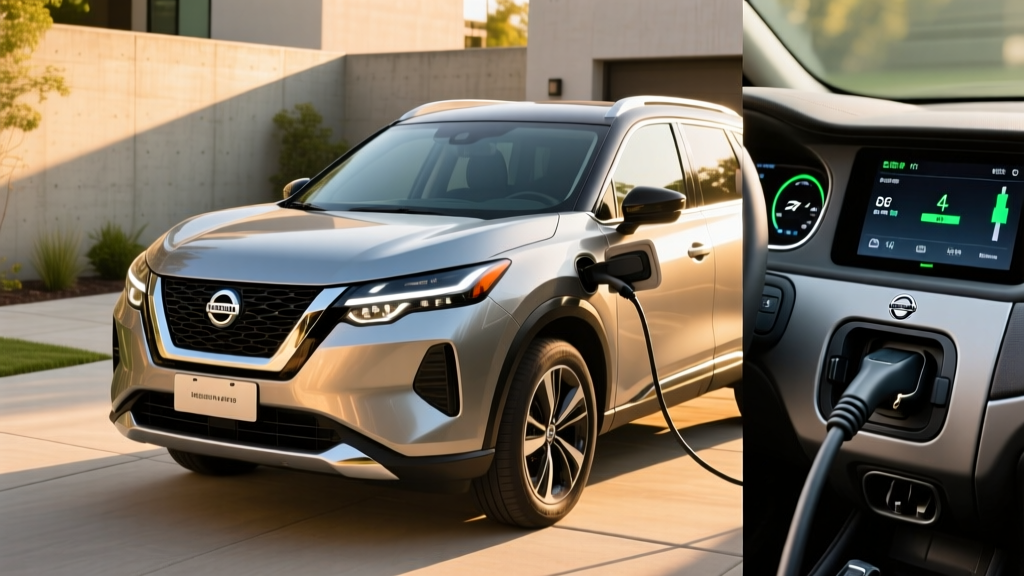
The 2026 Nissan Rogue Plug-In Hybrid arrives as Nissan's first PHEV offering for the U.S. market, slotting into one of the most competitive compact crossover segments. Built on the CMF-CD platform shared with the Mitsubishi Outlander PHEV, the Rogue PHEV pairs a turbocharged engine with dual electric motors and an 18.1 kWh battery pack to deliver 38 miles of electric-only driving before the gasoline engine takes over. For buyers who want electric commuting without range anxiety on road trips, this is the pitch — but does the execution match?
We've compiled every confirmed spec, real-world efficiency expectation, charging detail, and tax-credit nuance you need before putting down a deposit.
HEV vs PHEV: Which Rogue Are You Looking At?
Nissan sells the 2026 Rogue in two electrified forms, and confusing them is the most common buyer mistake. Here's the fundamental split:
| Feature | Rogue Hybrid (HEV) | Rogue Plug-In Hybrid (PHEV) |
|---|---|---|
| Battery | ~1.5 kWh (self-charging) | 18.1 kWh (plug-in capable) |
| Plug-in charging | No — regenerates via braking/engine | Yes — Level 1 & Level 2 |
| Electric-only range | None (electric assist only) | 38 miles EPA |
| Combined output | 201 hp | 248 hp |
| EPA combined | 38 MPG | 95 MPGe (electric) / 35 MPG (gas-only) |
| Starting MSRP | $32,490 | $39,990 |
| Federal tax credit | Not eligible | Up to $3,750 (§30D, see eligibility below) |
The conventional hybrid never plugs in and operates like a traditional gas car with better fuel economy. The PHEV gives you a genuine electric commute for most daily driving, then functions as a hybrid once the battery depletes. If you have access to home or workplace charging, the PHEV's economics shift dramatically in its favor.
Electric Range, MPGe, and Fuel Economy Breakdown
The headline number for any PHEV is how far it travels on electricity alone. The 2026 Rogue PHEV carries an 18.1 kWh lithium-ion battery pack (NMC chemistry), of which approximately 15.2 kWh is usable — the rest is buffer to protect long-term battery health.
| Metric | EPA Estimate | Real-World Expectation |
|---|---|---|
| Electric-only range | 38 miles | 32–36 mi (highway); 36–40 mi (city, mild weather) |
| MPGe (electric mode) | 95 MPGe | 88–98 MPGe depending on climate and terrain |
| Gas-only MPG (combined) | 35 MPG | 33–37 MPG; hybrids often exceed EPA in city driving |
| Gas-only MPG (city) | 37 MPG | 35–40 MPG — regenerative braking boosts city efficiency |
| Gas-only MPG (highway) | 33 MPG | 30–34 MPG; aerodynamic drag hurts at 75+ mph |
| Total combined range | ~470 miles | ~430–490 miles depending on driving mix |
Once the battery depletes, the Rogue PHEV operates as a conventional hybrid. The 35 MPG combined gas figure is competitive with the Toyota RAV4 Hybrid (39 MPG combined) but trails slightly due to the PHEV's additional battery weight — roughly 400 pounds more than the standard Rogue Hybrid.
Powertrain Specs and Performance
The 2026 Rogue PHEV powertrain is a carryover from the Mitsubishi-derived system, tuned for Nissan's driving character:
- Engine: 2.4-liter naturally aspirated 4-cylinder, 126 hp / 147 lb-ft
- Front electric motor: 85 kW (114 hp)
- Rear electric motor: 40 kW (54 hp) — provides electric Awd capability
- Combined system output: 248 hp / 332 lb-ft torque
- Transmission: Single-speed reduction gear (no traditional transmission)
- 0–60 mph: 7.1 seconds (estimated)
- Drivetrain: Electric AWD standard (rear motor engages automatically)
The dual-motor setup means the Rogue PHEV can operate in pure electric mode with all-wheel drive — a significant advantage over single-motor PHEVs that lose AWD capability in EV mode. Acceleration is brisk for the class, and the transition from electric to hybrid mode is seamless under normal driving. Under hard acceleration, the engine and both motors combine for the full 248 hp output.
Charging: Speeds, Connectors, and Home Setup
The Rogue PHEV uses a J1772 connector for AC charging. There is no DC fast charging capability — a common limitation among compact PHEVs, as the smaller battery doesn't justify the added cost and weight of DC hardware.
| Charging Level | Power | Time (0–100%) | Notes |
|---|---|---|---|
| Level 1 (120V household) | 1.4 kW | ~11 hours | Standard outlet; sufficient for overnight if you drive <30 mi/day |
| Level 2 (240V, 16A) | 3.8 kW | ~4.5 hours | Standard home wallbox or public Level 2 |
| Level 2 (240V, 32A) | 7.7 kW | ~2.5 hours | Requires upgraded onboard charger option |
| DC Fast Charge | N/A | N/A | Not equipped — J1772 AC only |
For most PHEV owners, a Level 1 outlet in the garage is adequate. Plug in when you get home, and 11 hours later the battery is full — more than enough for a daily commute cycle. If you want faster top-ups (for example, charging between an afternoon errand and evening commute), a Level 2 home charger running at 3.8 kW is the practical sweet spot. Installation typically runs $500–$1,500 depending on your electrical panel's proximity to the parking spot. A licensed electrician should evaluate your panel capacity before installation.
Pricing, Trims, and Tax Credit Eligibility
The 2026 Rogue Plug-In Hybrid launches in two trims:
- SV PHEV: $39,990 MSRP (includes $1,390 destination)
- SL PHEV: $44,590 MSRP (includes destination)
Both trims come standard with electric AWD, ProPILOT Assist (SAE Level 2 driver assistance), an 8-inch touchscreen with wireless Apple CarPlay and Android Auto, and a 6.6 kW onboard charger upgrade (on SL; 3.8 kW standard on SV).
Does the 2026 Rogue PHEV Qualify for a Federal Tax Credit?
Under current IRS §30D rules, the 2026 Rogue PHEV qualifies for a partial federal clean vehicle credit — up to $3,750 — subject to the following requirements:
- Battery capacity: ≥ 7 kWh (Rogue PHEV's 18.1 kWh qualifies) ✓
- MSRP cap: SUVs/vans/pickups must be ≤ $80,000 (Rogue PHEV qualifies) ✓
- Buyer income cap: AGI ≤ $150,000 (single) / $300,000 (joint) — verify on your tax return
- Critical minerals requirement: Partial credit ($3,750) if battery sourcing meets 2026 thresholds; full $7,500 requires both critical minerals AND battery component tests
- Final assembly: Must be assembled in North America ✓ (Smyrna, TN)
- Point-of-sale transfer: You can transfer the credit to the dealer at purchase for an upfront price reduction
The Rogue PHEV's battery sourcing currently satisfies the critical-minerals requirement but not the full battery-component test, yielding the $3,750 half-credit. Nissan has indicated sourcing updates may push this to the full $7,500 by late 2026 — check fueleconomy.gov for the latest eligibility before purchasing. Always confirm with a tax professional before relying on credit eligibility.
Battery Warranty, Reliability, and Replacement Cost
- Hybrid/PHEV battery: 8 years / 100,000 miles (capacity retention above 70%)
- Powertrain (engine + motors): 5 years / 60,000 miles
- Bumper-to-bumper: 3 years / 36,000 miles
Nissan's PHEV battery warranty is competitive and matches the industry standard set by Toyota, Hyundai, and Kia. The 70% capacity retention threshold means Nissan will repair or replace the battery if it degrades below 70% of original capacity within the warranty period. In practice, modern NMC PHEV batteries with active thermal management degrade slowly — expect roughly 8–12% capacity loss over 10 years of typical use, based on data from similar platforms.
Is the 2026 Rogue PHEV reliable? Nissan's e-Power and hybrid systems in global markets (Japan, Europe) have demonstrated strong durability records. The Mitsubishi-derived PHEV system in the Outlander has been on the road since 2013 with iterative improvements. The main reliability watch-point is Nissan's CVT history in non-hybrid models — however, the PHEV uses a single-speed reduction gear, eliminating the CVT entirely.
Battery replacement cost: Out of warranty, a PHEV battery pack replacement currently runs $8,000–$12,000 including labor. This cost has been declining roughly 8–10% annually as battery manufacturing scales, and by the time a 2026 model exits its warranty period (2034), replacement costs are projected to be significantly lower. Individual module replacement (rather than the full pack) may also be possible, reducing costs further.
Rogue PHEV vs Rivals: How It Stacks Up
| Spec | 2026 Nissan Rogue PHEV | 2026 Toyota RAV4 Prime | 2026 Hyundai Tucson PHEV |
|---|---|---|---|
| Electric range | 38 mi | 42 mi | 33 mi |
| Combined HP | 248 hp | 302 hp | 261 hp |
| Battery (kWh) | 18.1 kWh | 18.1 kWh | 13.8 kWh |
| Gas-only MPG | 35 combined | 38 combined | 35 combined |
| AWD | Standard (electric) | Standard (electric) | Standard (electric) |
| DC fast charge | No | No | No |
| Starting MSRP | $39,990 | $44,590 | $38,725 |
| Max tax credit | $3,750 | $3,750 | $3,750 |
The RAV4 Prime remains the segment benchmark with its 42-mile range and 302 hp, but it commands a premium and is frequently subject to limited dealer allocation. The Tucson PHEV offers a lower entry price but sacrifices electric range. The Rogue PHEV splits the difference — competitive range, strong AWD performance, and a price point that undercuts the RAV4 Prime by roughly $4,600.
Who Should Buy the Rogue PHEV — and Who Shouldn't?
- Your daily round-trip commute is under 35 miles and you can charge at home
- You want electric daily driving but need gas flexibility for road trips
- You need AWD for snow/rain but don't want a full EV's cold-weather range loss
- You want a mainstream brand with a nationwide dealer network for service
- You have reliable home charging and rarely drive more than 250 miles in a day
- You want zero maintenance on the powertrain (no oil changes, no engine)
- You qualify for the full $7,500 federal credit on a BEV (better economics)
- You cannot charge at home or at work (apartment, street parking)
- Your budget is tighter — the HEV starts at $32,490 vs $39,990
- You drive mostly highway miles where the PHEV's electric advantage diminishes
Pros and Cons at a Glance
- 38-mile electric range covers most commutes
- Standard electric AWD with dual motors
- No CVT — single-speed reduction gear is smoother
- Under $40K starting price before tax credit
- Competitive 35 MPG in gas-only hybrid mode
- Built in Tennessee — qualifies for §30D assembly requirement
- No DC fast charging
- Partial $3,750 tax credit, not the full $7,500
- Gas-only MPG trails the RAV4 Hybrid/Prime
- 2.4L engine sounds coarse under hard acceleration
- Cargo space reduced by ~4 cu ft vs gas Rogue (battery placement)
- 6.6 kW onboard charger limited to SL trim
Frequently Asked Questions
How many MPG does the 2026 Rogue plug-in hybrid get?
The EPA rates the 2026 Rogue PHEV at 95 MPGe in electric mode and 35 MPG combined (37 city / 33 highway) when operating as a gasoline hybrid after the battery depletes. In real-world city driving, owners often exceed the EPA city estimate thanks to regenerative braking, seeing 37–40 MPG on the gas engine alone.
How far can the Rogue PHEV go on electric only?
The EPA estimates 38 miles of electric-only range. In real-world conditions, expect 32–36 miles on the highway and up to 40 miles in city driving with mild temperatures. In cold weather (below 35°F), plan for 26–30 miles of electric range due to battery efficiency loss and cabin heating demands.
Hybrid vs PHEV vs EV — which is right for me?
If you can charge at home and your commute is under 35 miles, the PHEV gives you the best of both worlds: electric daily driving with gas backup. A conventional hybrid (HEV) makes sense if you can't plug in — it never needs charging and still delivers 38 MPG. A full EV (BEV) is ideal if you want maximum savings per mile, minimal maintenance, and your daily driving stays within range. The PHEV is the bridge option for households not ready to commit to pure electric.
Is the Rogue PHEV reliable, and what does battery replacement cost?
The PHEV system is derived from Mitsubishi's proven Outlander PHEV platform, now in its third generation globally. Nissan covers the hybrid battery for 8 years / 100,000 miles against degradation below 70%. Out-of-warranty battery replacement currently costs $8,000–$12,000, though this figure is expected to decline as battery costs continue to fall. The absence of a CVT (the PHEV uses a single-speed gear reduction) eliminates a historical Nissan reliability concern.
Does the 2026 Rogue PHEV qualify for a tax credit?
Yes — partially. Under current IRS §30D rules, the Rogue PHEV qualifies for up to $3,750 in federal clean vehicle credit (the half-credit for meeting critical minerals requirements but not the full battery component test). Eligibility also requires buyer AGI below $150K (single) or $300K (joint), and the credit can be transferred to the dealer at point of sale for an upfront price reduction. Always verify current eligibility at fueleconomy.gov and consult a tax professional before purchasing.
Can the Rogue PHEV use DC fast chargers?
No. The 2026 Rogue PHEV charges exclusively via AC power using a J1772 connector. Level 1 (120V) charging takes about 11 hours for a full charge; Level 2 (240V) takes 2.5–4.5 hours depending on your onboard charger configuration. This is typical for the PHEV segment — the smaller battery makes DC fast charging less cost-effective for manufacturers to include.