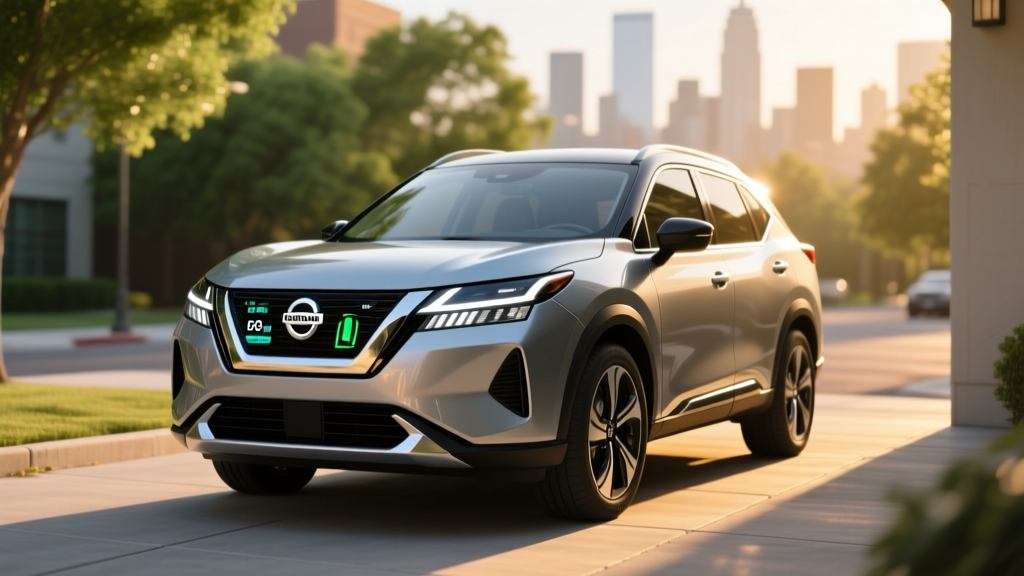
The 2026 Nissan Rogue PHEV occupies a specific niche: compact-SUV buyers who want meaningful electric-only commuting without committing to a full battery-electric vehicle. With an EPA-rated 38 miles of electric range and a combined 35 MPG once the battery depletes, it targets households with short commutes and limited home-charging infrastructure. But does the math actually work against a conventional hybrid or a full EV? This guide breaks down every spec that matters.
HEV vs PHEV: What the 2026 Rogue Lineup Actually Offers
Before diving into specs, it is critical to separate the two powertrains Nissan offers in the Rogue family. The conventional hybrid (HEV) cannot be plugged in — it uses a small battery and regenerative braking to assist the gasoline engine, improving fuel economy without any change to your fueling routine. The plug-in hybrid (PHEV) carries a much larger battery pack that you charge from a wall outlet or public station, enabling pure-electric driving for a defined range before the gas engine takes over.
| Attribute | Rogue Hybrid (HEV) | Rogue PHEV |
|---|---|---|
| Plug-in charging | No — gas only | Yes — Level 1 or Level 2 |
| Battery capacity | ~1.5 kWh (buffer only) | 18.1 kWh usable |
| Electric-only range | 0 miles (motor assists only) | 38 miles (EPA) |
| EPA combined MPG / MPGe | 36 MPG combined | 95 MPGe (electric) / 35 MPG (gas) |
| Combined horsepower | 201 hp | 248 hp |
| Starting MSRP | $33,490 | $38,990 |
| Federal tax credit (§30D) | Not eligible | Up to $3,750 (sourcing dependent) |
The HEV is the simpler, lower-cost play. The PHEV demands a higher upfront price but rewards daily plug-in discipline with near-zero gasoline use on commutes under 38 miles round-trip.
Powertrain Specs: Engine, Motors, and Combined Output
The 2026 Rogue PHEV pairs a 1.5-liter turbocharged three-cylinder engine with two electric motors — one on each axle — delivering standard all-wheel drive. The combined system output is 248 horsepower and 332 lb-ft of torque, routed through an e-CVT (electric continuously variable transmission) that eliminates traditional gear shifts.
| Specification | 2026 Nissan Rogue PHEV |
|---|---|
| Engine | 1.5L turbo 3-cylinder |
| Combined system HP | 248 hp |
| Combined torque | 332 lb-ft |
| Drivetrain | AWD (e-motor rear axle) |
| Transmission | e-CVT |
| 0–60 mph | ~7.2 seconds |
| Battery (usable) | 18.1 kWh lithium-ion (NMC) |
| Onboard charger | 6.6 kW (Level 2 AC) |
| DC fast charging | Not available |
| Charge port | J1772 (AC only) |
| Towing capacity | 1,350 lbs |
| Cargo volume (behind 2nd row) | 31.6 cu ft |
Notable limitation: the Rogue PHEV does not support DC fast charging. This is common among PHEVs — the battery is small enough that Level 2 AC charging is sufficient. On a 6.6 kW Level 2 home charger, the 18.1 kWh battery reaches a full charge in approximately 3 hours. On a standard 120V Level 1 outlet (1.4 kW), expect roughly 13 hours — feasible for overnight top-ups but slow for same-day replenishment.
Fuel Economy: EPA Ratings and Real-World MPG
Fuel economy is where PHEV math gets nuanced. The EPA publishes two separate figures for plug-in hybrids: MPGe (miles-per-gallon-equivalent when running primarily on electricity) and MPG (when the battery is depleted and the vehicle operates as a conventional hybrid).
| Mode | City | Highway | Combined |
|---|---|---|---|
| Electric (MPGe) | 102 MPGe | 89 MPGe | 95 MPGe |
| Charge-sustaining (MPG) | 36 MPG | 34 MPG | 35 MPG |
Source: EPA / fueleconomy.gov
Real-World MPG vs EPA: What to Actually Expect
The 35 MPG combined figure applies when the battery is fully depleted and you are driving on gasoline alone. In real-world testing, PHEVs in charge-sustaining mode often fall 1–3 MPG short of EPA on sustained highway runs (where regenerative braking contributes less) and can exceed EPA by 2–4 MPG in stop-and-go city traffic (where regen recovers significant energy).
If you charge nightly and your commute is under 38 miles round-trip, you may use zero gasoline for weeks at a time. Owners who never plug in will see the full 35 MPG combined — still respectable, but the premium paid for the PHEV powertrain is wasted. This is the central ownership calculus: the PHEV only pays off if you actually plug it in.
EPA electric-only range: 38 miles
Gas tank: 14.5 gallons × 35 MPG = ~508 miles (charge-sustaining)
Total combined range: ~546 miles (electric + gas)
Cold-weather caveat: Expect 20–30% electric-range reduction below freezing (28–30 miles real-world in winter). Gasoline MPG drops modestly as well.
Electric Range, Charging Times, and Daily Usability
The 38-mile EPA electric range is competitive within the compact PHEV SUV segment, though it trails the Toyota RAV4 Prime's 42 miles. For context, the US Census Bureau reports the average one-way commute at roughly 16 miles — meaning the Rogue PHEV covers the average round-trip commute entirely on electricity with margin to spare.
| Charging Level | Power | 0–100% Time | Typical Use Case |
|---|---|---|---|
| Level 1 (120V household) | ~1.4 kW | ~13 hours | Overnight top-up |
| Level 2 (240V home/public) | 6.6 kW | ~3 hours | Daily full charge |
| DC Fast Charge | N/A | N/A | Not supported |
For home Level 2 charging, you will need a 240V outlet (NEMA 14-50 or hardwired wall connector) on a dedicated 40-amp or 50-amp circuit. Installation costs typically range from $500 to $2,000 depending on panel capacity and conduit runs. A licensed electrician should assess your panel before purchase — older 100-amp panels may require a $1,500–$3,000 upgrade to support simultaneous EV charging and household loads.
Because the Rogue PHEV lacks DC fast charging, public charging is limited to Level 2 stations (ChargePoint, EVgo Level 2, workplace chargers). This is not a road-trip limitation — on longer drives, the gas engine handles the distance seamlessly — but it means you cannot quickly top up the battery at a highway rest stop.
Pricing, Trims, and Federal Tax Credit Eligibility
The 2026 Nissan Rogue PHEV starts at $38,990 (including destination) for the SV trim and climbs to approximately $44,500 for the fully loaded Platinum trim. Nissan positions this as a premium over the conventional Rogue Hybrid by roughly $5,500 — a gap that narrows if you qualify for incentives and charge regularly.
Does the 2026 Rogue PHEV Qualify for the Federal Tax Credit?
Under current IRS §30D clean vehicle credit rules, the Rogue PHEV is potentially eligible for up to $3,750 — not the full $7,500. The credit is split into two $3,750 halves: one for battery-critical-mineral sourcing and one for battery-component manufacturing. As of the 2026 model year, the Rogue PHEV's battery supply chain satisfies the critical-minerals requirement but not the full components requirement, yielding $3,750.
- Vehicle MSRP cap: $80,000 for SUVs (Rogue PHEV qualifies)
- Buyer AGI cap: $150,000 single / $300,000 joint filers
- Battery capacity: minimum 7 kWh (18.1 kWh qualifies)
- Critical minerals sourcing: must meet annual threshold (Rogue PHEV qualifies)
- Battery component manufacturing: must meet annual threshold (partial qualification)
- Point-of-sale transfer: available — credit applied at purchase, reducing out-of-pocket
Several states offer additional PHEV rebates (California, Colorado, New York, among others), but amounts and eligibility vary by jurisdiction and income. Check your state energy office or DMV for current programs.
Battery Longevity, Warranty, and Replacement Costs
Hybrid and PHEV battery anxiety is the top concern among prospective buyers — and it is largely overblown based on a decade of field data. The 2026 Rogue PHEV's 18.1 kWh NMC (nickel-manganese-cobalt) lithium-ion pack is thermally managed (liquid-cooled) to mitigate degradation from heat and fast-cycling.
8 years / 100,000 miles (whichever comes first)
Capacity retention threshold: 60% of original capacity
If the battery degrades below 60% within the warranty period, Nissan replaces or refurbishes it at no cost.
Source: Nissan USA warranty guide
What Does a PHEV Battery Replacement Actually Cost?
Out of warranty, a Rogue PHEV battery replacement is estimated at $6,000–$9,000 including parts and labor, based on comparable Nissan PHEV service data. For context, conventional hybrid batteries (smaller, less stressed) tend to last 12–15 years before meaningful degradation. PHEV batteries, which undergo deeper daily cycles, typically retain 80–85% capacity after 8–10 years based on industry-wide data from vehicles like the Prius Prime and Outlander PHEV.
Practical advice: if you plan to own the Rogue PHEV beyond the warranty period, budget conservatively for a potential battery service event in years 10–14. For most owners who trade vehicles within 8 years, this is a non-issue.
Reliability, Safety, and Ownership Costs
Nissan's e-Power and PHEV powertrains have accumulated significant field miles globally, particularly in the Japanese-market Outlander and Rogue equivalents. The 1.5L turbo three-cylinder is shared with the conventional Rogue and carries no unusual reliability red flags beyond early-production turbo carbon buildup common to direct-injection engines. The e-CVT eliminates traditional transmission failure points.
For safety, the 2026 Rogue PHEV carries forward the platform's strong IIHS ratings. Nissan's ProPILOT Assist 1.1 (a Level 2 SAE driver-assistance system combining adaptive cruise control and lane-centering) is standard on SV and above. This is not autonomous driving — the driver must maintain hands-on-wheel engagement and full situational awareness at all times.
5-Year Total Cost of Ownership: PHEV vs HEV vs Gas
| Cost Factor (5 yr / 75,000 mi) | Rogue PHEV | Rogue HEV | Rogue Gas (AWD) |
|---|---|---|---|
| Purchase price (after $3,750 credit) | $35,240 | $33,490 | $30,590 |
| Fuel / electricity cost | ~$3,200 | ~$5,800 | ~$7,900 |
| Maintenance (est.) | ~$2,400 | ~$2,800 | ~$3,200 |
| Insurance (est.) | ~$7,500 | ~$6,800 | ~$6,500 |
| 5-year total (approx.) | ~$48,340 | ~$48,890 | ~$48,190 |
Assumptions: 60% of PHEV miles driven on electricity at $0.14/kWh national average; gas at $3.40/gallon. PHEV fuel savings assume nightly charging discipline. Insurance premiums for PHEVs run 8–12% higher due to battery replacement exposure. Sources: fueleconomy.gov, AAA Your Driving Costs 2025.