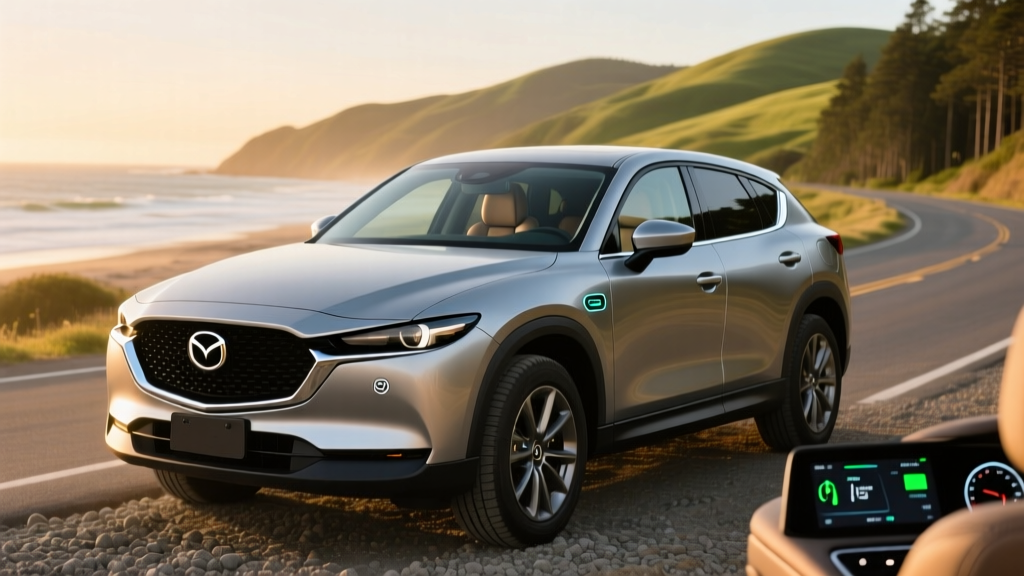
The 2026 Mazda CX-50 Hybrid occupies a specific niche in the compact crossover segment: it pairs Toyota's proven hybrid powertrain with Mazda's premium interior and chassis tuning. For buyers who want better fuel economy without committing to a plug-in hybrid or full electric vehicle, this conventional hybrid (HEV) warrants a close look. Here is every number that matters — from EPA fuel economy to battery warranty to out-the-door pricing.
HEV vs PHEV: What the CX-50 Hybrid Actually Is
Before diving into specs, it is critical to understand what the CX-50 Hybrid is not. It is a conventional hybrid electric vehicle (HEV), not a plug-in hybrid (PHEV). You never plug it in. The small battery charges exclusively through regenerative braking and the gasoline engine. This distinction matters because it determines your daily driving experience, fuel savings, and tax-credit eligibility.
Conventional Hybrid (HEV) vs Plug-In Hybrid (PHEV)
| Feature | HEV (CX-50 Hybrid) | PHEV (for comparison) |
|---|---|---|
| Plug-in charging required | No — never plug in | Yes — for electric-only range |
| Electric-only driving | Very short, low-speed only (~1 mi) | 20–40+ miles at highway speed |
| Battery size | ~1.6 kWh (small buffer) | 13–20+ kWh usable |
| Federal tax credit (§30D) | Not eligible | Up to $7,500 if requirements met |
| Best for | No home charging access, simpler ownership | Home chargers, short daily commutes |
The CX-50 Hybrid uses a Toyota-sourced hybrid system — the same architecture found in the RAV4 Hybrid. Mazda partnered with Toyota for this powertrain, combining Toyota's hybrid efficiency with Mazda's 2.5-liter engine character and all-wheel-drive calibration. The result is a crossover that requires zero change to your fueling habits: you simply fill up with regular 87-octane gasoline and drive.
Fuel Economy: EPA Ratings and Real-World MPG
The 2026 CX-50 Hybrid carries forward the powertrain that debuted for the 2025 model year. EPA fuel economy figures are based on fueleconomy.gov data for the Mazda CX-50 Hybrid AWD configuration.
| Metric | City | Highway | Combined |
|---|---|---|---|
| EPA Estimate | 39 MPG | 37 MPG | 38 MPG |
| Real-World Expectation | 37–41 MPG | 33–36 MPG | 35–39 MPG |
How many MPG does the CX-50 Hybrid get in real driving? Conventional hybrids like this one often exceed their EPA city rating because stop-and-go traffic maximizes regenerative braking and electric-motor assist. On a mostly-city route with moderate temperatures, owners of the mechanically similar RAV4 Hybrid routinely report 40–42 MPG. Highway driving is the opposite story: sustained 70–80 mph speeds reduce the hybrid system's advantage, and real-world highway fuel economy typically lands 3–5 MPG below the EPA sticker. Cold weather (below 30°F) further reduces efficiency by 5–10% as the engine runs more frequently for cabin heat.
With a 14.8-gallon fuel tank, the CX-50 Hybrid delivers a practical total range of approximately 520–575 miles per fill-up depending on your driving mix — enough for most buyers to visit the gas station once every two weeks.
Powertrain Specs: Toyota Hybrid Meets Mazda Engineering
| Powertrain | 2.5L 4-cylinder + 2 electric motors (Toyota hybrid system) |
| Combined Horsepower | 219 hp |
| Drivetrain | AWD (electronic rear motor, no mechanical driveshaft) |
| Transmission | eCVT (planetary gearset, not a belt-type CVT) |
| Hybrid Battery | ~1.6 kWh nickel-metal hydride (NiMH) |
| 0–60 mph | ~7.3 seconds (est.) |
| Towing Capacity | 1,500 lbs (hybrid); gas CX-50 turbo tows 3,500 lbs |
| Fuel Type | Regular 87-octane unleaded |
The 219-hp combined output comes from the 2.5-liter Atkinson-cycle four-cylinder engine paired with front and rear electric motors. The eCVT uses Toyota's planetary gearset design — this is fundamentally different from the rubber-belt CVTs found in some competitors, and it has proven exceptionally durable over millions of vehicles. The electronic AWD system engages the rear motor on demand for traction, without the weight and friction losses of a mechanical driveshaft.
One trade-off to note: the hybrid model's towing capacity drops to 1,500 pounds compared to 3,500 pounds for the turbocharged gas CX-50. If you tow even a small trailer regularly, the hybrid may not be the right configuration.
Pricing, Trims, and Tax Credit Eligibility
The 2026 Mazda CX-50 Hybrid is available across multiple trim levels. Pricing below reflects manufacturer MSRP before destination charges (approximately $1,420).
| Trim | MSRP (est.) |
|---|---|
| Preferred Hybrid | $35,395 |
| Premium Hybrid | $38,595 |
| Premium Plus Hybrid | $41,795 |
Does the CX-50 Hybrid Qualify for a Federal Tax Credit?
No. The federal §30D Clean Vehicle Credit applies only to plug-in electric vehicles (BEVs and PHEVs) with sufficient battery capacity. Conventional hybrids like the CX-50 Hybrid do not qualify for the $7,500 federal credit, the point-of-sale transfer, or the up-to-$4,000 used-EV credit.
Some states offer their own incentives for hybrid purchases, but these vary widely and change frequently. Check your state's energy or environmental agency website for current programs.
The hybrid powertrain does carry a price premium over the standard gas CX-50, typically around $1,500–$2,000 at equivalent trim levels. At 38 MPG combined versus roughly 27 MPG for the gas AWD model, the hybrid saves approximately $500–$650 per year in fuel costs (assuming 12,000 miles/year and $3.40/gallon). That means the hybrid premium pays for itself in roughly 3 years for an average driver — sooner if gas prices rise or you drive more than average.
Battery Warranty, Reliability, and Replacement Cost
Hybrid Battery Warranty
Federal mandate: Hybrid battery components are covered for a minimum of 8 years / 100,000 miles (10 years / 150,000 miles in California and states that follow CARB emissions standards).
Mazda's coverage: Mazda covers the hybrid battery and related components for 8 years / 100,000 miles nationwide, with extended coverage in CARB states.
General powertrain warranty: 5 years / 60,000 miles.
Is the CX-50 Hybrid reliable? This is where the Toyota partnership pays dividends. The hybrid system in the CX-50 is mechanically related to the powertrain Toyota has refined across the RAV4 Hybrid, Camry Hybrid, and Highlander Hybrid for over a decade. Toyota's hybrid synergy drive system has demonstrated exceptional longevity — it is common for these systems to exceed 200,000 miles without major hybrid-component failure. The NiMH battery pack, while less energy-dense than lithium-ion, is known for robust cycle life and thermal stability.
What does hybrid battery replacement cost? If the hybrid battery fails outside of warranty, replacement typically costs between $3,000 and $5,000 for the battery pack plus labor at a dealership. However, this is a worst-case scenario that rarely materializes within the first 10–15 years of ownership based on historical data from Toyota's hybrid fleet. Individual hybrid battery modules can sometimes be replaced for $500–$1,500 if only a portion of the pack degrades. Independent hybrid specialists in many metro areas offer refurbished battery packs for $1,500–$2,500 as a cost-effective alternative.
How the CX-50 Hybrid Compares: Hybrid vs PHEV vs EV
Choosing between a conventional hybrid, plug-in hybrid, and full electric vehicle depends on your specific situation. Here is a practical decision framework:
Choose the CX-50 Hybrid (HEV) If:
- You lack access to home or workplace charging (apartment, street parking)
- You want zero change to your fueling routine — just gas up and go
- You regularly take road trips exceeding 300 miles
- You want lower purchase price than a PHEV or EV
- You live in an area with limited public charging infrastructure
Choose a PHEV (e.g., Toyota RAV4 Prime) If:
- You have home Level 2 charging and a daily commute under 40 miles
- You want to drive mostly on electricity but need gas for longer trips
- You qualify for the $7,500 federal tax credit (check IRS §30D requirements)
Choose a Full EV (e.g., Tesla Model Y, Hyundai Ioniq 5) If:
- You have reliable home charging (Level 2, 240V)
- Your daily driving is under 250 miles and you can plan road-trip charging
- You want the lowest per-mile "fuel" cost and minimal maintenance
- You qualify for federal and state EV incentives
Pros and Cons at a Glance
✓ Pros
- 38 MPG combined — saves ~$500–$650/yr vs gas CX-50
- 219 hp provides confident acceleration and passing power
- No plug-in charging required — zero lifestyle change
- Toyota-sourced hybrid system with proven long-term reliability
- Premium interior materials and Mazda's driving dynamics
- Standard AWD with electronic rear motor
- 8-year/100,000-mile hybrid battery warranty
✗ Cons
- No federal tax credit eligibility (HEV, not PHEV/BEV)
- Towing limited to 1,500 lbs (gas turbo: 3,500 lbs)
- Highway MPG drops noticeably at sustained 75+ mph speeds
- ~$1,500–$2,000 premium over equivalent gas trim
- eCVT engine drone under hard acceleration (common to hybrid systems)
- Rear cargo space slightly reduced vs gas model due to battery placement
Real-World Ownership: What to Expect
Living with the CX-50 Hybrid day-to-day is remarkably straightforward. The hybrid system operates transparently — there is no mode selection required, no charging to manage. The vehicle automatically switches between electric-motor assist, engine power, and regenerative braking based on driving conditions. At low speeds and during gentle acceleration, the electric motor does most of the work, making the CX-50 Hybrid surprisingly quiet in city driving.
One characteristic to anticipate: under hard acceleration (merging onto a highway, for example), the eCVT holds the engine at a constant high RPM while the vehicle accelerates. This creates a drone that some drivers find objectionable, though it is common to all planetary-gearset hybrid systems and lasts only a few seconds.
In cold weather, expect fuel economy to dip to roughly 33–35 MPG combined. The gasoline engine must run more frequently to provide cabin heat and maintain battery temperature, reducing the hybrid system's efficiency advantage. This is normal for all hybrids and is not a defect.
Frequently Asked Questions
How many MPG does the 2026 Mazda CX-50 Hybrid get?
The EPA rates the CX-50 Hybrid at 39 MPG city, 37 MPG highway, and 38 MPG combined. In real-world driving, expect 37–41 MPG in city conditions (hybrids excel in stop-and-go traffic) and 33–36 MPG on sustained highway drives at 70–80 mph.
Does the CX-50 Hybrid need to be plugged in?
No. The CX-50 Hybrid is a conventional hybrid (HEV), not a plug-in. The small hybrid battery charges through regenerative braking and the gasoline engine. You never plug it in — just fill up with regular 87-octane gasoline.
How far can the CX-50 Hybrid drive on electric power alone?
As a conventional hybrid, the CX-50 Hybrid can travel roughly 0.5–1 mile on electric power alone at very low speeds (under 25 mph). This is not a meaningful electric-only range — it is designed for brief low-speed maneuvers, not commuting. For substantial electric-only driving, you need a PHEV or full EV.
Is the CX-50 Hybrid reliable? What about the battery?
The hybrid powertrain is sourced from Toyota, which has built millions of vehicles on this architecture with excellent long-term reliability records. The hybrid battery is covered for 8 years/100,000 miles (10 years/150,000 miles in CARB states). Based on Toyota hybrid fleet data, most hybrid batteries last 150,000–200,000+ miles before needing replacement.
What does a CX-50 Hybrid battery replacement cost?
Out-of-warranty hybrid battery replacement typically costs $3,000–$5,000 at a dealership. Refurbished packs from independent hybrid specialists run $1,500–$2,500. However, battery failure within the first 10–15 years is uncommon based on historical Toyota hybrid data.
Does the CX-50 Hybrid qualify for any tax credit?
The CX-50 Hybrid does not qualify for the federal §30D Clean Vehicle Credit, which is limited to plug-in vehicles (BEVs and PHEVs). Some states may offer separate hybrid incentives — check your state's energy agency for current programs. The hybrid's fuel savings (~$500–$650/year over the gas model) provide the primary financial benefit.
How does the CX-50 Hybrid compare to the RAV4 Hybrid?
The CX-50 Hybrid shares its core powertrain with the Toyota RAV4 Hybrid but offers a more premium interior, Mazda's chassis tuning, and slightly different exterior styling. The RAV4 Hybrid has marginally higher EPA ratings (41/38/40 MPG for the LE AWD) and a larger dealer network. Choose the CX-50 if interior quality and driving feel matter more to you than squeezing out the last 2 MPG.
Can the CX-50 Hybrid tow?
Yes, but with a reduced capacity of 1,500 pounds — adequate for a small utility trailer or a couple of dirt bikes, but not for a boat or camper. The turbocharged gas CX-50 tows up to 3,500 pounds if towing is a priority.
Sources: EPA fuel economy data via fueleconomy.gov; IRS Clean Vehicle Credit rules via irs.gov; Mazda USA specifications. Pricing and specs are based on 2026 model-year information available at time of publication and may vary by dealer. Always verify current incentive eligibility with a tax professional.