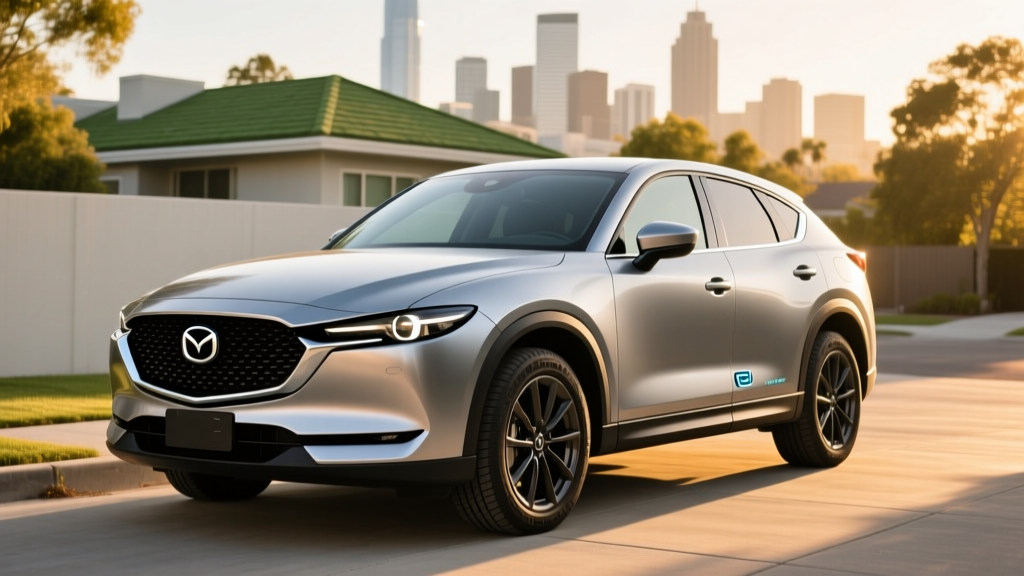
The 2026 Mazda CX-50 Hybrid occupies a specific niche: a compact crossover that pairs Toyota's proven hybrid synergy drive with Mazda's premium interior and rugged styling. For buyers who want to cut fuel costs without committing to a plug, this conventional hybrid (HEV) delivers meaningful efficiency gains over the gas-only CX-50 while retaining all-wheel drive as standard equipment. Here's the complete breakdown of what this powertrain delivers, what it costs, and whether it's the right choice for your driveway.
Quick Verdict: The CX-50 Hybrid at a Glance
| Spec | 2026 Mazda CX-50 Hybrid |
|---|---|
| Powertrain Type | Conventional Hybrid (HEV) — no plug required |
| Combined Horsepower | 219 hp |
| Engine | 2.5L 4-cylinder + electric motor |
| EPA MPG (City / Hwy / Combined) | 39 / 34 / 38 |
| Drivetrain | AWD (standard, electronic on-demand) |
| 0–60 mph | ~7.8 seconds (est.) |
| Towing Capacity | 1,500 lbs |
| Cargo Volume (behind 2nd row) | 31.4 cu ft |
| Base MSRP (Preferred trim) | $35,395 |
| Battery Warranty | 8 years / 100,000 miles |
The headline number is 38 MPG combined — a substantial improvement over the gas-only CX-50's 27 MPG combined. That translates to roughly 100 fewer gallons of fuel per year for a driver covering 15,000 miles, saving approximately $300–$450 annually depending on local gas prices.
HEV vs PHEV: Why the CX-50 Hybrid Doesn't Plug In
A critical distinction before going further: the 2026 Mazda CX-50 Hybrid is a conventional hybrid (HEV), not a plug-in hybrid (PHEV). Here's what that means in practice:
| Feature | HEV (CX-50 Hybrid) | PHEV (e.g., Toyota RAV4 Prime) |
|---|---|---|
| Plug-in Charging | Not required or possible | Yes — 120V or 240V outlet |
| Electric-Only Range | Less than 1 mile at low speed | 25–42 miles typical |
| Battery Size | ~1.6 kWh (small, self-charging) | 18–20 kWh |
| DC Fast Charging | No | Rarely; most PHEVs are Level 2 only |
| Federal Tax Credit (§30D) | Not eligible | Up to $7,500 if eligible |
| Driving Experience | Seamless gas-electric blending | EV-like on short trips, gas after depletion |
Mazda has not announced a CX-50 PHEV variant for the 2026 model year. If you need electric-only commuting capability, the Toyota RAV4 Prime (42 miles EV range) or the Hyundai Tucson PHEV (33 miles EV range) remain the segment benchmarks. But if you simply want better fuel economy without altering your refueling habits, the HEV approach is the lower-friction choice.
Fuel Economy: EPA Numbers vs Real-World MPG
According to fueleconomy.gov, the 2026 CX-50 Hybrid earns the following EPA ratings:
| Driving Cycle | EPA MPG | Real-World Expectation |
|---|---|---|
| City | 39 MPG | 38–42 MPG (hybrids often exceed EPA in stop-and-go) |
| Highway | 34 MPG | 31–35 MPG (aero drag limits electric assist at speed) |
| Combined | 38 MPG | 35–39 MPG depending on route mix |
Toyota's hybrid system — which Mazda licenses for this application — has a well-documented tendency to match or slightly beat its EPA city rating in real-world urban driving. Regenerative braking recaptures energy at every stoplight, and the engine shuts off frequently below 25 mph. Highway driving is where the CX-50's boxy, rugged styling works against it: the taller ride height and squared-off roofline create more aerodynamic drag than a sleeker crossover like the Mazda CX-5.
Cold-weather note: Expect a 5–10% MPG reduction in sustained sub-freezing temperatures. The engine runs more frequently to maintain cabin heat and bring the catalytic converter up to operating temperature. This is normal for all hybrids and far less severe than the 20–30% range loss a full EV experiences in the same conditions.
Powertrain Deep Dive: Toyota Hardware, Mazda Tuning
The CX-50 Hybrid uses the same hybrid synergy drive found in the Toyota RAV4 Hybrid: a 2.5-liter Atkinson-cycle four-cylinder engine paired with two electric motor-generators and an electronically controlled CVT (eCVT). Combined system output is 219 horsepower, which is 32 hp more than the gas-only CX-50's turbo-free 187-hp base engine.
The AWD system is electronic on-demand — a third electric motor on the rear axle provides torque to the rear wheels when slip is detected or during hard acceleration. There's no mechanical driveshaft connecting the front and rear axles, which reduces weight and drivetrain loss.
Acceleration to 60 mph takes approximately 7.8 seconds, which is competitive with the Honda CR-V Hybrid (7.6 sec) and noticeably quicker than the gas-only CX-50 (8.9 sec with the non-turbo engine). The eCVT delivers smooth, linear acceleration without the gear-hunting of a conventional automatic, though Mazda has programmed simulated shift points under hard throttle for a more traditional feel.
One trade-off: towing capacity drops from 3,500 lbs (gas CX-50 with turbo) to 1,500 lbs for the hybrid. If you regularly tow a small trailer or jet ski, the gas turbo model remains the better tool.
Pricing, Trims, and Tax Credit Eligibility
The 2026 CX-50 Hybrid is available across multiple trims, with pricing starting at approximately $35,395 for the Preferred trim and climbing to around $42,000 for the Premium Plus. The hybrid powertrain commands roughly a $2,000–$2,500 premium over equivalent gas-only trims.
Federal Tax Credit Status: The CX-50 Hybrid does not qualify for the IRS §30D federal clean vehicle tax credit. That credit (up to $7,500) is reserved for plug-in electric vehicles with battery capacity of at least 7 kWh — the CX-50 Hybrid's ~1.6 kWh battery falls well below that threshold.
Some states and municipalities offer separate incentives for conventional hybrids, but these are increasingly rare as incentive programs shift toward plug-in vehicles. Check your state energy office or the Alternative Fuels Data Center for current local programs.
Without a tax credit, the payback period for the hybrid premium depends entirely on your mileage and local fuel costs. At $3.50/gallon and 15,000 miles per year, the fuel savings versus the 27 MPG gas model work out to roughly $370 annually — meaning the $2,500 premium pays back in about 6–7 years. If you drive more than average or live in a state with expensive fuel (California, Washington, New York), that timeline shortens to 4–5 years.
Battery Warranty, Reliability, and Replacement Cost
Hybrid Battery Warranty: Mazda covers the CX-50 Hybrid's battery pack for 8 years or 100,000 miles (whichever comes first). In states that follow California Air Resources Board (CARB) standards — including CA, NY, MA, WA, and several others — that coverage extends to 10 years or 150,000 miles.
The battery pack itself is relatively small (~1.6 kWh, nickel-metal hydride or lithium-ion depending on build date) and operates within a narrow state-of-charge window — typically 40–80%. This shallow cycling is the primary reason Toyota/Mazda hybrid batteries routinely last 150,000–200,000+ miles without significant degradation. Unlike a full EV battery, which cycles deeply and holds 60–100 kWh, the hybrid battery's job is modest: assist acceleration, capture braking energy, and enable brief engine-off coasting.
Replacement cost: If the hybrid battery does eventually need replacement outside of warranty, expect a dealer-installed unit to cost between $2,500 and $4,000 depending on the specific pack. Independent hybrid specialists often offer refurbished packs for $1,500–$2,500. Given the proven longevity of this Toyota-derived system, this is a low-probability expense for most original owners.
Overall reliability expectations are high. The Toyota hybrid system in the RAV4 Hybrid has consistently earned above-average reliability scores from Consumer Reports and J.D. Power, and the CX-50 Hybrid uses the same core components. The IIHS has rated the CX-50 as a Top Safety Pick+ in prior model years, and the hybrid variant shares the same structural platform.
CX-50 Hybrid vs the Competition
| Spec | 2026 Mazda CX-50 Hybrid | 2026 Toyota RAV4 Hybrid | 2026 Honda CR-V Hybrid |
|---|---|---|---|
| EPA Combined MPG | 38 | 39 | 37 |
| Horsepower | 219 hp | 219 hp | 204 hp |
| AWD | Standard | Standard | Standard |
| Cargo (cu ft) | 31.4 | 37.6 | 36.3 |
| Starting MSRP | $35,395 | $33,575 | $36,350 |
| Interior Quality | Premium (leather, soft-touch) | Functional, durable | Modern, clean |
| Towing | 1,500 lbs | 1,750 lbs | 1,000 lbs |
The CX-50 Hybrid trades a small amount of cargo space and fuel economy for a noticeably more upscale cabin, standard AWD, and Mazda's engaging steering feel. If maximum utility and the lowest price are priorities, the RAV4 Hybrid wins. If interior refinement and driving dynamics matter, the CX-50 makes a compelling case despite the $1,500–$2,000 price premium.
Who Should Choose the CX-50 Hybrid (and Who Shouldn't)
Choose the CX-50 Hybrid If:
- You want 38 MPG without changing your fueling routine — no plug, no charger, no range planning
- You value a premium interior over maximum cargo volume
- You drive a mix of city and highway miles and want the city efficiency advantage of a hybrid
- You plan to keep the vehicle 5+ years and want proven hybrid reliability
- You live in a region without reliable public charging infrastructure
Look Elsewhere If:
- You want electric-only commuting — consider the RAV4 Prime PHEV (42 mi EV range)
- You regularly tow more than 1,500 lbs — the gas CX-50 Turbo handles 3,500 lbs
- You need maximum cargo space — the RAV4 Hybrid offers 6+ cu ft more
- You qualify for the $7,500 federal tax credit on a PHEV or EV — that credit dramatically shifts the economics
- You want the lowest possible purchase price — the RAV4 Hybrid starts ~$1,800 less
Hybrid vs PHEV vs EV — Which Fits You?
- HEV (CX-50 Hybrid): Best for drivers who want better MPG with zero lifestyle change. No plug needed, no range anxiety, familiar gas-station refueling. Ideal if you lack home charging access.
- PHEV (RAV4 Prime, Tucson PHEV): Best for drivers with home charging who commute 20–40 miles daily. You get EV-like daily driving with gas-engine backup for road trips. Requires a 120V or 240V outlet at home.
- BEV (Ioniq 5, Model Y): Best for drivers with reliable home charging who want the lowest per-mile fuel cost, zero tailpipe emissions, and minimal maintenance. Requires commitment to charging infrastructure but eliminates oil changes and exhaust system repairs entirely.
Frequently Asked Questions
How many MPG does the 2026 Mazda CX-50 Hybrid get?
The EPA rates the CX-50 Hybrid at 39 MPG city, 34 MPG highway, and 38 MPG combined. Real-world testing suggests city drivers may see 38–42 MPG thanks to regenerative braking, while sustained highway driving typically yields 31–35 MPG.
Does the CX-50 Hybrid need to be plugged in?
No. The CX-50 Hybrid is a conventional hybrid (HEV) that charges its small battery through regenerative braking and the gasoline engine. There is no plug, no charging cable, and no electric-only driving range to manage. You refuel at any gas station as normal.
How far can the CX-50 Hybrid drive on electric power alone?
Less than one mile at very low speeds (under 25 mph). The hybrid battery is too small (~1.6 kWh) for meaningful electric-only driving. Its purpose is to assist the gas engine during acceleration and recapture braking energy — not to replace it. If you need 20+ miles of electric-only range, you want a PHEV like the Toyota RAV4 Prime.
Is the CX-50 Hybrid reliable, and what does battery replacement cost?
The Toyota-derived hybrid system is among the most proven in the industry, with a track record spanning decades and millions of vehicles. Mazda covers the hybrid battery for 8 years/100,000 miles (10 years/150,000 miles in CARB states). Out-of-warranty replacement typically costs $2,500–$4,000 at a dealer, or $1,500–$2,500 through an independent hybrid specialist. Most owners will never need to replace it.
Does the 2026 CX-50 Hybrid qualify for any federal tax credit?
No. The IRS §30D clean vehicle tax credit applies only to plug-in electric vehicles with at least 7 kWh of battery capacity. The CX-50 Hybrid's ~1.6 kWh battery does not meet this threshold. Neither the $7,500 new-vehicle credit nor the $4,000 used-vehicle credit applies. Some state-level hybrid incentives may exist — check the Alternative Fuels Data Center for programs in your area.
How does the CX-50 Hybrid compare to the gas-only CX-50?
The hybrid delivers 38 MPG combined versus 27 MPG for the non-turbo gas model — a 41% improvement. It also produces more power (219 hp vs 187 hp) and accelerates more quickly. The trade-offs are a lower towing capacity (1,500 lbs vs 2,000 lbs for non-turbo, 3,500 lbs for turbo) and a $2,000–$2,500 price premium. If you don't tow and you drive more than 12,000 miles per year, the hybrid is the stronger value proposition.