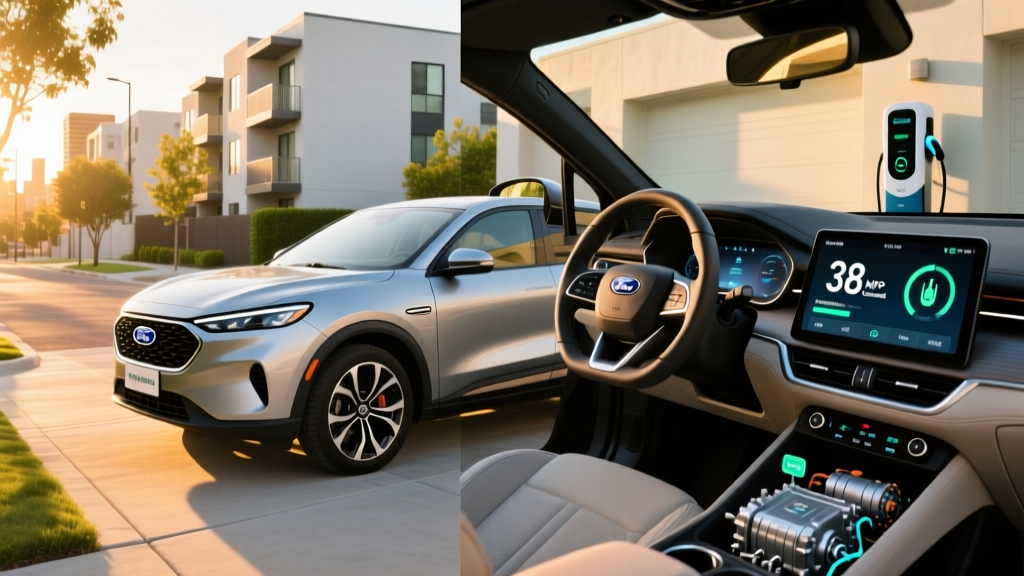
The compact pickup segment has exploded, but only one truck consistently returns over 40 MPG in city driving without ever needing a plug. The 2026 Ford Maverick Hybrid pairs a 2.5-liter Atkinson-cycle four-cylinder with a permanent-magnet electric motor for a combined 194 horsepower and an EPA-estimated 42 MPG city. For buyers who want truck utility without the fuel-pump punishment of a body-on-frame midsize pickup, the Maverick Hybrid remains the efficiency benchmark in its class.
This guide covers every number that matters: EPA and real-world fuel economy, the hybrid powertrain architecture, battery warranty and replacement costs, trim-level pricing, federal tax-credit eligibility, and whether the Maverick Hybrid, a PHEV alternative, or a full EV truck better fits your driveway.
HEV vs PHEV: What the 2026 Maverick Hybrid Actually Is
The 2026 Maverick Hybrid is a conventional hybrid electric vehicle (HEV). It has no plug, no external charging port, and no electric-only driving mode beyond brief low-speed maneuvers. The small traction battery recharges exclusively through regenerative braking and the gasoline engine.
| Feature | HEV (Maverick Hybrid) | PHEV (e.g., Toyota RAV4 Prime) | BEV (e.g., Ford F-150 Lightning) |
|---|---|---|---|
| Plug-in charging | No | Yes (Level 1/2) | Yes (Level 1/2/DC) |
| Electric-only range | ~0.5 mi low-speed | 35-42 mi typical | 230-320+ mi |
| Battery size | ~1.1 kWh (buffer usable) | 14-18 kWh usable | 70-130+ kWh usable |
| Gas engine | Yes — primary power | Yes — backup/extender | None |
| Fueling | Gas station only | Gas + plug-in | Plug-in only |
If you cannot install a home charger or lack reliable public charging, the HEV architecture is an advantage: you simply fuel up and drive. The trade-off is that you cannot run on grid electricity for your daily commute the way a PHEV can.
Fuel Economy: EPA Ratings and Real-World MPG
Ford rates the 2026 Maverick Hybrid at 42 MPG city / 37 MPG highway / 40 MPG combined for front-wheel-drive (FWD) trims. Adding the available all-wheel-drive (AWD) system reduces those figures to approximately 38 city / 35 highway / 37 combined, according to EPA data at fueleconomy.gov.
| Drivetrain | City MPG | Highway MPG | Combined MPG |
|---|---|---|---|
| FWD Hybrid | 42 | 37 | 40 |
| AWD Hybrid | 38 | 35 | 37 |
| FWD 2.0L EcoBoost (gas) | 23 | 30 | 26 |
| AWD 2.0L EcoBoost (gas) | 22 | 29 | 25 |
Real-World MPG: What Owners Actually See
Hybrids systematically outperform their EPA city ratings in stop-and-go traffic because regenerative braking recovers kinetic energy that a gas-only truck would waste as heat. Owners on Fuelly and Ford forums consistently report 43-47 MPG in urban and suburban driving. Highway driving is a different story: at sustained 75-80 MPH, aerodynamic drag dominates and the electric motor contributes less, so expect 33-36 MPG on flat interstate and potentially lower when towing or hauling heavy loads.
Cold weather reduces efficiency by roughly 10-15% due to increased engine runtime for cabin heat and reduced battery charge acceptance. In sub-freezing conditions, plan on 35-37 MPG combined rather than the 40 MPG sticker figure.
Powertrain and Performance Specifications
| Specification | 2026 Maverick Hybrid |
|---|---|
| Engine | 2.5L Atkinson-cycle I-4 |
| Electric motor | Permanent-magnet synchronous, integrated in transaxle |
| Combined output | 194 hp |
| Transmission | eCVT (planetary gearset, no fixed gears) |
| Drivetrain | FWD standard; AWD available |
| 0-60 MPH | ~7.8 sec (FWD est.) |
| Towing capacity | 2,000 lbs (standard); up to 2,000 lbs with AWD |
| Payload capacity | ~1,500 lbs |
| Battery type | Lithium-ion, ~1.1 kWh total capacity |
| Fuel tank | 16.5 gallons |
| Total range | ~660 mi (FWD combined) |
The eCVT is not a belt-and-cone CVT like those in some competitors; it uses a planetary gearset that blends engine and motor torque seamlessly. There are no shift shock points and no rubber-band rev drone under moderate acceleration. However, under hard acceleration or when climbing grades with a load, the engine holds a steady, elevated RPM — the inherent characteristic of an Atkinson-cycle engine on a planetary gearset. It is efficient, not sporty.
If you need more than 2,000 lbs of towing, the Maverick Hybrid is not the right truck. The 2.0L EcoBoost AWD with the 4K Tow Package can handle up to 4,000 lbs, but you will sacrifice roughly 15 MPG combined to get there.
Pricing, Trims, and Tax-Credit Eligibility
The 2026 Maverick Hybrid is available across multiple trims, with the hybrid powertrain typically adding $1,000-$1,500 over the equivalent 2.0L EcoBoost gas model.
| Trim | Approx. MSRP (FWD Hybrid) | Key Features |
|---|---|---|
| XL Hybrid | ~$27,000 | Base work truck, 8" touchscreen, Ford Co-Pilot360 |
| XLT Hybrid | ~$29,500 | Alloy wheels, upgraded interior, optional AWD |
| Lariat Hybrid | ~$33,000 | Leatherette, power seats, ambient lighting |
| Tremor Hybrid (AWD) | ~$38,500 | Off-road suspension, skid plates, 17" wheels |
| Lobo Hybrid | ~$36,000 | Street-performance styling, sport-tuned suspension |
Federal Tax Credit: Does the Maverick Hybrid Qualify?
Short answer: No. The 2026 Ford Maverick Hybrid is a conventional HEV, and the IRS §30D Clean Vehicle Credit applies exclusively to plug-in electric vehicles (BEVs and PHEVs) that meet battery-capacity, critical-mineral sourcing, MSRP cap, and buyer income thresholds.
Because the Maverick Hybrid cannot be plugged in, it does not qualify for the up-to-$7,500 federal tax credit, the point-of-sale transfer, or the up-to-$4,000 used EV credit under §25E. There is currently no federal tax incentive for purchasing a conventional hybrid.
Some states offer rebates or HOV-lane access for hybrids (California's CVRP program has historically included hybrid provisions, though funding varies by year). Check your state energy office or the AFDC state incentive database for current local programs.
Battery Warranty, Lifespan, and Replacement Cost
Ford covers the 2026 Maverick Hybrid's high-voltage battery with an 8-year / 100,000-mile warranty (extended to 10 years / 150,000 miles in states that follow California Air Resources Board (CARB) emissions standards, including CA, NY, MA, WA, OR, and others).
The warranty guarantees the battery will retain sufficient capacity to function as designed. If the battery fails or degrades below Ford's threshold within the warranty period, Ford replaces or refurbishes it at no cost to the owner.
How Long Will the Hybrid Battery Last?
Toyota and Ford hybrid battery packs have demonstrated remarkable longevity in fleet and taxi use. The Maverick Hybrid's lithium-ion pack is small (~1.1 kWh) and operates within a conservative state-of-charge window — it never fully charges or fully depletes, which is the primary enemy of lithium-ion longevity. This shallow-cycling strategy is the same reason Toyota Prius batteries routinely exceed 200,000 miles.
Real-world failure data from the Maverick Hybrid (introduced for the 2022 model year) shows very low incidence of battery replacement. Most hybrid battery failures, when they do occur, involve individual cell or module issues rather than full-pack degradation.
Battery Replacement Cost
Out of warranty, a full Maverick Hybrid battery replacement is estimated at $2,500-$4,500 including parts and labor, based on current Ford hybrid parts pricing and dealership labor rates. This is substantially less than a full EV battery replacement ($8,000-$20,000+) because the hybrid pack is small. Independent hybrid specialists often refurbish packs for $1,500-$2,500 by replacing degraded modules rather than the entire assembly.
Who Should Buy the Maverick Hybrid — and Who Shouldn't
Pros
- 42 MPG city — best-in-class for any pickup
- No plug-in charging required; fuel and go
- 660+ mile total range on one tank
- Low entry price (~$27K base)
- Practical 4.5-ft bed with DIY-friendly design
- Strong reliability record from Ford's hybrid system
Cons
- Only 2,000-lb towing capacity
- No plug-in / no electric-only commuting
- Highway MPG drops to mid-30s at speed
- eCVT drone under hard acceleration or load
- No federal tax credit eligibility
- AWD hybrid availability limited by production
Decision Framework: Maverick Hybrid vs PHEV vs Full EV
Choose the 2026 Maverick Hybrid if: You want a compact truck for daily commuting, light hauling, and weekend projects; you cannot charge at home; you drive predominantly in city and suburban traffic where regenerative braking maximizes fuel savings; and your towing needs stay under 2,000 lbs.
Choose a PHEV (e.g., Hyundai Tucson PHEV, Toyota RAV4 Prime) if: You want 30-40 miles of electric-only range for a short commute, have access to Level 2 home or workplace charging, need an SUV rather than a truck bed, and want eligibility for the §30D federal tax credit (subject to income and sourcing requirements).
Choose a full EV truck (e.g., Ford F-150 Lightning, Rivian R1T) if: You can install a Level 2 home charger, your daily driving is under 250 miles, you want zero tailpipe emissions and minimal maintenance, you need higher towing capacity (7,700-11,000 lbs for the Lightning), and you want to capture the full $7,500 federal tax credit (if eligible under current IRS rules).
Real-World Ownership Costs: Hybrid vs Gas Maverick
At 40 MPG combined versus 25 MPG combined for the EcoBoost AWD, the hybrid saves approximately 6 gallons per 100 miles. At $3.40/gallon (national average as of early 2026), that is roughly $20.40 saved per 100 miles, or about $2,450 over 12,000 annual miles. The hybrid premium of $1,000-$1,500 at purchase pays for itself within 6-9 months of average driving.
Insurance rates for the Maverick Hybrid are comparable to the gas model — the hybrid powertrain does not carry a significant insurance surcharge, unlike some full EVs. Maintenance is also lower: the hybrid system has no additional fluid changes, and regenerative braking extends brake-pad life to 80,000+ miles in typical driving.
Frequently Asked Questions
How many MPG does the 2026 Maverick Hybrid get in real driving?
The EPA rates it at 42 city / 37 highway / 40 combined (FWD). In real-world city and suburban driving, owners commonly report 43-47 MPG thanks to regenerative braking. Highway driving at 75+ MPH drops to 33-36 MPG. Cold weather reduces combined figures by roughly 10-15%.
Can you plug in the Maverick Hybrid to charge?
No. The Maverick Hybrid is a conventional HEV, not a PHEV. It has no charging port. The small lithium-ion battery recharges through regenerative braking and the gasoline engine. You fuel it at a gas station like any other vehicle.
Does the 2026 Maverick Hybrid qualify for a federal tax credit?
No. The IRS §30D Clean Vehicle Credit applies only to plug-in vehicles (BEVs and PHEVs) meeting battery, sourcing, MSRP, and income requirements. The Maverick Hybrid is not a plug-in vehicle and receives no federal tax credit. Check your state for any local hybrid incentives.
How long will the Maverick Hybrid battery last and what does replacement cost?
Ford warranties the hybrid battery for 8 years / 100,000 miles (10 years / 150,000 miles in CARB states). Real-world data from Ford and Toyota hybrid systems suggests these packs routinely last 150,000-200,000+ miles. Out-of-warranty replacement costs approximately $2,500-$4,500 at a dealership, or $1,500-$2,500 through an independent hybrid specialist.
Is the Maverick Hybrid good for towing?
The Maverick Hybrid is rated for 2,000 lbs of towing across all trims. This handles a small utility trailer, a pair of dirt bikes, or a light camper. If you regularly tow over 2,000 lbs, the 2.0L EcoBoost with the 4K Tow Package (4,000 lbs) or a midsize truck like the Ford Ranger is a better choice — but you will sacrifice 15+ MPG.
Is the Maverick Hybrid reliable?
Ford's 2.5L hybrid powertrain shares architecture with the Escape Hybrid and has demonstrated strong reliability since its introduction. The eCVT planetary gearset has no belts or clutches to wear, and the hybrid battery's shallow cycling strategy minimizes degradation. Early Maverick Hybrid models (2022-2024) have shown low rates of powertrain-related complaints on NHTSA and owner forums.