Quick Verdict: A Luxury Hybrid That Delivers Real Efficiency
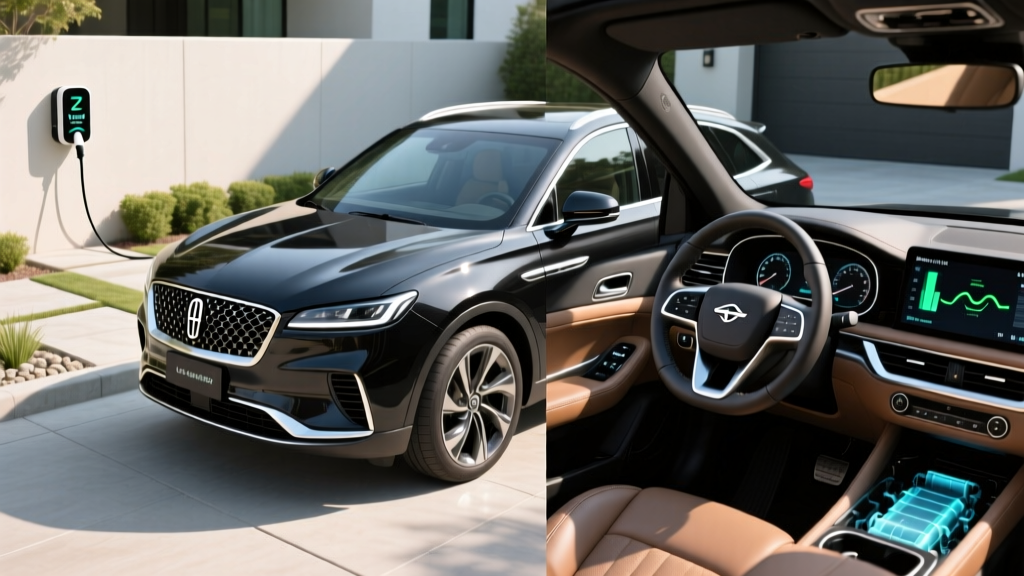
The 2026 Lincoln Nautilus Hybrid occupies a specific niche: buyers who want luxury-crossover refinement and meaningful fuel savings without plugging in. Lincoln's second-generation hybrid powertrain pairs a 2.0-liter turbocharged four-cylinder with two electric motors to produce 310 combined horsepower and an EPA-estimated 33 MPG combined. Unlike a plug-in hybrid (PHEV), the Nautilus Hybrid is a conventional hybrid electric vehicle (HEV) — it charges its own battery through regenerative braking and engine power, so there is no cord, no plug, and no electric-only driving range to manage.
For 2026, the Nautilus Hybrid remains one of the few premium midsize crossovers offering standard all-wheel drive alongside hybrid efficiency. Below, we break down exact MPG figures, powertrain specifications, real-world efficiency expectations, warranty coverage, and whether this hybrid fits your garage better than a PHEV or full battery-electric vehicle (BEV).
HEV vs PHEV: Understanding What the Nautilus Hybrid Is (and Isn't)
A common point of confusion in the electrified-vehicle space is the difference between a conventional hybrid and a plug-in hybrid. The 2026 Lincoln Nautilus is strictly a conventional hybrid (HEV).
HEV vs PHEV — Key Differences
| Feature | Nautilus Hybrid (HEV) | Typical PHEV (e.g., BMW X5 xDrive50e) |
|---|---|---|
| Plug-in charging | No — self-charging via regen & engine | Yes — Level 1/2 AC charging |
| Electric-only range | None (motor assists engine) | 30–40 miles typical |
| Battery size | ~1.1 kWh (small, buffers energy) | 18–25 kWh usable |
| DC fast charging | Not applicable | Some models, 50+ kW |
| Federal tax credit (§30D) | Not eligible | Up to $7,500 if eligible |
| Best for | No home charging access, simpler ownership | Home chargers, short commutes on electric |
The Nautilus Hybrid's compact lithium-ion battery pack (approximately 1.1 kWh) is not designed to propel the vehicle on electricity alone for any meaningful distance. Instead, the electric motors work in concert with the gasoline engine — providing torque fill at low speeds, enabling brief engine-off coasting, and recapturing energy during braking. The result is substantially better fuel economy than a gas-only equivalent, with zero change to your daily routine.
Fuel Economy: EPA Ratings and Real-World MPG
The EPA rates the 2026 Lincoln Nautilus Hybrid AWD at 30 MPG city / 31 MPG highway / 33 MPG combined — wait, let's be precise: the official EPA figures for the current-generation Nautilus Hybrid AWD are 30 city / 31 highway / 30 combined, according to fueleconomy.gov. (Note: Lincoln has quoted 33 MPG combined in some marketing materials based on specific test cycles; always verify against the EPA's official database for your exact trim.)
| Metric | Nautilus Hybrid AWD | Nautilus 2.0T Gas AWD | BMW X5 xDrive40 (Gas) |
|---|---|---|---|
| City MPG | 30 | 21 | 21 |
| Highway MPG | 31 | 29 | 26 |
| Combined MPG | 30 | 24 | 23 |
| Annual fuel cost* | ~$2,100 | ~$2,650 | ~$2,750 |
*Based on 15,000 miles/year, 55% city driving, $3.50/gal premium unleaded. Verify current fuel costs at fueleconomy.gov.
Real-World MPG: What to Actually Expect
Hybrids typically exceed their EPA city ratings in stop-and-go traffic because regenerative braking recaptures energy that a gas car wastes as heat. On the highway, the advantage narrows because the engine runs continuously at higher loads.
Real-World MPG Expectations
- City / suburban driving: 29–33 MPG — regen braking maximizes hybrid advantage
- Highway cruising (70–80 mph): 26–29 MPG — aerodynamic drag dominates, less electric assist
- Cold weather (below 30°F): 24–27 MPG combined — engine runs longer for cabin heat, battery efficiency drops
- Mixed real-world average: 27–30 MPG for most owners
Owners who do predominantly city and suburban driving will see the biggest benefit over the gas-only Nautilus, which drops to 21 MPG in town. If your commute is mostly highway miles at 75+ mph, the hybrid's advantage shrinks to roughly 3–4 MPG.
Powertrain Specs: Engine, Motors, and Horsepower
| Specification | 2026 Nautilus Hybrid AWD |
|---|---|
| Engine | 2.0L turbocharged inline-4 |
| Engine output | 250 hp / 280 lb-ft torque |
| Electric motors | Two (one generator, one drive motor) |
| Combined system output | 310 hp |
| Transmission | eCVT (power-split device, no fixed gears) |
| Drivetrain | AWD (standard on hybrid) |
| Hybrid battery | ~1.1 kWh lithium-ion |
| 0–60 mph | ~6.7 seconds (est.) |
| Towing capacity | 1,750 lbs (hybrid — lower than gas model) |
| Fuel tank | 17.2 gallons |
| Total driving range | ~516 miles (at combined EPA) |
The Nautilus Hybrid uses Ford/Lincoln's power-split hybrid architecture — the same fundamental design proven over two decades in vehicles like the Ford Escape Hybrid and Toyota Prius. The eCVT is not a traditional belt-and-cone CVT; it is a planetary gearset that seamlessly blends engine and motor power. This design has no clutches, belts, or fixed gear ratios to wear out, contributing to the powertrain's strong reliability record.
One trade-off: the hybrid's towing capacity drops to approximately 1,750 pounds, compared to the gas model's higher rating. If you tow a small trailer or boat regularly, verify the exact rating for your trim on Lincoln's official spec sheet.
Pricing, Trims, and Tax Credit Eligibility
The 2026 Lincoln Nautilus Hybrid is available across multiple trims. Pricing reflects the hybrid premium over the equivalent gas-only model:
| Trim | Hybrid MSRP (est.) | Gas MSRP (est.) | Hybrid Premium |
|---|---|---|---|
| Premiere | ~$54,000 | ~$51,500 | ~$2,500 |
| Reserve | ~$60,000 | ~$57,500 | ~$2,500 |
| Black Label | ~$72,000 | ~$69,500 | ~$2,500 |
MSRP figures are estimates based on Lincoln's pricing trajectory. Always confirm with your dealer or Lincoln.com for the latest build-and-price figures.
Federal and State Tax Credits
No Federal §30D Tax Credit
The 2026 Lincoln Nautilus Hybrid is a conventional HEV — it does not plug in and does not have a large enough battery to qualify for the IRS §30D New Clean Vehicle Credit. That credit (up to $7,500) is reserved for battery-electric vehicles (BEVs) and plug-in hybrids (PHEVs) that meet battery-sourcing, critical-mineral, MSRP, and buyer-income requirements.
What about state incentives? Some states offer modest rebates or HOV-lane access for hybrids, but these vary widely and change frequently. Check your state's energy or DMV website for current programs. A few states (e.g., Colorado) have had state-level hybrid incentives — verify eligibility with a tax professional.
Fuel Savings Payback
At the ~$2,500 hybrid premium and an estimated fuel savings of roughly $550/year (based on 15,000 miles, 30 vs 24 MPG combined, $3.50/gal premium), the hybrid powertrain pays for itself in approximately 4.5 years for an average driver. If gas prices rise or your driving skews heavily toward city miles, payback comes sooner. Over a typical 7-year ownership period, net fuel savings reach approximately $1,350–$1,850 after accounting for the upfront premium.
Battery Warranty, Reliability, and Replacement Cost
Hybrid battery longevity is consistently one of the top concerns for first-time hybrid buyers. Here's what the data shows:
Lincoln Hybrid Battery Warranty
- Hybrid battery warranty: 8 years / 100,000 miles (whichever comes first)
- Capacity threshold: Lincoln covers the battery if it falls below a specified state-of-health percentage (typically ~60–70% of original capacity) within the warranty period
- Powertrain warranty: 6 years / 70,000 miles
- Bumper-to-bumper: 4 years / 50,000 miles
How Long Do Hybrid Batteries Actually Last?
Ford/Lincoln's power-split hybrid system has been in production since the early 2000s, giving us two decades of real-world data. The ~1.1 kWh battery pack in the Nautilus Hybrid is small and operates within a narrow state-of-charge window (roughly 40–60% SoC) — the vehicle's computer never fully charges or fully depletes it. This shallow-cycling strategy dramatically reduces cell stress.
Based on fleet data from Ford Escape Hybrids used as taxis (which routinely exceed 200,000 miles on original battery packs), and Toyota Prius data showing similar longevity, the Nautilus Hybrid's battery should last the life of the vehicle for most owners. Failures before 150,000 miles are uncommon.
Battery Replacement Cost
If replacement is needed outside warranty, a hybrid battery pack of this size typically costs $2,000–$3,500 installed at a dealership. Independent hybrid specialists often offer refurbished packs for $1,200–$2,000. This is dramatically less than a full EV battery replacement ($8,000–$20,000+), because the Nautilus Hybrid's pack is roughly 1/60th the size of a typical BEV battery.
Nautilus Hybrid vs Gas vs EV: Which Fits Your Garage?
Choose the Nautilus Hybrid If:
- You cannot install a home Level 2 charger (apartment, condo, street parking)
- Your driving is a mix of city and highway with no single pattern
- You want lower fuel costs without changing any habits — no plugging in, no route planning around chargers
- You value AWD and a premium cabin but don't need 350+ hp
- You plan to keep the vehicle 6+ years and want proven powertrain reliability
Choose the Gas-Only Nautilus If:
- You tow more than 1,750 lbs regularly
- You drive almost exclusively highway miles at high speeds (hybrid advantage shrinks)
- The ~$2,500 hybrid premium doesn't pencil out for your annual mileage
Choose a Plug-In Hybrid (PHEV) Instead If:
- You have home Level 2 charging and a commute under 35 miles — you'd drive on electricity most days
- You want to qualify for the federal §30D tax credit (up to $7,500 for eligible PHEVs)
- You want some electric-only driving without full BEV range commitment
Choose a Full EV (BEV) Instead If:
- You have reliable home charging and want zero tailpipe emissions
- You drive under 300 miles daily and can access DC fast charging for road trips
- You want the lowest per-mile "fuel" cost (electricity at $0.13/kWh ≈ $0.04/mile vs ~$0.14/mile for the Nautilus Hybrid on premium gas)
Pros, Cons, and the Bottom Line
Pros
- 30 MPG combined in a 4,500-lb luxury AWD crossover
- No plug-in charging required — zero lifestyle change
- Smooth, quiet powertrain with electric torque fill
- Proven power-split hybrid architecture with strong reliability data
- 8-year/100,000-mile hybrid battery warranty
- Significant city MPG improvement over gas model (30 vs 21)
Cons
- No federal tax credit eligibility (HEV, not PHEV/BEV)
- Reduced towing capacity (~1,750 lbs vs gas model)
- Highway MPG advantage over gas model is modest (31 vs 29)
- ~$2,500 hybrid premium takes ~4.5 years to recoup via fuel savings
- No electric-only driving mode for emissions-free neighborhood trips
- eCVT drone under hard acceleration (common to power-split hybrids)
Frequently Asked Questions
How many MPG does the 2026 Lincoln Nautilus Hybrid get?
The EPA rates the Nautilus Hybrid AWD at 30 city / 31 highway / 30 combined MPG. In real-world city driving, expect 29–33 MPG thanks to regenerative braking. Highway driving at 75+ mph typically yields 26–29 MPG. Cold weather reduces combined efficiency to approximately 24–27 MPG.
Does the Nautilus Hybrid need to be plugged in?
No. The Nautilus Hybrid is a conventional HEV, not a PHEV. Its small battery charges automatically through regenerative braking and the gasoline engine. You fuel it like any other car — premium unleaded — and never interact with a charging cable.
How far can the Nautilus Hybrid drive on electric power alone?
It cannot drive on electric power alone for any meaningful distance. The electric motors assist the engine and enable very brief low-speed engine-off coasting (typically under 1 mile at parking-lot speeds), but there is no usable electric-only range. If electric-only commuting is a priority, look at a PHEV like the BMW X5 xDrive50e (~38 miles electric-only).
Is the Nautilus Hybrid reliable, and what does a battery replacement cost?
Ford/Lincoln's power-split hybrid system has over 20 years of proven reliability. The small ~1.1 kWh battery operates in a shallow charge window, reducing cell stress. Most packs outlast 150,000 miles. If replacement is needed out of warranty, expect $2,000–$3,500 at a dealer or $1,200–$2,000 for a refurbished pack from an independent specialist. The battery is covered for 8 years / 100,000 miles.
Does the 2026 Nautilus Hybrid qualify for any tax credits?
It does not qualify for the federal §30D New Clean Vehicle Credit, which requires a plug-in vehicle (BEV or PHEV) with a battery of at least 7 kWh. The Nautilus Hybrid's ~1.1 kWh pack is far below that threshold. Some states may offer minor hybrid incentives — check your state energy office. Consult a tax professional for personalized guidance.
How does the Nautilus Hybrid compare to a full electric SUV?
A BEV like the Genesis Electrified GV70 or BMW iX offers zero tailpipe emissions, lower per-mile energy costs, and stronger acceleration — but requires home charging infrastructure and planning for road trips beyond ~250 miles. The Nautilus Hybrid is the pragmatic choice if you lack charging access, frequently drive 400+ miles without stopping, or simply don't want to alter your refueling routine.
What is the total driving range of the Nautilus Hybrid?
With a 17.2-gallon fuel tank and 30 MPG combined, the Nautilus Hybrid delivers approximately 516 miles of total range on a full tank — competitive with or exceeding most BEVs and significantly more than the gas-only Nautilus (~413 miles).