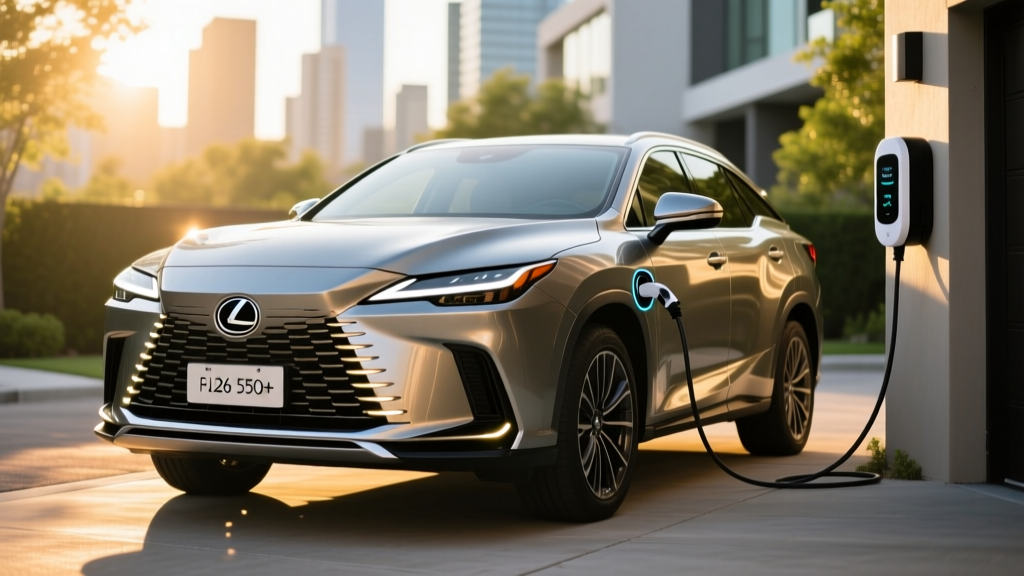
The 2026 Lexus TX 550h+ occupies a narrow but compelling niche: a three-row luxury SUV that can handle daily school runs on electricity alone, then switch to hybrid mode for weekend road trips without a single charging stop. For families who aren't ready to commit to a full battery-electric vehicle but want meaningful electric driving, this plug-in hybrid (PHEV) deserves serious scrutiny. Below, we break down every spec that matters — from real-world electric range and EPA fuel economy to battery warranty and federal tax credit eligibility — so you can decide whether the TX 550h+ fits your garage.
Quick Verdict: Who the TX 550h+ Is For
The TX 550h+ is built for households with predictable daily driving under 30 miles, access to Level 2 home charging, and a need for three-row luxury. If your commute is 15 miles each way and you can plug in overnight, you'll burn almost no gasoline on weekdays. If you regularly drive 60+ miles daily without charging access, a conventional hybrid like the TX 500h will serve you better at lower cost. And if you have reliable charging and want zero tailpipe emissions, a full EV such as the Rivian R1S or Tesla Model X eliminates fuel entirely — though at the cost of range planning on long trips.
Choose the TX 550h+ if: You want 30+ miles of electric commuting, three rows, and road-trip flexibility without charging stops.
Choose the TX 500h (HEV) if: You can't charge at home and want strong fuel economy with no plug-in routine.
Choose a full EV if: You have home charging, drive under 300 miles between stops, and want zero tailpipe emissions.
HEV vs PHEV: What's the Difference in the TX Lineup?
Lexus offers the TX in two electrified flavors, and confusing them is easy at the dealership. Here's the critical distinction:
| Feature | TX 500h (HEV) | TX 550h+ (PHEV) |
|---|---|---|
| Plug-in charging | No — self-charging via engine and regenerative braking | Yes — plug in to charge the larger battery |
| Battery capacity | ~1.8 kWh (small buffer) | 20.5 kWh usable (18.1 kWh net) |
| Electric-only driving | Very short distances at low speed | EPA-estimated 33 miles |
| Combined horsepower | 366 HP | 406 HP |
| Federal tax credit | Not eligible | Eligible — up to $7,500 (see rules below) |
| Starting MSRP | ~$63,000 | ~$73,000 |
The conventional TX 500h hybrid never needs a plug. Its small battery recharges through regenerative braking and the engine. The TX 550h+ PHEV has a much larger battery that you charge by plugging in — ideally at home with a Level 2 charger — enabling genuine electric-only commuting. Once the battery depletes, it operates as a conventional hybrid.
Powertrain Specs: 406 HP and Standard AWD
| Specification | 2026 Lexus TX 550h+ |
|---|---|
| Engine | 3.5L V6 naturally aspirated |
| Electric motors | Front + rear (eAxle AWD) |
| Combined system output | 406 HP |
| Transmission | eCVT (planetary gearset) |
| Drivetrain | Electronic AWD standard |
| 0–60 mph | ~5.9 seconds |
| Towing capacity | 5,000 lbs |
| Battery (gross / usable) | 20.5 kWh / 18.1 kWh (lithium-ion NMC) |
| EPA electric-only range | 33 miles |
| Total combined range | ~440 miles (electric + gas) |
| Max AC charge rate | 6.6 kW (Level 2) |
| DC fast charging | Not available |
| Charge time (Level 2, 0–100%) | ~3 hours |
| Charge time (Level 1, 120V) | ~11 hours |
The TX 550h+ pairs a 3.5-liter V6 with front and rear electric motors for a combined 406 horsepower. Unlike turbocharged PHEV rivals, the naturally aspirated V6 prioritizes smoothness and reliability over peak torque. The eCVT delivers seamless acceleration without the shift hunting you feel in conventional automatics. Electronic all-wheel drive is standard, with the rear motor providing torque independently — no mechanical driveshaft.
Fuel Economy and Electric Range: EPA vs Real World
| Driving Mode | City | Highway | Combined |
|---|---|---|---|
| Charge-depleting (electric + hybrid) | 64 MPGe combined | ||
| Charge-sustaining (hybrid only, battery depleted) | 27 MPG | 28 MPG | 27 MPG |
EPA electric range: 33 miles. In real-world testing, expect 28–31 miles in mild weather with mixed driving. Highway speeds above 65 mph and cold temperatures below 40°F can reduce electric range to 22–25 miles. Cabin heating in winter draws heavily from the battery.
Once the battery is depleted, the TX 550h+ operates as a conventional hybrid returning approximately 27 MPG combined. That's competitive for a 5,000-lb three-row SUV but lower than the smaller Lexus RX 500h. In city driving where regenerative braking recaptures energy, real-world hybrid-mode MPG can climb to 28–29. On sustained highway trips at 75+ mph, expect 25–26 MPG.
The 64 MPGe figure applies only when you start with a full battery and drive within the electric range. MPGe (miles per gallon equivalent) converts electricity consumption to a gasoline-equivalent number for comparison. Once you exceed 33 miles, the 27 MPG hybrid figure is what matters.
Charging the TX 550h+: What You Need at Home
The TX 550h+ charges exclusively via AC — there is no DC fast charging capability, which is typical for PHEVs in this class. Here's what charging looks like in practice:
| Charging Level | Power | 0–100% Time | Setup |
|---|---|---|---|
| Level 1 (120V household outlet) | ~1.4 kW | ~11 hours | No installation needed |
| Level 2 (240V, 32A circuit) | 6.6 kW (vehicle max) | ~3 hours | Requires 40A circuit, NEMA 14-50 or hardwired |
A standard 120V outlet will fully recharge the battery overnight — barely. If you plug in at 8 PM with a depleted battery, you'll have a full charge by 7 AM. However, a Level 2 home charger is strongly recommended. At 6.6 kW, the TX 550h+ charges to full in roughly three hours, meaning you can top up during evening hours or take advantage of time-of-use electricity rates.
Level 2 installation typically costs $800–$2,000 depending on your electrical panel capacity and the distance from the panel to your garage or driveway. If your home has a 200-amp panel with spare capacity, expect the lower end. A panel upgrade to 200A or 400A adds $1,500–$4,000. Always get a quote from a licensed electrician before purchasing the vehicle.
The TX 550h+ uses a J1772 connector for AC charging, the universal standard for non-Tesla PHEVs and EVs in North America. If you own a Tesla Wall Connector, you'll need an adapter or a separate J1772 charger.
Pricing, Trims, and Federal Tax Credit Eligibility
The 2026 Lexus TX 550h+ is offered in two trims:
- TX 550h+ Luxury: ~$73,000 MSRP (destination included)
- TX 550h+ Executive: ~$78,000 MSRP
Both trims come well-equipped with Lexus Safety System+ 3.0, a 14-inch touchscreen, wireless Apple CarPlay and Android Auto, heated and ventilated front seats, and a panoramic moonroof. The Executive adds semi-aniline leather, a Mark Levinson audio system, and rear sunshades.
Does the TX 550h+ Qualify for the Federal Tax Credit?
The TX 550h+ may qualify for up to $7,500 under IRS §30D, but eligibility depends on several factors that change periodically:
- MSRP cap: SUVs must have an MSRP under $80,000 — both TX 550h+ trims qualify.
- Buyer income cap: Modified AGI must not exceed $150,000 (single), $225,000 (head of household), or $300,000 (joint filers).
- Battery sourcing: Critical minerals and battery components must meet phased-in domestic/content requirements per the Inflation Reduction Act. These thresholds tighten annually. Verify current-year compliance on IRS.gov or fueleconomy.gov before purchasing.
- Point-of-sale transfer: As of 2024, you can transfer the credit to the dealer at purchase, reducing your out-of-pocket cost immediately rather than waiting for tax filing.
Consult a tax professional to confirm your personal eligibility. Credit rules are subject to change, and manufacturer sales caps or sourcing disqualifications can remove eligibility with little notice.
Some states offer additional PHEV rebates — California's CVRP program, Colorado's state credit, and various utility company incentives may stack with the federal credit. Check your state's energy office or utility provider for current programs.
Battery Warranty, Reliability, and Replacement Cost
Hybrid battery warranty: 10 years / 150,000 miles (whichever comes first) in all 50 states, covering defects and capacity loss below a defined threshold.
Powertrain warranty: 6 years / 70,000 miles.
Basic vehicle warranty: 4 years / 50,000 miles.
Lexus (and parent company Toyota) has the deepest track record in hybrid technology of any automaker, with over 25 years of hybrid production since the 1997 Prius. The TX 550h+ uses an NMC (nickel manganese cobalt) lithium-ion pack, which offers higher energy density than the NiMH batteries in older Toyota hybrids. Lexus's thermal management system keeps the battery within optimal temperature ranges, which is the single biggest factor in long-term longevity.
Based on data from Toyota/Lexus PHEVs and hybrids in the field, expect battery degradation of roughly 8–12% over the first 100,000 miles — meaning the 33-mile electric range might drop to 29–30 miles after several years. This is well within the warranty threshold.
If the hybrid battery requires replacement outside of warranty, expect a cost of $4,000–$7,000 including parts and labor at a Lexus dealer. Third-party hybrid battery specialists can sometimes perform the replacement for $2,500–$4,500. However, given Lexus's reliability history and the 10-year/150,000-mile warranty, out-of-pocket battery replacement during typical ownership is uncommon.
For overall vehicle reliability, Lexus consistently ranks at or near the top in J.D. Power Vehicle Dependability Studies and Consumer Reports reliability surveys. The TX shares its platform with the Toyota Grand Highlander, which has shown strong early reliability in its first model years.
Ownership Costs: 5-Year Outlook
Here's a realistic 5-year / 60,000-mile ownership estimate for the TX 550h+ compared to the gas-only TX 350 and the conventional hybrid TX 500h:
| Cost Category | TX 350 (Gas) | TX 500h (HEV) | TX 550h+ (PHEV) |
|---|---|---|---|
| Purchase price (base MSRP) | ~$56,000 | ~$63,000 | ~$73,000 |
| Federal tax credit | $0 | $0 | Up to $7,500* |
| Effective purchase price | $56,000 | $63,000 | ~$65,500 |
| Fuel/electricity (60k mi) | ~$10,800 | ~$7,500 | ~$5,200** |
| Maintenance (5 yr) | ~$3,500 | ~$3,000 | ~$3,000 |
| Insurance (5 yr avg) | ~$11,000 | ~$11,500 | ~$12,000 |
| Estimated 5-yr total | ~$81,300 | ~$85,000 | ~$85,700 |
*Assumes full §30D credit eligibility. **Assumes 70% of driving within electric range with home charging at $0.14/kWh and 30% in hybrid mode. Your costs will vary based on electricity rates, driving patterns, and gas prices.
The TX 550h+ narrows the cost gap with the gas model significantly when the federal tax credit applies, and fuel savings compound over time. However, if you cannot charge at home, the PHEV premium over the TX 500h becomes difficult to justify — you'd be carrying extra battery weight without using its electric capability.
Pros and Cons
Pros
- 33 miles of electric range covers most daily commutes
- 406 HP provides confident merging and passing
- Three-row seating with 5,000-lb towing
- Standard AWD with no mechanical complexity
- Lexus reliability and 10-year hybrid battery warranty
- Eligible for up to $7,500 federal tax credit
- No range anxiety — gas engine for long trips
Cons
- $73,000+ starting price is steep for the segment
- No DC fast charging — Level 2 only
- Electric range drops to ~22–25 mi in cold weather
- 27 MPG hybrid mode is average, not class-leading
- Third row is tight for adults on long trips
- J1772 connector may require adapter for Tesla charger owners
- Tax credit eligibility depends on sourcing rules that change yearly
Frequently Asked Questions
How many MPG does the 2026 Lexus TX 550h+ get?
Once the battery is depleted, the TX 550h+ returns an EPA-estimated 27 MPG combined (27 city / 28 highway). When starting with a full charge and driving within the 33-mile electric range, it achieves 64 MPGe. Real-world hybrid-mode MPG tends to be slightly better in city driving (28–29 MPG) and slightly lower on the highway at high speeds (25–26 MPG).
How far can the TX 550h+ go on electric only?
The EPA rates the TX 550h+ at 33 miles of electric-only range. In real-world conditions with mild temperatures and mixed driving, expect 28–31 miles. At sustained highway speeds or in cold weather below 40°F, that drops to 22–25 miles. The total combined range (electric + gas tank) is approximately 440 miles.
Hybrid vs PHEV vs EV — which should I choose?
Choose a conventional hybrid (HEV) like the TX 500h if you cannot charge at home — it requires no plug and still delivers strong fuel economy. Choose a plug-in hybrid (PHEV) like the TX 550h+ if you have home charging and want electric commuting with gas-engine backup for road trips. Choose a full EV if you have reliable charging, drive under 300 miles between stops, and want the lowest operating costs and zero tailpipe emissions. The PHEV is the bridge option for households not yet ready to go fully electric.
Is the TX 550h+ reliable, and what does a battery replacement cost?
Lexus ranks among the most reliable luxury brands in long-term dependability studies by J.D. Power and Consumer Reports. The hybrid battery is covered by a 10-year/150,000-mile warranty. If replacement is needed out of warranty, expect $4,000–$7,000 at a dealer or $2,500–$4,500 at a hybrid specialist. Based on Toyota/Lexus hybrid history, battery failure within the warranty period is rare.
Does the 2026 TX 550h+ qualify for the $7,500 federal tax credit?
It may qualify for up to $7,500 under IRS §30D, but eligibility depends on your income (under $300,000 for joint filers), the vehicle's MSRP (under $80,000 for SUVs — both trims qualify), and battery component/critical mineral sourcing requirements that tighten each year. The credit can be transferred to the dealer at point of sale. Always verify current eligibility at IRS.gov and consult a tax professional before purchasing.
Can the TX 550h+ DC fast charge?
No. The TX 550h+ accepts only AC charging at a maximum rate of 6.6 kW (Level 2). A full charge takes approximately 3 hours on a Level 2 home charger or about 11 hours on a standard 120V outlet. This is typical for PHEVs — the smaller battery makes DC fast charging unnecessary for most owners since overnight Level 2 charging is sufficient.
What happens if I never plug in the TX 550h+?
The vehicle operates as a conventional hybrid, returning approximately 27 MPG combined. You won't damage anything, but you'll forgo the electric range benefit and the fuel savings that justify the PHEV price premium. If you can't charge regularly, the TX 500h HEV is a more cost-effective choice.
Sources: EPA fuel economy data via fueleconomy.gov, Lexus USA specifications, IRS §30D clean vehicle credit guidelines at irs.gov. Specifications and pricing reflect 2026 model year information available at time of publication. Always verify current pricing and tax credit eligibility with your dealer and tax advisor.