Quick Verdict: A Proven Hybrid With Luxury and Efficiency
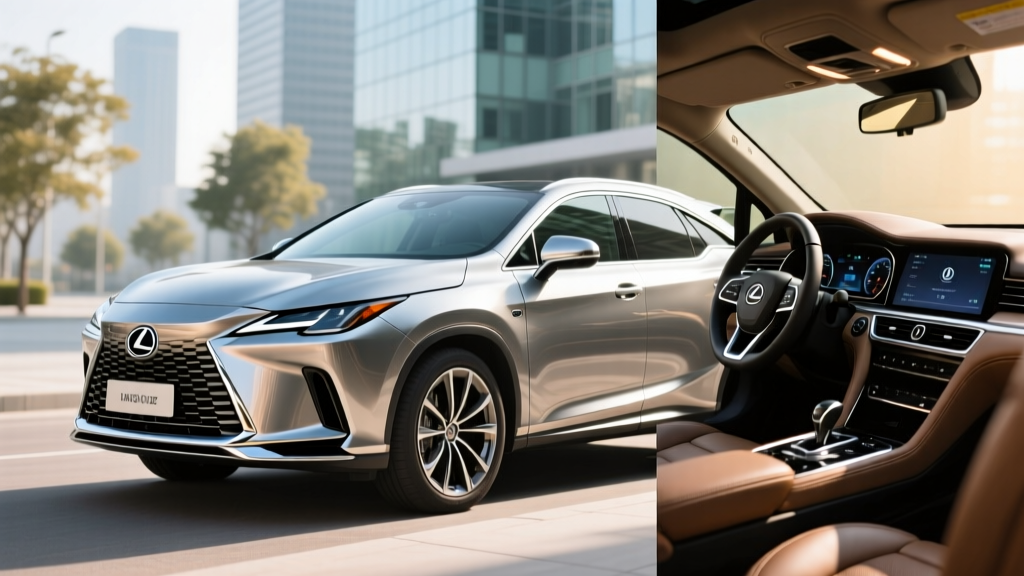
The 2026 Lexus RX 350h Premium Plus occupies a specific niche in the luxury midsize SUV segment: it delivers meaningful fuel savings without requiring a plug, a behavioral change, or a garage electrical upgrade. Under the hood sits a 2.5-liter inline-four paired with two electric motors for a combined 306 horsepower and standard all-wheel drive. The EPA rates it at 36 MPG combined — a number that, based on real-world driving patterns, many owners will actually exceed in city traffic.
This trim sits in the middle of the RX 350h lineup, adding features like a panoramic moonroof, heated and ventilated front seats, and a 14-inch touchscreen over the base Premium trim. For buyers who want luxury SUV comfort without range anxiety, charging logistics, or the higher sticker price of the plug-in RX 500h+, the RX 350h Premium Plus makes a compelling case.
| Spec | Value |
|---|---|
| Powertrain | 2.5L I4 + 2 electric motors (AWD) |
| Combined Horsepower | 306 hp |
| EPA MPG (City / Hwy / Combined) | 37 / 34 / 36 |
| Hybrid Battery | ~1.6 kWh NiMH (self-charging HEV) |
| Plug-In Required? | No — regenerative braking & engine charge the battery |
| 0-60 mph | 7.4 seconds (est.) |
| Towing Capacity | 3,500 lbs |
| Cargo Volume (behind 2nd row) | 29.6 cu ft |
| Base MSRP (Premium Plus) | ~$56,000 |
| Federal Tax Credit (§30D) | Not eligible (HEV, not PHEV/BEV) |
| Hybrid Battery Warranty | 10 years / 150,000 miles |
HEV vs PHEV vs EV: Which Powertrain Fits You?
The Lexus RX lineup now spans three electrification levels, and choosing among them hinges on your daily driving pattern, home charging access, and budget. Here's how they break down:
| Attribute | RX 350h (HEV) | RX 500h+ (PHEV) | Full EV Alternative (e.g., Tesla Model X) |
|---|---|---|---|
| Plug-In Required? | No | Yes (Level 2 recommended) | Yes (Level 2 or DC fast) |
| EPA Combined MPG / MPGe | 36 MPG | ~65 MPGe combined | ~100 MPGe |
| Electric-Only Range | N/A (motor assists engine) | ~37 miles | 300+ miles |
| Total Range | ~570 miles | ~420 miles | 300–350 miles |
| Starting MSRP | ~$52,000 | ~$63,000 | ~$80,000+ |
| Federal Tax Credit | None | Up to $7,500 (eligibility varies) | Up to $7,500 (eligibility varies) |
| Best For | No garage charger, long commutes, simplicity | Home charger + short daily commute | Full electric lifestyle, home charging |
The RX 350h (HEV) is a conventional hybrid. It never plugs in. The small nickel-metal hydride battery charges through regenerative braking and the gasoline engine. The electric motors assist during acceleration and enable brief low-speed electric-only movement, but the engine is always the primary power source. Think of it as a gas car that's simply much more efficient.
The RX 500h+ (PHEV) has a larger lithium-ion battery (~18.1 kWh) that you plug in to charge. It can drive roughly 37 miles on electricity alone before the engine kicks in. If your daily round-trip commute is under 35 miles and you charge at home nightly, you may go weeks without burning gas. But if you don't plug it in regularly, you're just hauling a heavy battery around at lower efficiency than the HEV.
A full EV eliminates gasoline entirely but demands reliable charging access — ideally a home Level 2 charger — and a willingness to plan around charging on road trips.
Fuel Economy: EPA Ratings and Real-World MPG
| Driving Condition | EPA Rating | Real-World Expectation |
|---|---|---|
| City | 37 MPG | 38–42 MPG (hybrids excel in stop-and-go) |
| Highway | 34 MPG | 30–33 MPG (aerodynamic drag, sustained speeds) |
| Combined | 36 MPG | 34–38 MPG (varies by driving mix) |
Lexus hybrids have a well-documented real-world advantage: city MPG often exceeds the EPA estimate. The electric motors handle low-speed acceleration — the least efficient phase for a gas engine — while regenerative braking recaptures energy at every stoplight. Owners who drive predominantly in urban and suburban conditions regularly report 38 to 42 MPG on the RX 350h, per aggregated owner data on fueleconomy.gov.
Highway driving tells a different story. At sustained 70–80 mph speeds, the gasoline engine does most of the work, and the hybrid system's advantage narrows. Expect 30–33 MPG on long interstate trips. Cold weather further reduces efficiency by 5–10% as the engine runs longer to warm the cabin and the battery's chemical reactions slow.
For comparison, the non-hybrid 2026 RX 350 (turbocharged gas-only) achieves an EPA-rated 25 MPG combined. That 11 MPG gap translates to roughly $400–$600 in annual fuel savings at 12,000 miles per year and $3.50/gallon, depending on your driving mix.
Powertrain Deep Dive: 306 Horsepower, Seamlessly Delivered
The RX 350h pairs a 2.5-liter Atkinson-cycle inline-four engine with two permanent-magnet electric motors — one on the front axle, one on the rear — delivering electronic all-wheel drive without a mechanical driveshaft. Combined output is 306 horsepower, a meaningful step up from the prior-generation RX 450h.
The Atkinson-cycle engine sacrifices some low-end torque for thermal efficiency, but the electric motors fill that gap instantly, providing smooth acceleration from a stop. The electronically controlled continuously variable transmission (eCVT) avoids the shift-shock of conventional automatics, though it can produce a droning engine note under hard acceleration — a common hybrid characteristic, not a defect.
The AWD system (Lexus calls it E-Four) engages the rear motor only when traction demands it, reducing parasitic losses during cruising. This is a part-time AWD system, not a performance-oriented torque-vectoring setup. It handles rain, light snow, and gravel confidently, but it won't satisfy buyers seeking aggressive cornering dynamics.
Premium Plus Trim: What You Get for ~$56,000
The Premium Plus trim sits above the base Premium and below the Luxury grade. Key additions at this level include:
- 14-inch touchscreen with wireless Apple CarPlay and Android Auto
- Panoramic glass moonroof
- Heated and ventilated front seats with leather upholstery
- Heated steering wheel
- Power-folding rear seats
- Lexus Safety System+ 3.0 (adaptive cruise, lane tracing, pre-collision, blind-spot monitor)
- 21-inch alloy wheels
The MSRP for the 2026 RX 350h Premium Plus starts around $56,000, with destination charges adding roughly $1,350. Options like the Technology Package (head-up display, panoramic camera) or the Mark Levinson audio system can push the as-tested price past $62,000.
Tax Credits and Incentives: What Applies to the RX 350h?
Because the RX 350h is a conventional hybrid (HEV) — not a plug-in hybrid or battery-electric vehicle — it does not qualify for the federal §30D Clean Vehicle Credit. That credit, worth up to $7,500, is reserved for PHEVs and BEVs that meet battery-sourcing, MSRP, and buyer-income requirements outlined by the IRS.
However, some states offer incentives for conventional hybrids, though these are increasingly rare as policy shifts toward plug-in vehicles. A few considerations:
- State hybrid rebates: Check your state energy office — a handful of states still offer $500–$1,500 rebates for HEVs.
- Insurance discounts: Some insurers offer 5–10% green-vehicle discounts on hybrids.
- HOV lane access: Most states have phased out HOV stickers for non-plug-in hybrids, but verify local rules.
- Employer benefits: Some companies offer preferred parking or fuel subsidies for hybrid commuters.
If the federal tax credit is a priority for you, the RX 500h+ (PHEV) may qualify for up to $7,500 depending on your income (AGI caps: $300K joint, $225K head of household, $150K single), the vehicle's MSRP (SUV cap: $80,000), and battery mineral sourcing compliance. Consult a tax professional for your specific situation.
Battery Longevity, Warranty, and Replacement Costs
Lexus Hybrid Battery Warranty
Coverage: 10 years or 150,000 miles (whichever comes first), transferable to subsequent owners.
What's covered: Defects and capacity loss below a specified threshold (typically 60–70% of original capacity).
Out-of-warranty replacement cost: Approximately $3,000–$5,000 for the hybrid battery pack, including labor, based on current Lexus dealer pricing. Third-party refurbished options may reduce this to $1,500–$2,500.
Hybrid battery longevity is one of the most common buyer concerns — and one where real-world data is reassuring. Toyota and Lexus hybrid systems have been in production since 1997 (Prius), and the NiMH and lithium-ion packs used in the RX lineage have demonstrated strong durability. Many RX 400h and RX 450h examples from the 2006–2015 era are still on their original batteries at 150,000+ miles.
The RX 350h's ~1.6 kWh battery is small and operates within a conservative state-of-charge window (roughly 40–80%), which dramatically reduces degradation stress. Unlike a full EV battery that cycles through deep charge/discharge daily, the hybrid battery experiences shallow, frequent cycles — the least stressful usage pattern for battery chemistry.
The 10-year/150,000-mile warranty provides substantial coverage. According to Lexus specifications, the hybrid system components — including the inverter, electric motors, and battery control module — are covered under this warranty. For context, the average American drives ~13,500 miles per year, meaning the warranty covers roughly 11 years of typical use.
If replacement is needed outside warranty, the cost is significantly lower than a full EV battery replacement ($10,000–$20,000+). The RX 350h's small battery pack runs $3,000–$5,000 at a dealer, and independent hybrid specialists can often perform the swap for less.
Reliability, Safety, and Ownership Costs
Lexus consistently ranks at or near the top of J.D. Power and Consumer Reports reliability surveys, and the RX is the brand's best-selling model globally. The hybrid powertrain adds complexity in theory but has proven simpler in practice — there's no traditional starter motor, no alternator, and the eCVT has no clutch packs or bands to wear out. Brake pad life often extends past 80,000 miles thanks to regenerative braking handling most deceleration.
Safety ratings for the RX are strong. The NHTSA and IIHS have historically awarded the RX top marks, and the Lexus Safety System+ 3.0 suite includes pre-collision with pedestrian detection, lane departure alert with steering assist, dynamic radar cruise control, and road sign assist. Note that this is an SAE Level 2 driver-assistance system — it requires the driver to remain fully engaged at all times and is not a self-driving system.
Five-year total cost of ownership advantages over the gas-only RX 350 include:
- Fuel savings: ~$2,500–$3,500 over 5 years at 12,000 miles/year
- Brake savings: ~$400–$800 (longer pad life from regen)
- Depreciation: Lexus RX hybrids historically hold value well, often depreciating 2–5% less than gas counterparts over 5 years
- Insurance: Comparable to the gas RX 350 — no significant hybrid surcharge
Who Should Buy the RX 350h Premium Plus?
Pros
- 36 MPG combined, often exceeded in city driving
- No plug-in charging required — zero lifestyle change
- 306 hp with smooth, linear acceleration
- 10-year/150,000-mile hybrid battery warranty
- Strong resale value and proven reliability
- Standard AWD for all-weather confidence
Cons
- No federal tax credit eligibility
- Highway MPG drops to ~30–33 at sustained speeds
- eCVT drone under hard acceleration
- Premium Plus pricing near $56K before options
- No electric-only driving range to speak of
- Rear cargo slightly reduced vs. gas RX (~1 cu ft)
Choose the RX 350h Premium Plus If:
- You don't have access to home or workplace charging
- Your commute is mixed city/highway and you want 35+ MPG without thinking about it
- You value Lexus reliability and strong resale value
- You want AWD capability without the fuel penalty of a conventional AWD SUV
- You plan to keep the vehicle 8+ years and want warranty peace of mind
Look at a PHEV or EV Instead If:
- You have a garage and can install a Level 2 charger (consider the RX 500h+ for 37 mi electric range)
- Your daily commute is under 30 miles round-trip (a PHEV can eliminate daily gas use)
- You want to qualify for the federal tax credit (up to $7,500 for eligible PHEVs/BEVs)
- You're ready to go fully electric and want zero tailpipe emissions
Frequently Asked Questions
How many MPG does the 2026 Lexus RX 350h get?
The EPA rates the RX 350h at 37 MPG city, 34 MPG highway, and 36 MPG combined. In real-world city driving, many owners report 38–42 MPG thanks to the hybrid system's stop-and-go efficiency. Highway driving at 70+ mph typically yields 30–33 MPG.
Does the RX 350h need to be plugged in?
No. The RX 350h is a conventional hybrid (HEV). Its small battery charges through regenerative braking and the gasoline engine. You fuel it like any other car — just less often.
How far can the RX 350h drive on electric power alone?
Only very short distances at low speeds (typically under 1 mile at parking-lot speeds). The electric motors assist the engine rather than replacing it. If you want meaningful electric-only range, consider the RX 500h+ PHEV, which offers approximately 37 miles of electric driving.
Is the hybrid battery reliable, and what does replacement cost?
Lexus hybrid batteries have an excellent longevity track record, with many lasting 150,000+ miles on the original pack. The battery is covered by a 10-year/150,000-mile warranty. Out-of-warranty replacement runs approximately $3,000–$5,000 at a dealer, or $1,500–$2,500 through an independent hybrid specialist.
Does the 2026 RX 350h qualify for a federal tax credit?
No. The federal §30D Clean Vehicle Credit applies only to plug-in hybrids (PHEVs) and battery-electric vehicles (BEVs). The RX 350h is a conventional hybrid and is not eligible. The plug-in RX 500h+ may qualify for up to $7,500 depending on buyer income, MSRP, and battery sourcing requirements.
How does the RX 350h compare to the gas-only RX 350?
The gas-only RX 350 (turbocharged 2.4L) achieves roughly 25 MPG combined versus the 350h's 36 MPG — an 11 MPG advantage for the hybrid. The 350h also delivers smoother acceleration from its electric motor assist and standard AWD, though it carries a ~$3,000–$4,000 price premium over the equivalent gas trim.
What's the difference between the RX 350h and the RX 500h+?
The RX 350h is a self-charging hybrid (HEV) — no plug, 36 MPG combined. The RX 500h+ is a plug-in hybrid (PHEV) with ~37 miles of electric-only range, a larger battery (~18.1 kWh), and a higher starting price (~$63,000). The 500h+ may qualify for federal tax credits; the 350h does not.